

Nearly one in three UK property transactions collapsed before completion in recent years, with late-stage survey discoveries and undisclosed party wall disputes among the most cited causes. That statistic sits at the heart of why Homebuying Reform Updates Q2 2026: Scaling Party Wall Notices for Mandatory Upfront Surveys has become one of the most consequential shifts in residential conveyancing practice in a generation. As mandatory upfront condition assessments begin rolling out and the revised TA6 form takes effect, chartered surveyors face a structural change in when and how party wall procedures must be initiated.
Key Takeaways
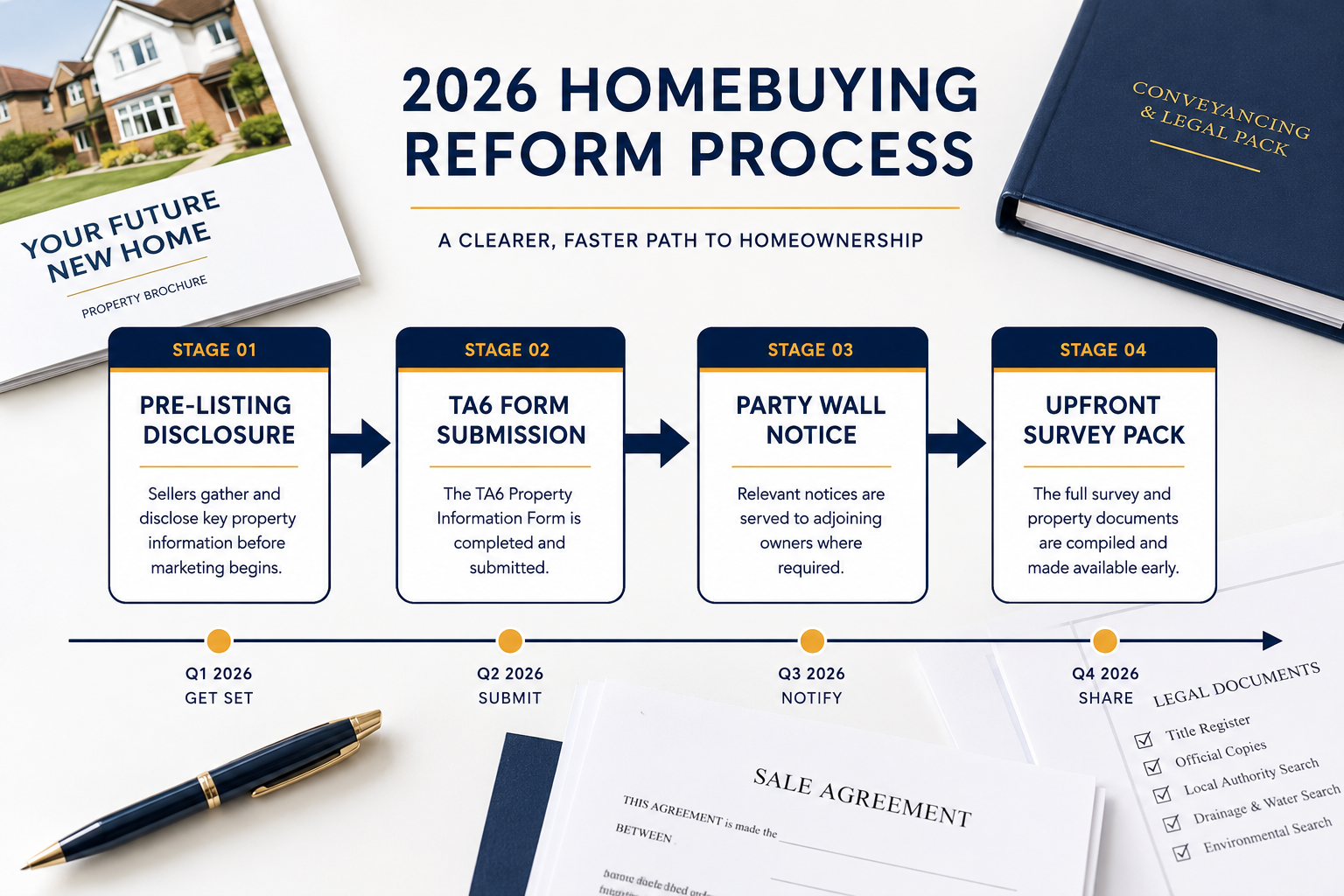
- From 30 March 2026, sellers must complete the revised TA6 Property Information Form before listing, incorporating National Trading Standards material information requirements.
- The 2026 reforms actively encourage party wall notices and condition reports to be included in pre-sale disclosure packs, moving compliance earlier in the transaction timeline.
- RICS opened a consultation in May 2026 on the draft 8th edition of its Party Wall Legislation and Procedure guidance, proposing clearer standards for surveyor conduct.
- The Renters' Rights Act, effective 1 May 2026, adds new complexity for landlords planning extensions, requiring party wall procedures to account for strengthened tenant protections.
- Chartered surveying practices must scale capacity and workflow systems now, ahead of full mandatory implementation, to meet rising demand for upfront party wall assessments.
What the 2026 Homebuying Reforms Actually Change
The UK government's push toward upfront property information is not new in concept, but 2026 marks the point at which policy ambition becomes operational reality. The revised TA6 Property Information Form, effective 30 March 2026, requires sellers to disclose material information, EPC certificates, council tax bands, and other key property details before a property is listed for sale, not after an offer is accepted [1]. This front-loads the information burden onto sellers and their advisors, compressing the period between listing and legally binding exchange.
For party wall matters, this shift is significant. Historically, party wall notices were served after an offer was accepted and a buyer had instructed their own solicitor. Under the emerging framework encouraged by the 2026 reforms, party wall notices and any existing condition reports should ideally form part of the pre-sale disclosure pack [2]. The logic is straightforward: if a buyer knows about a shared wall, a planned loft extension, or an existing party wall award before making an offer, late-stage renegotiations and transaction collapses become less likely.
Why does this matter for surveyors?
The practical consequence is that demand for party wall surveys is moving earlier in the transaction cycle. Sellers and their agents are increasingly asking for party wall assessments at the listing stage rather than weeks into a sale. This creates both an opportunity and a capacity challenge for surveying practices of all sizes.
A survey by LRG found that 90% of sellers are willing to pay approximately £300 for upfront property information if it speeds up the sales process [2]. That willingness signals genuine market readiness. However, readiness on the demand side only translates into revenue if the supply side, meaning chartered surveying firms, can absorb the increased volume without compromising quality or turnaround times.
For buyers navigating these changes, understanding what your party wall rights actually are before entering a transaction is increasingly important, particularly when purchasing properties with shared boundaries or where renovation works are planned.
The Revised TA6 Form and Material Information
The updated TA6 form is the most immediate operational change for conveyancers and surveyors in 2026. It requires sellers to confirm whether any party wall notices have been served, whether any party wall awards exist, and whether any works affecting shared walls are planned or ongoing. This means that a seller who has recently completed a loft conversion or basement excavation must now disclose the associated party wall documentation upfront.
For properties where no party wall work has been carried out but where the physical condition of a shared wall is in question, the reforms create an implicit expectation that sellers will commission a condition survey before listing. Understanding the cost of a party wall agreement and the associated surveyor fees is therefore a practical consideration for any seller preparing to list in 2026.
Integrating Party Wall Notices Into Pre-Sale Disclosure Packs
The integration of party wall procedures into pre-sale disclosure is the most technically demanding aspect of Homebuying Reform Updates Q2 2026: Scaling Party Wall Notices for Mandatory Upfront Surveys. It requires surveyors to operate in a compressed timeframe and to coordinate with sellers, estate agents, and conveyancers simultaneously rather than sequentially.

How the Pre-Sale Party Wall Process Works in Practice
Under the 2026 framework, the recommended sequence for a property with a shared wall is as follows:
| Stage | Action | Responsible Party |
|---|---|---|
| Pre-listing | Seller commissions condition report on party wall | Seller / Surveyor |
| Pre-listing | Party wall notice served if works are planned | Building owner / Surveyor |
| Listing | TA6 form completed with party wall disclosures | Seller / Conveyancer |
| Offer stage | Buyer reviews existing party wall documentation | Buyer / Solicitor |
| Post-offer | Any outstanding party wall awards finalised | Surveyor |
This model reduces the risk of a buyer discovering a problematic shared wall only after instructing their own surveyor weeks into the transaction. It also reduces the risk of a seller being unable to proceed with planned works because party wall notices were not served in time.
The consequences of ignoring the Party Wall Act remain unchanged by the 2026 reforms, but the reforms make non-compliance more visible and harder to overlook during the conveyancing process.
RICS 8th Edition Consultation: What It Proposes
In May 2026, RICS opened a consultation on the draft 8th edition of its Party Wall Legislation and Procedure guidance, with the consultation closing on 5 June 2026 [3]. The proposed changes are directly relevant to how surveyors will be expected to operate under the new upfront disclosure regime.
Key proposals in the draft 8th edition include:
- Clearer standards for surveyor conduct when acting as agreed surveyor or as one of two appointed surveyors
- Expanded scope for party wall awards to address condition documentation more explicitly
- Guidance on digital service of notices, reflecting the reality that many transactions now involve electronic communication
- Revised timelines that better align with the compressed transaction periods encouraged by upfront disclosure reforms
For surveyors who regularly handle party wall matters, engaging with the role and responsibilities of an agreed surveyor is essential preparation for the changes the 8th edition will introduce.
"The direction of travel is clear: party wall compliance is moving from a reactive, post-offer process to a proactive, pre-listing one. Surveyors who adapt their workflows now will be better positioned than those who wait for mandatory implementation."
The Renters' Rights Act Dimension
Effective 1 May 2026, the Renters' Rights Act abolished Section 21 no-fault evictions and converted all assured shorthold tenancies to assured periodic tenancies [4]. For landlords planning extensions or structural works that trigger the Party Wall Act, this creates a new layer of procedural complexity.
Under the previous regime, a landlord could serve notice on a tenant and, if the works became disruptive, rely on a Section 21 notice as a backstop. That option no longer exists. Landlords must now manage party wall works around legally protected tenants, which means:
- Extended consultation periods before works commence
- Enhanced documentation of how tenant disruption will be managed
- Coordination between party wall notices and tenancy management obligations [5]
Institutional landlords expanding their portfolios face the most significant compliance burden. Integrating tenant notification protocols with traditional party wall procedures requires careful planning and, in many cases, specialist advice that bridges both areas of law [5].
Scaling Surveyor Capacity for the New Upfront Demand
The operational challenge at the centre of Homebuying Reform Updates Q2 2026: Scaling Party Wall Notices for Mandatory Upfront Surveys is not regulatory complexity alone. It is volume. When party wall assessments shift to the pre-listing stage, the number of instructions per transaction does not necessarily increase, but the timing becomes more concentrated and the lead times shorter.
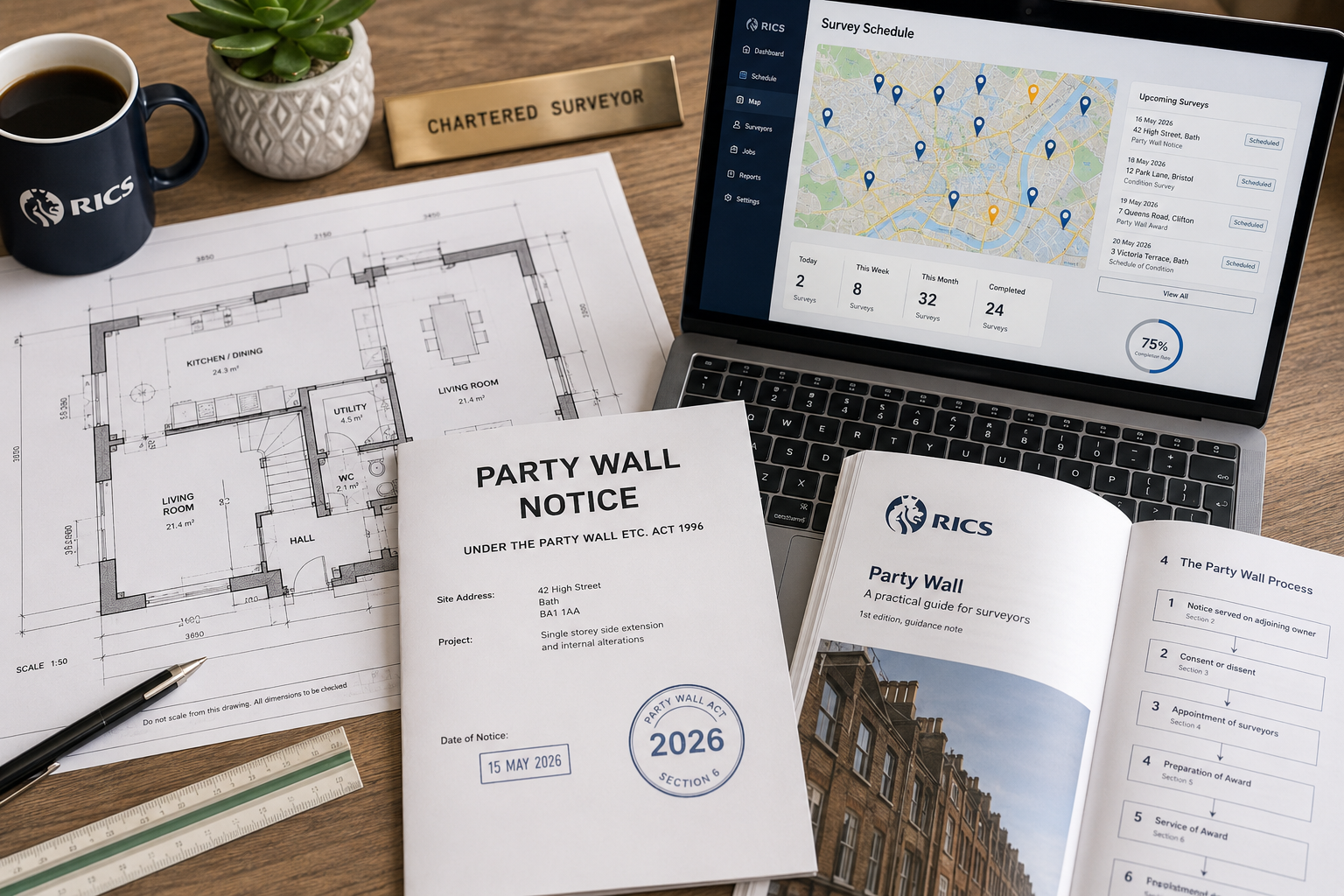
RICS has advised a minimum 24-month implementation period for mandatory upfront property condition assessments to allow for capacity building and standards development [6]. That window is not a reason for complacency. Practices that begin scaling now will capture the early-mover advantage as the market adjusts.
Practical Scaling Strategies for Chartered Surveyors
1. Workflow segmentation
Separate the pre-listing party wall assessment workflow from the post-offer workflow. Pre-listing instructions typically require a condition report and a notice review rather than a full award. Creating a distinct service tier for pre-listing work allows faster turnaround and clearer pricing.
2. Digital notice management
The RICS 8th edition consultation signals that digital service of notices will become standard [3]. Investing in document management systems that handle electronic service, acknowledgment tracking, and deadline monitoring reduces administrative overhead significantly.
3. Capacity forecasting
If upfront disclosure becomes mandatory across a region, the volume of pre-listing party wall instructions will broadly mirror the number of new listings in that area. Using local listing data to forecast demand allows practices to plan staffing and subcontracting arrangements in advance.
4. Cross-disciplinary coordination
The integration of party wall notices into pre-sale packs requires surveyors to work more closely with estate agents and conveyancers than traditional party wall practice demands. Establishing referral relationships and shared communication protocols with local agents is a practical step that pays dividends quickly.
5. Pricing transparency
Sellers commissioning upfront surveys need clear, fixed-fee pricing. Understanding the typical cost of a party wall surveyor and communicating that clearly at the point of instruction reduces friction and improves conversion from enquiry to instruction.
Building Survey Integration
The upfront disclosure reforms do not apply only to party wall matters. The broader push for pre-listing condition assessments means that RICS building surveys are increasingly essential for homebuyers at an earlier stage of the transaction. Practices that offer both building surveys and party wall services are well-placed to serve sellers who need to compile a comprehensive pre-sale disclosure pack in a single engagement.
For properties with loft conversion potential or existing loft works, the question of whether party wall agreements are required for loft extensions is one that sellers and their advisors will increasingly need to address before listing rather than after.
Common Pitfalls to Avoid
- Serving notices too early: If a seller serves a party wall notice before a buyer is found and the notice period expires before works commence, the process must restart. Timing notices correctly within the pre-listing framework requires careful judgment.
- Incomplete disclosure packs: A TA6 form that references a party wall award without including the award document itself creates problems at the offer stage. Disclosure packs must be complete, not just referenced.
- Underestimating tenant-related delays: For landlord-owned properties, the Renters' Rights Act means that works timelines must account for enhanced tenant consultation, which can add weeks to the party wall process [4].
What Buyers and Sellers Should Do Now
For sellers preparing to list in 2026, the practical steps are clear:
- Instruct a chartered surveyor to review the condition of any shared walls before completing the TA6 form.
- Confirm whether any party wall notices have previously been served or received and locate the documentation.
- If works are planned post-sale, consider whether serving notice before listing is appropriate given the transaction timeline.
- Include all party wall documentation in the pre-sale disclosure pack, not just a reference to its existence.
For buyers, the upfront disclosure reforms mean that more information should be available before an offer is made. However, buyers should not assume that a seller's pre-listing party wall documentation is a substitute for independent advice. Understanding the top questions to ask about party wall surveys before proceeding with a purchase remains essential due diligence.
Conclusion
The Homebuying Reform Updates Q2 2026: Scaling Party Wall Notices for Mandatory Upfront Surveys represent a genuine structural shift in how property transactions are conducted in England and Wales. The revised TA6 form, the RICS 8th edition consultation, and the Renters' Rights Act together create a new operating environment in which party wall compliance must be addressed earlier, documented more thoroughly, and integrated more closely with the broader conveyancing process.
Actionable next steps for surveyors and property professionals:
- Review current party wall workflows against the pre-listing disclosure model and identify where process changes are needed.
- Monitor the outcome of the RICS 8th edition consultation and begin adapting practice standards in anticipation of the final guidance.
- Develop a clear pre-listing party wall service offering with transparent fixed-fee pricing.
- Build referral relationships with estate agents and conveyancers who will be directing pre-listing instructions.
- For landlord clients, integrate party wall advice with Renters' Rights Act compliance guidance to provide a joined-up service.
The 24-month implementation window that RICS recommends [6] is not a delay, it is a preparation period. Practices that use it well will be the ones best placed to serve the market when mandatory upfront assessments become the norm.
References
[1] Upfront Property Information Home Buying Reform – propertypassport.uk
[2] Party Wall Awards Under Homebuying Reforms Integrating Surveys Into 2026 Upfront Processes – kingstonsurveyors.com
[3] Rics 8th Edition Party Wall Guidance 2026 Consultation What Changed And What It Means For London Property Owners – partywallsurveyorlondon.uk
[4] Party Wall Surveys Under Renters Rights Act 2026 Managing Landlord Extensions With New Tenant Protections – kingstonsurveyors.com
[5] Party Wall Surveys For Institutional Buy To Let Expansions Managing Notices Under 2026 Renters Rights Act Compliance – nottinghillsurveyors.com
[6] Homebuying Process Reforms 2026 Impact On Early Building Surveys And Valuation Timing – nottinghillsurveyors.com
[7] 2026 Alta Nsps Survey Standards Update Key Takeaways For Commercial Real Estate – taftlaw.com
How Prince Surveyors can help: explore our party wall surveyors or learn about our party wall surveyor costs.