

Planning a loft conversion, rear extension, or basement dig in your terraced or semi-detached home? Before the first brick is laid or the first beam installed, there's a critical legal step that could make or break your project: party wall compliance. In 2026, approximately 95% of London extension projects require adherence to the Party Wall etc. Act 1996[1], yet many homeowners remain unaware of their obligations until costly disputes arise. Understanding Party Wall Risks in Terraced and Semi-Detached Homes: Practical Guidance for Loft Conversions, Extensions and Basement Digs can save thousands of pounds and prevent construction delays that stretch for months.

Key Takeaways
- Party wall agreements are mandatory for most domestic projects involving shared walls, foundations, or excavations within 3-6 metres of neighbouring properties, even for Permitted Development works[1]
- Budget £1,500-£12,000+ for party wall surveyor fees depending on project complexity, with basement excavations incurring the highest costs[1]
- Start the process 2-4 months before construction to avoid injunctions and work stoppages that can halt your project indefinitely[1]
- Schedule of Condition documentation is essential protection against spurious damage claims, providing photographic evidence of pre-existing conditions[1]
- Professional surveyor involvement significantly reduces dispute risks for complex projects involving structural work, excavation, or multiple neighbours[3]
Understanding Party Wall Risks in Your Property Type
What Makes Terraced and Semi-Detached Homes Different? 🏘️
Terraced and semi-detached properties present unique challenges under the Party Wall etc. Act 1996. Unlike detached homes, these properties share structural walls with neighbours, creating legal obligations whenever construction work affects these shared boundaries.
The Party Wall etc. Act 1996 applies only in England and Wales[4], establishing a framework that protects both building owners (those undertaking work) and adjoining owners (neighbours). The Act covers three main categories of work:
- Work directly to an existing party wall or structure
- Construction of new walls at or astride the boundary line
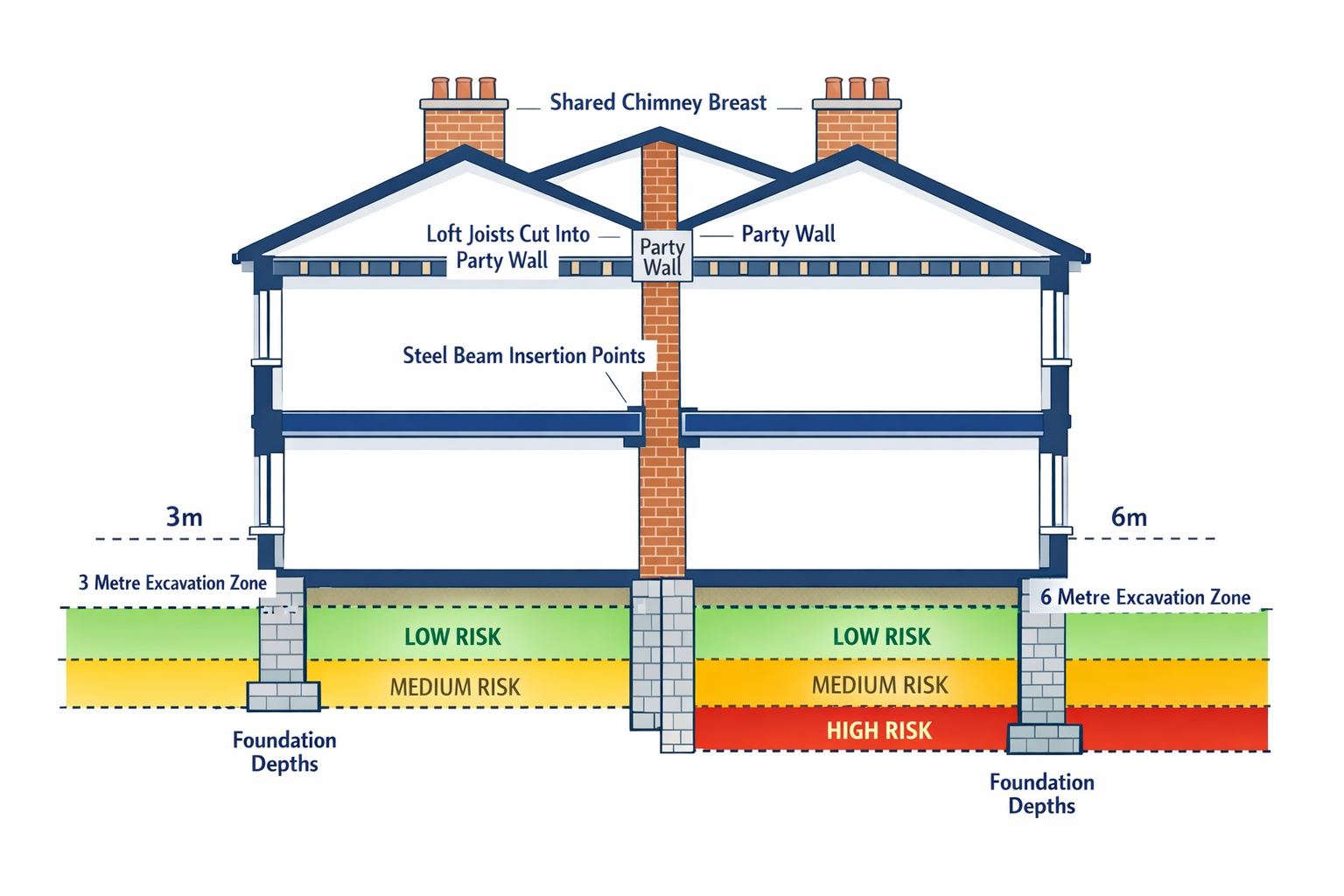
- Excavation within 3-6 metres of a neighbouring building[3]
For terraced homes, the complexity multiplies. A mid-terrace property shares walls with two neighbours, potentially doubling surveyor fees and extending the notification timeline. Semi-detached homes typically affect one neighbour, but the scope of work often determines the overall risk and cost.
When Does the Party Wall Act Apply to Your Project?
Understanding trigger points prevents costly mistakes. The Act applies when you plan to:
Loft Conversions:
- Cut into or remove part of a party wall for steel beam insertion
- Build against an existing party wall
- Raise a party wall to support new roof structures
- Install new joists that rest on or cut into the party wall[2]
For detailed guidance on loft-specific requirements, review our comprehensive guide on party wall agreements for loft conversions.
Extensions:
- Dig new foundations within 3 metres of a neighbour's structure (if going deeper than their foundations)
- Excavate within 6 metres of a neighbour's structure (if excavation cuts a 45-degree line from the bottom of their foundations)[3]
- Build a new wall on or astride the boundary line
- Underpin or strengthen existing party walls
Basement Excavations:
- Any digging that extends below neighbouring foundations
- Underpinning work to existing party walls
- Installation of new basement walls adjacent to party structures
The excavation rules are particularly critical for extensions and basement digs. Even if your planning permission doesn't require party wall compliance, the Act operates independently—Permitted Development extensions still require party wall agreements[1].
Practical Step-by-Step Process for Party Wall Compliance
Step 1: Determine Your Notice Requirements (2-4 Months Before Construction) ⏰
The party wall process begins well before construction. Property owners should initiate the process immediately after securing planning approval[1] to avoid delays.
Notice periods vary by work type:
| Work Type | Notice Period | Form Required |
|---|---|---|
| Line of Junction Notice (new walls on boundary) | 1 month | Specified form |
| Party Structure Notice (work to existing party wall) | 2 months | Detailed plans required |
| Adjacent Excavation Notice (within 3-6m) | 1 month | Excavation details |
Serving notice too late is one of the most common mistakes. Failing to serve proper notice can result in immediate work injunctions[1], with neighbours entitled to apply for court orders stopping construction until compliance is achieved.
Step 2: Serve Formal Notice to Affected Neighbours
Notice must be served in writing, containing specific information:
- Detailed description of proposed works
- Technical drawings and specifications
- Start date for construction
- Contact information for the building owner
For complex projects, professional surveyors can prepare and serve notices, ensuring all legal requirements are met. Our party wall drawings service provides the technical documentation needed for compliant notices.
Step 3: Neighbour Response and Surveyor Appointment
Neighbours have 14 days to respond to a party wall notice[1]. Three outcomes are possible:
Consent: The neighbour agrees in writing to the proposed works. Even with consent, conducting a Schedule of Condition is strongly recommended.
Dissent: The neighbour objects or doesn't respond within 14 days. This triggers the surveyor appointment process.
Counter-Notice: The neighbour requests additional protective works at the building owner's expense.
When dissent occurs, each party appoints a surveyor or both parties agree to use a single "Agreed Surveyor." For guidance on this approach, see our complete guide to Agreed Surveyor roles and benefits.
Step 4: Schedule of Condition Documentation 📸
Schedule of Condition photographic documentation is critical protection[1]. This comprehensive survey records the pre-construction state of neighbouring properties through:
- Detailed photographs of all rooms, walls, ceilings, and external elevations
- Documentation of existing cracks, settlement, or defects
- Video walkthroughs for comprehensive records
- Written descriptions of current conditions
Without this evidence, defending against post-construction damage claims becomes nearly impossible. The building owner cannot prove that cracks or defects existed before work commenced, leaving them vulnerable to spurious damage claims[1].
Step 5: Party Wall Award Preparation
Appointed surveyors prepare a Party Wall Award, a legally binding document that specifies:
- Scope of permitted works
- Working hours and access arrangements
- Protective measures required
- Monitoring procedures during construction
- Dispute resolution mechanisms
Surveyor fees for 2026 range £750-£1,800 per affected neighbour[1]. Total costs vary significantly by property type:
- Semi-detached rear extension: £1,500-£3,600
- Mid-terrace extension (2 neighbours): £3,000-£7,200
- Mid-terrace basement (2-3 neighbours): £4,500-£12,000+[1]
Basement excavations incur the highest costs due to the complexity of working near neighbouring foundations and the extensive monitoring required.
If appointed surveyors cannot agree on Award terms, a Third Surveyor makes binding decisions. Third Surveyor dispute resolution costs £1,500-£4,000 in 2026[1], with costs typically split or assigned based on the circumstances.
Managing Common Party Wall Risks and Disputes

Risk 1: Construction Damage and Liability 🔨
Damage liability persists even without formal agreement[2]. While failing to obtain a Party Wall Agreement isn't a criminal offence, neighbours can claim damages for work-related harm. Without a Schedule of Condition, building owners cannot prove pre-existing conditions, making compliance financially protective.
Common damage types include:
- Structural cracks from vibration or settlement
- Subsidence from excavation work
- Water ingress from disturbed weatherproofing
- Cosmetic damage to decorations and finishes
Professional monitoring during construction helps identify issues early. Many Party Wall Awards require regular inspections by the appointed surveyor to ensure compliance with agreed methods.
Risk 2: Neighbour Disputes and Refusals
What happens when neighbours refuse party wall works? The Act provides mechanisms to proceed even without neighbour cooperation:
- Deemed dissent after 14 days allows surveyor appointment
- Surveyors act impartially to protect both parties' interests
- Awards are binding on both building and adjoining owners
However, maintaining good neighbour relations reduces stress and costs. Best practices include:
✅ Early communication about your plans before formal notices
✅ Transparent sharing of drawings and specifications
✅ Reasonable accommodation of neighbour concerns
✅ Professional surveyor involvement to mediate disputes
For comprehensive guidance on resolving conflicts, explore our resources on party wall disputes.
Risk 3: Project Delays and Cost Overruns
The 2-4 month minimum timeline[1] for party wall compliance can delay construction if not planned properly. Critical path considerations include:
Month 1: Prepare detailed drawings and serve notices
Month 2: Await neighbour responses and appoint surveyors
Month 3: Complete Schedule of Condition surveys
Month 4: Finalise and serve Party Wall Awards
Delays compound when:
- Multiple neighbours require separate agreements
- Complex excavation work needs detailed engineering assessments
- Third Surveyor appointments become necessary
- Neighbours raise legitimate concerns requiring design modifications
Building these timelines into your home extension cost considerations prevents budget surprises and scheduling conflicts with contractors.
Risk 4: Inadequate Professional Advice
Professional surveyor appointment is strongly recommended for complex projects[3]. Projects requiring expert involvement include:
- Excavation work (basements, deep foundations)
- Structural alterations (steel beam insertion, wall removal)
- Unclear boundaries or title disputes
- Terraced properties affecting multiple neighbours
- Chimney removal or significant party wall modifications
- Loft conversions with structural implications
DIY notice service may seem cost-effective, but mistakes can prove far more expensive. Improperly served notices may be invalid, requiring the entire process to restart. Inadequate technical descriptions can lead to disputes about the scope of permitted works.
Project-Specific Guidance for Common Renovations
Loft Conversions in Terraced and Semi-Detached Homes
Loft conversions frequently trigger party wall requirements when:
- Hip-to-gable conversions extend the roof structure
- Steel beams are inserted into or bear upon party walls
- Joists are cut or fixed into party walls
- Party walls are raised to accommodate new roof heights
The key question: does your loft work involve cutting into, building against, or raising the party wall? If yes, party wall compliance is mandatory[2].
Budget considerations for loft party wall work:
- Single neighbour (semi-detached): £750-£1,800
- Two neighbours (mid-terrace): £1,500-£3,600
- Complex structural work: Add 20-30% for additional surveys
Rear and Side Extensions
Extensions present the most common party wall scenario. Foundation excavation within 3-6 metres of neighbouring structures triggers Adjacent Excavation Notice requirements[3].
The 3-metre and 6-metre rules work as follows:
3-metre rule: If excavating within 3 metres of a neighbour's building and going deeper than their foundations, notice is required.
6-metre rule: If excavating within 6 metres and the excavation cuts a 45-degree line from the bottom of the neighbour's foundations, notice is required.
For typical single-storey rear extensions:
- Foundation depth: 1-1.2 metres
- Excavation zone: Usually within 3 metres of boundaries
- Notice required: Almost always for terraced/semi-detached properties
Basement Excavations and Conversions
Basement excavations incur the highest party wall costs[1] due to:
- Deep excavation below neighbouring foundations
- Underpinning requirements for party walls
- Extended monitoring throughout construction
- Multiple affected neighbours in terraced properties
Mid-terrace basement projects affecting 2-3 neighbours typically cost £4,500-£12,000+[1]. The complexity of excavation work near neighbouring foundations requires experienced surveyors with structural engineering knowledge.
Critical basement considerations:
⚠️ Groundwater management to prevent neighbour subsidence
⚠️ Temporary works design for excavation support
⚠️ Underpinning methodology to protect adjoining foundations
⚠️ Vibration monitoring during excavation and concrete work
Cost-Benefit Analysis: Is Party Wall Compliance Worth It?
The True Cost of Non-Compliance
While party wall surveyor fees may seem substantial, the costs of non-compliance far exceed these professional charges:
Legal costs: Neighbour injunctions to stop work can cost £5,000-£15,000+ in legal fees, plus construction delays of 3-6 months.
Damage claims: Without Schedule of Condition evidence, building owners face unlimited liability for claimed damage, with settlements often reaching £10,000-£50,000+.
Project delays: Work stoppages while resolving disputes add contractor standby costs of £200-£500 per day.
Reduced property value: Undisclosed party wall disputes must be revealed to buyers, potentially reducing sale prices by 5-10%.
The Protection Party Wall Compliance Provides
Proper compliance delivers tangible benefits:
✅ Legal protection against spurious damage claims
✅ Clear documentation of pre-existing conditions
✅ Defined scope of permitted works
✅ Professional mediation of neighbour concerns
✅ Construction certainty with agreed timelines
✅ Property value protection with compliant documentation
For more insights on managing renovation projects successfully, explore our top 5 party wall agreement considerations for renovation.
Choosing the Right Party Wall Surveyor
Qualifications and Experience to Look For
Not all surveyors are equally qualified for party wall work. Look for:
Professional credentials:
- RICS membership (Royal Institution of Chartered Surveyors)
- FPWS membership (Faculty of Party Wall Surveyors)
- Specialist party wall qualifications
Relevant experience:
- Local knowledge of your property type and area
- Track record with similar projects (lofts, basements, extensions)
- Dispute resolution experience if conflicts are likely
Communication skills:
- Clear explanations of process and timelines
- Responsive to questions and concerns
- Professional in neighbour interactions
Questions to Ask Potential Surveyors
Before appointing a party wall surveyor, ask:
- How many similar projects have you handled in the past year?
- What is your fee structure, and what does it include?
- How long will the process take from notice to Award?
- Will you personally conduct the Schedule of Condition?
- How do you handle disputes between owners?
- Can you provide references from recent clients?
Agreed Surveyor vs. Separate Surveyors
Two appointment options exist:
Agreed Surveyor (one surveyor for both parties):
- Lower costs (single fee split between parties)
- Faster process (no negotiation between surveyors)
- Suitable for straightforward projects with cooperative neighbours
Separate Surveyors (each party appoints their own):
- Independent representation for each party
- Better for complex projects or existing disputes
- Higher costs but stronger protection
For amicable neighbour relationships and standard projects, an Agreed Surveyor often provides the best value. For more information, visit our detailed guide on Agreed Surveyor roles and appointments.
Regional Variations and Special Considerations
London and Urban Areas
Approximately 95% of London extension projects require party wall compliance[1], reflecting the density of terraced and semi-detached housing stock. Urban considerations include:
- Higher surveyor fees reflecting London rates
- More complex access arrangements in dense neighbourhoods
- Multiple affected properties in terraced rows
- Conservation area additional requirements
Leasehold Properties
Leasehold terraced and semi-detached homes add another layer of complexity:
- Freeholder consent may be required in addition to party wall compliance
- Lease restrictions on structural alterations must be checked
- Service charge implications for shared structures
- Building insurance notification requirements
Listed Buildings and Conservation Areas
Party wall work in listed buildings requires:
- Listed Building Consent in addition to party wall compliance
- Heritage-sensitive construction methods
- Specialist surveyors with conservation experience
- Extended timelines for heritage authority approvals
Conclusion: Protecting Your Investment Through Proper Party Wall Compliance
Understanding Party Wall Risks in Terraced and Semi-Detached Homes: Practical Guidance for Loft Conversions, Extensions and Basement Digs is essential for successful home improvement projects in 2026. The Party Wall etc. Act 1996 provides a robust framework that protects both building owners and neighbours, but only when properly implemented.
Key actions for homeowners:
-
Start early – Initiate the party wall process 2-4 months before planned construction to avoid costly delays[1]
-
Budget appropriately – Factor £1,500-£12,000+ for surveyor fees depending on project complexity and property type[1]
-
Prioritize documentation – Insist on comprehensive Schedule of Condition surveys to protect against spurious damage claims[1]
-
Engage professionals – Appoint experienced RICS or FPWS qualified surveyors for complex projects involving excavation, structural work, or multiple neighbours[3]
-
Maintain communication – Keep neighbours informed throughout the process to minimize disputes and maintain good relationships
-
Understand your obligations – The Act applies even to Permitted Development works that don't require planning permission[1]
The costs of compliance pale in comparison to the risks of non-compliance: injunctions, damage claims, project delays, and neighbour disputes can easily exceed £20,000-£50,000 in additional costs. Professional party wall management provides peace of mind, legal protection, and construction certainty.
Whether planning a loft conversion, rear extension, or basement excavation, proper party wall compliance transforms a potential legal minefield into a manageable, structured process. By following the practical guidance outlined in this article and engaging qualified professionals, homeowners can protect their investment, maintain good neighbour relations, and complete their renovation projects successfully.
For expert assistance with your party wall requirements, comprehensive party wall services provide the professional support needed to navigate this complex area with confidence.
References
[1] Party Wall Agreement London 2026 – mayfairstudio.co.uk
[2] Party Wall Agreements What You Need To Know – fmb.org.uk
[3] Understanding Party Wall Damage Claims Protecting Neighbouring Properties During Construction – adamjoseph.co.uk
[4] Party Wall Agreement – hoa.org.uk