

Last updated: July 24, 2026
Quick Answer: When valuation and building survey advice conflict, it is usually because the two reports serve fundamentally different purposes and are written for different audiences. A valuation answers "what is this property worth today?" while a building survey answers "what condition is this property in?" Apparent contradictions between the two are normal, but they must be managed carefully to protect client confidence and avoid professional liability.
Key Takeaways
- A valuation and a building survey are separate professional opinions with different scopes, methods, and intended users.
- Conflicting advice between the two reports does not mean one professional is wrong; it usually reflects different questions being answered.
- RICS standards require surveyors to disclose any other involvement in a property and to obtain informed consent before accepting dual instructions.
- The valuer's opinion on price does not override the surveyor's findings on condition, and vice versa.
- Major defects flagged in a building survey can affect mortgage lending decisions even when the valuation figure appears sound.
- Clients should receive a clear written explanation of why the two reports may differ before they read either document.
- Coordination between valuer and surveyor on the same property requires formal information barriers or explicit consent to share findings.
- In 2026, all RICS reports must explicitly declare the measurement basis used, following the archiving of the Property Measurement 2nd Edition.
What Does a Property Valuation Actually Tell You vs a Building Survey
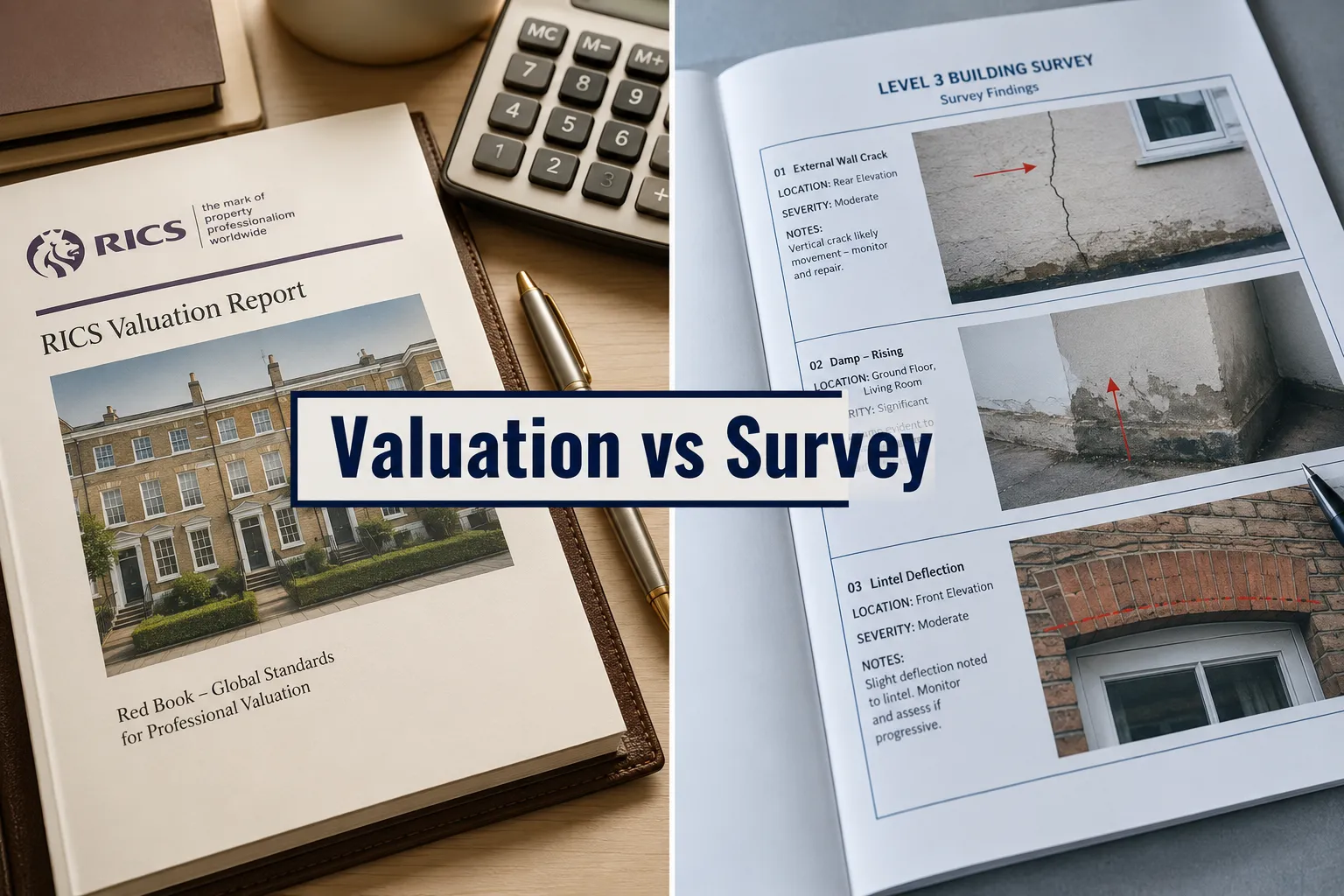
A valuation tells you the market value of a property on a specific date, based on comparable sales, location, and general condition. A building survey tells you the physical state of the property in detail, including defects, risks, and recommended remedial works.
These are two distinct professional exercises. A valuation is typically a short document prepared for a lender or a buyer who needs a price opinion. It is not designed to identify every defect. A Level 3 full building survey is a comprehensive technical inspection that examines structure, fabric, services, and materials. It is designed to protect the buyer's long-term interests, not to confirm a price.
Key differences at a glance:
| Feature | Valuation | Building Survey |
|---|---|---|
| Primary output | Market value figure | Condition and defect report |
| Commissioned by | Lender or buyer | Buyer or owner |
| Depth of inspection | Visual, limited | Thorough, detailed |
| Covers defects? | Only if price-affecting | Yes, in full |
| RICS standard | Red Book (VPS/VPGA) | Home Survey Standard |
Because the two documents answer different questions, clients who read both side by side often encounter language that appears contradictory. Managing this is a core professional skill.
Can a Surveyor and Valuer Give Different Advice About the Same Issue
Yes, and this is entirely normal. When valuation and building survey advice conflict on the same property feature, it does not indicate professional error. It reflects the different frameworks each professional applies.
For example, a valuer may note "some evidence of movement" without reducing the valuation significantly, because comparable properties in the area with similar characteristics have sold at similar prices. The building surveyor, examining the same wall, may recommend immediate structural investigation and flag it as a Category 3 defect requiring urgent attention. Both statements can be accurate simultaneously.
The valuer is asking: "Would a willing buyer in this market pay less for this?" The building surveyor is asking: "Is this safe, and what will it cost to fix?" A buyer needs both answers.
Is It Normal for a Building Survey and Valuation to Contradict Each Other
Contradictions between the two reports are common and should be expected on older or complex properties. They are not a sign that one professional has made a mistake.
Common scenarios where the two reports appear to conflict:
- Damp: A valuer may not reduce the figure if damp is typical for the property type and area. A building surveyor will describe the cause, extent, and remediation cost in detail.
- Roof condition: A valuer may note "roof at end of serviceable life" without adjusting the price if the market has already priced this in. The building surveyor will specify materials, likely replacement cost, and urgency.
- Structural movement: A valuer may accept minor cracking as historic and stable. A building surveyor may recommend a structural engineer's report before the client proceeds.
The building pathology behind each defect matters enormously to the surveyor's advice, even when the market has already absorbed the risk into the price.
What If the Valuation Says the Price Is Fine but the Survey Finds Major Defects
This is one of the most common and stressful scenarios in residential property transactions. The valuation figure standing does not mean the defects are minor or that the buyer should proceed without negotiation.
When a building survey identifies significant defects, the buyer has several options regardless of what the valuation says:
- Renegotiate the price based on the estimated cost of remedial works.
- Request specialist reports (structural engineer, damp specialist, asbestos surveyor) before exchanging contracts.
- Withdraw from the purchase if the defects are too serious or the seller will not negotiate.
- Proceed with full knowledge of the repair liability, having budgeted accordingly.
A valuation that does not reduce the figure is not an endorsement of the property's condition. Lenders instruct valuers to confirm that the property provides adequate security for the loan. A property can provide adequate security and still require tens of thousands of pounds in remedial work. Clients must understand this distinction clearly before they receive their reports.
For properties with serious structural concerns, reviewing urgent or dangerous building issues guidance helps buyers understand the urgency of acting on survey findings.

How to Explain Conflicting Survey and Valuation Reports to a Client
The best approach is to explain the difference in scope before the client reads either report, not after they have already found the apparent contradiction.
A practical framework for managing dual instructions without confusing the client:
Before the reports are issued:
- Brief the client verbally or in writing on what each report covers and what it does not.
- Confirm that different conclusions on the same issue are expected and do not indicate professional disagreement.
- Explain which report is relevant to which decision (price negotiation vs. repair planning).
When presenting the reports:
- Highlight any sections where the two reports address the same feature.
- Provide a short written summary explaining why the language differs.
- Avoid leaving the client to reconcile the two documents alone.
After the reports are issued:
- Offer a follow-up call or meeting to answer questions.
- Direct the client to sourcing extra specialist advice where further investigation is recommended.
"Clients do not lose confidence because two reports differ. They lose confidence when no one explains why."
Should a Client Prioritise the Valuer's Opinion or the Surveyor's Opinion
Neither opinion overrides the other because they address different questions. Clients should use each report for the purpose it was designed for.
- Use the valuation to assess whether the asking price is justified and whether the lender will proceed.
- Use the building survey to assess the physical risk of the purchase and to plan for future costs.
If a client must make a single decision, the building survey carries more weight on condition and repair liability. The valuation carries more weight on market price and lender appetite. Trying to use one to override the other leads to poor decisions.
Choose the valuer's opinion if: you need to know whether the lender will approve the mortgage at the agreed price.
Choose the surveyor's opinion if: you need to know what condition the property is in and what it will cost to maintain or repair.
How Do Surveyors and Valuers Communicate With Each Other on the Same Property
When a surveyor and valuer are instructed on the same property, RICS standards impose strict requirements on how they may interact. Under the RICS conflict-of-interest framework, dual instructions are only acceptable when three conditions are met:
- It is in the interests of both parties that the work is undertaken.
- Any risk of conflict can be avoided through effective information barriers.
- Informed consent can be obtained without disclosing confidential information.
In practice, this means a surveyor acting for a buyer and a valuer acting for a lender on the same property should not share findings informally. Each professional's duty runs to their own client. Sharing draft findings without consent could breach confidentiality obligations and compromise the objectivity of both reports.
RICS Red Book VPGA 2 also requires mandatory disclosure of any other involvement in the property and any potential impact on objectivity. In 2026, following a period of tighter regulation and the introduction of valuation compliance officer requirements at larger firms, these disclosure obligations are more strictly enforced than at any previous point.
What Are Common Areas Where Valuations and Surveys Disagree
Several recurring property features generate apparent disagreements between valuation and survey reports. Understanding these in advance helps both professionals and clients manage expectations.
Most frequent areas of apparent conflict:
- Damp and timber decay: Surveyors assess cause and extent; valuers assess market impact. See our guide on wood rot identification and treatment for context on how serious these issues can become.
- Roof coverings: Age and condition may be priced into the market but still require urgent replacement.
- Structural movement: Valuers may accept historic cracking; surveyors may flag it for further investigation.
- Asbestos-containing materials: A valuer may not adjust the price if the material is undisturbed; a surveyor will recommend a full asbestos survey and management plan.
- Extensions and alterations: A valuer may include the additional floor area in the value; a surveyor may flag missing building regulation compliance documentation.
- Drainage and services: Rarely reflected in valuations unless severely defective; often flagged in detail in building surveys.
How to Present Two Different Professional Opinions Without Losing Client Trust
Client trust is maintained through transparency, not through forcing the two reports to agree. The professional managing dual instructions must position themselves as the person who helps the client understand both documents, not as an advocate for one over the other.
Practical steps:
- Use plain language. Avoid technical jargon when summarising differences to a non-professional client.
- Acknowledge the difference directly. Do not minimise or dismiss the apparent contradiction.
- Explain the purpose of each report. Remind the client that both professionals are correct within their own scope.
- Provide a written summary. A short covering note that maps the key findings from each report against each other is far more useful than asking the client to do this themselves.
- Refer to specialist advice where needed. If a defect is serious enough to affect the client's decision, recommend a specialist report rather than leaving the client to weigh two conflicting opinions alone.
For clients who want to understand what questions to raise before and after a survey, this guide to building survey questions is a useful starting point.
Can Conflicting Advice Affect the Mortgage or Sale of a Property
Yes. When a building survey identifies defects that the valuation did not flag as price-affecting, lenders may still impose mortgage retention or decline to lend if the surveyor's findings are brought to their attention.
Lenders base their lending decision on the valuation, but they are also entitled to request additional information if serious defects emerge during the conveyancing process. If a buyer shares their building survey with the lender (which they are not obliged to do), the lender may:
- Impose a retention until specified works are completed.
- Require a specialist report before releasing funds.
- Withdraw the mortgage offer entirely in extreme cases.
From a seller's perspective, if a buyer's survey identifies major defects and the buyer uses this to renegotiate, the sale price may fall below the original valuation figure. This can create a secondary conflict if the seller's lender has also obtained a valuation. Understanding building problems and their solutions early in the process helps sellers anticipate these scenarios.
What Is the Best Way to Coordinate Instructions Between Valuer and Surveyor
Coordination should be formal, documented, and structured around the client's interests rather than professional convenience. The following checklist reflects best practice for dual instruction management in 2026.
Dual instruction coordination checklist:
- Confirm in writing that both instructions have been accepted and identify any potential conflicts.
- Issue separate engagement letters to each client making clear the scope and limitations of each role.
- Establish information barriers between the valuer and surveyor if both are from the same firm.
- Obtain written informed consent from the client before any findings are shared between the two professionals.
- Update report templates to include the mandatory measurement basis declaration now required following the archiving of the RICS Property Measurement 2nd Edition.
- Issue a client briefing note before reports are delivered, explaining the purpose of each document.
- Schedule a post-report debrief with the client to address any apparent conflicts in the findings.
For clients considering a full building survey alongside a separate valuation, understanding the building survey timeframes helps with transaction planning.
How Much Weight Should Clients Give to Each Type of Report
Clients should give each report full weight within its own domain. Neither report is more authoritative than the other in absolute terms; they are authoritative in different areas.
A useful mental model: the valuation is the financial lens, and the building survey is the technical lens. A buyer who relies only on the valuation is making a financial decision without a full technical picture. A buyer who relies only on the building survey has a full technical picture but no independent view on whether they are paying a fair price.
For most residential buyers, the building survey carries greater practical weight for post-purchase decision-making, because the valuation figure becomes largely irrelevant once contracts are exchanged. The condition of the property, however, remains relevant for the entire period of ownership.
.cg-checker{font-family:Arial,sans-serif;max-width:560px;margin:2em auto;border:2px solid #1a3a5c;border-radius:8px;overflow:hidden}
.cg-checker-header{background:#1a3a5c;color:#fff;padding:14px 18px;font-size:1.05em;font-weight:700}
.cg-checker-body{padding:16px 18px;background:#f7f9fc}
.cg-checker label{display:block;font-size:.93em;font-weight:600;margin-bottom:6px;color:#1a3a5c}
.cg-checker select{width:100%;padding:8px 10px;border:1px solid #b0bec5;border-radius:5px;font-size:.93em;margin-bottom:14px;background:#fff}
.cg-checker button{background:#1a3a5c;color:#fff;border:none;padding:9px 22px;border-radius:5px;font-size:.93em;cursor:pointer;font-weight:700}
.cg-checker button:hover{background:#2e5f8a}
.cg-result{margin-top:14px;padding:12px 14px;border-radius:6px;font-size:.92em;line-height:1.55;display:none}
.cg-result.val{background:#e8f4fd;border-left:4px solid #1a7fc1}
.cg-result.surv{background:#eaf7ee;border-left:4px solid #2e7d32}
.cg-result.both{background:#fff8e1;border-left:4px solid #f9a825}
.cg-result strong{display:block;margin-bottom:4px}
function cgShowResult(){
var sel=document.getElementById(‘cg-question’);
var res=document.getElementById(‘cg-result’);
var v=sel.value;
var msgs={
val:{cls:’val’,title:’Use the Valuation Report’,text:’A valuation answers price and lender-related questions. It reflects market value based on comparable sales and is the document your mortgage lender relies on.’},
surv:{cls:’surv’,title:’Use the Building Survey’,text:’A building survey answers condition-related questions. It identifies defects, assesses risk, and recommends remedial works, independent of market price.’},
both:{cls:’both’,title:’Use Both Reports Together’,text:’Renegotiation requires the building survey to quantify the defect cost and the valuation to establish the baseline price. Both documents are needed to make a credible case to the seller.’}
};
if(!v){res.style.display=’none’;return;}
var m=msgs[v];
res.className=’cg-result ‘+m.cls;
res.innerHTML=’‘+m.title+’‘+m.text;
res.style.display=’block’;
}
Conclusion
When valuation and building survey advice conflict, the root cause is almost always a difference in purpose rather than a difference in professional competence. Valuers and building surveyors are answering different questions, and clients who understand this distinction from the outset are far less likely to feel confused or misled when the two reports appear to contradict each other.
Actionable next steps for clients and professionals in 2026:
- Before instructing: Confirm whether you need a valuation, a building survey, or both, and understand what each will and will not cover.
- Before reports are issued: Ask your surveyor or valuer to brief you on how the two documents relate to each other.
- After receiving both reports: Do not attempt to reconcile them alone. Request a follow-up conversation with the relevant professional to work through any apparent conflicts.
- If major defects are found: Treat the building survey findings as the primary guide to negotiation and repair planning, regardless of what the valuation says about price.
- For professionals managing dual instructions: Update engagement letters and report templates to reflect current RICS disclosure requirements, including the mandatory measurement basis declaration now required in all reports.
Transparency, clear communication, and a well-structured client briefing are the most effective tools for managing dual instructions without losing client trust. The two reports are not in competition; they are complementary tools that together give a buyer the most complete picture of any property purchase.
Frequently Asked Questions
Why do my valuation and building survey say different things about the same crack?
A valuer assesses whether the crack affects market value relative to comparable properties. A building surveyor assesses the structural cause, risk, and remediation required. Both observations can be accurate; they are simply answering different questions.
Does a clean valuation mean the property is in good condition?
No. A valuation confirms market value, not physical condition. A property can achieve full market value and still require significant repair work. Always commission a building survey separately if you want a detailed condition assessment.
Can I share my building survey with the mortgage lender?
You are not obliged to share it, but you may choose to. If you do, the lender may impose a retention or request specialist reports before releasing funds, particularly if serious defects are identified.
Who is responsible if conflicting advice causes me financial loss?
Each professional is responsible for the accuracy of their own report within its stated scope. If a valuer or surveyor has failed to meet the standard of a reasonably competent professional, a negligence claim may be possible. Legal advice should be sought in such cases.
Is it a conflict of interest for the same firm to provide both a valuation and a building survey?
It can be, depending on the circumstances. RICS standards require the firm to confirm that both clients' interests can be served without compromise, that effective information barriers are in place, and that informed consent has been obtained from all parties.
What should I do if the building survey recommends further investigations but the valuation has already been agreed?
Proceed with the specialist investigations before exchanging contracts. A valuation figure does not expire immediately, and most lenders will allow a short extension if further reports are needed. Never exchange contracts on a property with unresolved structural concerns simply because the valuation has been agreed.
Tags: building survey, property valuation, RICS surveyor, dual instructions, survey conflicts, chartered surveyor, building defects, homebuyer advice, valuation report, Level 3 building survey, conflict of interest, property advice UK