

Scotland's housing market holds the second-highest house price net balance in the entire UK as of mid-2026 — a position that creates both opportunity and complexity for every chartered surveyor operating north of the border. Understanding what drives that outperformance, and how to respond with rigorous valuation practice, is the defining professional challenge of the current market cycle.
Valuing Scotland's 2026 housing outperformance: surveyor strategies amid RICS-reported price momentum requires more than awareness of headline figures. It demands a structured approach to comparable sales analysis, risk weighting, and client communication that accounts for a market simultaneously showing price resilience and softening buyer demand.
Key Takeaways
- Scotland recorded a net balance of 12% of surveyors reporting rising house prices in May 2026, the second highest in the UK after Northern Ireland, despite a moderation from the 37% recorded in the previous survey period [1][2].
- New buyer enquiries improved from -38% in April to -17% in May 2026, signalling a lessening decline rather than a recovery, which surveyors must reflect carefully in valuations [1].
- Supply constraints remain acute, with new instructions to sell recording a net balance of -26% in April 2026, compressing available comparables and elevating valuation risk [2].
- Average transaction time rose to 21.5 weeks in May 2026 — the longest since 2017 — requiring surveyors to apply time-adjusted comparable analysis [5].
- Surveyors should align protocols with updated RICS guidelines, emphasising thorough documentation and defensible methodology in a market where price momentum and demand signals are diverging [4].

Scotland's Position in the 2026 UK Housing Landscape
The RICS UK Residential Survey for May 2026 confirmed what many Scottish practitioners had already observed on the ground: Scotland is outperforming the broader UK housing market by a meaningful margin [5]. A net balance of 12% of Scottish surveyors reported rising house prices over the preceding three months, placing Scotland second only to Northern Ireland in the UK regional rankings [2].
That figure deserves careful interpretation. While 12% is the lowest net balance recorded in Scotland since February 2024, it remains positive at a time when several English regions are reporting flat or declining balances [1]. The moderation from 37% in the prior survey period reflects a normalisation rather than a reversal, but it does signal that the pace of price growth is slowing.
Why Scotland has outperformed:
- Persistent undersupply relative to demand, particularly in Edinburgh, Aberdeen, and the Central Belt
- A relatively lower average house price base compared to London and the South East, preserving affordability headroom
- Strong rental market pressure diverting would-be sellers into the buy-to-let sector, further restricting stock
- Resilient employment in financial services, energy, and public sector roles supporting household purchasing power
For surveyors, this context is not merely background colour. It directly shapes the weight given to comparable evidence, the adjustments applied to time-lagged sales, and the risk commentary included in valuation reports.
Reading the Demand Signals Correctly
New buyer enquiries in Scotland recorded a net balance of -17% in May 2026, an improvement from -38% in April [1]. A negative balance still means more surveyors reported falling enquiries than rising ones, but the direction of travel matters. The rate of decline is easing.
This distinction — between a market that is deteriorating and one that is stabilising at a lower level — is critical for valuation methodology. Geopolitical uncertainty and elevated mortgage rates continue to weigh on buyer confidence across the UK [6], and Scotland is not immune. Surveyors who treat current price momentum as evidence of unconditional strength risk producing valuations that do not adequately reflect demand-side fragility.
The Supply Constraint Problem: Implications for Comparable Evidence
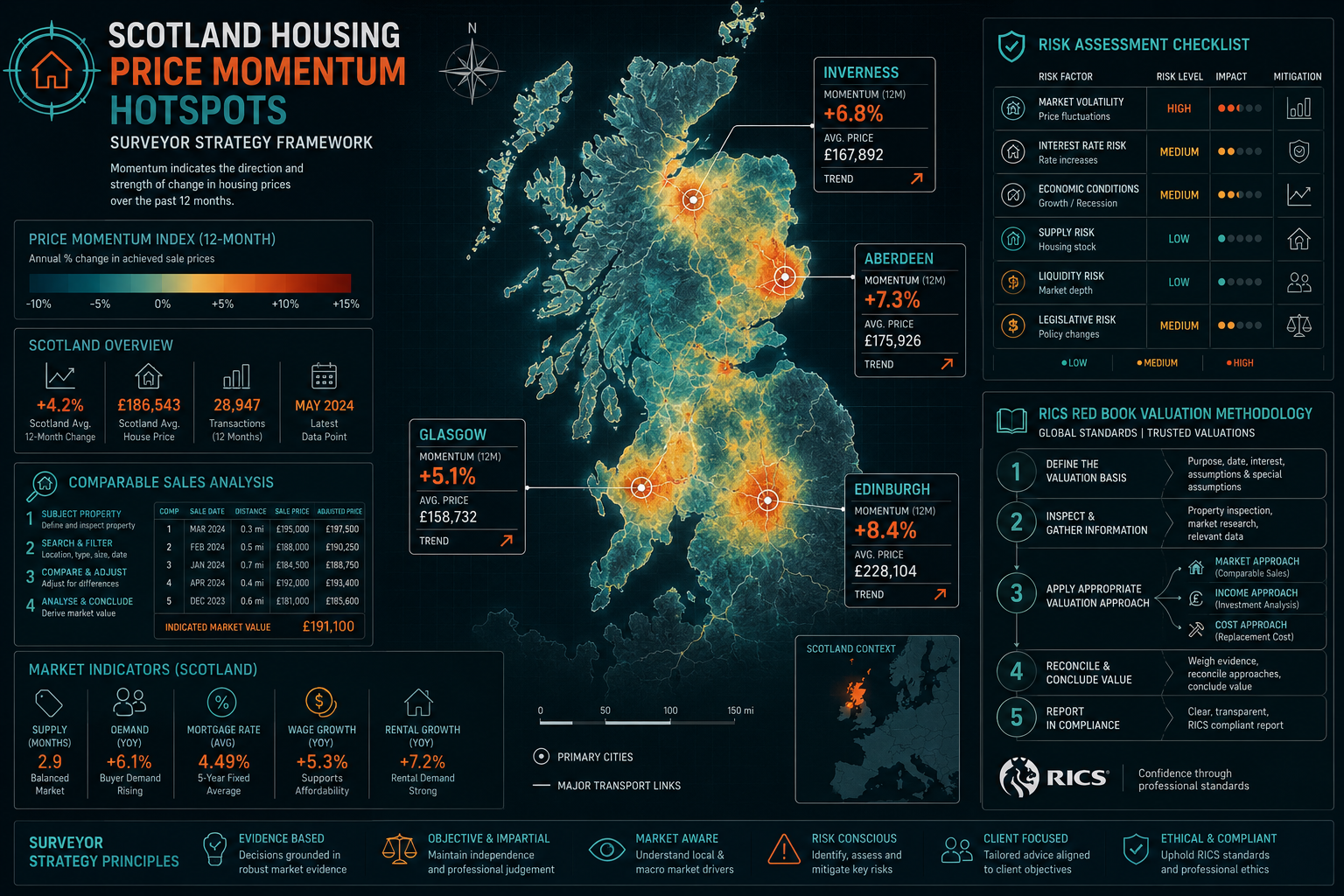
Supply constraints represent the single most significant structural factor shaping valuing Scotland's 2026 housing outperformance: surveyor strategies amid RICS-reported price momentum. New instructions to sell recorded a net balance of -26% in April 2026, down from -15% in March, indicating that the stock of available properties is shrinking further at the very moment when demand signals are tentatively improving [2].
For a practising surveyor, a thin market creates a specific technical problem: there are fewer recent, comparable transactions from which to derive reliable market evidence. When the pool of comparables is shallow, the risk of over-reliance on a small number of atypical sales increases significantly.
Building a Robust Comparable Sales Framework in a Low-Supply Market
The following framework addresses the challenge of limited comparable evidence in Scotland's current market conditions:
| Step | Action | Risk Mitigation |
|---|---|---|
| 1. Widen the search radius | Extend comparable search to adjacent postcodes with similar property characteristics | Flag any geographic adjustments explicitly in the report |
| 2. Apply time adjustments | Adjust sales older than three months using the RICS net balance trend data | Document the adjustment methodology and source data |
| 3. Stratify by property type | Separate terraced, semi-detached, and detached comparables | Avoid mixing property types without explicit adjustment |
| 4. Weight recent evidence more heavily | Give greater weight to sales within the last 60 days | Acknowledge the reduced sample size in the limitations section |
| 5. Cross-reference asking price data | Use current listing prices as a directional check, not a primary comparable | Note that listing prices are not transacted evidence |
This approach is consistent with the RICS Red Book Global Standards and with the updated valuation protocols recommended in response to subdued market activity [4]. For surveyors seeking a structured overview of how valuation methodology applies across different property types, the guidance on RICS building surveys provides a useful reference framework.
The Transaction Duration Problem
The average time from listing to completion reached 21.5 weeks in May 2026 — the longest duration recorded since 2017 [5]. This extended timeline has a direct bearing on comparable analysis. A sale agreed in January 2026 and completed in May 2026 reflects market conditions from five months ago. In a market where the net price balance has moved from 37% to 12% over a similar period, using that sale without time adjustment would introduce a material upward bias into the valuation.
Practical adjustment approach:
- Identify the date of exchange, not completion, as the reference point for market conditions
- Apply a conservative downward adjustment to comparables agreed during the higher-momentum period
- Document the rationale for each adjustment in the body of the report, not just the appendix
Surveyors handling complex or older properties should also consider whether a RICS Level 3 Building Survey is appropriate, as structural condition evidence can materially affect the defensibility of a valuation in a thinly traded market.
Surveyor Strategies for Regional Hotspots: Risk Assessment and Valuation Protocols

Valuing Scotland's 2026 housing outperformance: surveyor strategies amid RICS-reported price momentum is not a uniform exercise across the country. Regional variation within Scotland is significant, and the strategies that apply in a high-demand Edinburgh suburb differ from those appropriate in a rural Highlands market.
Identifying Regional Hotspot Characteristics
A regional hotspot, for valuation purposes, is a submarket where:
- Price growth has consistently exceeded the Scottish average over the preceding 12 months
- Days on market are materially below the national average of 21.5 weeks
- The ratio of buyer enquiries to available stock is high relative to comparable areas
- Rental yields are compressing, indicating capital value growth outpacing income returns
In these locations, surveyors face the risk of anchoring valuations to comparables that are already stale relative to current market conditions. The appropriate response is not to abandon comparable evidence but to apply a structured premium adjustment, documented with reference to the specific demand and supply metrics observed in that submarket.
Risk Assessment Framework for Scottish Valuations in 2026
Every valuation produced in Scotland's current market should incorporate a formal risk assessment addressing the following factors:
Demand-side risks:
- Mortgage rate sensitivity: How exposed is the subject property's likely buyer pool to further rate increases?
- Buyer enquiry trend: Is the local net balance improving or deteriorating relative to the Scottish average?
- Geopolitical uncertainty: Ongoing international tensions continue to affect consumer confidence and mortgage availability [6]
Supply-side risks:
- Comparable scarcity: How many genuinely comparable transactions have occurred in the preceding 90 days?
- New instruction trend: Is local stock likely to increase or decrease over the next quarter?
- Off-market activity: In very thin markets, off-market sales may represent a material proportion of transactions
Property-specific risks:
- Structural condition: Properties with known defects require careful adjustment relative to condition-matched comparables. A specific defect report can provide the evidence base for defensible downward adjustments
- Tenure complexity: Leasehold properties, particularly those with short leases or onerous ground rent terms, require specialist valuation input. The process of valuing a freehold adds a layer of complexity that must be reflected in the methodology
- Non-standard construction: Scotland has a significant stock of traditional stone-built and non-standard construction properties that require specialist assessment
Aligning with Updated RICS Guidelines
The RICS has signalled that surveyors should adjust valuation protocols in response to current market conditions, with particular emphasis on thorough documentation and adherence to updated guidelines [4]. In practical terms, this means:
- Every material assumption must be stated explicitly, not implied
- Sensitivity analysis should be included where the valuation is particularly dependent on a small number of comparables
- The limitations section of the report should reflect the specific characteristics of the local market, not rely on standard boilerplate language
Surveyors should also ensure that their approach to property valuation pricing reflects the additional time and complexity involved in producing a defensible valuation in a low-supply, high-momentum market.
The Rental Market Dimension and Its Effect on Capital Values
Scotland's rental market is adding a further layer of complexity to the valuation picture. Tenant demand recorded a net balance of +14% in May 2026, while landlord instructions remained deeply negative at -28% [5]. This supply-demand imbalance is driving rising rent expectations, which in turn affects the investment value of residential property and the behaviour of both buyers and sellers.
For surveyors, the rental market dynamic matters in two specific ways:
1. Buy-to-let valuations: Rising rents support higher investment valuations on a yield basis, but surveyors must be careful not to allow rental income projections to drive capital value assessments beyond what comparable sales evidence supports. The two methodologies should be used as a cross-check, not conflated.
2. Vendor behaviour: Landlords facing negative instruction balances are choosing to retain rather than sell properties. This reduces available stock, which supports prices in the short term but also means that the comparables pool is further constrained. Surveyors should note this dynamic explicitly when the available comparable evidence is limited.
For properties where rental income is a material component of value, a Red Book valuation provides the formal methodology required for mortgage, legal, and investment purposes.
Surveyor Optimism and the Forward-Looking Picture
Despite the moderation in price momentum, Scottish surveyors remain broadly optimistic about the trajectory of the market. A net balance of 46% anticipated that sales volumes would rise in the first three months of 2026 [3]. That optimism has been partially validated by the improvement in buyer enquiries from -38% to -17% between April and May [1].
The forward-looking indicators suggest a market that is pausing rather than reversing. For surveyors, this creates a specific professional challenge: how to produce valuations that are neither overly conservative (anchored to a period of slower activity) nor overly optimistic (extrapolating from the peak momentum of late 2025 and early 2026).
The answer lies in transparent, documented methodology. When the market is sending mixed signals — rising prices but falling enquiries, optimistic surveyors but constrained supply — the quality of the valuation report's reasoning matters as much as the final figure.
Surveyors who want to ensure they are choosing the right property survey approach for each instruction will find that the current market conditions make survey type selection a more consequential decision than in a straightforward rising market.
Conclusion
Scotland's housing market in 2026 occupies a distinctive position: leading the UK in price momentum, but facing genuine headwinds from constrained supply, moderating buyer demand, and extended transaction timelines. Valuing Scotland's 2026 housing outperformance: surveyor strategies amid RICS-reported price momentum is not a passive exercise in recording what the market has done. It is an active, analytical process that requires structured comparable selection, formal risk assessment, and transparent documentation.
Actionable next steps for surveyors operating in Scotland:
- Adopt a formal time-adjustment methodology for all comparables older than 60 days, referencing RICS net balance data as the adjustment benchmark
- Build a regional hotspot register that tracks local supply, demand, and transaction duration metrics on a quarterly basis
- Incorporate a risk assessment section into every valuation report that addresses demand-side, supply-side, and property-specific risks explicitly
- Review report templates to ensure the limitations section reflects current market conditions rather than standard boilerplate
- Engage with updated RICS guidelines on valuation protocols for subdued or mixed-signal markets, ensuring that documentation standards meet the higher bar required when comparable evidence is thin
- Consider whether specialist survey types — including defect surveys, structural assessments, or Red Book valuations — are appropriate for complex instructions in the current environment
The surveyors who navigate this market most successfully will be those who combine local knowledge of Scotland's regional dynamics with the rigorous, documented methodology that RICS standards demand. Price momentum is an opportunity. Undocumented optimism is a liability.
References
[1] Scottish Surveyors Expect House Prices To Keep Rising – projectscot.com
[2] Rics Scottish House Price Balance Amongst Highest In Uk – scottishhousingnews.com
[3] Scottish Surveyors Optimistic About 2026 Housing Market – projectscot.com
[4] Rics May 2026 Housing Signals Adjusting Party Wall And Valuation Protocols For Subdued Activity – canterburysurveyors.com
[5] Uk Residential Survey May 2026 – rics.org
[6] Uncertainty And Higher Mortgage Rates Dampen Buyer Demand Rics Reports – thenegotiator.co.uk
How Prince Surveyors can help: explore our property valuations or learn about our which survey you need.