

Early 2026 data recorded a 57% surge in buyer demand relative to the subdued lows of late 2024, yet the RICS UK Residential Market Survey for April 2026 simultaneously reported a headline house price indicator of -34% — a steeper decline than the -25% recorded in March [1]. That apparent contradiction sits at the heart of the challenge facing every chartered surveyor, estate agent, and property owner right now. Valuing properties in the 2026 UK housing market rebound demands a more rigorous, evidence-led approach than at any point in the previous decade, precisely because demand signals and price signals are moving in opposite directions across different regions. This guide applies current RICS tactics to help professionals and buyers navigate surging buyer demand and a record volume of new listings with accuracy and confidence.
Key Takeaways
- The 2026 UK housing market is characterised by rising buyer activity alongside downward price pressure, creating a complex valuation environment.
- RICS Red Book standards and updated ESG guidance provide the methodological backbone for accurate, defensible valuations in volatile conditions.
- Regional divergence is sharp: Scotland and Northern Ireland show modest price gains while London and the South East face the steepest declines.
- Mortgage rates averaging 5.73% and geopolitical headwinds are suppressing affordability, extending time-on-market and complicating comparable analysis.
- Surveyors must apply prudent valuation criteria aligned with Basel 3.1/CRR3 requirements to maintain lender and market trust.

Understanding the 2026 Market Landscape Before Valuing Properties
Before applying any valuation methodology, surveyors must understand the structural forces shaping the 2026 market. The RICS April 2026 survey shows new buyer enquiries at a net balance of -34%, an improvement from -40% in March but still firmly negative [1]. Agreed sales remain weak at -36%, confirming that increased activity at the top of the funnel has not yet translated into completed transactions [1].
What Is Driving Buyer Demand Upward?
Several factors have contributed to the demand surge seen in early 2026:
- Stamp duty threshold changes introduced in late 2025 encouraged a wave of first-time buyer activity in Q1 2026.
- Rental market pressure pushed tenants toward ownership as landlord instructions remained negative, constraining rental supply and pushing rents higher [7].
- Pent-up demand from buyers who deferred decisions during the 2023-2024 rate peak began releasing into the market.
Despite this, mortgage rates averaging 5.73% continue to act as a ceiling on purchasing power [2]. Properties are taking longer to sell, and the volume of new listings has risen sharply as vendors who waited through the downturn attempt to capitalise on renewed interest. This combination — more buyers and more stock — is producing a balanced-to-buyer-favourable market in most English regions, which directly affects how comparable evidence must be weighted in a valuation.
Regional Divergence: A Critical Valuation Variable
One of the most important considerations when valuing properties in the 2026 UK housing market rebound is the scale of regional divergence. The RICS data is unambiguous:
| Region | Price Trend (April 2026) |
|---|---|
| Scotland | Modest gains |
| Northern Ireland | Modest gains |
| London | Significant decline |
| South East | Significant decline |
| East Anglia | Significant decline |
| South West | Significant decline |
| Midlands / North | Mixed, broadly flat |
[1][8]
For surveyors operating in London and the South East, this divergence means that national averages are almost meaningless as a valuation anchor. A RICS home survey must draw on hyper-local comparable sales data, adjusted for current time-on-market trends rather than relying on headline indices.
"Regional divergence in 2026 is not a footnote — it is the central valuation challenge. A surveyor who applies national averages to a South East property will produce a figure that neither lender nor buyer can trust."
RICS Valuation Methods Applied to the 2026 Rebound
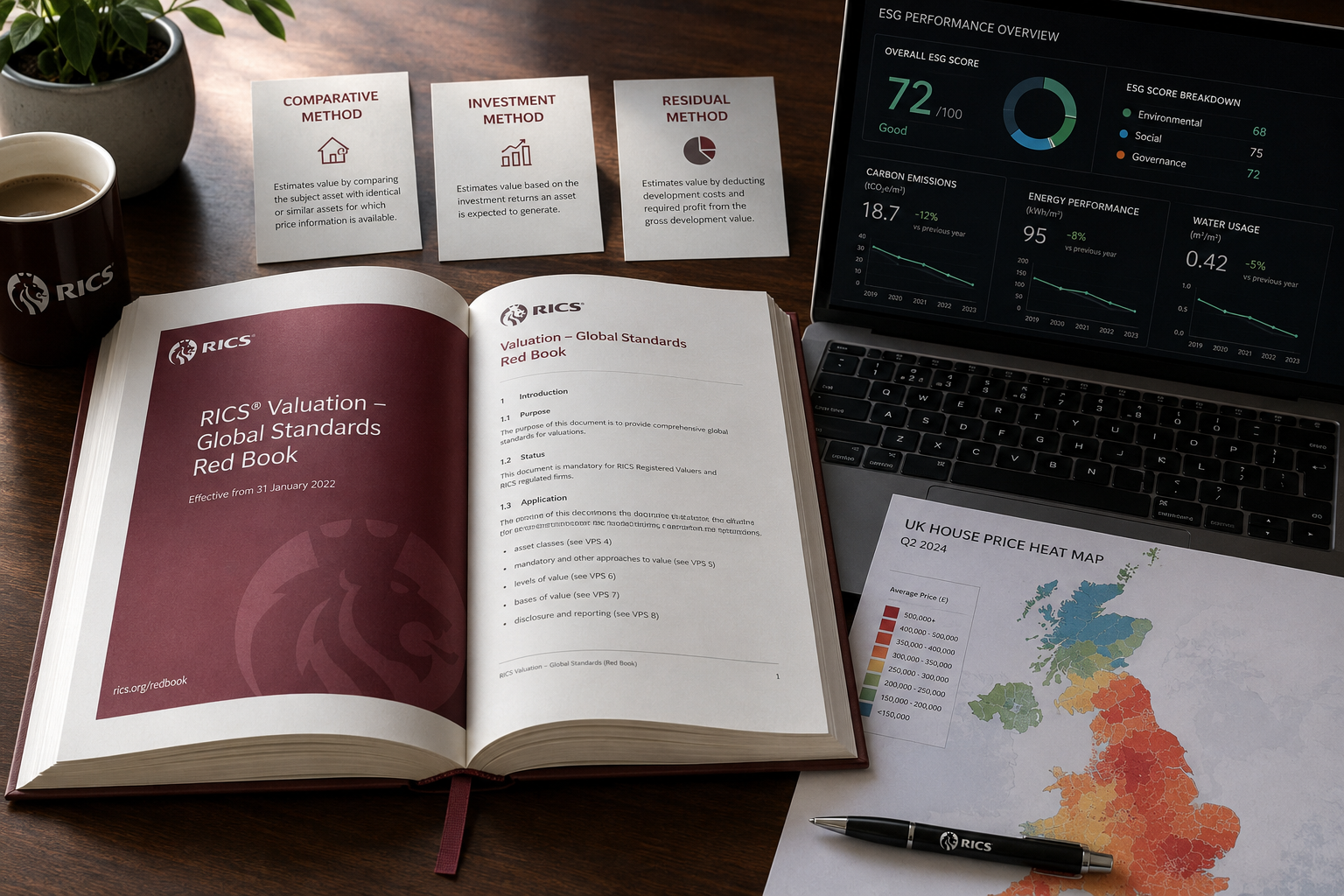
Valuing properties in the 2026 UK housing market rebound: RICS tactics for surging buyer demand and listings require a firm grounding in the five core valuation methods. RICS guidance identifies these as the comparative, investment, residual, profits, and depreciated replacement cost approaches [6]. Each has a distinct role in the current market environment.
The Comparative Method: Adjusting for a Fast-Moving Market
The comparative method remains the most widely used approach for residential property. It relies on recent sales of similar properties to establish market value. In a rebound market with surging listings, the key challenge is selecting the right comparables.
Practical steps for 2026:
- Restrict the comparable window to transactions completed within the last 60-90 days. Older sales may reflect the pre-rebound trough and will undervalue current market conditions.
- Adjust for time-on-market. Properties selling in under 30 days carry a premium signal; those sitting for 90+ days indicate price resistance.
- Apply regional adjustment factors based on the RICS regional data, not national indices.
- Account for energy performance. The updated RICS ESG standard, effective from 30 April 2026, requires surveyors to incorporate environmental, social, and governance factors into valuation advice [3]. EPC ratings now carry measurable price differentials, particularly in the residential sector.
For those working on more complex residential assets, a RICS Building Survey Level 3 provides the structural detail needed to support accurate adjustments for condition and defects within the comparative analysis.
The Investment Method: Rental Yields in a Constrained Supply Market
For buy-to-let and investment properties, the investment method capitalises net rental income at an appropriate yield. The 2026 rental market presents a specific dynamic: tenant demand increased in the three months to January 2026, ending two consecutive quarters of flat or negative readings, while landlord instructions remained negative [7]. Constrained supply is sustaining rental values even as house prices soften.
This creates an environment where gross yields are compressing relative to capital values in some regions, while in others — particularly Scotland and Northern Ireland — yields remain attractive. Surveyors must source current rental evidence carefully and apply a yield that reflects both the local lettings market and the risk profile of the specific asset.
For leasehold investment properties, understanding the implications of lease length on both rental and capital value is essential. Our leasehold guidance covers the key considerations that affect investment valuations in this tenure type.
The Residual Method: Development Viability in a Volatile Market
The residual method is used for development sites and properties with significant conversion potential. Rising build costs, higher finance costs (reflecting the 5.73% mortgage rate environment), and uncertain end values make residual valuations particularly sensitive in 2026 [2]. A small change in the assumed gross development value can produce a large swing in the residual land value.
RICS guidance on valuation approaches emphasises the importance of stress-testing residual valuations under multiple scenarios, particularly in extreme market conditions [6]. Surveyors should present a range of outcomes rather than a single-point figure when market uncertainty is elevated.
Prudent Valuation and Basel 3.1/CRR3 Alignment
A critical development for 2026 is the emphasis RICS places on prudent valuation in the context of Basel 3.1/CRR3 banking regulation requirements [5]. Lenders are required to apply conservative valuation criteria to properties used as collateral. This means:
- Valuations must be based on sustainable, long-term value rather than peak cyclical prices.
- Surveyors must document their reasoning for any upward adjustments in a rising demand environment.
- Where market evidence is limited or contradictory, a more cautious figure is required.
This is not about undervaluing property — it is about producing figures that will remain defensible if market conditions deteriorate. For lenders and borrowers alike, a valuation grounded in prudent RICS methodology provides a more reliable foundation than one that simply chases the most optimistic comparable.
Practical RICS Tactics for Surging Buyer Demand and Listings
The third dimension of valuing properties in the 2026 UK housing market rebound — RICS tactics for surging buyer demand and listings — is operational. How should surveyors structure their workflow and advice when instruction volumes are high and market conditions are shifting week by week?

The Red Book at 50: Standards That Anchor Volatile Markets
August 2026 marks the 50th anniversary of the RICS Valuation Global Standards, universally known as the Red Book [4]. Half a century of refinement has produced a framework that is specifically designed to maintain valuation quality through market cycles. In a rebound environment, the Red Book's requirements for:
- Independence and objectivity — preventing pressure from vendors or buyers to adjust figures
- Adequate investigation — ensuring physical inspection quality does not slip under volume pressure
- Transparent reporting — making assumptions and limitations explicit
…are more important than ever. The RICS Red Book valuation standard provides the formal basis for mortgage valuations, probate, and dispute resolution, and its 50th anniversary is a timely reminder of why professional standards exist precisely for moments like the current market.
ESG Integration: The New Valuation Frontier
The fourth edition of the RICS global professional standard on ESG and sustainability in commercial property valuation, effective from 30 April 2026, signals a clear direction of travel [3]. While the standard focuses on commercial property, its influence is already being felt in the residential sector through:
- EPC-linked pricing adjustments becoming standard practice in mortgage valuations
- Flood risk and climate resilience factors being incorporated into long-term value assessments
- Social value considerations in mixed-use and regeneration schemes
Surveyors who develop competency in ESG-integrated valuation now will be better positioned as these requirements extend more formally into residential practice. For commercial instructions, the RICS commercial building survey provides the physical assessment framework that underpins ESG-aware commercial valuations.
Managing Instruction Volume Without Compromising Quality
When buyer demand surges and listings multiply, the risk of quality dilution in survey and valuation work increases. Key tactics to maintain standards include:
Prioritise inspection time allocation. A homebuyers survey requires adequate time on site to identify defects that affect value. Compressing inspection time to handle more instructions in a busy market is a professional risk that can lead to negligence claims.
Use structured comparable databases. Building and maintaining a local comparable database reduces the time needed to source evidence without reducing its quality. Automated valuation models (AVMs) can assist with initial screening but should never replace professional judgment in a divergent market.
Flag uncertainty explicitly. Where market evidence is thin — for example, in micro-markets with very few recent transactions — RICS standards require surveyors to report this uncertainty. In 2026, with regional divergence as sharp as it is, this obligation applies more frequently than in a uniform market.
Communicate proactively with clients. Buyers and vendors in a rebound market often have inflated expectations driven by headline demand statistics. Surveyors who explain the difference between demand activity and price achievement — and who ground their advice in RICS methodology — provide genuine value that goes beyond a figure on a report.
Specialist Valuations in the 2026 Context
Not all valuations in a rebound market are straightforward residential instructions. Several specialist scenarios require additional RICS expertise:
- Freehold valuations: As leasehold reform continues to reshape the market, freehold valuation instructions are increasing. Surveyors must apply current RICS guidance on ground rent capitalisation rates, which have shifted materially in the post-reform environment.
- Collective enfranchisement: Leaseholders in blocks are increasingly exercising their right to purchase the freehold collectively. Collective enfranchisement valuations require specialist knowledge of the statutory framework and current market evidence for intermediate interests.
- Reinstatement cost assessments: With construction costs remaining elevated, reinstatement cost valuations for insurance purposes need updating. Many properties are currently underinsured because reinstatement figures have not kept pace with build cost inflation.
Geopolitical Risk and Its Effect on Valuation Assumptions
No analysis of the 2026 market is complete without addressing geopolitical risk. The ongoing conflict in the Middle East, including the war in Iran, has contributed to rising borrowing costs and reduced consumer confidence [2]. This has fed directly into the 5.73% average mortgage rate that is suppressing transaction volumes despite elevated buyer demand.
For valuers, geopolitical uncertainty introduces a specific methodological challenge: how much weight should be given to current market evidence when that evidence may reflect a temporary shock rather than a structural shift?
RICS guidance on valuation in extreme conditions is clear that valuers should not simply extrapolate short-term distortions into long-term value assessments [6]. Instead, the approach should be to:
- Report the current market value based on available evidence, with explicit acknowledgment of the uncertainty.
- Note the specific external factors creating that uncertainty.
- Recommend a review period — typically 90 days — after which the valuation should be reconsidered if conditions change materially.
This approach protects both the surveyor and the client while maintaining the integrity of the valuation process.
Conclusion
The 2026 UK housing market presents a genuinely complex environment for property valuation. Buyer demand has surged, listings are at record levels, yet prices are under downward pressure in most English regions while Scotland and Northern Ireland move in the opposite direction. Mortgage rates at 5.73%, geopolitical uncertainty, and the new ESG valuation standards all add layers of complexity that require disciplined, evidence-based methodology.
Actionable next steps for surveyors and property professionals:
- Update your comparable databases to reflect only the most recent 60-90 days of transaction evidence, adjusted for regional divergence.
- Incorporate ESG and EPC factors into every residential valuation as a matter of standard practice, ahead of formal regulatory extension.
- Apply prudent valuation principles aligned with Basel 3.1/CRR3 requirements on all mortgage security instructions.
- Invest time in client communication to manage expectations created by headline demand statistics that do not reflect local price achievement.
- Review all reinstatement cost assessments issued before 2025 to ensure insurance adequacy in the current build cost environment.
- Engage with the RICS Red Book 50th anniversary resources to reinforce methodological grounding during a period of market volatility.
For buyers, vendors, and investors, the message is equally clear: professional RICS-standard valuation advice is not a commodity in this market — it is the difference between a transaction grounded in reality and one built on market noise. Engaging a qualified chartered surveyor who applies current RICS methodology is the single most important step any party can take before exchanging contracts in 2026.
References
[1] UK Residential Survey April 2026 – rics.org
[2] House Prices – moneyweek.com
[3] RICS Publishes Updated Global Standard ESG Sustainability Commercial Property Valuation – rics.org
[4] Red Book 50 – rics.org
[5] Prudent Valuation – community.rics.org
[6] Valuation Approaches Methods Models – ww3.rics.org
[7] UK Resi Survey Jan 2026 Report Shows Early Signs Market Recovery Despite Caution – rics.org
[8] Subdued Momentum Persists In UK Housing Market Amidst Autumn Budget Uncertainty – rics.org
How Prince Surveyors can help: explore our property valuations or learn about our which survey you need.