

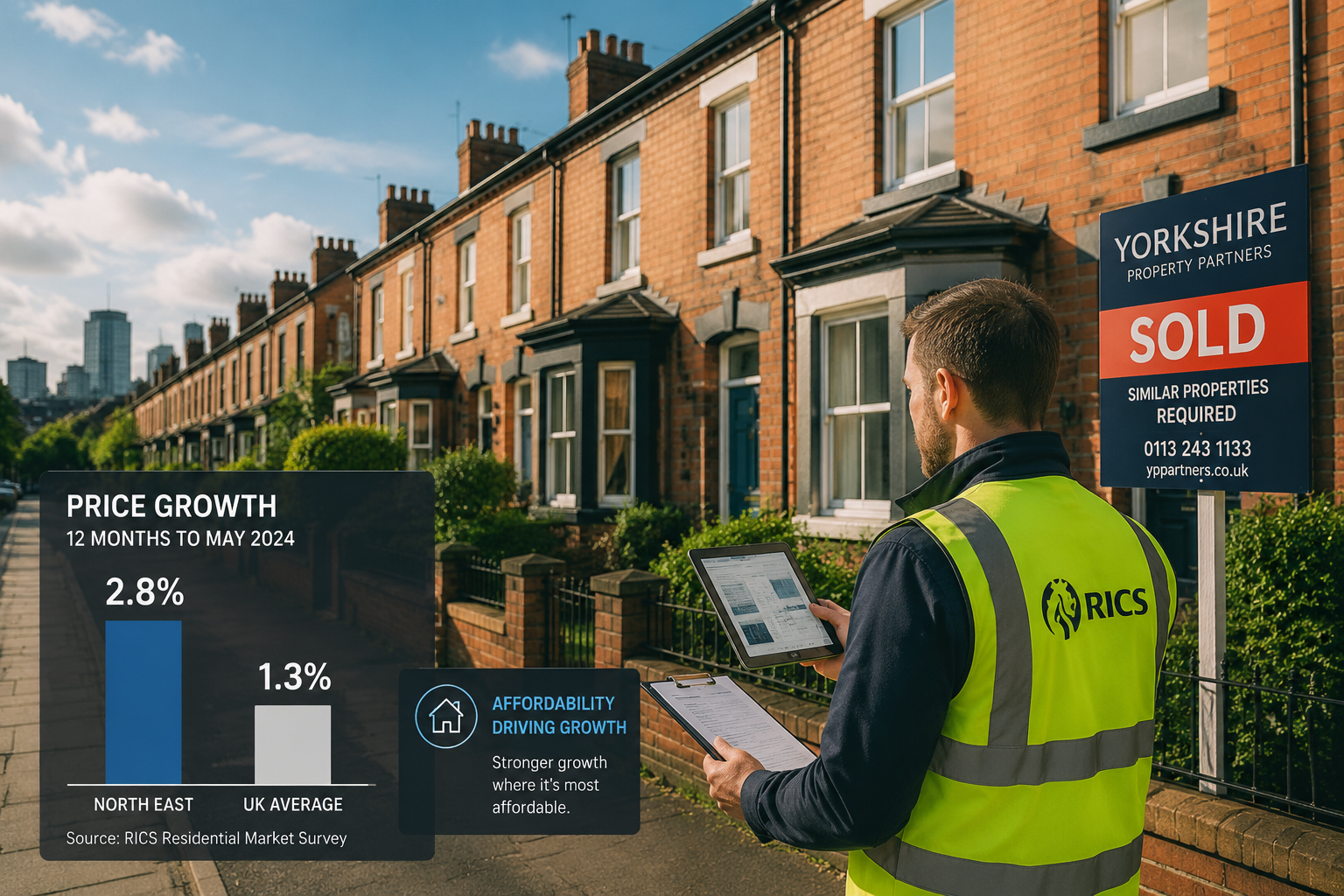
The North East of England recorded annual house price growth of 2.8% in Q1 2026 — more than double the UK national average of 1.3% [1]. That single statistic tells a story that every surveyor, buyer, and investor operating in the region needs to understand clearly. Valuing Properties in Northern England Price Surge: RICS Adjustments for 2026 Affordability-Led Growth is not simply a technical exercise; it is a discipline that now demands regional precision, wage-sensitive comparable analysis, and a firm grasp of how affordability is reshaping buyer behaviour across Yorkshire, the North East, and Greater Manchester.
While London posted a price balance of -40% in February 2026 [2], Northern markets have continued to attract buyers priced out of the South. This divergence has created a two-speed property market — one where the tools and benchmarks used in Mayfair are simply not fit for purpose in Middlesbrough.
Key Takeaways
- The North East grew at 2.8% annually in Q1 2026, outpacing the UK average of 1.3%, driven by affordability and wage-relative pricing.
- RICS-registered valuers are applying upward time adjustments of modest but meaningful percentages to Northern comparables, while applying downward adjustments of 1.5-2% per month in London.
- Regional wage data and local employment trends are now essential inputs in Northern England valuations, not optional context.
- Near-term national price expectations turned negative at -18% in February 2026, but twelve-month optimism surged to +35% — creating a nuanced environment for valuers.
- Rental supply constraints, with landlord instructions at -27% nationally, are adding upward pressure on rents and indirectly supporting capital values in Northern buy-to-let markets.
Why Northern England Is Outperforming: The Affordability Advantage
The fundamental driver behind Northern England's price resilience is straightforward: properties remain affordable relative to local wages. While the average London home requires a buyer to stretch to multiples of 10-12 times annual earnings, comparable properties in cities like Leeds, Sheffield, and Newcastle sit far closer to the 5-7 times range. That gap is not just a statistic — it is the engine pulling demand northward.
Affordability has attracted a broader buyer base to Northern markets, supporting transaction volumes and price resilience in ways that Southern England simply cannot replicate at current income levels [3]. First-time buyers who have been locked out of the South are increasingly committing to Northern cities, particularly where transport infrastructure improvements have enhanced connectivity.
Key affordability drivers in Northern England:
- Lower average house prices relative to median local wages
- Growing graduate retention in cities like Leeds, Manchester, and Newcastle
- Continued investment in Northern infrastructure and employment hubs
- Remote and hybrid working enabling buyers to prioritise value over proximity to London
This buyer-driven dynamic has important implications for how surveyors approach comparable evidence. A valuation methodology calibrated for a stagnant or declining market will produce misleading results in a region where demand is structurally supported.
How Wage Data Is Reshaping Valuation Inputs
In 2026, RICS-compliant valuers working across Northern England are increasingly integrating local wage data alongside traditional comparable sales evidence. The rationale is straightforward: in an affordability-led market, the ceiling on sustainable price growth is anchored to what buyers can actually borrow and service.
For RICS valuations in Northern regions, this means cross-referencing ONS wage growth data for specific local authority areas, not just regional averages. A valuer working in West Yorkshire, for example, should be aware that wage growth in financial and professional services in Leeds has outpaced broader regional figures — and that this supports a higher price ceiling for well-located city-centre properties than a blunt regional average would suggest.
"In an affordability-led market, the ceiling on sustainable price growth is anchored to what buyers can actually borrow and service — making wage data an essential valuation input, not an optional footnote."
RICS Valuation Adjustments for the Northern England Price Surge
Understanding the mechanics of Valuing Properties in Northern England Price Surge: RICS Adjustments for 2026 Affordability-Led Growth requires a close look at how surveyors are modifying their standard methodology to reflect regional conditions.
Time Adjustments on Comparable Evidence
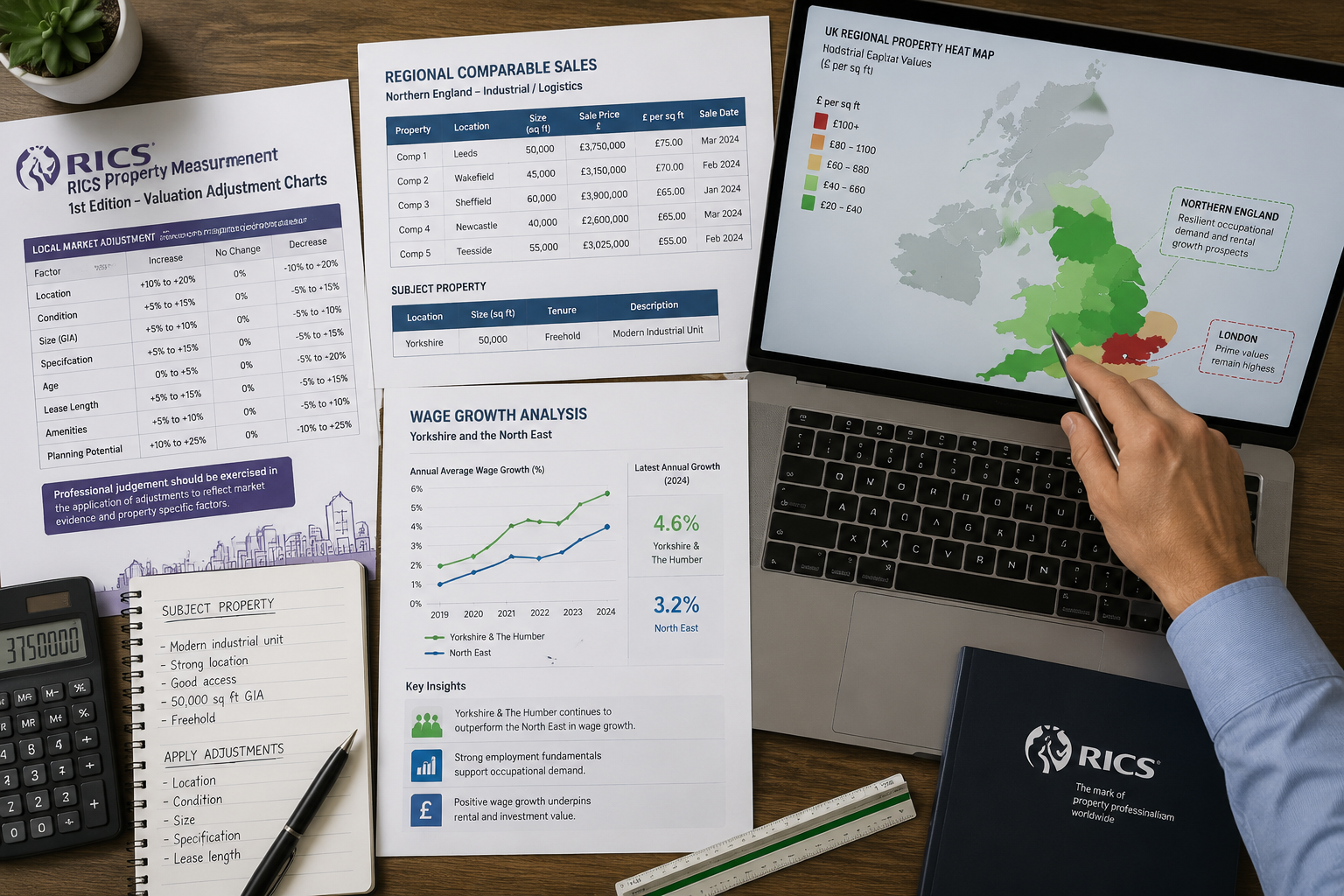
One of the most significant technical changes in 2026 is the application of time adjustments to comparable sales evidence. In a market where prices are moving — upward in the North, downward in parts of the South — a comparable sale from six months ago may no longer reflect current market value without adjustment.
RICS guidance and regional surveying practice now recommend [4]:
| Region | Adjustment Direction | Approximate Monthly Rate |
|---|---|---|
| North East England | Upward | 0.2-0.4% per month |
| Yorkshire and Humber | Upward | 0.2-0.3% per month |
| Greater Manchester | Upward | 0.2-0.4% per month |
| London (prime) | Downward | 1.5-2.0% per month |
| South East | Downward to neutral | 0.5-1.0% per month |
These adjustments are not arbitrary. They are calibrated against actual transaction data, RICS survey sentiment readings, and local market intelligence. A surveyor who fails to apply an upward time adjustment to a Northern comparable from Q3 2025 risks producing a valuation that understates current market value — potentially harming sellers and creating mortgage lending anomalies.
Selecting Regional Comparables
The selection of comparable evidence has always been the cornerstone of residential valuation. In Northern England's current market, this process requires heightened care. Comparables should ideally be:
- Drawn from the same sub-market — a sale in a regenerating inner-city neighbourhood is not directly comparable to one in a suburban commuter village
- Recent enough to reflect current conditions — preferably within three months, with time adjustments applied beyond that window
- Adjusted for condition and specification — particularly relevant as Northern buyers increasingly prioritise energy efficiency and modern kitchens
For properties with structural concerns or unusual construction, a RICS building survey provides the detailed condition evidence needed to justify downward adjustments from headline comparable values. Condition-based adjustments remain just as important in a rising market as in a falling one.
The Role of Near-Term Versus Medium-Term Indicators
February 2026 data from RICS showed that near-term price expectations turned negative at a net balance of -18%, while new buyer enquiries declined to a net balance of -26%, down from -15% in January [2]. At face value, these figures might suggest caution. However, twelve-month price expectations surged to +43% of respondents anticipating higher prices, and overall market optimism reached a net balance of +35% in January 2026 — the strongest reading since December 2024 [6].
For valuers, this tension between short-term softness and medium-term optimism requires careful judgement. A valuation must reflect the market as it stands on the date of inspection, not where the valuer expects it to be in twelve months. However, understanding the medium-term trajectory helps contextualise whether a near-term dip in enquiries represents a genuine price correction or a seasonal pause.
Practical guidance for surveyors navigating this tension:
- Anchor the valuation to current comparable evidence, properly time-adjusted
- Note market sentiment indicators in the valuation report as contextual commentary
- Avoid speculative upward adjustments based solely on twelve-month optimism
- Flag any significant divergence between short-term and medium-term indicators in the assumptions section
Broader Market Context: Divergence, Rental Dynamics, and Economic Headwinds
Valuing Properties in Northern England Price Surge: RICS Adjustments for 2026 Affordability-Led Growth cannot be fully understood without placing it in the context of wider UK market conditions and the economic backdrop of 2026.

The North-South Divide Deepens
The UK housing market in 2026 is characterised by a level of regional divergence not seen in recent cycles. While Northern England, Scotland, and Northern Ireland have shown consistent resilience, London's price balance of -40% in February 2026 signals a market under genuine pressure [2]. Higher stamp duty thresholds, elevated mortgage rates, and stretched affordability multiples have combined to suppress demand in the capital.
For Northern valuers, this divergence creates both opportunity and risk. The opportunity lies in a market where transaction volumes are healthier and comparable evidence is more abundant. The risk lies in the temptation to extrapolate national-level caution into a regional market that is behaving differently.
Surveyors considering RICS homebuyer surveys at Level 2 for Northern properties should ensure their reporting reflects local market conditions rather than defaulting to nationally framed language about price uncertainty.
Rental Market Pressures Supporting Capital Values
The rental market is adding an indirect but meaningful support to Northern England capital values. Nationally, landlord instructions stood at a firmly negative net balance of -27%, while tenant demand remained broadly stable at +2%. A net +20% of RICS survey participants expected rents to rise over the following three months [2].
This structural imbalance — fewer rental properties entering the market while demand holds firm — is pushing rents upward. For buy-to-let investors and valuers assessing investment properties, this rental growth story strengthens the income case for Northern acquisitions. Properties valued for investment purposes, including those requiring RICS shared ownership valuations, need to reflect this rental market context when assessing yield-based comparables.
Economic Headwinds and Interest Rate Sensitivity
The broader economic picture in 2026 introduces genuine uncertainty. Economic growth expectations have been halved following spikes in energy prices and anticipated second-round inflationary effects. Interest rates are now viewed as more likely to rise than fall over the remainder of the year, with inflation remaining above the Bank of England's 2% target [5].
For Northern England valuers, this matters for two reasons. First, mortgage affordability is sensitive to rate movements, and any further increases will compress borrowing capacity — even in markets where headline prices remain relatively low. Second, the cost of development and refurbishment has increased, affecting the residual land values that underpin many Northern regeneration schemes.
Surveyors involved in insurance reinstatement valuations should also note that build cost inflation remains elevated, requiring upward revisions to reinstatement figures across the region.
Signs of Stabilisation at the National Level
Despite the headwinds, there are genuine signs of stabilisation. The national net balance for house prices over the past three months stood at -10% in January 2026, improving from -19% in October 2025 [6]. This trajectory suggests the market is finding a floor, even if it has not yet returned to consistent positive territory.
For Northern England, where prices have remained positive throughout this period, stabilisation at the national level removes one of the key downside risks — the possibility of a broader market correction dragging Northern values down despite strong local fundamentals.
Practical Steps for Surveyors and Buyers in 2026
Whether acting as a RICS-registered valuer, a buyer seeking survey advice, or an investor assessing acquisition opportunities, the following practical steps reflect best practice for the current Northern England market.
For RICS valuers:
- Apply upward time adjustments of 0.2-0.4% per month to comparables older than three months in Yorkshire and the North East
- Integrate local wage and employment data as supporting evidence for price ceiling analysis
- Distinguish clearly between near-term sentiment indicators and medium-term price expectations in valuation reports
- Ensure comparable selection reflects genuine sub-market equivalence, not just broad regional proximity
For buyers and investors:
- Commission a RICS homebuyer survey before committing to purchase, particularly for older terraced stock common across Northern cities
- Understand that a mortgage lender's valuation is not a condition survey — it protects the lender, not the buyer
- For properties with visible defects or unusual construction, consider a specific defect survey to quantify repair costs before negotiating on price
- Review valuation costs to understand the full range of assessment options available
For landlords and shared ownership purchasers:
- Rental market pressures make professional valuation more important, not less — ensure any shared ownership valuation reflects current market rent evidence
- With landlord instructions declining nationally, well-maintained Northern rental properties represent a structurally undersupplied asset class
Conclusion
Northern England's property market in 2026 is being driven by a clear and durable force: affordability. With the North East growing at 2.8% annually against a national average of 1.3%, and with London posting a price balance of -40%, the regional divergence is not a temporary anomaly — it is a structural shift that demands a recalibrated approach to valuation.
Valuing Properties in Northern England Price Surge: RICS Adjustments for 2026 Affordability-Led Growth requires surveyors to move beyond generic national frameworks and apply regionally specific tools: upward time adjustments on comparables, wage-sensitive price ceiling analysis, and a nuanced reading of the gap between near-term caution and medium-term optimism.
Actionable next steps:
- Instruct a RICS-registered valuer with demonstrable Northern England market experience for any valuation in the region.
- Request that comparables used in your valuation report include explicit time adjustment calculations and sub-market justification.
- If purchasing an older Northern property, commission a full RICS building survey to ensure condition-based adjustments are properly reflected in the agreed price.
- Review the full range of assessment types available to ensure the right level of inspection is matched to the property type and transaction context.
- Monitor RICS quarterly survey data through Q2 and Q3 2026 to track whether near-term sentiment indicators begin to align with the stronger twelve-month outlook.
The Northern England market rewards those who engage with it on its own terms. Precise, regionally grounded valuation is not a luxury in this environment — it is a professional and financial necessity.
References
[1] Rics Residential Survey Q1 2026 Valuation Strategies For Northern England Price Surge Vs Southern Caution – Rics residential survey q1 2026 valuation strategies for northern england price surge vs southern caution
[2] Uk Residential Survey February 2026 – rics.org
[3] Why Northern England And Scotland Are Set To Lead Uk House Price Growth In 2026 – belvoir.co.uk
[4] Valuation Adjustments In Regional Divergences Rics February 2026 Data For Surveyors In London Vs North – canterburysurveyors.com
[5] Uk Economy And Property Market Update – rics.org
[6] Uk Resi Survey Jan 2026 Report Shows Early Signs Market Recovery Despite Caution – rics.org
How Prince Surveyors can help: explore our property valuations or learn about our which survey you need.