

Landlords across England exited the private rented sector at an accelerating pace through late 2024 and into 2025, and by early 2026 the downstream effect is unmistakable: a meaningful surge of ex-rental stock has reached the open market, particularly in the lower and middle price bands. For first-time buyers, downsizers, and value-focused investors, this shift represents a genuine opportunity. For surveyors, it creates a more complex valuation environment than at any point in recent memory. Valuing ex-Rental Properties in 2026: Surveyor Insights on Part-Ex Deals and Lower-Priced Market Entry is therefore not merely a technical exercise — it is a discipline that sits at the intersection of market intelligence, condition assessment, and negotiation strategy.
Key Takeaways
- Ex-rental properties now form a significant share of lower-priced listings in 2026, driven by landlord exits, creating accessible entry points for buyers.
- RICS data shows new buyer enquiries contracted sharply in early 2026, giving buyers greater negotiating leverage — but only when supported by professional valuations.
- Part-exchange deals offered by developers are increasingly common, and accurate condition-adjusted valuations are essential to avoid overpaying or underselling.
- Building survey findings — covering damp, structural defects, and dilapidations — directly affect achievable valuations and can justify price reductions of 5–15%.
- Regional variation is significant: Northern England and Scotland show stronger value fundamentals for ex-rental stock than the national average.
Why Ex-Rental Stock Is Reshaping the 2026 Lower-Price Market
The volume of ex-rental properties entering the sales market has been building steadily since regulatory and tax changes began squeezing landlord margins. RICS commentary from its January 2026 UK Residential Market Survey noted a marked increase in available stock in the lower and middle price segments, with East Lancashire cited as a particularly active area [1]. This is not an isolated regional story — it reflects a national pattern of landlord disposals that is now materially affecting supply dynamics.
What makes ex-rental properties distinctive as a valuation challenge?
Several factors set them apart from owner-occupied homes coming to market:
- Condition variability: Properties managed under tenancy arrangements vary widely in maintenance quality. Some landlords invested consistently; others deferred repairs for years.
- Presentation gap: Ex-rental homes rarely benefit from the cosmetic preparation that owner-occupiers apply before sale. This can suppress perceived value without reflecting true structural worth.
- Tenure history: Multiple tenancy cycles can accelerate wear on fixtures, fittings, kitchens, bathrooms, and flooring — all of which feed into condition adjustments.
- EPC ratings: Energy efficiency has become a front-line valuation factor in 2026. Properties with lower EPC ratings face buyer resistance and may require upgrade costs to be factored into valuations [4].
For surveyors, each of these variables requires methodical assessment rather than reliance on comparable evidence alone. The comparable sales approach remains the foundation, but condition-adjusted valuations are now standard practice for ex-rental stock.
Surveyor Insights on Part-Ex Deals and Lower-Priced Market Entry
Part-exchange deals — where a buyer uses an existing property as partial payment toward a new build — have become a prominent feature of the 2026 market. Developers are actively promoting them to maintain transaction volumes at a time when buyer demand has softened considerably [2].
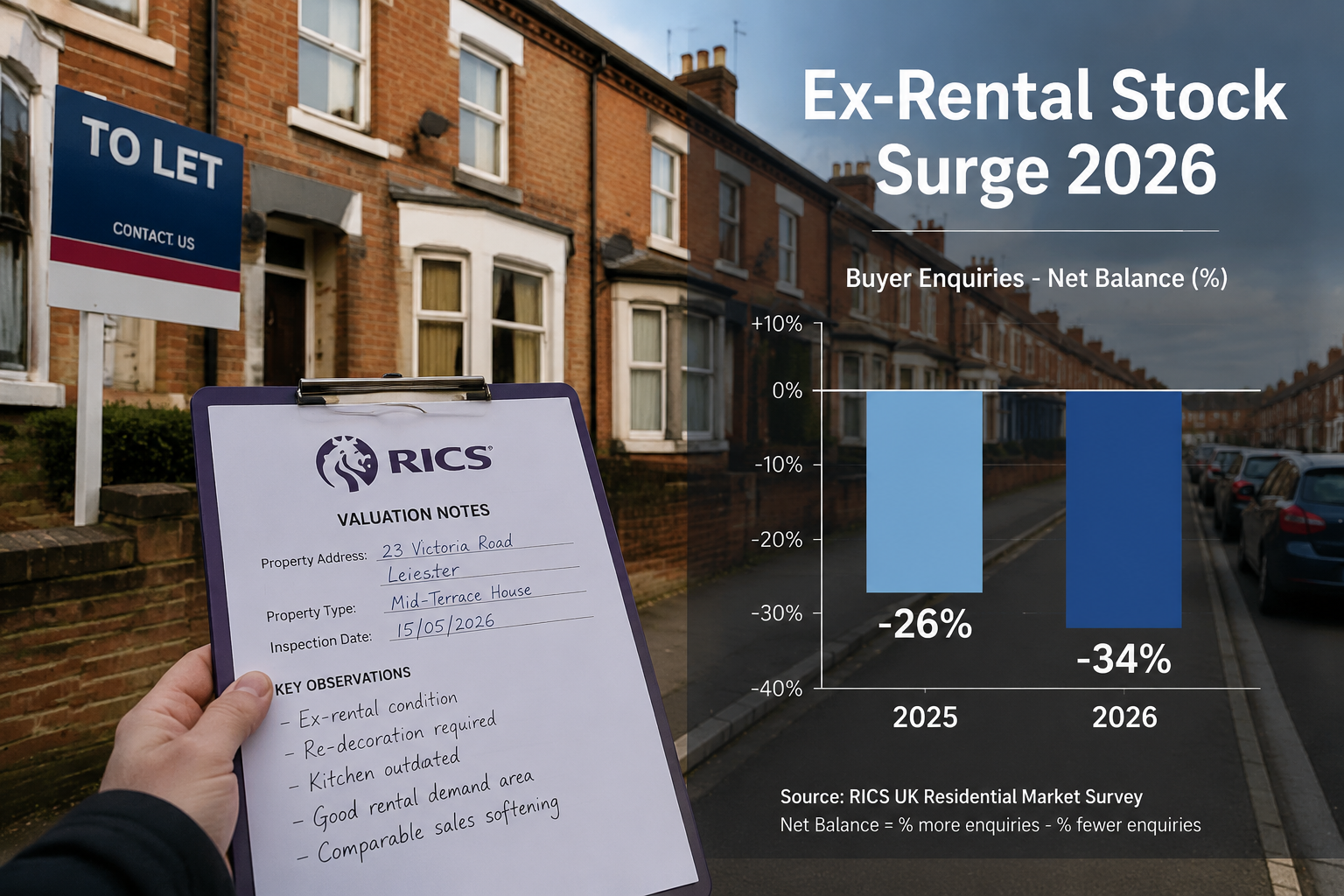
RICS data recorded a net balance of -26% for new buyer enquiries in February 2026, followed by a steeper -34% in April [4]. In this environment, developers face the challenge of keeping sales pipelines moving while buyers face affordability constraints. Part-exchange schemes address both problems — but they introduce a valuation complexity that neither party should underestimate.

How Part-Exchange Valuations Work in Practice
When a developer accepts a property in part-exchange, they typically commission an independent RICS valuation of the incoming property. The buyer, however, should commission their own. The gap between these two assessments is often where disputes arise.
Key considerations for surveyors valuing properties in part-exchange scenarios include:
| Factor | Valuation Impact |
|---|---|
| Structural condition | Direct deduction from market value if defects are present |
| Damp and timber decay | Can reduce value by 3–8% depending on severity |
| Roof condition | Significant defects may trigger 5–10% adjustment |
| EPC rating | Sub-D ratings increasingly affect buyer pool and value |
| Lease length (if leasehold) | Short leases create material value reduction |
| Local comparable sales | Must reflect ex-rental condition, not prime stock |
A RICS Red Book valuation provides the formal, defensible basis for part-exchange negotiations. Without it, buyers risk accepting a developer's internal figure that may not reflect the true open market value of the property they are surrendering.
The Role of Building Surveys in Condition Adjustments
Building survey findings are now integral inputs into rental and resale valuation models [6]. A surveyor assessing an ex-rental property for part-exchange purposes cannot rely solely on a desktop appraisal or a brief inspection. A thorough RICS Level 3 building survey will identify:
- Damp penetration and rising damp
- Structural movement or subsidence indicators
- Roof covering deterioration
- Defective rainwater goods
- Outdated or non-compliant electrical installations
- Plumbing condition and boiler age
When multiple defects are present, professional survey findings provide concrete evidence for price negotiation. Buyers using survey data have secured price reductions of 5–15% on properties with significant defects [9]. In a part-exchange context, this evidence is equally valuable — it protects the buyer from surrendering a property at an undervalued figure.
Valuing ex-Rental Properties in 2026: Condition Adjustments, Regional Dynamics, and Advanced Methodology
Condition Adjustments: A Structured Approach
The condition adjustment process for ex-rental properties requires surveyors to move beyond standard comparable analysis. The methodology involves three layers:
1. Gross Comparable Value
Establish the market value assuming the property were in average condition for its type, age, and location. This uses recent comparable sales data from the immediate area.
2. Condition Deductions
Apply deductions for identified defects, using cost-to-cure estimates where appropriate. Surveyors typically obtain contractor quotes or use recognised cost databases to quantify repair costs, then apply a percentage of those costs as a valuation deduction (commonly 1.0x to 1.5x the repair cost, reflecting buyer risk premium).
3. Presentation and Marketability Adjustment
Ex-rental properties often require cosmetic updating — decoration, flooring replacement, kitchen and bathroom refreshes. These costs are quantified and applied as a further adjustment, particularly relevant in lower-price markets where buyers have limited post-purchase budgets.
"In the current market, a property that looks tired but is structurally sound can be a genuine opportunity — but only if the buyer has a clear, evidence-based picture of what remediation will actually cost."
This structured approach aligns with the more sophisticated Discounted Cash Flow (DCF) methodologies now being employed by surveyors to navigate 2026's market complexity [7]. For investment purchasers, the DCF model incorporates projected rental income, void periods, maintenance reserves, and exit value — all of which are directly influenced by the initial condition assessment.
Regional Variation: Where Ex-Rental Stock Offers the Best Entry Points
Not all ex-rental markets are equal in 2026. Northern England and Scotland are experiencing stronger value gains than the national average, and lower entry prices relative to rental income produce higher gross yields — a combination that is attracting yield-focused investors as well as owner-occupiers [5].
Key regional dynamics to understand:
- East Lancashire and surrounding areas: High volume of ex-rental stock, lower entry prices, and improving rental demand create favourable conditions for buyers willing to accept some condition risk [1].
- Northern cities (Manchester, Leeds, Sheffield): Stronger rental demand supports valuations even where condition adjustments are applied.
- London and South East: Ex-rental stock enters a more competitive market; condition adjustments are proportionally smaller relative to overall values, but EPC and leasehold factors carry greater weight.
- South West and Home Counties: Mixed picture; rural ex-rental properties may face longer marketing periods, affecting valuation assumptions.
For buyers considering entry into any of these markets, choosing the right property survey is a critical first step. The survey level should match the age, construction type, and condition risk profile of the property in question.

Supply Constraints and Their Valuation Implications
New property deliveries are projected to fall to their lowest level since 2011 in Q2 2026 [3]. This supply contraction has a direct bearing on the valuation of existing stock, including ex-rental properties. When new supply is constrained, demand pressure on existing properties — even those requiring work — tends to support values.
For surveyors, this means that condition-adjusted valuations must be calibrated carefully. Applying overly aggressive deductions in a supply-constrained market risks undervaluing properties and creating unfair outcomes for sellers. Conversely, ignoring genuine defects in a market where buyers have more leverage than at any point in recent years [8] would expose buyers to unquantified risk.
The balance point is evidence-based precision: deductions grounded in actual repair costs, supported by survey findings, and cross-referenced against local comparable data.
Leasehold Considerations for Ex-Rental Properties
A significant proportion of ex-rental stock — particularly flats and maisonettes — is leasehold. Lease length is a material valuation factor, and in the context of part-exchange deals, it can be a deal-breaker if not identified early.
Properties with fewer than 80 years remaining on the lease face a disproportionate valuation impact because the cost of lease extension increases sharply below this threshold. Buyers and surveyors should assess lease extension valuation implications before finalising any offer or part-exchange agreement.
Additionally, service charge history, ground rent terms, and building insurance arrangements all feed into the overall valuation picture for leasehold ex-rental properties.
Practical Steps for Buyers Entering the Ex-Rental Market in 2026
The combination of increased ex-rental availability, softer buyer demand, and developer part-exchange incentives creates a genuinely favourable entry environment — but only for buyers who approach it with the right professional support.
Step 1: Commission a RICS Red Book Valuation
Before entering any part-exchange negotiation or making an offer on ex-rental stock, obtain a formal valuation from a chartered surveyor. This establishes a defensible market value figure.
Step 2: Commission a Full Building Survey
A homebuyer survey may be sufficient for newer, well-maintained properties, but ex-rental stock — particularly pre-1980s construction — warrants a full Level 3 building survey. The additional cost is modest relative to the negotiating leverage it provides.
Step 3: Quantify Condition Adjustments
Work with the surveyor to translate defect findings into cost estimates. Use these figures to negotiate a price reduction or to recalibrate a part-exchange offer.
Step 4: Assess EPC Rating and Upgrade Costs
Factor in the cost of bringing the property to at least an EPC C rating, particularly if the property is intended for future letting. Regulatory direction of travel strongly suggests minimum EPC requirements will tighten further.
Step 5: Verify Lease Terms (if Leasehold)
Check the remaining lease length, ground rent terms, and service charge history. If the lease is below 85 years, model the cost of extension before committing.
Step 6: Review Local Comparable Sales
Ensure that the comparables used in any valuation genuinely reflect ex-rental condition stock, not prime owner-occupied properties. The condition gap can be significant and should be reflected in the evidence base.
Conclusion
Valuing ex-Rental Properties in 2026: Surveyor Insights on Part-Ex Deals and Lower-Priced Market Entry is a topic that sits at the heart of the current UK property market. The convergence of landlord exits, constrained new supply, softened buyer demand, and developer part-exchange incentives has created a market moment that rewards preparation and professional rigour.
For buyers, the opportunity is real — but so are the risks of purchasing ex-rental stock without adequate survey and valuation support. Condition adjustments can be substantial, and the difference between a well-evidenced valuation and a speculative one can easily run to tens of thousands of pounds.
For surveyors, the 2026 market demands a more integrated approach: combining comparable analysis with detailed condition assessment, DCF modelling where appropriate, and a clear understanding of regional dynamics and leasehold complexity.
Actionable next steps:
- Engage a RICS-regulated chartered surveyor before making any offer on ex-rental stock or entering a part-exchange agreement.
- Request a full Level 3 building survey on any pre-1980 property or any property showing visible signs of deferred maintenance.
- Use survey findings as a structured negotiation tool, not merely a due diligence exercise.
- Verify lease terms and EPC ratings as standard elements of the pre-offer checklist.
- Consider regional market dynamics carefully — the best value opportunities in 2026 are not uniformly distributed across the country.
For professional valuation and survey support across London and the South East, Canterbury Surveyors provides RICS-regulated expertise across the full range of residential and commercial property needs.
References
[1] UK Residential Market Survey January 2026 – rics.org
[2] Web July 2025 RICS UK Residential Market Survey – rics.org
[3] Q2 2026 Deliveries Expected to Fall to Their Lowest Level Since 2011 – costargroup.com
[4] Valuing Energy Efficiency Upgrades in Cautious 2026 Markets: RICS Insights on Buyer Demand Dip – manchestersurveyors.com
[5] Valuing Buy-to-Let Properties in 2026: Lettings Surge, Surveyor Strategies for Tenant Demand – kingstonsurveyors.com
[6] Valuing Properties in 2026: Tenant Demand Uptick, Building Survey Integration for Rental Growth – manchestersurveyors.com
[7] Valuing Rental Properties in Tightening Lettings Markets: Surveyor Tactics Amid 2026 Tenant Demand Pressures – wimbledonsurveyors.com
[8] Affordability Pressures and Valuation Accuracy: How Surveyors Can Support Buyers Negotiating Harder in the 2026 Market – wimbledonsurveyors.com
[9] Building Surveys for Ex-Rental Properties in East Lancs: Spotting Risks in 2026 Market Accessibility Boom – wimbledonsurveyors.com
How Prince Surveyors can help: explore our block management services or learn about our leasehold services.