

Fewer than 1 in 10 UK local authorities currently meets its own housing delivery targets — a structural deficit that has kept property prices elevated even as affordability deteriorates. For surveyors, this creates a critical challenge: standard valuation frameworks were not designed to separate genuine demand-driven growth from shortage-driven artificial price support. The Valuation Methodology for Properties in Constrained Housing Markets: Accounting for Shortage-Driven Price Support in 2026 Surveys has therefore become one of the most pressing technical questions facing the profession today.
Getting this distinction wrong carries real consequences. Overvaluing a constrained market asset by treating shortage-driven premiums as permanent fundamentals can expose lenders, buyers, and investors to significant downside risk if supply conditions change. Undervaluing it can result in under-insurance, failed transactions, and professional liability claims.

Key Takeaways
- Shortage-driven price support must be explicitly identified and quantified in 2026 surveys, not absorbed silently into comparable evidence.
- RICS guidance recommends tightening the comparable evidence window to 0-3 months in stabilising markets to reduce distortion from older transactions.
- A Supply Constraint Premium of 0.5-1.0% yield compression is now recognised in constrained rental markets with negative landlord instruction balances.
- Building survey condition findings directly affect achievable rents and long-term asset performance in supply-constrained areas.
- Valuation support indicators — including market liquidity, days on market, and investor sentiment — should supplement the three core appraisal approaches in volatile conditions.
Understanding Shortage-Driven Price Support in the UK Housing Market
The UK housing market has experienced persistent negative inventory slack since at least 2010, with conditions reaching extreme tightness during the pandemic years. Research published in 2026 confirms a statistically significant inverse relationship between housing market slack — the deviation of inventory from equilibrium levels — and house price growth [5]. In plain terms: when supply falls short of equilibrium, prices rise beyond what income growth or demand alone would justify.
This is not a temporary blip. Zoning restrictions, planning delays, and land price dynamics have created a structural ceiling on new supply. A 2026 study linking housing Tobin's Q — the ratio of house prices to replacement costs — to regulatory barriers found that a Tobin's Q persistently above unity is a reliable indicator of supply-side constraint rather than demand-side exuberance [6]. When the cost to build a home is materially lower than the price to buy one, regulation and land scarcity are doing the heavy lifting on price.
For surveyors, this means that comparable transaction evidence in constrained markets already embeds shortage premiums. Using that evidence without adjustment does not neutralise the problem — it perpetuates it.
The core distinction surveyors must make in 2026:
| Price Driver | Nature | Valuation Treatment |
|---|---|---|
| Income and employment growth | Fundamental | Reflect directly in comparable selection |
| Population and migration inflows | Fundamental | Reflect in demand weighting |
| Regulatory supply barriers | Structural constraint | Apply explicit shortage premium notation |
| Temporary inventory squeeze | Cyclical | Adjust or flag in evidence weighting |
| Speculative sentiment | Behavioural | Discount or exclude from core evidence |
Core Valuation Methodology for Properties in Constrained Housing Markets
Tightening the Comparable Evidence Window
The single most important technical adjustment in constrained markets is controlling the age of comparable evidence. RICS guidance for 2026 recommends that in stabilising markets, evidence aged 0-3 months should require minimal adjustment, while transactions older than 12 months may need significant recalibration or outright exclusion from the core dataset [2].
This matters because shortage conditions are not static. A comparable sale from 18 months ago may reflect a different inventory environment entirely. Using stale evidence in a supply-constrained market risks either anchoring the valuation to a period of greater slack (undervaluing) or to a period of even tighter conditions (overvaluing).
Practical steps for evidence window management:
- Prioritise sales within the same postcode sector completed in the last 90 days
- Apply a documented time adjustment factor for evidence between 3 and 12 months old
- Exclude evidence older than 12 months unless no recent comparables exist, and note this clearly in the report
- Cross-reference Land Registry data with current listing prices to identify directional trends
For properties where recent local comparables are genuinely scarce — a common problem in highly constrained micro-markets — surveyors should expand the geographic search radius while tightening the time window, rather than the reverse.
Applying the Supply Constraint Premium in Rental Valuations
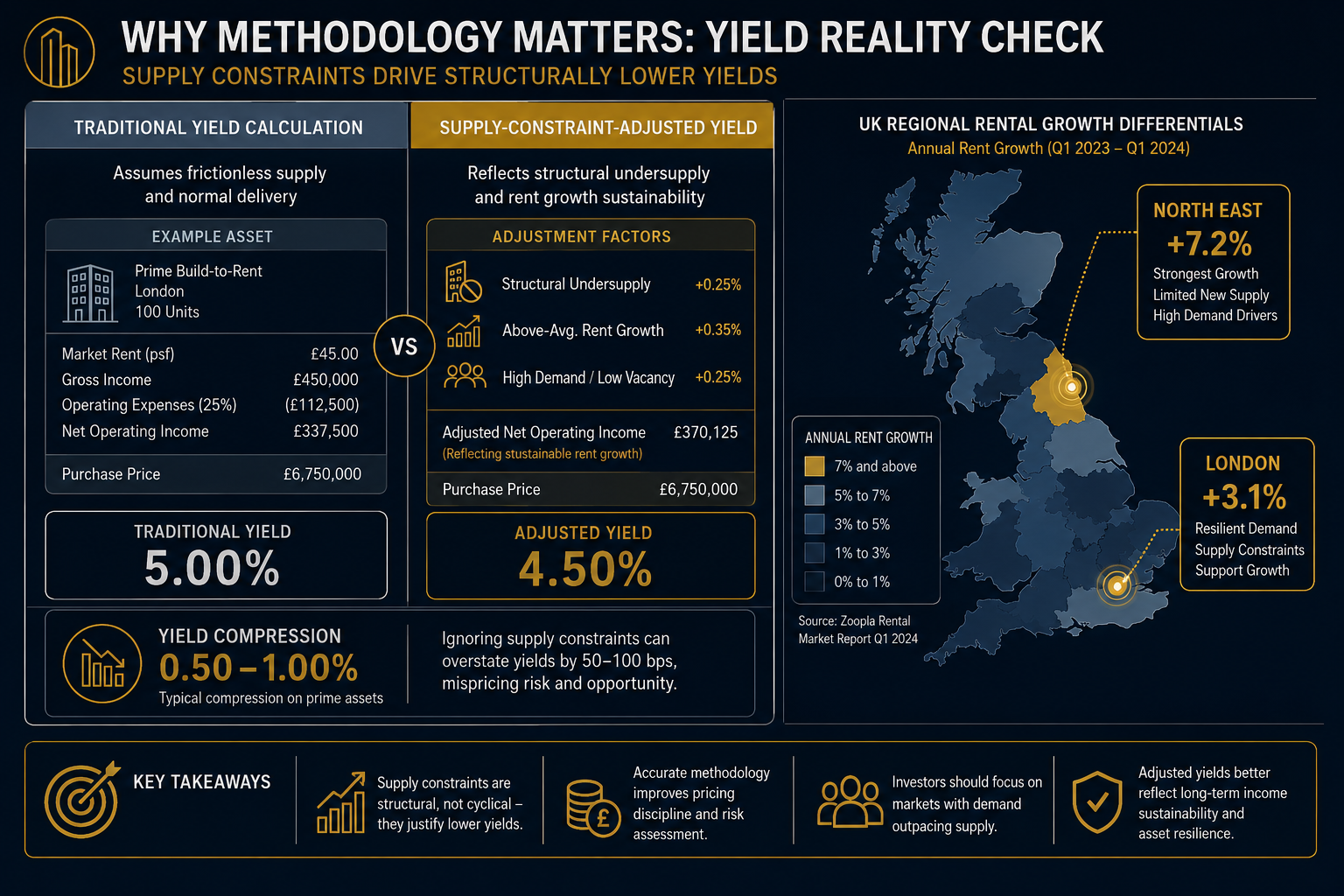
In rental markets, shortage-driven support manifests through yield compression. Canterbury Surveyors' 2026 guidance advises applying a documented Supply Constraint Premium of 0.5-1.0% yield compression in areas where landlord instruction balances are negative — meaning more landlords are withdrawing stock than entering the market [1].
Regional differentials make this more complex. Annual rental growth of 8.0% in the North East versus just 1.1% in London reflects fundamentally different supply-demand dynamics in each region [1]. A flat national yield adjustment would misrepresent both markets.
"Surveyors who apply a single national yield assumption to constrained regional markets are not valuing the property — they are averaging away the most important information."
The adjusted yield calculation should incorporate:
- Base market yield — derived from recent comparable lettings
- Supply constraint adjustment — 0.5-1.0% compression where negative instruction balance is confirmed
- Regional growth differential — weighted by rolling 12-month rental growth data
- Void risk adjustment — reduced in high-demand constrained markets, increased where tenant affordability is stretched
This approach is consistent with the broader shift toward real estate assessment frameworks that account for structural market conditions rather than treating yield as a static input.
Integrating Building Survey Findings into Valuations
With effective rent growth returning to positive territory in Q1 2026, the condition of a property has become a more significant valuation variable than it was during the pandemic-era shortage frenzy, when almost any habitable unit commanded premium rents regardless of condition [3].
In constrained markets with reduced new supply, tenants have less choice — but they are also more likely to remain in a well-maintained property, reducing void periods and turnover costs. A RICS building survey that identifies significant defects therefore has a direct bearing on achievable rent, tenant retention rates, and long-term asset performance.
Specific condition factors that should now be explicitly linked to rental valuation adjustments include:
- Damp and moisture ingress — directly affects habitability and legal compliance
- Roof and structural condition — affects insurance premiums and maintenance reserves
- Energy Performance Certificate rating — increasingly relevant to tenant demand and regulatory compliance
- Heating system age and efficiency — affects tenant running costs and desirability
Surveyors should document the valuation impact of each material defect rather than treating the building survey as a separate exercise from the rental valuation. Choosing the right level of survey is also important — understanding whether a homebuyers report or full structural survey is appropriate can affect the depth of condition data available to inform the valuation.
Valuation Methodology for Properties in Constrained Housing Markets: Advanced Techniques for 2026
Risk-Based Pricing and Cap Rate Stabilisation
In the multifamily and build-to-rent sectors, the market has shifted toward risk-based pricing in response to higher interest rates, rent caps, and rising insurance premiums. Cap rates have stabilised at approximately 6% through 2026, with Class A and B assets clustering in the low-to-mid 5% range and Class C properties typically pricing around 6% [4].
This stratification is itself a product of shortage dynamics. In a fully supplied market, the spread between asset classes would be narrower. In a constrained market, quality differentiation is amplified because tenants compete for the best available stock, pushing up relative values at the top of the quality spectrum.
For surveyors, this means:
- Class A assets in constrained markets may warrant cap rate compression below the market average if condition and location are genuinely superior
- Class C assets should not benefit from shortage premiums unless condition is adequate to compete for the available tenant pool
- Rent cap exposure must be explicitly modelled as a downside scenario in income approach valuations
Incorporating Valuation Support Indicators
Traditional appraisal methods — cost approach, sales comparison, and income approach — provide the structural framework but can be insufficient in volatile or constrained conditions. Incorporating valuation support indicators alongside these three approaches strengthens the analytical foundation [8].
Relevant support indicators for constrained UK markets in 2026 include:
- Days on market — a falling figure indicates tightening conditions and supports higher valuations
- Listing-to-sale price ratio — a ratio consistently above 100% signals competitive bidding driven by shortage
- Mortgage approval volumes — provides context on financing conditions
- Net new instructions balance — the RICS February 2026 survey recorded a net balance of just +2% for new property instructions, confirming continued supply constraint [10]
- Investor sentiment indices — useful for commercial and build-to-rent assets
These indicators do not replace core methodology but they do provide the evidential context that justifies or challenges the conclusions reached through comparable analysis.
Accounting for Mobility Risk in Constrained Markets
A stochastic model published in April 2026 highlights how mobility risk — the probability that an owner will need to sell before their optimal holding period — reduces the effective value of ownership in markets with transient populations [9]. This is particularly relevant for constrained urban markets where employment-driven migration creates high turnover.
In practical terms, a property in a constrained market with a predominantly transient tenant or buyer population carries higher liquidity risk than the headline shortage premium might suggest. Valuers should consider:
- Adjusting marketing period assumptions upward in markets with high population churn
- Applying a liquidity discount where the buyer pool is narrow despite strong demand
- Noting where shortage-driven price support is concentrated in a specific demographic segment that may be vulnerable to employment or migration shifts
This connects to broader guidance on monitoring surveys and ongoing market tracking, which can help identify when constrained conditions are beginning to ease.
Recalibrating Comparable Selection in High-Growth Regions
Surveyors working in high-growth Northern regions face a specific challenge: the pace of price appreciation has been faster than in London and the South East, meaning that comparables from even six months ago may significantly understate current values [7].
The recommended recalibration approach expands comparable selection criteria to include:
- Inventory levels — areas with fewer than two months of supply should be treated as acutely constrained
- Price trend direction — a consistent upward trend over 12 months supports a forward-looking adjustment
- Supply pipeline — planning permissions granted but not yet built should be factored into medium-term supply assumptions
- Migration patterns — net inward migration driven by affordability refugees from higher-cost regions amplifies demand in receiving areas
This broader evidence base is particularly important when negotiating the purchase price after a building survey, where surveyors must distinguish between defect-related price adjustments and market-level shortage premiums that are unlikely to be negotiated away.
For lease-related valuations, shortage-driven price support also affects the premium calculations involved in lease extension valuations, where the underlying freehold value is directly influenced by constrained market conditions.

Documenting Shortage-Driven Assumptions in Survey Reports
Professional liability considerations require that shortage-driven valuation assumptions are explicitly documented rather than embedded silently in the comparable evidence. A robust 2026 survey report in a constrained market should include:
- A market context section identifying supply constraint indicators specific to the subject property's location
- An explicit shortage premium notation where applicable, with supporting evidence
- A sensitivity analysis showing how the valuation would change if supply conditions normalised by 20% or 50%
- A comparables schedule with time adjustments clearly documented for each piece of evidence
- A risk flag where shortage-driven support is the primary driver of value above replacement cost
Using a structured property survey template that incorporates these elements ensures consistency across reports and provides a defensible audit trail.
Geopolitical Uncertainty and Its Interaction with Constrained Markets
The RICS February 2026 residential survey recorded a notable slump in buyer sentiment linked to geopolitical uncertainty, even as supply remained constrained [10]. This creates a short-term tension: shortage fundamentals support prices, but sentiment-driven demand weakness can temporarily suppress transaction volumes and agreed prices.
Surveyors must distinguish between:
- Permanent shortage-driven support — structural, likely to persist unless planning reform delivers material new supply
- Cyclical sentiment weakness — temporary, likely to reverse as uncertainty resolves
The practical response is to extend marketing period assumptions in valuations completed during periods of elevated uncertainty, while maintaining the shortage premium in the core value estimate where structural supply constraints are confirmed. Recalibrating price expectations downward in response to sentiment alone — without evidence of actual price falls in comparable transactions — risks producing valuations that will look conservative within 12-18 months.
Conclusion
The Valuation Methodology for Properties in Constrained Housing Markets: Accounting for Shortage-Driven Price Support in 2026 Surveys demands a more granular and explicitly documented approach than standard comparable analysis provides. The UK's structural housing deficit is not a market anomaly to be averaged away — it is the dominant pricing mechanism in most urban and suburban markets, and surveyors who fail to account for it systematically will produce valuations that are either dangerously optimistic or unnecessarily conservative.
Actionable next steps for surveyors and property professionals:
- Audit your current comparable selection process and implement a formal evidence window policy aligned with RICS 2026 guidance
- Develop a documented Supply Constraint Premium framework for rental valuations, calibrated to regional instruction balance data
- Integrate building survey condition findings directly into rental valuation adjustments rather than treating them as separate outputs
- Incorporate at least three valuation support indicators alongside the three core appraisal approaches in every constrained market report
- Document shortage-driven assumptions explicitly in every survey report, including a sensitivity analysis for normalised supply conditions
- Review comparable selection criteria for high-growth Northern regions to ensure migration and pipeline data are included
The profession's credibility in constrained markets depends on the ability to explain not just what a property is worth, but why — and specifically, how much of that value is structural, how much is cyclical, and how much depends on conditions that could change.
References
[1] Rental Market Valuations In 2026 How Surveyors Should Price Properties With Rising Tenant Demand And Constrained Supply – canterburysurveyors.com
[2] Valuing Stabilised National Prices In Early 2026 Rics Techniques From January Survey Insights – kingstonsurveyors.com
[3] Valuing Properties In 2026 Tenant Demand Uptick Building Survey Integration For Rental Growth – manchestersurveyors.com
[4] Return Of Risk Based Multifamily Valuations – matthews.com
[5] S0165188926001156 – sciencedirect.com
[6] V 3a71 3ay 3a2026 3ai 3ac 3as1051137725000737 – econpapers.repec.org
[7] Valuation Adjustments For 2026 Affordability Driven Markets How Surveyors Must Recalibrate In High Growth Northern Regions – Valuation adjustments for 2026 affordability driven markets how surveyors must recalibrate in high growth northern regions
[8] Beyond Three Approaches How Valuation Support Indicators Can Strengthen – reit.com
[9] arxiv – arxiv.org
[10] Valuation Strategies Amid Rics February 2026 Residential Survey Responding To Geopolitical Uncertainty And Buyer Sentiment Slump – manchestersurveyors.com
How Prince Surveyors can help: explore our property valuations or learn about our which survey you need.