

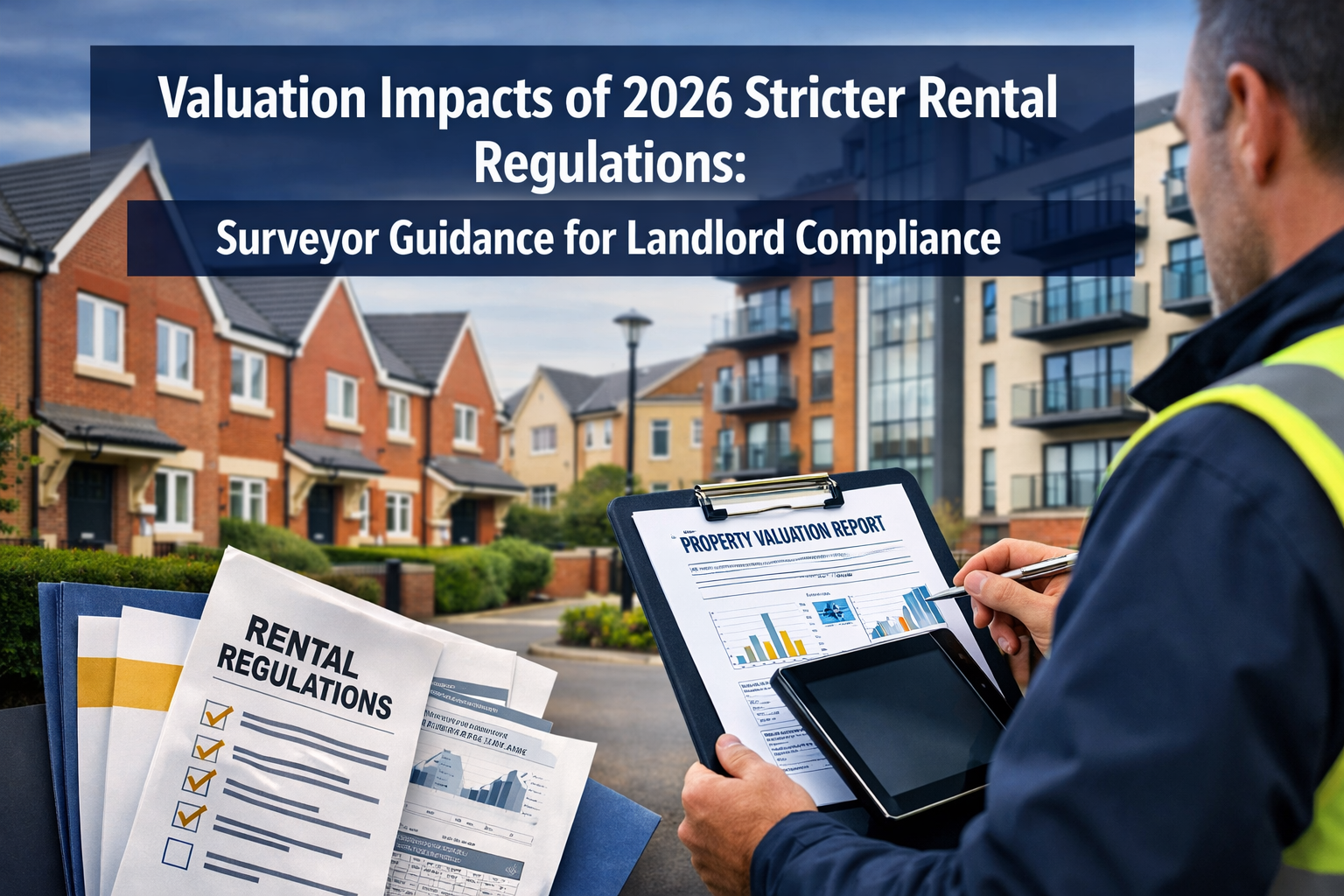
The rental property landscape has shifted dramatically in 2026. New federal legislation targeting institutional investors has created unprecedented challenges for property valuations across the United Kingdom and beyond. Surveyors now face complex regulatory frameworks that fundamentally alter how rental properties must be assessed, valued, and reported. Understanding the Valuation Impacts of 2026 Stricter Rental Regulations: Surveyor Guidance for Landlord Compliance has become essential for property professionals navigating this transformed market.
The Senate-passed bill introduces threshold-based restrictions that will reshape property portfolios, force divestments, and create predictable supply shocks. For chartered surveyors, these changes demand new valuation methodologies that account for regulatory risk, forced-sale scenarios, and evolving tenant protections. This comprehensive guide breaks down the emerging rental regulations shaping the market and provides practical valuation frameworks for assessing properties under new constraints.
Key Takeaways
- 🏢 Institutional investors owning 350+ single-family homes face acquisition restrictions and mandatory build-to-rent divestment within seven years, creating predictable valuation impacts starting around 2030-2033[1][2]
- 📊 Small landlords with fewer than 350 units remain exempt from forced-sale provisions, maintaining stable valuations for smaller portfolios while larger institutional holdings face significant discounts[2]
- 📈 Reduced rental supply is projected to increase rents for remaining properties, potentially boosting income-approach valuations despite overall market uncertainty[4]
- ⚖️ Treasury Department regulatory authority creates ongoing compliance uncertainty that surveyors must factor into risk assessments and valuation adjustments[1]
- 🔍 New surveyor guidance requires comprehensive regulatory compliance assessments including tenant protection measures, property inspection protocols, and forced-sale scenario planning
Understanding the 2026 Regulatory Framework and Valuation Impacts
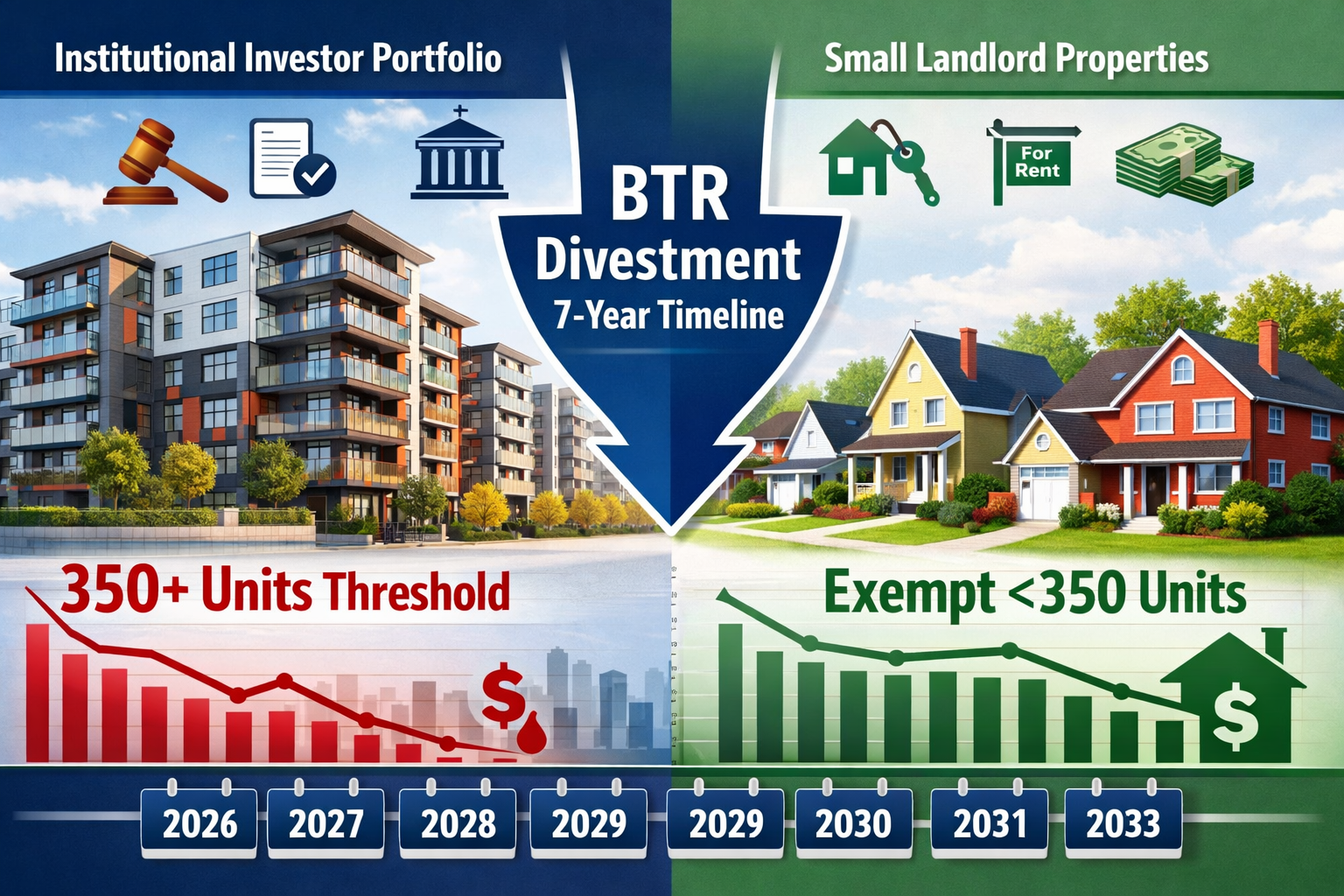
The legislative changes introduced in 2026 represent the most significant regulatory intervention in rental property markets in decades. Section 901 of the Senate-passed housing affordability bill establishes a threshold-based system that fundamentally alters the investment landscape for institutional players[1].
The 350-Unit Threshold: Creating Two-Tier Market Valuations
The legislation draws a clear line at 350 single-family homes. Institutional investors holding properties above this threshold face immediate acquisition restrictions and long-term divestment requirements[1]. This creates distinct valuation frameworks:
Large Institutional Portfolios (350+ units):
- Restricted from additional single-family acquisitions
- Subject to mandatory build-to-rent (BTR) divestment within seven years
- Face significant valuation discounts due to forced-sale scenarios
- Must account for regulatory compliance costs and penalties
Small Landlord Portfolios (<350 units):
- Exempt from acquisition restrictions
- No forced divestment requirements
- Maintain traditional valuation methodologies
- Potential beneficiaries of reduced competition
For surveyors conducting independent property valuations, this threshold creates immediate assessment challenges. A portfolio of 349 units carries fundamentally different risk characteristics than one holding 351 units, despite minimal operational differences.
Build-to-Rent Divestment Timeline: The 2030-2033 Supply Shock
Perhaps the most significant valuation impact stems from the mandatory seven-year divestment requirement for build-to-rent properties held by institutional investors[2]. This creates a predictable future supply injection that surveyors must incorporate into current valuations.
| Timeline | Market Impact | Valuation Consideration |
|---|---|---|
| 2026-2027 | Initial regulatory adjustment | Immediate discount for BTR institutional holdings |
| 2028-2029 | Pre-divestment positioning | Accelerated depreciation as deadlines approach |
| 2030-2033 | Forced divestment period | Significant supply increase, price compression |
| 2034+ | Post-divestment stabilization | New equilibrium with redistributed ownership |
This timeline creates known future inventory that will enter the market around 2033, offering opportunities for smaller investors but depressing valuations for existing BTR properties approaching divestment deadlines[2]. Surveyors must discount current valuations to reflect this anticipated supply shock.
Treasury Department Regulatory Authority: The Unknown Variable
Section 901 grants unusually broad regulatory authority to the Treasury Department to address "market disruptions"[1]. This creates significant uncertainty for long-term valuations. What constitutes a market disruption? How might future regulations expand beyond current provisions?
Chartered surveyors must now incorporate regulatory risk premiums into their assessments. Properties that comply with current 2026 regulations may face additional requirements in 2027, 2028, or beyond. This ongoing uncertainty justifies valuation discounts that reflect potential future compliance costs.
Surveyor Guidance for Assessing Rental Property Values Under New Regulations

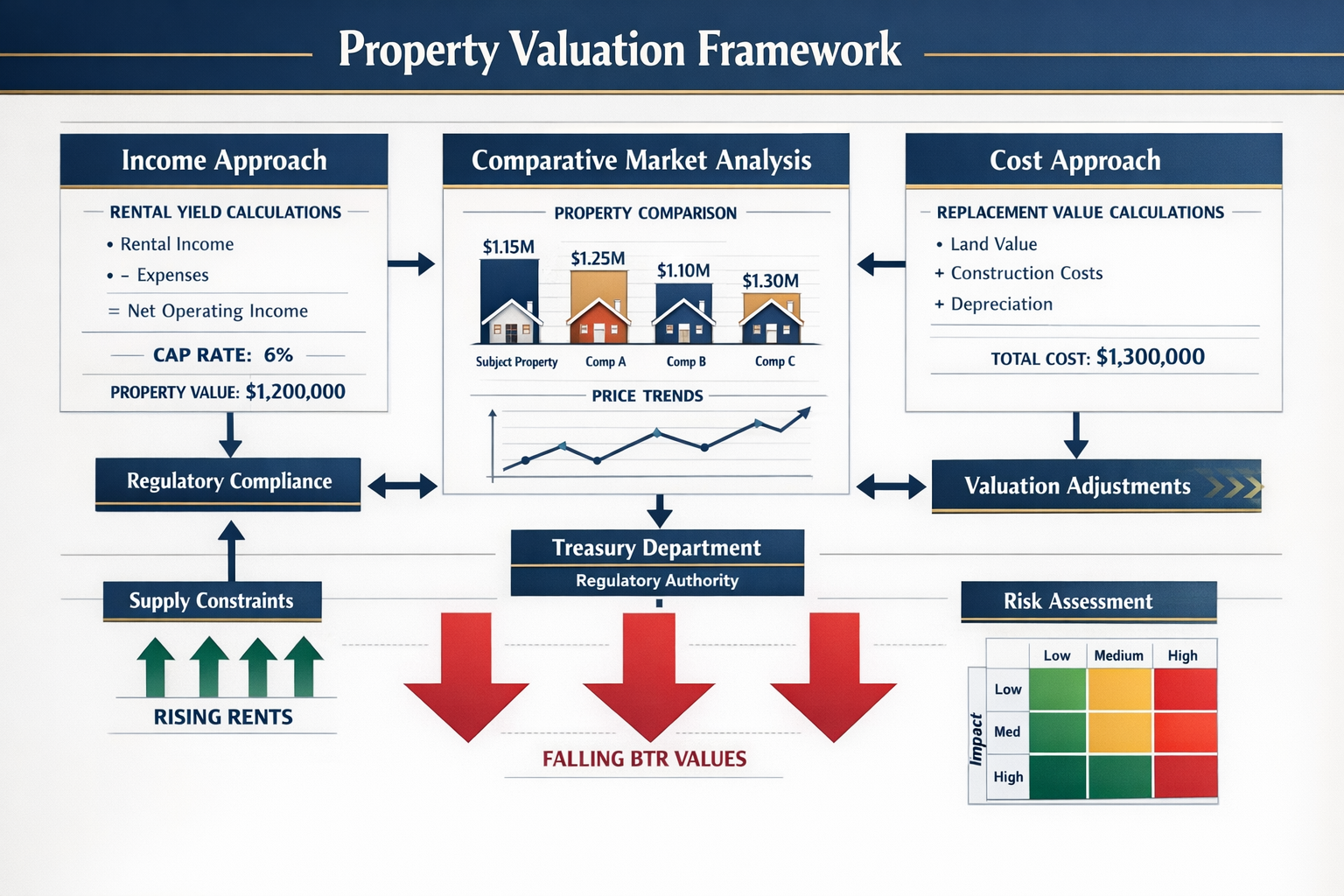
Valuing rental properties in 2026 requires surveyors to adopt enhanced methodologies that account for regulatory compliance, tenant protections, and supply constraints. Traditional approaches must be augmented with new frameworks specifically designed for the current regulatory environment.
Enhanced Income Approach: Factoring Rent Projections and Supply Constraints
The income approach to valuation takes on new complexity under 2026 regulations. Analysts project that restricting institutional investor purchases will increase rents due to reduced new rental supply[4]. However, this rent increase must be balanced against other regulatory impacts.
Key Income Approach Adjustments:
- Rent Growth Projections: Factor in reduced supply competition, but discount for potential future rent control measures
- Vacancy Rates: Account for improved tenant retention from reduced institutional competition
- Operating Expenses: Increase estimates for enhanced compliance requirements and tenant protection measures
- Capitalization Rates: Adjust upward to reflect increased regulatory risk
Research indicates that institutional investor entry into local markets historically decreased rents modestly while reducing owner-occupied home availability by only 0.22 units per institutional purchase[8]. This suggests that current market participants may be overestimating the negative impact of institutional investors, potentially creating valuation opportunities for well-positioned smaller landlords.
Comparative Market Analysis: Accounting for Portfolio Size Differentials
The 350-unit threshold creates significant challenges for traditional comparative market analysis. Properties are no longer directly comparable based solely on physical characteristics, location, and condition. Ownership structure now materially affects value.
When conducting market comparisons, surveyors must:
- Segment comparable sales by portfolio size (institutional vs. small landlord)
- Apply portfolio premium/discount adjustments based on regulatory exposure
- Consider buyer pool restrictions that limit institutional participation
- Factor in forced-sale scenarios for properties approaching divestment deadlines
A build-to-rent property sold by a small landlord in 2026 should command a premium over an identical property sold by an institutional investor facing a 2033 divestment deadline. Surveyors must quantify this differential through careful market analysis and risk assessment.
Cost Approach Modifications: Regulatory Compliance as a Value Component
The cost approach to valuation must now incorporate regulatory compliance as a distinct value component. Properties that meet current tenant protection standards, energy efficiency requirements, and safety regulations carry less regulatory risk than those requiring significant upgrades.
Compliance Assessment Checklist:
✅ Energy Performance Certificate (EPC) compliance – Properties must meet minimum standards, with EPC ratings affecting marketability
✅ Safety certification – Current electrical, gas, and fire safety documentation
✅ Tenant protection compliance – Deposit protection, proper notice procedures, habitability standards
✅ Inspection protocols – Regular rental unit inspection schedules documented and maintained
✅ Maintenance records – Comprehensive documentation of repairs and upgrades
Properties with complete compliance documentation should receive valuation premiums, while those requiring significant regulatory upgrades warrant corresponding discounts. Surveyors should quantify these adjustments based on estimated compliance costs and timeline to full regulatory conformity.
Risk-Adjusted Valuation Framework: Quantifying Regulatory Uncertainty
The 2026 regulatory environment demands a risk-adjusted valuation framework that explicitly accounts for regulatory uncertainty. This approach combines traditional methodologies with scenario analysis and probability weighting.
Three-Scenario Valuation Model:
- Base Case (60% probability): Current regulations remain stable, gradual market adjustment
- Restrictive Case (25% probability): Additional regulations expand restrictions, further valuation compression
- Liberalization Case (15% probability): Regulations relaxed or repealed, partial value recovery
By weighting these scenarios, surveyors can provide clients with probability-adjusted valuations that reflect the full range of regulatory outcomes. This approach proves particularly valuable for pension valuations and long-term investment assessments where regulatory stability significantly impacts projected returns.
Practical Compliance Strategies and Valuation Impacts for Landlords
Understanding regulatory impacts represents only half the equation. Landlords and property investors need actionable compliance strategies that protect and potentially enhance property valuations despite the challenging regulatory environment.
Portfolio Restructuring: Staying Below the 350-Unit Threshold
For investors approaching the 350-unit threshold, strategic portfolio restructuring offers the most direct path to avoiding forced divestment requirements. This may involve:
- Entity separation: Dividing holdings across multiple legal entities, each below the threshold
- Asset class diversification: Shifting from single-family to multi-family properties not covered by restrictions
- Geographic distribution: Spreading holdings to minimize concentration risk
- Selective divestment: Proactively selling lower-performing properties before forced-sale scenarios
Surveyors conducting annual tax valuations should work closely with clients to model the valuation impacts of various restructuring scenarios. A well-executed restructuring completed in 2026-2027 may preserve significantly more value than waiting until approaching the 2033 divestment deadline.
Tenant Protection Enhancement: Converting Compliance into Competitive Advantage
Rather than viewing tenant protections as regulatory burdens, forward-thinking landlords can convert compliance into competitive advantage. Properties that exceed minimum standards attract higher-quality tenants, reduce turnover, and command premium rents.
Value-Enhancing Tenant Protections:
- 🏠 Extended warranty periods beyond statutory minimums
- 🔧 Rapid maintenance response systems with guaranteed timelines
- 💰 Transparent fee structures with no hidden charges
- 📱 Digital tenant portals for seamless communication and service requests
- 🌡️ Enhanced energy efficiency reducing tenant utility costs
Surveyors should recognize and quantify these enhancements in their valuations. Properties demonstrating superior tenant satisfaction and retention deserve income approach premiums reflecting reduced vacancy risk and stable cash flows.
Build-to-Rent Acquisition Opportunities: Positioning for the 2030-2033 Window
The mandatory divestment timeline creates significant acquisition opportunities for small landlords and investors positioned below the 350-unit threshold. As institutional investors approach divestment deadlines, well-capitalized buyers can acquire quality BTR properties at discounted prices[2].
Strategic Acquisition Planning:
- 2026-2028: Build capital reserves and financing relationships
- 2029-2030: Begin identifying target properties approaching divestment
- 2031-2033: Execute acquisitions as institutional sellers face deadlines
- 2034+: Benefit from reduced competition and stabilized market
Surveyors providing investment property valuations should help clients model these acquisition scenarios, quantifying potential returns from strategic timing and positioning.
Supply Constraint Positioning: Capitalizing on Reduced Competition
The legislation is projected to increase overall home prices by reducing total housing supply, as institutional investors who formerly built BTR properties redirect capital elsewhere[4]. This creates opportunities for landlords who maintain or expand their rental supply.
Properties in markets with:
- High institutional investor concentration (greatest supply reduction)
- Strong rental demand fundamentals (employment growth, population increases)
- Limited new construction pipelines (zoning restrictions, development constraints)
…should see the strongest rent growth and valuation appreciation. Surveyors must conduct thorough market analysis to identify these high-opportunity locations and adjust valuations accordingly.
Documentation and Compliance Records: Building Valuation Support
Perhaps the most overlooked valuation strategy involves comprehensive documentation of regulatory compliance. Properties with complete, well-organized compliance records demonstrate lower regulatory risk and justify valuation premiums.
Essential Documentation Systems:
📋 Compliance Calendar: Tracking all inspection, certification, and renewal deadlines
📋 Tenant Communication Log: Documented history of maintenance requests and responses
📋 Upgrade Investment Records: Complete records of property improvements and compliance investments
📋 Professional Service Contracts: Relationships with qualified contractors, building surveyors, and compliance specialists
📋 Insurance Documentation: Current coverage meeting all regulatory requirements, including insurance reinstatement valuations
When conducting valuations, surveyors should thoroughly review these documentation systems. Properties with superior compliance documentation warrant reduced risk premiums and higher valuations compared to otherwise identical properties with poor record-keeping.
Regional Variations and Local Implementation Considerations
While federal legislation establishes the baseline regulatory framework, local implementation varies significantly across regions. Surveyors must understand jurisdiction-specific requirements that affect property valuations beyond the federal baseline.
Short-Term Rental Overlay Regulations
Some jurisdictions have layered additional short-term rental restrictions atop federal regulations. Washington State, for example, has considered legislation affecting short-term rental access and compliance requirements[5]. These overlay regulations create additional valuation complexity for properties with mixed-use potential.
Properties in jurisdictions with restrictive short-term rental policies may see reduced valuation multiples due to limited revenue optimization strategies. Conversely, properties in permissive jurisdictions maintain flexibility that justifies valuation premiums.
Municipal Tenant Protection Ordinances
Cities including Washington, D.C., have implemented local tenant protection measures that exceed federal requirements[7]. These may include:
- Enhanced just-cause eviction requirements
- Rent increase limitations
- Mandatory relocation assistance
- Extended notice periods
Surveyors conducting valuations in these jurisdictions must apply additional risk adjustments reflecting the cumulative regulatory burden. A property in a high-regulation municipality may warrant 10-15% valuation discounts compared to an identical property in a lower-regulation jurisdiction.
State-Level Housing Initiatives
State governments continue developing their own housing affordability initiatives that interact with federal regulations[3]. Maryland, for example, has implemented comprehensive housing programs that affect property valuations through:
- First-time homebuyer assistance (affecting demand for rental properties)
- Affordable housing development incentives (affecting supply dynamics)
- Landlord compliance programs (affecting operating costs)
Chartered surveyors must stay informed about state-level initiatives in their practice areas and incorporate these factors into valuation assessments.
Long-Term Market Projections and Valuation Outlook
Looking beyond immediate 2026 impacts, surveyors must consider long-term market dynamics that will shape property valuations through 2030 and beyond.
The 2030-2033 Transition Period: Planning for Supply Redistribution
The mandatory seven-year divestment window creates a predictable transition period where ownership will shift from large institutional investors to smaller landlords and individual buyers[2]. This redistribution will fundamentally reshape market dynamics.
Expected Market Characteristics (2030-2033):
- Increased transaction volume as institutional portfolios are broken up and sold
- Price compression for BTR properties as supply exceeds demand
- Opportunities for well-capitalized small investors to acquire quality assets
- Potential market volatility as large volumes of properties change hands
- Stabilization of owner-occupied home availability as rental supply converts
Surveyors providing long-term investment guidance should help clients position portfolios to capitalize on this transition. Properties acquired during the 2030-2033 window may offer superior returns compared to pre-2026 or post-2033 purchases.
Post-2033 Market Equilibrium: The New Normal
After the divestment transition completes, the rental market will establish a new equilibrium characterized by:
- Smaller average portfolio sizes
- Reduced institutional investor participation
- Potentially higher rents due to constrained supply
- More fragmented ownership structure
- Increased importance of professional property management
Valuations in this post-transition environment will likely favor properties with:
- Professional management infrastructure compensating for smaller ownership scale
- Superior tenant retention reducing turnover costs in a higher-rent environment
- Energy efficiency and sustainability features meeting evolving regulatory standards
- Location in supply-constrained markets where new construction remains limited
Regulatory Evolution: Anticipating Future Changes
The broad regulatory authority granted to the Treasury Department suggests that 2026 regulations represent a starting point rather than a final framework[1]. Surveyors must anticipate potential future regulatory expansions:
- Lowering of the 350-unit threshold
- Extension of restrictions to multi-family properties
- Enhanced tenant protection requirements
- Stricter energy efficiency mandates
- Expanded reporting and compliance obligations
Properties and portfolios positioned to adapt to evolving regulations will maintain stronger valuations than those requiring significant future compliance investments. Forward-thinking surveyors incorporate regulatory adaptability as a distinct valuation factor.
Conclusion: Navigating the New Valuation Landscape
The Valuation Impacts of 2026 Stricter Rental Regulations: Surveyor Guidance for Landlord Compliance represent a fundamental shift in how rental properties must be assessed and valued. The introduction of threshold-based restrictions, mandatory divestment timelines, and broad regulatory authority creates unprecedented complexity for chartered surveyors and property investors.
However, complexity also creates opportunity. Surveyors who develop expertise in regulatory compliance assessment, risk-adjusted valuation methodologies, and long-term market positioning will provide exceptional value to clients navigating this transformed landscape. Landlords who proactively address compliance requirements, optimize portfolio structures, and position for the 2030-2033 transition period can protect and potentially enhance property values despite regulatory headwinds.
Actionable Next Steps for Property Professionals
For Chartered Surveyors:
- Develop enhanced valuation frameworks incorporating regulatory risk assessments
- Create compliance checklists specific to 2026 regulatory requirements
- Build expertise in scenario-based valuation modeling for long-term projections
- Establish relationships with compliance specialists, building surveyors, and legal experts
- Stay informed about regional regulatory variations affecting local markets
For Landlords and Investors:
- Conduct immediate portfolio assessments to determine proximity to 350-unit threshold
- Implement comprehensive compliance documentation systems
- Consider strategic restructuring to optimize regulatory positioning
- Develop capital reserves and financing relationships for potential 2030-2033 acquisitions
- Engage qualified surveyors for regular property valuations reflecting current regulatory environment
For Property Buyers:
- Request detailed regulatory compliance assessments as part of due diligence
- Understand seller motivations (forced divestment vs. voluntary sale)
- Factor regulatory positioning into purchase price negotiations
- Engage experienced surveyors for comprehensive property inspections
- Plan for potential future compliance investments in acquisition analysis
The rental property market of 2026 demands sophisticated analysis, proactive compliance, and strategic positioning. By understanding the valuation impacts of stricter rental regulations and implementing the surveyor guidance outlined in this article, property professionals can successfully navigate this challenging but opportunity-rich environment.
References
[1] March 20 2026 – https://www.rer.org/roundtable-weekly/march-20-2026/
[2] Housing Affordability Bill 2026 – https://www.offermarket.us/blog/housing-affordability-bill-2026
[3] Ecm%20 %20134141709167808719%20 %20state%20of%20housing%20%e2%80%93%20presentation%20materials%20%e2%80%93%20ecm – https://mgaleg.maryland.gov/meeting_material/2026/ecm%20-%20134141709167808719%20-%20State%20of%20Housing%20%E2%80%93%20Presentation%20Materials%20%E2%80%93%20ECM.pdf
[4] 21st Century Road To Housing Act Impact – https://jbrec.com/insights/21st-century-road-to-housing-act-impact/
[5] Washington Short Term Rental Access Bill – https://shorttermrentalz.com/news/washington-short-term-rental-access-bill/
[6] Whats In The 21st Century Road To Housing Act – https://bipartisanpolicy.org/explainer/whats-in-the-21st-century-road-to-housing-act/
[7] Real Estate Landlords New Housing Landscape Dc – https://www.washingtonblade.com/2026/02/08/real-estate-landlords-new-housing-landscape-dc/
[8] The Ripple Effects Of Banning Institutional Purchases Of Single Family Rentals – https://www.brookings.edu/articles/the-ripple-effects-of-banning-institutional-purchases-of-single-family-rentals/