

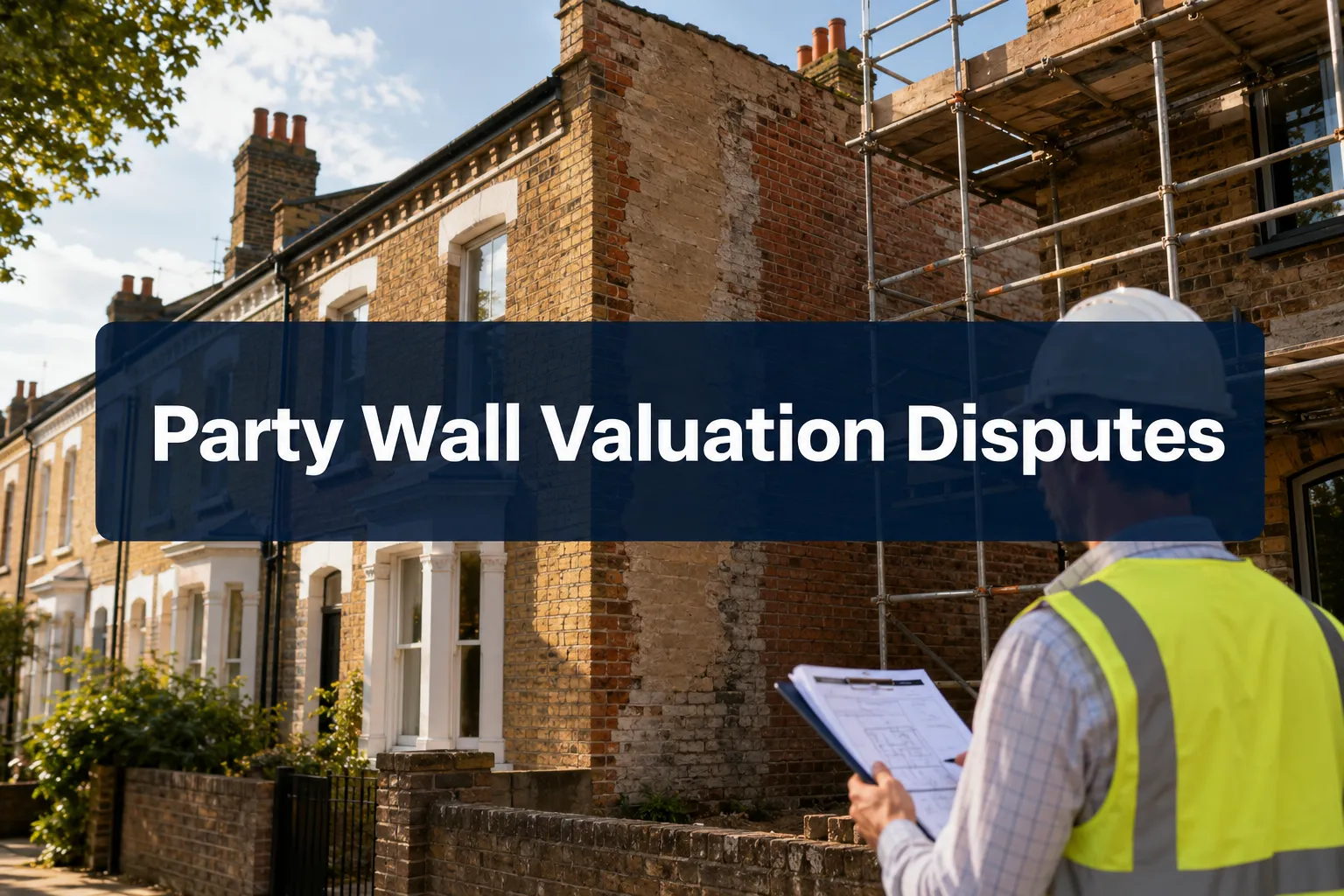
Last updated: July 24, 2026
Quick Answer: Valuation disputes in party wall awards arise when the compensation claimed for construction damage significantly exceeds what the building owner or their surveyor anticipated. Resolving these disputes requires RICS-qualified expert witnesses, CPR Part 35-compliant reports, and a clear methodology for establishing both causation and financial quantum. Without credible expert evidence, claims can collapse or awards can be successfully challenged in court.
Key Takeaways
- A party wall award is a legally binding document that can include compensation for damage caused by notifiable construction works.
- Damage claims frequently exceed initial expectations because surveyors underestimate structural complexity, regional property values, or the scope of consequential losses.
- Expert evidence must comply with Civil Procedure Rules (CPR) Part 35 to be admissible in court proceedings.
- Causation is the hardest element to prove: distinguishing new damage from pre-existing defects requires a thorough pre-works schedule of condition.
- A party wall schedule of condition completed before works begin is the single most effective tool for protecting both parties.
- Party wall awards can be appealed to the county court within 14 days of service.
- Independent expert witnesses are preferred by courts over surveyors who were involved in the original award process.
- Valuation disputes in London and the South East carry higher financial stakes due to the regional property value gap, which can exceed £85,000 for comparable properties.
- Resolving a contested valuation typically takes three to twelve months, depending on whether the matter proceeds to litigation.
- A specialist surveyor is usually sufficient for most disputes; a solicitor becomes necessary only when court proceedings are likely.
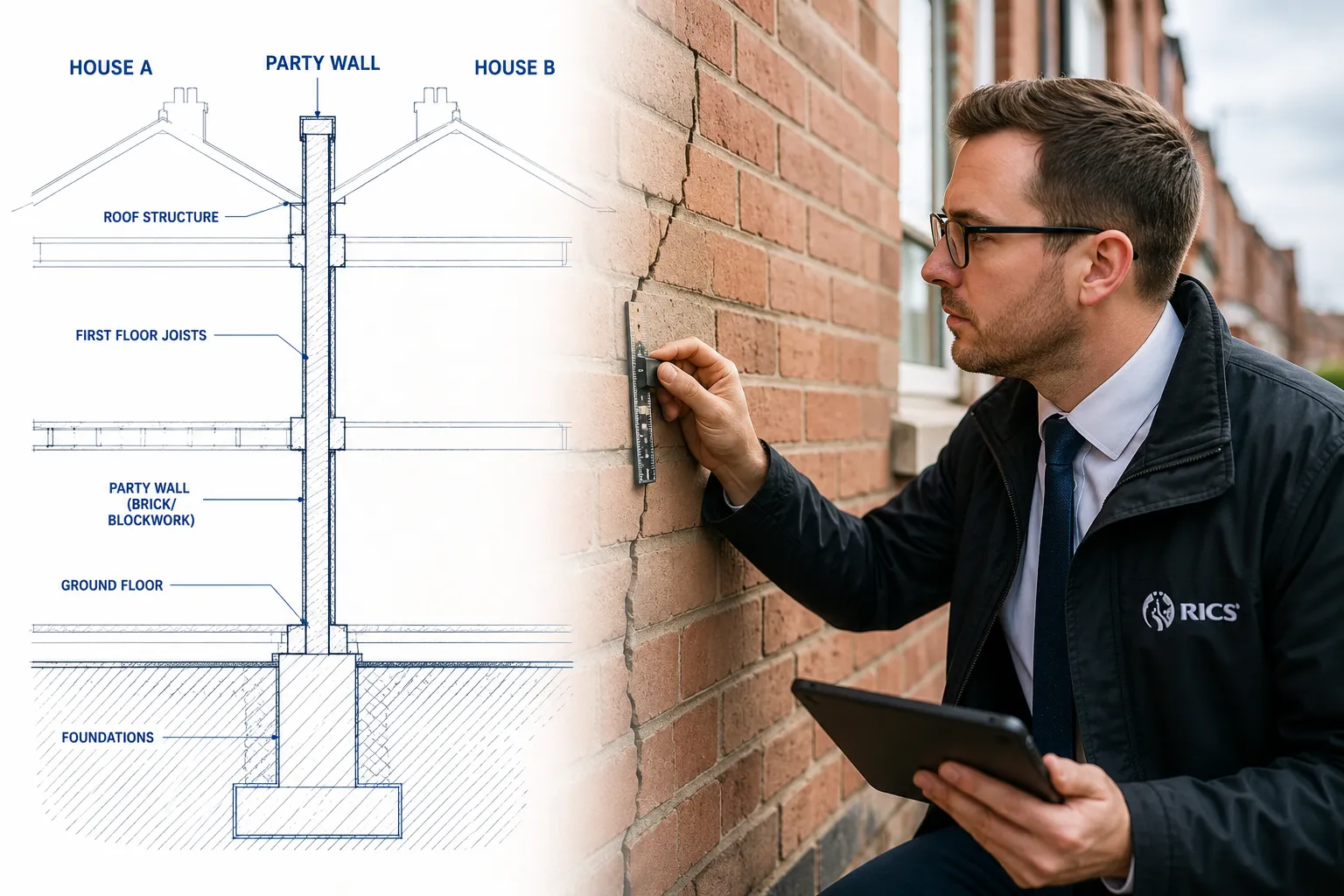
What Is a Party Wall Award and How Does Valuation Work
A party wall award is a formal written document produced by appointed surveyors under the Party Wall etc. Act 1996. It sets out the rights and obligations of both the building owner (the person carrying out works) and the adjoining owner, and it can include provisions for compensation where damage occurs.
Valuation within a party wall award works in two distinct stages:
- Technical liability: Did the notifiable works cause the alleged damage? This is a factual and structural question.
- Quantum: If liability is established, what is the financial value of the loss? This involves reinstatement costs, diminution in value, and in some cases consequential losses such as temporary accommodation costs.
The valuation methodology must be defensible. Surveyors typically reference comparable repair costs, contractor quotes, and where necessary, formal RICS Red Book valuations to establish diminution in market value. For a deeper understanding of how party wall awards are structured, see this guide to party wall awards.
Why Do Damage Claims Exceed Expectations in Party Wall Disputes
Damage claims exceed initial expectations for several consistent reasons, and understanding them early can prevent costly surprises.
Common reasons claims escalate:
- Underestimated structural complexity. Basement excavations, underpinning, and loft conversions in older terraced properties often reveal hidden vulnerabilities that amplify damage.
- Regional property values. In London and the South East, the valuation gap between regions means that even minor structural damage can translate to a significant diminution in market value. The gap between northern and southern UK property values for comparable homes has widened considerably, directly inflating compensation figures in high-value areas.
- Consequential losses. Adjoining owners may claim for temporary rehousing, loss of rental income, or business interruption, none of which are always anticipated at the outset.
- Climate risk factors. In 2026, property valuations increasingly incorporate flood exposure, energy efficiency ratings, and regulatory compliance costs. Damage that affects a property's EPC rating or flood resilience can generate claims far beyond simple repair costs.
- Scope creep in repair works. Once contractors begin remedial work, they frequently uncover secondary damage, pushing final costs above the original estimate.
"A claim that looks straightforward at the schedule of condition stage can multiply several times over once structural engineers and specialist contractors are involved."
For context on how disputes arise and escalate, the party wall disputes overview provides useful background.
How Do Surveyors Value Property Damage in Party Wall Cases
RICS-qualified surveyors use a structured methodology to value property damage in party wall cases. The approach depends on the nature and severity of the damage.
Valuation methods commonly used:
| Damage Type | Primary Valuation Method |
|---|---|
| Cracking to plasterwork | Contractor reinstatement quotes |
| Structural movement | Engineer's report plus reinstatement cost |
| Diminution in market value | Comparable sales analysis (Red Book) |
| Loss of rental income | Letting agent evidence plus void period |
| Temporary accommodation | Receipts and market rate evidence |
For straightforward cosmetic damage, two or three contractor quotes are usually sufficient. For structural damage or claims involving diminution in value, a formal RICS valuation is required. The surveyor must document their methodology clearly, because any figure without a traceable rationale will be challenged.
Climate-related risk factors are now also being factored in. If construction damage worsens a property's flood resilience or causes it to fail an energy efficiency threshold, the financial impact can extend well beyond physical repair costs.
What Counts as Admissible Expert Evidence in Party Wall Valuation
Expert evidence in party wall valuation disputes must comply with Civil Procedure Rules (CPR) Part 35 to be admissible in court. Non-compliant reports are routinely disregarded by judges, regardless of the quality of the underlying analysis.
A CPR Part 35-compliant expert report must:
- State that the expert understands their overriding duty is to the court, not the instructing party.
- Confirm the expert's qualifications and relevant experience.
- Clearly separate facts from opinions.
- Identify any material facts or assumptions on which the opinion depends.
- Include a statement of truth signed by the expert.
Courts in 2026 are also scrutinising dual-role situations more closely. A surveyor who was involved in producing the original party wall award may face challenges to their independence if they then act as an expert witness in the resulting dispute. Instructing a genuinely independent expert, with no prior connection to the matter, is now strongly preferred. For cases requiring formal expert witness reports, expert witness report services from a chartered surveyor provide the independence courts expect.
What Is the Difference Between Agreed Valuations and Disputed Valuations in Party Wall Work
An agreed valuation occurs when both surveyors (or the agreed surveyor) reach a consensus on the financial value of damage without the need for litigation. A disputed valuation arises when the parties cannot agree, and the matter is referred to a third surveyor or escalated to court.
Key differences:
- Agreed valuations are faster, cheaper, and less adversarial. They are incorporated directly into the award and are legally binding.
- Disputed valuations require formal expert evidence, may involve a third surveyor appointed under Section 10 of the Party Wall etc. Act 1996, and can ultimately proceed to county court if the award itself is challenged.
The third surveyor mechanism is often underused. When two appointed surveyors cannot agree on quantum, either party can refer the matter to the third surveyor, whose decision is binding. This avoids the cost and delay of court proceedings in many cases.
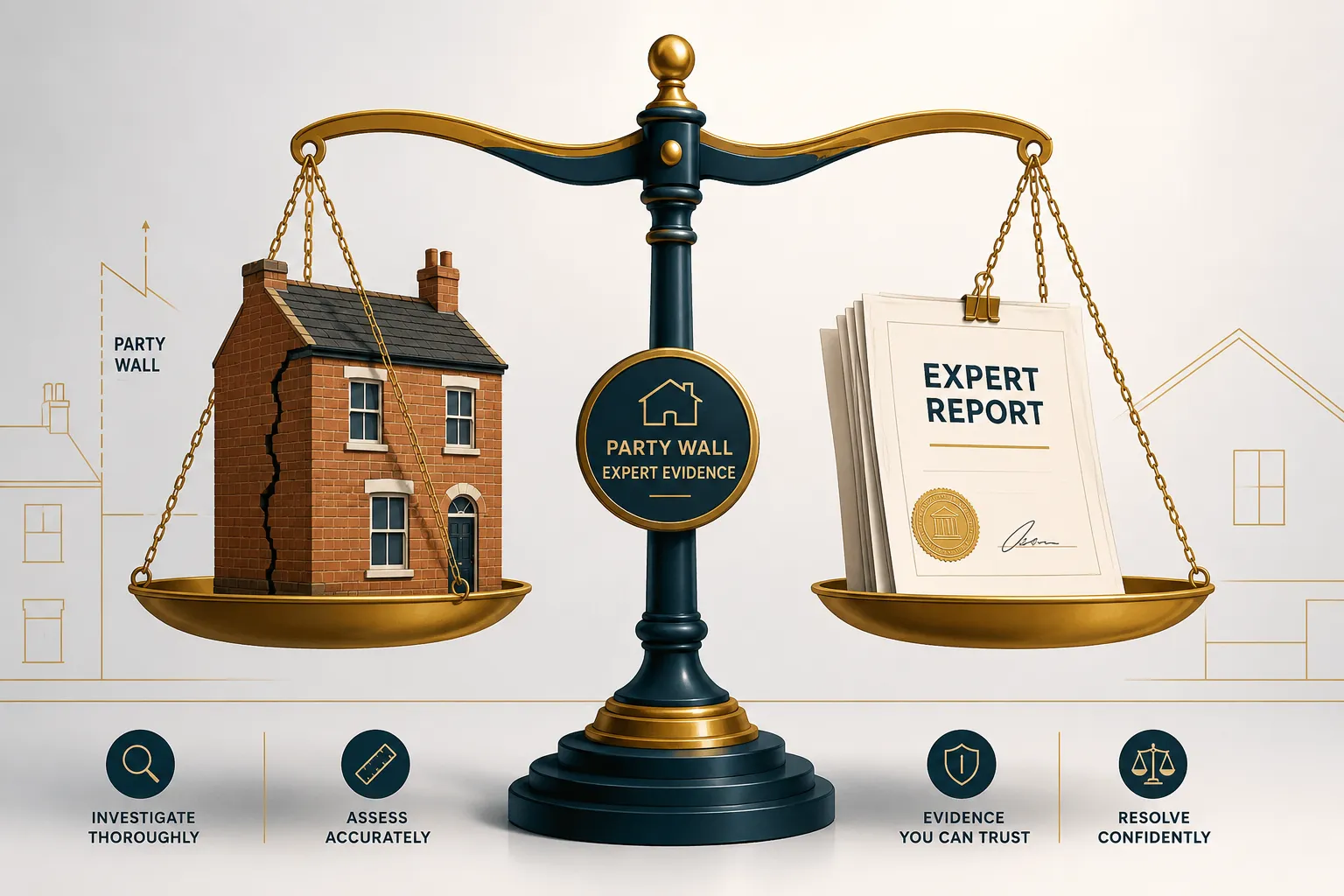
How to Prove Damage Was Caused by Party Wall Work and Not Pre-Existing
Proving causation is the central challenge in most party wall damage claims. The burden of proof rests on the adjoining owner to demonstrate that the damage was caused or materially worsened by the notifiable works.
The most effective tool is a pre-works schedule of condition. This is a detailed photographic and written record of the adjoining property's condition before any works begin. Without it, the building owner's surveyor will argue that any damage identified after works is pre-existing.
Steps to establish causation:
- Commission a schedule of condition before works start.
- Document any new damage promptly after works begin, with dated photographs.
- Obtain a structural engineer's report linking the damage pattern to the type of works carried out.
- Use crack monitoring data if movement is ongoing.
- Have an expert witness compare pre- and post-works conditions in a CPR Part 35-compliant report.
Expert witnesses must distinguish between three categories: pre-existing defects, pre-existing defects that were exacerbated by the works, and entirely new damage. Each category carries different compensation implications.
What Happens If Expert Valuations Disagree in a Party Wall Dispute
When two expert valuations disagree, the dispute follows a defined escalation path. The outcome depends on how far apart the figures are and whether the parties are willing to negotiate.
Escalation options:
- Third surveyor referral: Under the Party Wall etc. Act 1996, either party can refer a valuation dispute to the third surveyor. This is faster and cheaper than court.
- Mediation: Increasingly used in 2026 as a cost-effective alternative to litigation, particularly where the gap between valuations is not enormous.
- County court appeal: A party wall award can be appealed within 14 days of service. In court, a judge will weigh the competing expert reports and may appoint a single joint expert if the valuations are irreconcilable.
When expert reports conflict, courts look for methodological rigour. The report that clearly sets out its assumptions, uses verifiable comparable evidence, and demonstrates independence will carry more weight.
How Much Does It Cost to Dispute a Party Wall Valuation
The cost of disputing a party wall valuation varies significantly depending on the route taken and the complexity of the claim.
Indicative cost ranges (2026):
- Third surveyor referral: Typically £1,500 to £5,000 in surveyor fees, depending on complexity.
- Expert witness report: Specialist surveyors acting as expert witnesses command substantial hourly rates, reflecting both the demand for qualified experts and the complexity of CPR-compliant reporting.
- County court proceedings: Legal costs can reach £15,000 to £50,000 or more for a contested hearing, including solicitor and barrister fees.
- Mediation: Usually £1,000 to £3,000 per party for a half-day session.
For context on typical surveyor fee structures, the cost of a party wall surveyor guide covers the baseline costs before any dispute arises. The cost of a party wall agreement article is also useful for understanding the full financial picture.
Under the Party Wall etc. Act 1996, the building owner is generally responsible for the reasonable costs of the adjoining owner's surveyor. However, in disputed valuations, cost allocation can itself become contested.
Can You Appeal a Party Wall Award If You Disagree With the Valuation
Yes. A party wall award can be appealed to the county court within 14 days of service under Section 10(17) of the Party Wall etc. Act 1996. The court has wide powers to rescind or modify the award.
Grounds for appeal typically include:
- Jurisdictional error (the surveyors exceeded their powers under the Act).
- Procedural bad faith or bias.
- A valuation figure that is demonstrably unsupported by evidence.
- Failure to follow proper procedure in appointing surveyors.
After the 14-day window closes, the award becomes binding. Courts have occasionally allowed late appeals in exceptional circumstances, but this is not reliable. Anyone considering an appeal should act immediately and seek specialist advice. Understanding your party wall rights before the award is served is the best way to avoid being caught out by this deadline.
Common Mistakes People Make When Claiming Party Wall Damage
Several recurring errors undermine otherwise valid party wall damage claims.
Mistakes to avoid:
- No schedule of condition. The single most damaging omission. Without a pre-works record, causation becomes very difficult to prove.
- Delayed reporting. Waiting months to report damage allows the building owner to argue that other factors caused it.
- Accepting the first repair quote. A single low quote can anchor the valuation at an unrealistically low level.
- Instructing a surveyor with a conflict of interest. A surveyor who knows the building owner socially or professionally may not provide genuinely independent evidence.
- Confusing repair cost with diminution in value. In high-value properties, the market value impact of structural damage can exceed the physical repair cost.
- Missing the 14-day appeal window. Once it closes, options narrow considerably.
- Failing to document consequential losses. Temporary accommodation receipts, rental loss evidence, and business interruption records must be gathered contemporaneously.
When Should You Hire a Surveyor for Party Wall Valuation Disputes
Appoint a surveyor as early as possible, ideally before works begin rather than after damage has occurred. Early involvement allows the surveyor to establish a baseline condition record and monitor works as they progress.
Hire a specialist surveyor if:
- You have received a party wall notice and are concerned about the scope of proposed works.
- Damage has appeared during or after notifiable works.
- The building owner's surveyor is proposing a compensation figure you believe is too low.
- You are considering appealing a party wall award.
- The works involve basement excavation, underpinning, or significant structural alterations.
For guidance on whether a surveyor is needed and what they do, the do you need a party wall surveyor article covers the key decision points clearly.
Do You Need a Lawyer for Party Wall Valuation Disputes or Just a Surveyor
In most party wall valuation disputes, a specialist chartered surveyor is sufficient. The Party Wall etc. Act 1996 is designed to be administered by surveyors, and the third surveyor mechanism provides a built-in dispute resolution route without requiring legal representation.
A solicitor becomes necessary when:
- You are appealing an award to the county court.
- The building owner has carried out works without serving a valid notice (a trespass situation requiring injunctive relief).
- The financial value of the claim is high enough to justify the cost of litigation.
- There are allegations of fraud or bad faith that go beyond a valuation disagreement.
For most disputes, the surveyor-led process is faster, cheaper, and more proportionate. Bringing in solicitors prematurely can escalate costs and antagonise the other party unnecessarily.
What Types of Damage Are Hardest to Value in Party Wall Claims
Some categories of damage are consistently difficult to value because they involve subjective judgements, long-term consequences, or market uncertainty.
The hardest damage types to value:
- Diminution in market value. Buyers may discount a property that has suffered structural damage, even after full repair. Quantifying this "stigma" discount requires comparable sales evidence, which is rarely straightforward.
- Ongoing movement. If a property is still settling, the final repair cost cannot be known. Valuations must account for future remediation, which requires engineering projections.
- Damage to historic or period features. Replacing original cornicing, Victorian tiles, or bespoke joinery at modern trade rates rarely reflects the true cost of like-for-like reinstatement.
- Climate-related consequential losses. If works damage a property's flood defences or insulation, the resulting increase in insurance premiums or energy costs is difficult to capitalise into a single figure.
- Loss of amenity. Noise, dust, and disruption during prolonged remedial works are real losses but notoriously hard to quantify.
For properties where structural complexity is a factor, understanding what happens during a building inspection can help owners understand what surveyors are looking for and why certain damage types generate higher claims.
Frequently Asked Questions
What is the 14-day rule for party wall award appeals?
Under Section 10(17) of the Party Wall etc. Act 1996, any party wishing to appeal a party wall award must do so within 14 days of the award being served. After this window closes, the award becomes binding. Courts rarely grant extensions, so legal advice should be sought immediately if an appeal is being considered.
Can a party wall surveyor also act as an expert witness in the same dispute?
Technically yes, but courts in 2026 are scrutinising dual-role situations carefully. A surveyor who produced the original award may be seen as lacking independence, which can undermine the weight given to their expert evidence. An independent expert with no prior connection to the matter is strongly preferred.
Who pays for the expert witness in a party wall valuation dispute?
Under the Party Wall etc. Act 1996, the building owner generally bears the reasonable costs of the adjoining owner's surveyor. However, in contested disputes that proceed to court, cost allocation becomes a judicial decision and is not guaranteed to follow this default rule.
What is a schedule of condition and why does it matter?
A schedule of condition is a detailed photographic and written record of a property's state before notifiable works begin. It is the primary tool for proving that damage occurred as a result of the works rather than being pre-existing. Without one, causation claims become significantly harder to sustain.
How long does it take to resolve a party wall valuation dispute?
Resolution timelines vary. A third surveyor referral can take two to four months. Mediation typically resolves within one to three months of the parties agreeing to it. County court proceedings can take six to eighteen months or longer, depending on court availability and the complexity of the evidence.
What is the difference between reinstatement cost and diminution in value?
Reinstatement cost is the cost of physically repairing the damage to its pre-works condition. Diminution in value is the reduction in the property's market value that persists even after repair, often due to buyer perception or residual structural concern. In high-value areas, diminution in value can exceed the reinstatement cost.
Can I claim for temporary accommodation costs during party wall repairs?
Yes, if the damage caused by notifiable works renders part or all of the property uninhabitable, temporary accommodation costs can form part of the compensation claim. These must be documented contemporaneously with receipts and must be reasonable relative to the property's rental value.
Conclusion
Valuation disputes in party wall awards are among the most financially consequential and technically demanding situations a property owner can face. The gap between an initial damage estimate and a fully evidenced compensation claim can be substantial, particularly in high-value areas where structural damage intersects with market sensitivity and evolving climate risk factors.
The key to a successful outcome on either side of a party wall dispute is preparation: a properly executed schedule of condition before works begin, prompt documentation of any damage that arises, and early instruction of a genuinely independent RICS-qualified surveyor. When claims do escalate, CPR Part 35-compliant expert evidence is not optional, it is the foundation on which any credible valuation argument is built.
Actionable next steps:
- If you have received a party wall notice, instruct a surveyor immediately and request a schedule of condition before works start.
- If damage has already occurred, document it thoroughly with dated photographs and obtain at least two contractor repair quotes.
- If you disagree with a compensation figure in an existing award, check the 14-day appeal window and seek specialist advice without delay.
- If a dispute is escalating toward court, instruct an independent expert witness with no prior involvement in the award process.
- For complex structural cases, consider whether mediation or third surveyor referral offers a faster and more cost-effective route than litigation.
For tailored advice on party wall matters, including valuation disputes and expert witness support, contact a chartered surveyor with specialist party wall experience.
Tags: party wall disputes, party wall award, valuation disputes, expert witness surveyor, party wall damage claims, CPR Part 35, schedule of condition, RICS surveyor, party wall act 1996, property damage valuation, party wall appeal, building owner rights