

Falls from baths and stairs account for more than 6,000 serious injuries annually in UK homes, yet until 2026 these hazards carried no mandatory remediation timeline in the private rented sector. That changes with Phase 2 of Awaab's Law, effective October 2026, which brings falls from baths, stairs, and level surfaces within the scope of mandatory landlord action under the Housing Health and Safety Rating System (HHSRS). For chartered surveyors and landlords alike, the practical question is no longer just one of safety compliance — it is one of money. Valuation adjustments for falling bath/stairs hazards under Awaab's Law: surveyor strategies for 2026 PRS are now a front-line concern for anyone assessing, buying, or holding rental property in England.
Key Takeaways
- Phase 2 of Awaab's Law (October 2026) mandates formal assessment and remediation of fall hazards — baths, stairs, and level surfaces — in all PRS properties.
- Unresolved Category 1 fall hazards under HHSRS can reduce a property's capital value by 8-12% through increased capitalisation rates.
- Surveyors must follow detailed documentation protocols: two photographs per defect, numerical measurements, and a structured summary table.
- Proactive condition surveys and HHSRS-style inspections are the most effective way for landlords to protect both compliance standing and asset value.
- Expert witness surveyors face heightened evidential scrutiny in Awaab's Law disputes, requiring precise, quantifiable hazard data.
What Awaab's Law Phase 2 Means for Fall Hazards in 2026 PRS
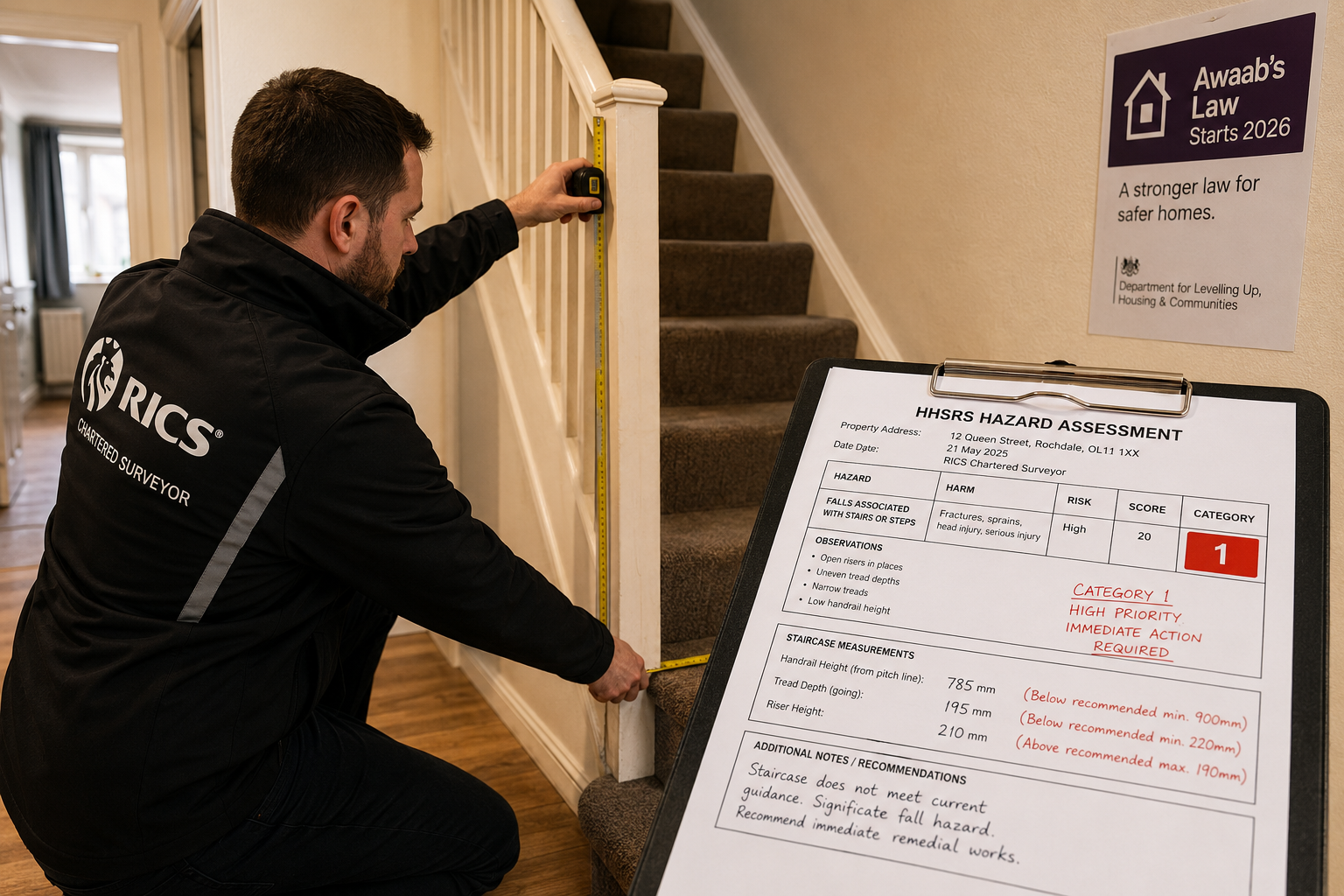
Awaab's Law was originally enacted in response to the death of two-year-old Awaab Ishak, who died from prolonged exposure to mould in a social housing property. Phase 1 focused on damp and mould. Phase 2, taking effect in October 2026, significantly broadens the scope to include falls associated with baths, stairs, and level surfaces — hazards that HHSRS has long classified but which lacked the same enforcement urgency [1].
Under the extended framework, landlords in the private rented sector must:
- Investigate reported fall hazards within a defined timeframe
- Begin remediation works within a prescribed period after investigation
- Complete emergency repairs to Category 1 fall hazards within 24 hours where there is imminent risk
Surveyors are now required to integrate HHSRS fall hazard assessments into standard building inspections for PRS properties. This means evaluating the likelihood of harm, the probable severity of outcomes, and the vulnerability of occupants — including elderly tenants, young children, and those with mobility impairments [6].
What counts as a fall hazard under HHSRS?
| Hazard Type | Common Defects | HHSRS Category |
|---|---|---|
| Stairs | Inadequate handrails, uneven treads, poor lighting | Category 1 or 2 |
| Baths/Wet Rooms | Absence of grab rails, slippery surfaces, step-in height | Category 1 or 2 |
| Level Surfaces | Uneven flooring, loose carpets, threshold lips | Category 1 or 2 |
A Category 1 designation triggers mandatory landlord action and, critically, creates a documented liability trail that directly affects how a surveyor must value the asset.
For landlords and investors seeking a thorough understanding of how physical condition intersects with market value, reviewing the key factors that affect property valuation is a useful starting point before commissioning any compliance-focused inspection.
Surveyor Documentation Protocols for Bath and Stair Fall Hazards
Proper documentation is the backbone of defensible valuation adjustments for falling bath/stairs hazards under Awaab's Law: surveyor strategies for 2026 PRS depend on it. The standard has been raised considerably for 2026. Surveyors who rely on narrative descriptions alone will find their reports challenged in both landlord-tenant disputes and expert witness proceedings.
Minimum documentation requirements per defect [2]:
- At least two photographs: one contextual shot showing the hazard in its wider setting, and one close-up showing the specific defect
- Numerical measurements, including handrail heights (the UK standard is 900mm to 1000mm for domestic stairs), tread depths, nosing projections, and step riser heights
- A structured summary table covering: location, description, HHSRS category, recommended remedial action, priority timeline, and any vulnerability flags for the occupant profile
Why measurements matter beyond compliance
Numerical data transforms a qualitative observation into a quantifiable liability. A surveyor who notes "handrail present but low" provides little basis for cost forecasting. A surveyor who records "handrail at 780mm, below the 900mm minimum, requiring replacement or extension" gives a landlord, lender, or court a precise remediation scope — and therefore a precise cost estimate.
This precision feeds directly into valuation methodology. When a Red Book valuation is required for a PRS asset, the surveyor must reflect identified hazards in the Special Assumptions or Special Conditions of the report, ensuring the figure presented is not misleadingly clean.
Recommended summary table structure:
| Field | Detail Required |
|---|---|
| Location | Room, floor level, specific fixture |
| Defect Description | Precise, measured, objective |
| HHSRS Category | 1 (mandatory action) or 2 (advisory) |
| Recommended Action | Specific works, not generic advice |
| Priority Timeline | Immediate / 28 days / routine |
| Vulnerability Flag | Elderly, child, mobility-impaired occupant |
Surveyors operating across Greater London should note that older housing stock — particularly Victorian and Edwardian terraces common in areas such as Chelsea and Hampstead — frequently presents stair configurations that predate modern dimensional standards, making thorough measurement protocols especially important.
Valuation Adjustments for Falling Bath/Stairs Hazards Under Awaab's Law: Surveyor Strategies for 2026 PRS
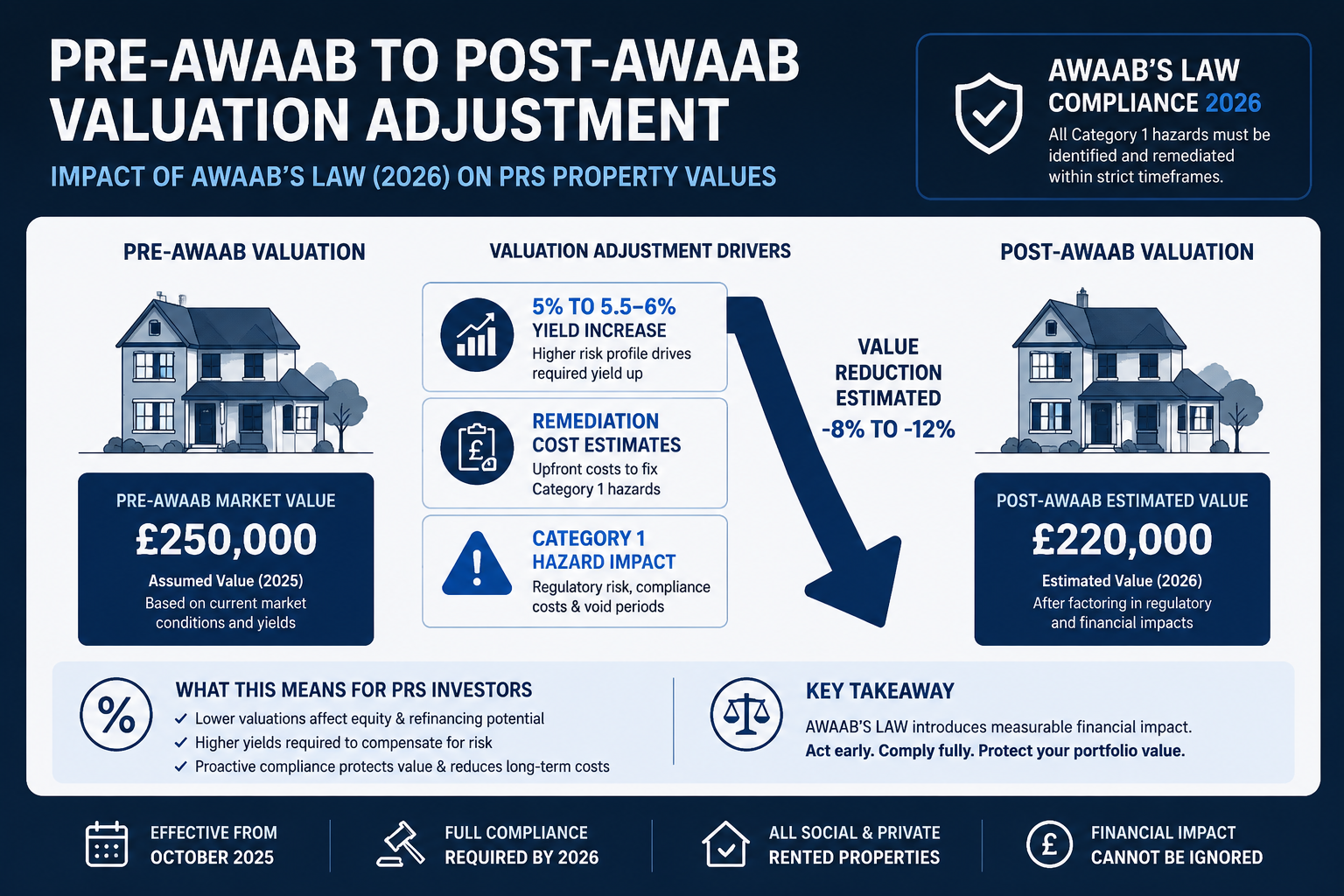
This is where regulatory compliance and financial analysis converge. The presence of unresolved fall hazards does not merely create a legal risk — it creates a measurable reduction in asset value that surveyors must be equipped to quantify and explain.
How Capitalisation Rates Are Affected
The introduction of Awaab's Law and the broader Renters' Rights Act 2026 framework has pushed capitalisation rates upward for PRS properties carrying unresolved HHSRS hazards. Research indicates that a property previously assessed at a 5% yield may now attract a 5.5% to 6% yield when Category 1 fall hazards are present and unresolved, representing a potential reduction in capital value of 8-12% [4].
This adjustment reflects several compounding risks:
- Direct remediation costs: Stair rectification (handrail replacement, tread resurfacing, lighting upgrades) typically ranges from £500 to £3,500 depending on scope and access
- Rental income reduction: A property with a known Category 1 hazard may be unlettable pending remediation, creating void period risk
- Regulatory compliance costs: Surveyor fees, contractor management, and re-inspection costs add to the total liability
- Compensation exposure: Tenants who suffer falls in properties with documented hazards have a strengthened basis for personal injury claims
- Insurance implications: Insurers are beginning to price PRS policies with reference to HHSRS compliance status, and unresolved Category 1 hazards may void certain policy provisions [9]
Applying the Adjustment in Practice
Surveyors should approach valuation adjustments for falling bath/stairs hazards under Awaab's Law using a structured, defensible methodology:
- Identify and categorise all fall hazards using HHSRS scoring, noting likelihood of harm and spread of outcomes
- Obtain or estimate remediation costs using current contractor rates and schedule of works
- Assess void period risk based on the severity of the hazard and the likely remediation timeline
- Apply a risk premium to the yield where hazards remain unresolved at the date of valuation
- Reflect the adjusted value in the report with a clear narrative linking each adjustment to the identified hazard
For portfolio valuations, this process must be applied property by property. A landlord holding ten properties where three carry unresolved Category 1 stair hazards faces a portfolio-level impairment that cannot be averaged away. Those commissioning capital gains tax valuations or freehold valuations for PRS assets should ensure their instructed surveyor is fully conversant with the Awaab's Law compliance picture before figures are agreed.
Party Wall Considerations During Remediation
When remediation works — such as stair reconfiguration or bathroom adaptation — are carried out near or against a party wall, additional obligations arise. Surveyors should prepare a Schedule of Condition for the adjoining property before works commence. This creates a baseline record that protects both the landlord and the neighbouring owner from disputed damage claims arising from the retrofit works [8].
Expert Witness Standards and Evidence in Awaab's Law Fall Hazard Disputes
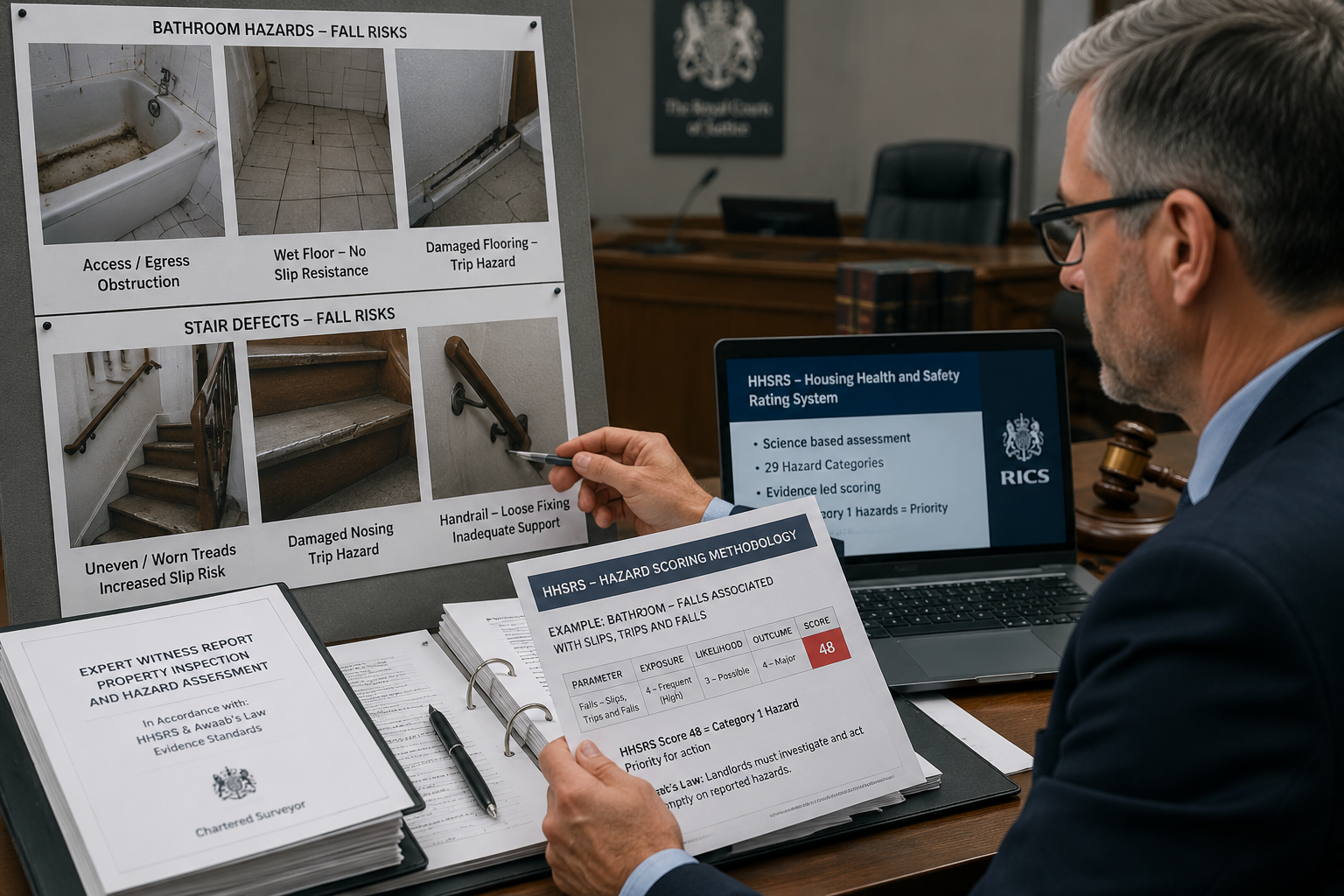
As Awaab's Law disputes reach tribunals and courts with greater frequency in 2026, the role of the expert witness surveyor has become both more prominent and more demanding. Courts are scrutinising not just the conclusions surveyors reach, but the methodology and evidence base behind them [5].
What Courts Expect from Expert Surveyors
An expert witness instructed on a fall hazard dispute — whether a tenant compensation claim, a landlord enforcement action, or a valuation challenge — must be able to demonstrate:
- Precise measurements taken at the time of inspection, with photographic corroboration
- HHSRS scoring methodology applied consistently and transparently, showing likelihood of harm, probable outcomes, and occupant vulnerability weighting
- Comparator evidence where valuation adjustments are contested, drawing on comparable properties with and without remediated hazards
- Independence and objectivity, with no financial interest in the outcome beyond the expert fee
"Courts are increasingly scrutinising the methodology and evidence presented in Awaab's Law hazard disputes. A surveyor whose report lacks numerical precision or photographic corroboration will find their evidence carries significantly less weight." [5]
Surveyors who also provide expert witness reports for property disputes should review their inspection protocols against the updated HHSRS evidence standards before accepting instructions in fall hazard cases.
Common Evidential Failures to Avoid
- Relying on tenant descriptions of hazards without independent measurement
- Failing to photograph defects at the time of inspection (photographs taken later may be challenged)
- Using generic cost estimates rather than itemised schedules of works
- Conflating Category 1 and Category 2 hazards in valuation adjustments, which overstates or understates the financial impact
- Omitting occupant vulnerability assessment, which is a formal component of HHSRS scoring and affects the hazard score materially
Proactive Strategies for Landlords and Surveyors in 2026
The most cost-effective response to Awaab's Law Phase 2 is not reactive compliance — it is proactive hazard identification before enforcement action is triggered. Landlords who commission condition surveys or HHSRS-style inspections now, before a tenant complaint is filed, gain several advantages [7]:
- They create a documented record of compliance efforts, which carries weight in any subsequent dispute
- They can prioritise remediation by severity, spreading costs over time rather than facing emergency repair demands
- They protect the investment value of their assets by addressing hazards before they are formally recorded as unresolved Category 1 defects
For landlords with properties in South West London, Surrey, or the Home Counties, working with locally experienced surveyors who understand both the regulatory framework and the specific housing stock is particularly valuable. Teams covering areas such as South West London and Surrey are well-positioned to deliver HHSRS-compliant inspections that serve both compliance and valuation purposes.
A practical pre-inspection checklist for landlords:
- Confirm handrail heights on all staircases (900mm to 1000mm required)
- Check stair tread depth (minimum 220mm under Building Regulations guidance)
- Assess bathroom grab rail provision for vulnerable occupants
- Inspect flooring for trip hazards: loose edges, threshold lips above 6mm, worn stair nosings
- Review lighting levels on staircases (minimum 100 lux recommended at tread level)
- Document all findings with dated photographs before any works are carried out
Conclusion
Awaab's Law Phase 2 marks a genuine shift in how fall hazards must be treated in PRS properties — not as background maintenance issues, but as formally assessed, documented, and time-bound compliance obligations with direct financial consequences. For surveyors, the practical implications are clear: inspection protocols must be upgraded to meet the documentation standard, valuation reports must reflect the financial impact of unresolved hazards with precision, and expert witness work requires a level of evidential rigour that goes beyond narrative observation.
Actionable next steps for surveyors and landlords in 2026:
- Commission an HHSRS-style inspection of all PRS properties before October 2026 to establish a compliance baseline.
- Upgrade survey report templates to include the two-photograph requirement, numerical measurements, and the structured hazard summary table.
- Where Category 1 fall hazards are identified, obtain itemised remediation cost estimates immediately and reflect these in any current or forthcoming valuation.
- For properties near party walls, prepare a Schedule of Condition before remediation works begin.
- Review expert witness report templates against the updated HHSRS evidence standards if instructed on fall hazard disputes.
- Engage a RICS registered valuer with specific PRS compliance experience for any Red Book valuation of a property with outstanding fall hazards.
The cost of proactive compliance is measurable and manageable. The cost of unresolved Category 1 fall hazards — in capital value reduction, compensation exposure, and regulatory penalty — is considerably higher.
References
[1] Awaabs Law Phase 2 Changes 2026 – hazardclock.co.uk
[2] Building Surveys For Bath Stair And Fall Hazards Under Awaabs Law 2026 Level 3 Protocols For Rental Property Compliance – wimbledonsurveyors.com
[3] Valuing Buy To Let Properties In 2026 Lettings Surge Surveyor Strategies For Tenant Demand 2 – kingstonsurveyors.com
[4] Valuing Buy To Let Portfolios Under New Prs Ombudsman Rules Surveyor Checklists For 2026 Dispute Risks – kingstonsurveyors.com
[5] Expert Witness Challenges In Awaabs Law 2026 Hazard Extensions Evidence Standards For Excess Cold Falls And Fire Risks – wimbledonsurveyors.com
[6] Awaabs Law 2026 Extensions Building Surveyors Guide To Assessing Excess Cold Fire And Electrical Hazards In Prs Properties – canterburysurveyors.com
[7] Awaabs Law Phase 2 October 2026 Hhsrs Hazards What Private Landlords And Surveyors Must Do Now – canterburysurveyors.com
[8] Party Wall Implications For Stair And Bath Fall Hazard Retrofits Awaabs Law 2026 Survey Protocols – nottinghillsurveyors.com
[9] Expert Witness Challenges In Awaabs Law 2026 Disputes Testifying On Expanded Hazards In Rental Valuations – manchestersurveyors.com
[10] Valuing Fire And Electrical Hazard Remediation Under Renters Rights Act 2026 Surveyor Adjustments For Prs Properties – wimbledonsurveyors.com
How Prince Surveyors can help: explore our property valuations or learn about our which survey you need.