

Only 23% of residential portfolio transactions above £1 million proceed at the originally agreed purchase price — the remainder are renegotiated or collapse entirely after independent surveyor scrutiny exposes gaps between agent-led narratives and documented market evidence [2]. That single statistic defines why valuation accuracy for professional landlord portfolios: surveyor tactics in 2026's institutional buy-to-let boom has become one of the most consequential disciplines in UK property investment today.
Institutional landlords now control approximately 5% of the UK's private rented sector, a share that is rising sharply as smaller landlords exit under mounting tax and regulatory pressure [1]. The capital flowing into large-scale buy-to-let is significant, and the margin for valuation error is correspondingly narrow. Surveyors who serve this market are not simply providing a number — they are constructing a defensible, evidence-based case that underpins financing, portfolio strategy, and long-term yield performance.
Key Takeaways
- Institutional landlords are rapidly expanding their share of the UK private rented sector, making rigorous portfolio valuation more critical than ever in 2026.
- Surveyors use two primary frameworks — comparable evidence and yield-based analysis — and must know when to apply each.
- Automated Valuation Models carry significant risks for high-value portfolios, often anchoring to outdated transaction data.
- Five specific risk factors consistently depress portfolio valuations, and surveyors have developed structured protocols to address each.
- Post-acquisition management, including annual valuations and periodic condition assessments, is now standard practice for institutional operators.

Why the Institutional Buy-to-Let Boom Demands Stronger Valuation Frameworks
The structural shift in the UK rental market is not a short-term cycle. Regulatory changes — including mortgage interest relief restrictions, increased stamp duty surcharges, and the phased rollout of the Renters' Rights Act — have made small-scale landlordship less financially viable. Institutional operators, by contrast, can absorb compliance costs across large portfolios and benefit from economies of scale in management and financing.
This concentration of ownership raises the stakes for every valuation instruction. A single portfolio assessment may cover dozens of properties across multiple local authority areas, each with different planning conditions, tenancy structures, and market dynamics. The surveyor's role has evolved from transactional to strategic.
In early 2026, the Royal Institution of Chartered Surveyors (RICS) released a draft code of practice for residential stock condition surveys, specifically designed to standardise methodologies for large-scale portfolio assessments [1]. This followed the publication in late 2025 of the second edition of RICS's professional standard on the valuation of buy-to-let and HMO properties, which directly acknowledges the major shift towards professional landlords in the UK housing market [7].
For surveyors and their institutional clients alike, these developments signal a clear direction: standardised, evidence-led, and defensible valuation practice is now the baseline expectation, not a premium offering.
The Limits of Agent-Led Valuations
Estate agents serve a legitimate function in the market, but their valuations are inherently optimistic — they are incentivised by transaction completion. For institutional buyers acquiring portfolios at scale, relying on agent-led figures without independent verification is a material risk. The 77% renegotiation or collapse rate for £1m+ portfolio transactions [2] is a direct consequence of this gap.
Professional surveyors provide something fundamentally different: an independent opinion of market value supported by documented comparable evidence, condition assessment, and yield analysis. For institutional lenders, this independence is non-negotiable.
The Two Core Valuation Frameworks: Comparable vs Yield Basis
Surveyors working on high-value residential portfolios employ two primary methodologies, and the choice between them is not arbitrary [2] [3].
Comparable Basis Valuation
The comparable basis relies on recent sales of genuinely similar properties in the same or closely related market areas. For this method to hold weight, surveyors must:
- Identify transactions within an appropriate time window (typically 6-12 months, adjusted for market velocity)
- Apply rigorous adjustments for differences in size, condition, specification, and location
- Distinguish between open market sales and distressed or related-party transactions
- Verify data through Land Registry records rather than relying solely on portal listings
The comparable basis works well for standard residential units where there is sufficient transactional evidence. It becomes problematic in thin markets, for unusual property types, or where recent sales are dominated by new-build premiums that do not reflect the resale value of existing stock.
Yield Basis Valuation
The yield basis assesses market rents against capitalisation rates that reflect asset quality, location risk, and prevailing investor appetite. This approach is particularly relevant for:
- HMO properties with six or more tenants, which RICS guidance treats as commercial assets valued on net operating income [4] [7]
- Portfolios where rental income is the primary driver of value
- Properties in locations with limited comparable sales evidence
The yield calculation requires surveyors to establish both a supportable market rent and an appropriate yield. Both inputs carry risk. Rents must be verified against actual tenancy agreements and local market evidence, not simply accepted from landlord-provided schedules. Yields must reflect current investor sentiment, not historic benchmarks that may no longer apply.
A critical nuance: smaller HMOs (up to six tenants) are typically valued as standard residential properties with rent assessed per room, while larger HMOs shift to a commercial valuation framework [4]. Misclassifying a property between these categories is a common source of valuation error in portfolio assessments.
For landlords seeking to understand how capital gains tax implications interact with portfolio valuations, the choice of methodology can also affect the figures used in tax calculations — making accuracy doubly important.
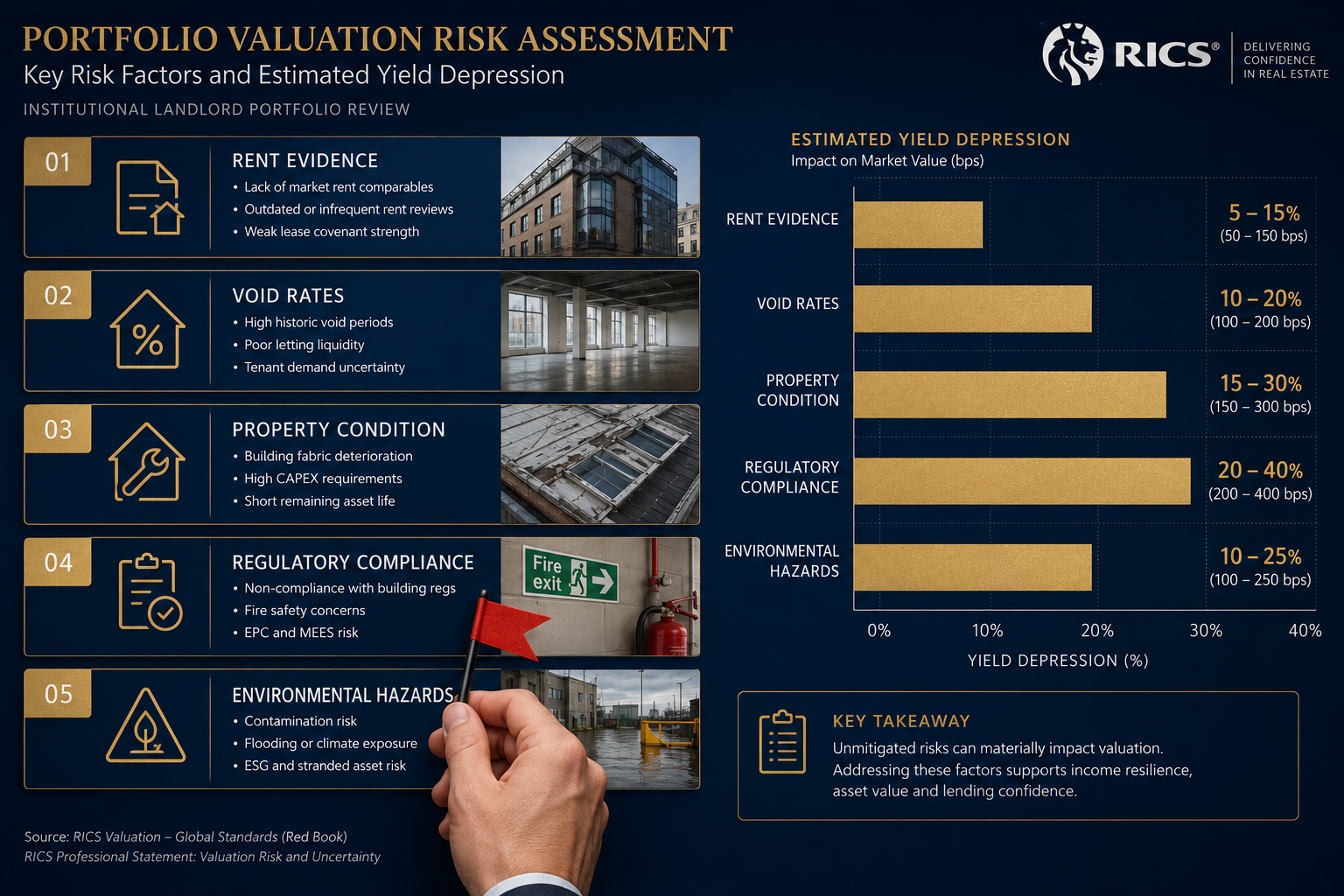
Surveyor Risk Assessment Protocols: The Five Valuation Depressors
Surveyors working on institutional portfolios have identified five recurring factors that consistently depress valuations when left unaddressed [3] [5]. Understanding these factors allows professional landlords to prepare more effectively for formal assessment.
| Risk Factor | Typical Impact | Surveyor Response |
|---|---|---|
| Weak or unverifiable rent evidence | Yield basis undermined | Request tenancy schedules, cross-reference market rents |
| Unexplained voids and arrears | Income reliability questioned | Analyse void history, assess management quality |
| Poor condition relative to comparables | Comparable adjustments applied | Full condition survey, cost-to-cure estimates |
| Regulatory compliance failures | Lender restrictions triggered | EPC ratings, HMO licensing, fire safety checks |
| Environmental hazards | Blight adjustments or exclusions | Flood risk, contamination, Japanese knotweed |
Rent Evidence and Void Analysis
Surveyors cannot simply accept a landlord's rent roll at face value. Rent schedules must be cross-referenced against actual tenancy agreements, and any discrepancies between headline rents and passing rents require explanation. High void rates — even if temporary — signal management or demand issues that a prudent buyer would price into an offer.
Regulatory Compliance as a Valuation Factor
The regulatory environment for rental properties in 2026 is substantially more demanding than it was five years ago. Energy Performance Certificate (EPC) ratings, HMO licensing requirements, and fire safety obligations all have direct valuation implications. A property that fails to meet Minimum Energy Efficiency Standards (MEES) may be unlettable without remediation, which must be reflected in the valuation. Surveyors should review the EPC and MEES implications for building surveys as part of standard portfolio due diligence.
For portfolios containing blocks of flats or managed buildings, fire risk assessments and health and safety inspections form an essential part of the compliance picture that feeds directly into valuation.
The AVM Problem
Automated Valuation Models have become widely used in mortgage processing, but their limitations are acute for institutional portfolios. In 2026, AVMs have been observed lagging behind real market conditions, frequently overestimating values by anchoring to outdated transaction data [3]. This creates funding gaps when lender valuations based on AVM outputs are subsequently challenged by independent surveyors.
"AVMs process historical data efficiently, but they cannot assess condition, compliance status, or the quality of tenancy management — the very factors that determine whether a portfolio performs at, above, or below market yield."
For high-value portfolios, AVM outputs should be treated as a starting point for analysis, not a substitute for professional judgment.
Standardisation, Quality Assurance, and the RICS Framework
Institutional clients have a fundamentally different expectation of surveying services than individual property buyers. They require consistency across multiple properties and multiple survey engagements — a standard that demands systematic quality assurance from surveying firms [5].
Leading practices in 2026 include:
- Standardised inspection checklists aligned with RICS guidance, ensuring no material element is omitted across a large portfolio
- Peer review processes where a second qualified surveyor reviews the primary valuation before it is issued
- Continuous professional development requirements, particularly around evolving regulatory standards and emerging property types
- Panel arrangements that give institutional clients consistent valuation standards and preferential pricing for volume instructions [6]
Selecting a surveyor with appropriate RICS qualifications, demonstrable buy-to-let experience, and genuine local market knowledge is not simply good practice — it is a prerequisite for lender acceptance on most institutional financing arrangements [6].
For portfolios concentrated in specific regions, local expertise matters significantly. Surveyors with deep knowledge of sub-markets — whether in South East London, Bromley, or Sussex — bring comparable evidence and yield benchmarks that a generalist surveyor operating outside their core area simply cannot replicate.
Professional Indemnity and Liability
Given the financial stakes in institutional portfolio valuations, professional indemnity insurance coverage has become a material consideration in surveyor selection. Firms serving this market are maintaining coverage limits calibrated to client portfolio values, with retroactive coverage and increasingly, cyber liability protection for digitally held valuation data [5]. Institutional clients should verify PI coverage as part of their surveyor appointment process.

Ongoing Portfolio Management: Valuation Beyond Acquisition
Valuation accuracy for professional landlord portfolios does not end at acquisition. The most sophisticated institutional operators treat ongoing valuation and condition assessment as a continuous management discipline rather than a transactional event [6].
Standard post-acquisition protocols in 2026 include:
- Annual portfolio valuations to track asset performance, support refinancing, and inform disposal decisions
- Periodic condition assessments every 3-5 years to identify capital expenditure requirements before they become urgent or dangerous
- Regulatory compliance audits aligned with the evolving legislative landscape
For landlords managing large residential blocks, understanding how often rental units should be inspected is fundamental to maintaining both asset condition and valuation integrity.
Annual valuations also serve a tax planning function. For portfolios held within SIPPs or other pension structures, SIPP pension valuations must meet specific HMRC requirements, and accuracy here has direct financial consequences. Similarly, annual tax valuations for properties subject to ongoing tax obligations require the same standard of evidence-based methodology applied to acquisition assessments.
Insurance Reinstatement: The Overlooked Valuation
One area where institutional portfolios frequently carry unquantified risk is insurance reinstatement. Market value and reinstatement cost are entirely different figures, and a portfolio that is correctly valued for acquisition purposes may be severely under-insured if reinstatement costs have not been independently assessed. Insurance reinstatement cost valuations should form part of every institutional portfolio's ongoing management programme.
Practical Steps for Professional Landlords Preparing for Portfolio Valuation
The following checklist summarises the preparation steps that consistently improve valuation outcomes for institutional landlords:
Documentation
- Compile verified tenancy schedules with actual passing rents, lease start and end dates, and deposit details
- Prepare void history for each property over the preceding 24 months
- Gather all current EPC certificates and note any properties below the required rating
- Confirm HMO licensing status for all qualifying properties
Condition
- Commission pre-valuation condition assessments for properties that have not been formally surveyed within the past three years
- Address any urgent or dangerous building issues before the formal valuation instruction
- Document recent capital expenditure with receipts and contractor details
Compliance
- Confirm fire safety compliance for all multi-occupancy properties
- Verify that all properties meet current MEES requirements or have a compliant exemption in place
- Review planning use class for any properties operating as HMOs
Surveyor Engagement
- Select surveyors with RICS qualifications and demonstrable portfolio valuation experience
- Establish a panel arrangement for volume instructions to ensure consistency
- Brief surveyors fully on portfolio strategy, financing requirements, and any known issues
Conclusion
The convergence of institutional capital, tightening regulation, and more demanding lender requirements has made valuation accuracy for professional landlord portfolios: surveyor tactics in 2026's institutional buy-to-let boom a genuinely specialist discipline. The days when a desktop AVM or an agent's opinion could underpin a major portfolio transaction are effectively over.
For professional landlords and institutional investors, the actionable priorities are clear:
- Engage RICS-qualified surveyors with specific portfolio and buy-to-let experience before any acquisition above £500,000.
- Prepare comprehensive, verified documentation — rent schedules, void histories, compliance certificates — before the valuation instruction is placed.
- Understand which valuation methodology applies to each property type in the portfolio, particularly for HMOs above and below the six-tenant threshold.
- Build ongoing valuation and condition assessment into portfolio management rather than treating it as a one-time acquisition cost.
- Verify insurance reinstatement values independently from market valuations to eliminate under-insurance risk.
The surveyors who will define best practice in this market are those who combine rigorous RICS-aligned methodology with genuine local market knowledge, robust quality assurance processes, and the professional indemnity coverage to stand behind their opinions. For institutional landlords, engaging that calibre of professional is not an overhead — it is a core component of yield optimisation.
References
[1] Building Surveys For 2026 Institutional Buy To Let Expansion Rics Checklists Beyond Residential Recovery – wimbledonsurveyors.com
[2] Surveyor Valuation Frameworks For 1m Residential Portfolios Evidence Based Strategies Beyond Agent Hype – canterburysurveyors.com
[3] Surveyor Valuation Frameworks For 1m Residential Portfolios Yield Vs Comparable Evidence In 2026 Markets – wimbledonsurveyors.com
[4] Valuing Buy To Let Properties In 2026 Surveyor Strategies Amid Institutional Landlord Surge And Tax Pressures – Valuing buy to let properties in 2026 surveyor strategies amid institutional landlord surge and tax pressures
[5] Institutional Buy To Let Surge Building Surveyors Risk Assessment Protocols For Professional Landlord Portfolios – kingstonsurveyors.com
[6] Buy To Let Valuation Surge 2026 Survey Strategies For Institutional Investors In A Recovering Market – nottinghillsurveyors.com
[7] Valuation of Buy-to-Let and HMO Properties 2nd Edition – rics.org