

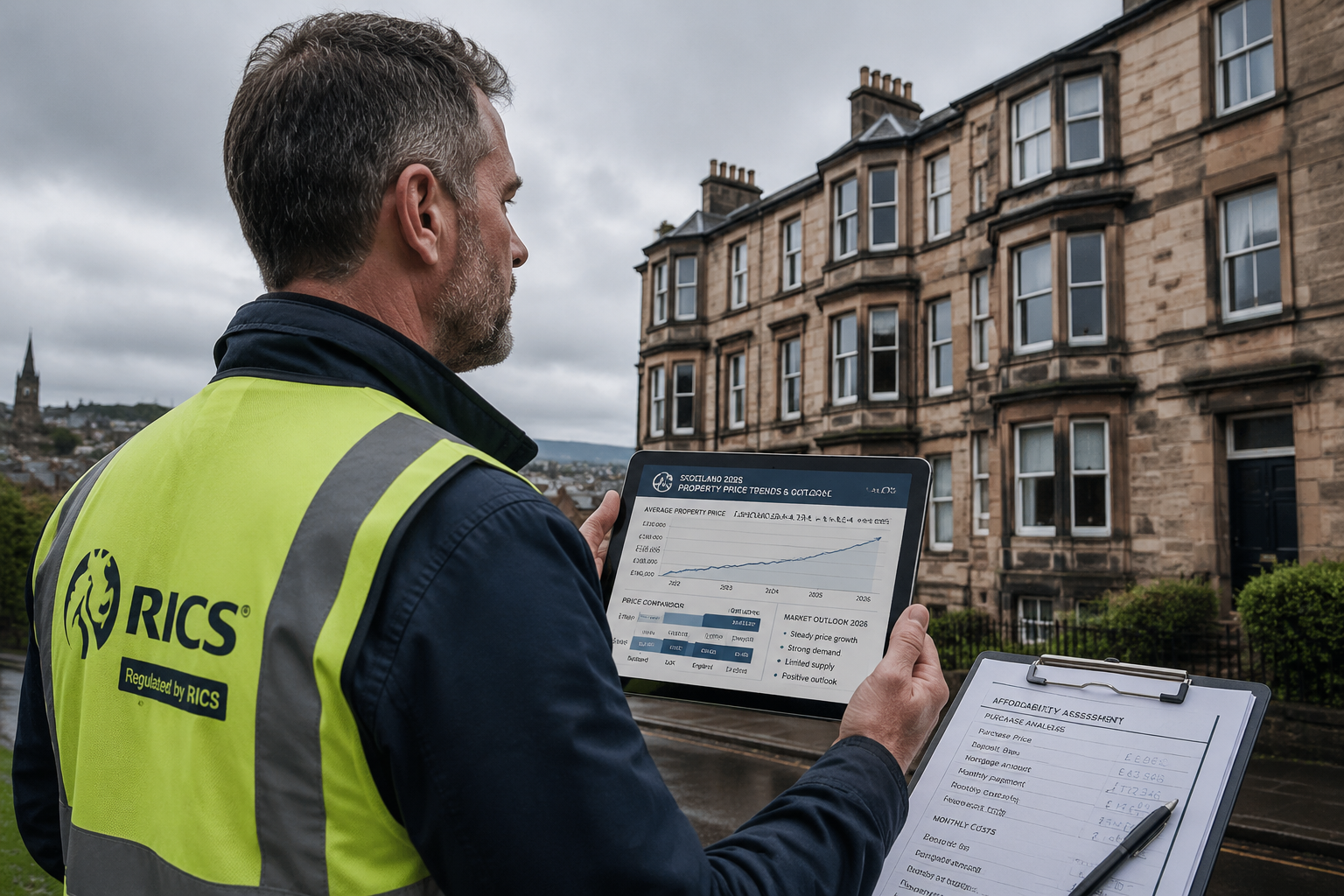
Scotland's housing market recorded a net balance of +42% of surveyors reporting rising house prices in early 2026 — the strongest reading since early 2025 and a stark contrast to the UK-wide balance of -10% recorded in January 2026 [1]. That divergence is not a footnote. It is the defining pressure point for first-time buyers entering Scottish property in 2026, and it makes valuation accuracy for first-time buyers in Scotland's price boom: RICS strategies for 2026 affordability checks not just a technical concern but a financial survival skill.
Southern buyers priced out of London and the South East are increasingly looking north, drawn by comparatively lower entry prices and stronger economic momentum. But a market rising faster than the national average demands rigorous, professionally grounded valuations — not optimistic guesswork or automated estimates.
Key Takeaways
- Scotland's house prices rose 6.6% for first-time buyers between December 2024 and November 2025, outpacing the broader UK market.
- RICS surveyors are applying tighter comparable evidence windows and time-adjusted data to keep appraisals accurate in a fast-moving market.
- Hyper-local intelligence — street-level transaction data — is now essential for reliable valuations in Scotland's divergent micro-markets.
- The updated RICS ESG standard (effective April 2026) requires sustainability factors to be embedded in all formal appraisals.
- Accurate RICS valuations empower first-time buyers to negotiate price reductions of 5–10% and validate affordability before committing.
Why Scotland's Price Boom Creates Unique Valuation Challenges
The Scale of First-Time Buyer Price Growth
Between December 2024 and November 2025, average first-time buyer prices in Scotland rose by £9,868 — a 6.6% increase that surpassed the £6,925 gain recorded in the previous year and broadly matched the overall Scottish housing market's 6.2% growth [2]. For a buyer stretching to meet a deposit threshold, a valuation that lags even three months behind current market conditions can mean the difference between mortgage approval and a shortfall.
The challenge is compounded by regional divergence within Scotland itself. Edinburgh's New Town commands entirely different dynamics from Dundee's waterfront regeneration zones or rural Perthshire. A single national benchmark figure is almost meaningless at street level.
"Scotland's outperformance is not uniform — it is a patchwork of micro-markets, each requiring its own evidentiary foundation for a defensible valuation."
This is precisely why the principles of valuation accuracy for first-time buyers in Scotland's price boom demand location-specific methodology rather than broad-brush estimates.
How Scotland Compares to the Rest of the UK
| Region | House Price Balance (Early 2026) | Market Trend |
|---|---|---|
| Scotland | +42% net surveyor balance | Strong growth |
| Northern Ireland | Positive | Resilient |
| UK Average | -10% | Declining/flat |
| London & South East | Negative | Stagnation/modest decline |
Source: RICS survey data, early 2026 [1]
This table illustrates why location-specific valuation approaches are no longer optional. Applying a UK-average methodology to a Scottish property in 2026 risks systematic undervaluation — a serious problem for lenders and buyers alike [1].
RICS Strategies Driving Valuation Accuracy for First-Time Buyers in Scotland's Price Boom
Tighter Comparable Evidence Windows
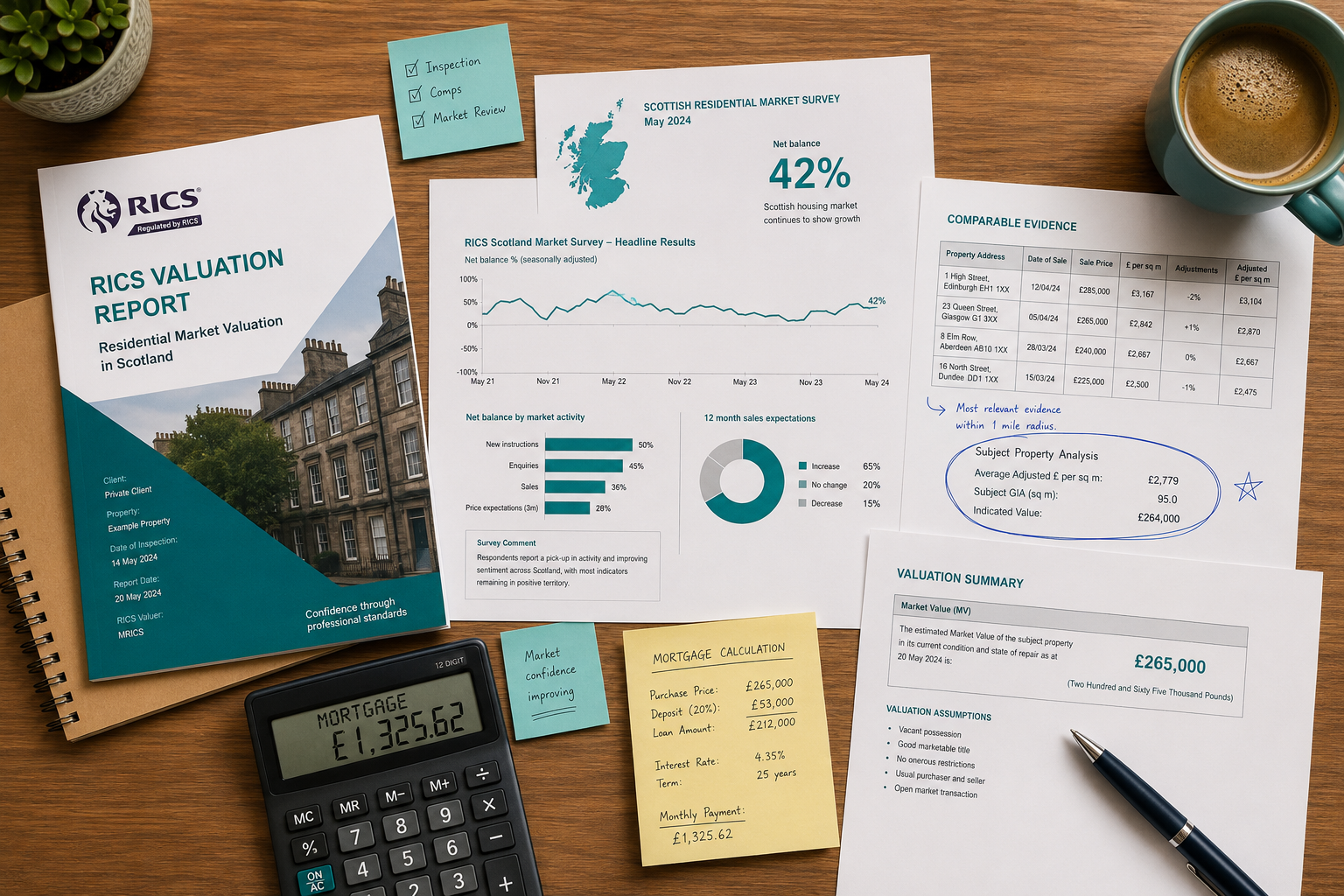
In a rising market, stale comparables are dangerous. RICS surveyors operating in Scotland in 2026 have adopted tighter windows for comparable evidence — typically limiting analysis to transactions completed within the past three months rather than the conventional six-month period [4]. This adjustment ensures that the valuation reflects current market sentiment rather than a price level that has already been surpassed.
When selecting comparables, surveyors are prioritising:
- Recent arm's-length transactions within the immediate postcode
- Properties with similar tenure, condition, and energy performance ratings
- Adjustments for time elapsed since each comparable sale, using explicit percentage uplifts where market evidence supports them
Understanding the full factors of valuation — from location and condition to tenure and market timing — is essential context for any first-time buyer commissioning a formal appraisal.
Hyper-Local Market Intelligence
Surveyors are moving beyond regional price indices and building detailed transaction databases at the micro-market level [5]. This means capturing:
- Street-by-street sale price variations within a single postcode district
- Days-on-market data as a leading indicator of demand pressure
- Listing-to-sale price ratios that reveal whether sellers are achieving, exceeding, or falling short of asking prices
This granular intelligence is particularly valuable in Scottish cities where a single postcode can span dramatically different property types, tenement blocks sitting alongside modern flatted developments, each with distinct buyer pools and price trajectories.
For first-time buyers, this level of detail in a RICS home survey or formal valuation report provides a defensible basis for both mortgage applications and purchase negotiations.
Explicit Time Adjustments in Appraisals
Where comparable transactions are unavoidably older than three months, RICS-compliant surveyors in Scotland are now applying explicit time adjustments — stated percentage corrections that account for the market movement between the comparable sale date and the valuation date [4]. These adjustments must be:
- Evidenced by market data, not assumed
- Disclosed transparently in the valuation report
- Reviewed against multiple data sources to avoid over-reliance on any single index
This practice protects both the lender and the first-time buyer from a valuation that looks rigorous on the surface but is anchored to an outdated price level.
Affordability Checks: What First-Time Buyers Must Understand in 2026
The Full Cost Picture
Affordability is not simply a question of whether the monthly mortgage payment fits within income multiples. RICS guidance emphasises that first-time buyers in 2026 must account for the full transaction cost stack [8]:
| Cost Item | Typical Range (2026) |
|---|---|
| Mortgage arrangement fee | £999 – £2,000 |
| RICS survey (Level 2 or 3) | £400 – £1,500+ |
| Solicitor/conveyancing fees | £1,000 – £2,500 |
| Land and Buildings Transaction Tax (Scotland) | Variable by price band |
| Removal costs | £500 – £2,000 |
| Initial repair/improvement budget | Property-dependent |
Buyers who focus solely on the headline purchase price and ignore these costs routinely find themselves financially stretched within weeks of completion.
A mortgage valuation is not the same as a survey — a point that cannot be overstated. The lender's valuation protects the lender's security interest. It does not identify defects, assess condition, or give the buyer negotiating leverage.
Mortgage Rate Improvements and Their Impact
By March 2026, mortgage rates had declined to approximately 4.5–5%, and housing stock in key first-time buyer areas had increased by 15–20% [3]. These twin developments have improved affordability metrics and given buyers greater negotiating power than they held in 2023–2024. However, the improvement is relative: in a market where first-time buyer prices have risen by nearly £10,000 in twelve months, the affordability gains from rate reductions can be quickly eroded by further price growth.
This is why a formal RICS valuation — rather than an automated valuation model (AVM) — remains the gold standard for affordability verification. AVMs aggregate historical data and struggle to capture the real-time sentiment shifts that characterise Scotland's current market [7].
How Accurate Valuations Support Scheme Eligibility
For buyers using government-backed purchase schemes, valuation accuracy carries additional weight. Help to Buy and shared ownership schemes in Scotland set eligibility thresholds and maximum property values based on formal RICS appraisals.
An inflated valuation can push a property above a scheme's eligible price ceiling, disqualifying the buyer. An undervaluation can create complications at redemption. Understanding how RICS Help to Buy valuations work — and how they differ from standard mortgage valuations — is essential preparation for any buyer relying on scheme support.
Similarly, buyers exploring shared ownership valuations need to understand that the initial share price, and any future staircasing costs, are directly tied to the accuracy of the underlying RICS appraisal.
ESG Integration and the April 2026 RICS Standard
What the New Standard Requires
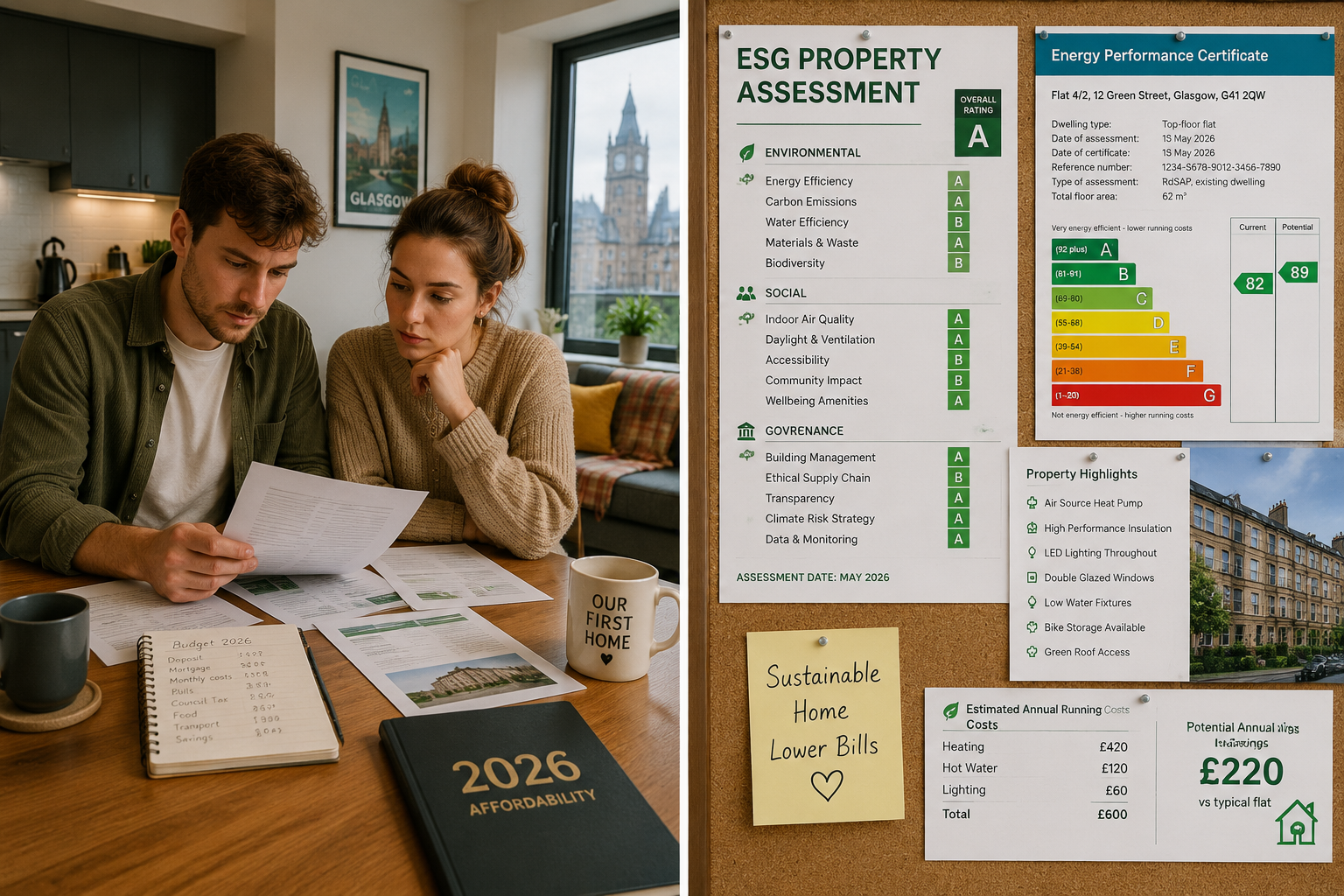
The updated RICS Environmental, Social, and Governance (ESG) standard, effective April 2026, requires valuers to incorporate ESG factors into all formal appraisals [6]. For residential properties, this primarily means:
- Energy Performance Certificate (EPC) ratings must be assessed for their impact on value and saleability
- Capital expenditure requirements for bringing a property to minimum energy efficiency standards must be disclosed
- Operational cost implications — heating, insulation, and utility costs — must be considered as part of the overall affordability picture
For first-time buyers in Scotland, this is highly relevant. Many of the most affordable properties in the market are older tenement flats and Victorian terraces with poor insulation and outdated heating systems. A property priced attractively on the headline figure may carry significant hidden costs once ESG factors are properly assessed.
Practical Implications for Buyers
An ESG-compliant valuation in 2026 will typically include:
- A commentary on the property's current EPC rating and its trajectory under proposed legislation
- An estimate of the cost to reach EPC Band C (the likely minimum standard for mortgage lending in the medium term)
- An assessment of whether any green mortgage products are available and how they affect the overall affordability calculation
Buyers commissioning a RICS Level 2 homebuyer survey should confirm with their surveyor that the report addresses ESG factors in line with the April 2026 standard, particularly if the property is pre-1970s construction.
Real-Time Surveyor Insights vs. Automated Valuation Models
Why Human Expertise Leads in a Volatile Market
The increased reliance on real-time insights from RICS-qualified surveyors over automated valuation models reflects a structural limitation of algorithmic tools [7]. AVMs are trained on historical transaction data. In a market where Scotland's price balance is running 52 percentage points above the UK average, historical data is a poor guide to current value.
RICS surveyors bring several capabilities that no algorithm currently replicates:
- Direct observation of property condition — identifying defects that reduce value but do not appear in Land Register data
- Interpretation of buyer sentiment — reading whether demand is accelerating or plateauing based on open day attendance and offer patterns
- Contextual judgment — understanding why two apparently identical flats on the same street command different prices
Accurate valuations identifying defects, market positioning, and comparable sales data empower first-time buyers to negotiate 5–10% reductions in asking prices [3].
That negotiating leverage is only available when the valuation is grounded in real-time, surveyor-led analysis — not an AVM output generated from eighteen-month-old transaction records.
Choosing a RICS-Registered Valuer
Not all surveyors are equal. First-time buyers should verify that their chosen professional is registered with the RICS and holds the appropriate qualifications for residential valuation work in Scotland. Key questions to ask include:
- How many comparable transactions have you analysed in this specific postcode in the last 90 days?
- Will the report include explicit time adjustments for any comparables older than three months?
- Does your methodology comply with the April 2026 RICS ESG standard?
- Will the valuation be suitable for mortgage purposes and, if applicable, scheme eligibility verification?
Understanding valuation costs upfront helps buyers budget accurately and avoid being surprised by fees that vary significantly based on property value, type, and report level.
Conclusion
Scotland's position as the UK's strongest-performing housing market in early 2026 creates both opportunity and risk for first-time buyers. The opportunity lies in a market with genuine demand fundamentals, improving mortgage conditions, and greater negotiating power than buyers have held in years. The risk lies in overpaying for a property whose true market value — adjusted for condition, energy performance, and hyper-local comparable evidence — is materially lower than the asking price.
Valuation accuracy for first-time buyers in Scotland's price boom: RICS strategies for 2026 affordability checks is the framework that bridges that gap. The actionable steps are clear:
- Commission a formal RICS valuation — not just a lender's mortgage valuation — before exchanging contracts.
- Verify that the surveyor uses tighter comparable evidence windows (90 days or less) appropriate to Scotland's rising market.
- Confirm ESG compliance with the April 2026 RICS standard, particularly for older properties.
- Use the valuation report as a negotiating tool — identified defects and market data can support price reductions of 5–10%.
- Account for the full transaction cost stack in affordability calculations, not just the headline purchase price.
- Avoid relying on automated valuation models in a market where human, real-time surveyor intelligence is demonstrably superior.
For buyers using government schemes, ensuring that Help to Buy valuations and shared ownership appraisals are conducted by RICS-registered professionals with current Scottish market knowledge is not optional — it is the foundation of a financially sound purchase decision in 2026.
References
[1] Valuation Strategies For Scotlands 2026 Housing Outperformance Rics Techniques Amid Regional Price Surge – kingstonsurveyors.com
[2] Why Affordability Is Key For The First Time Buyers Market – djalexander.co.uk
[3] Valuing First Time Buyer Properties In 2026 Rics Tactics Amid Improving Affordability And Supply – nottinghillsurveyors.com
[4] Valuing Stabilised National Prices In Early 2026 Rics Techniques From January Survey Insights – kingstonsurveyors.com
[5] Valuation Accuracy In Scotlands 2026 Property Market Outperformance Surveyor Strategies – wimbledonsurveyors.com
[6] Valuation Adjustments For Stabilising Prices Rics Techniques For Accurate Appraisals In Early 2026 Recovery – kingstonsurveyors.com
[7] Market Volatility And Valuation Accuracy Using Rics Real Time Surveyor Insights Over Automated Models In Q2 2026 – canterburysurveyors.com
[8] Valuing Stabilizing House Prices In A Buyers Market Rics Tactics For First Time Buyers In 2026 – nottinghillsurveyors.com
How Prince Surveyors can help: explore our property valuations or learn about our which survey you need.