

A party wall notice is a legal requirement in England and Wales if your construction work involves shared walls, boundary walls, or excavation near a neighbour’s property. This process is governed by the Party Wall etc. Act 1996, which ensures that property owners can carry out building work while protecting their neighbours’ rights. Here’s what you need to know:
- When to Serve a Notice: If constructing new walls on a boundary, altering shared structures, or excavating near neighbouring foundations.
- Notice Periods: 1 month for new boundary walls or excavations; 2 months for changes to shared structures.
- Key Details to Include: Names and addresses of property owners, description of the work, start date, and any relevant drawings.
- Failure to Comply: Skipping this step could lead to legal action, work stoppages, or liability for damages.
Neighbours have 14 days to respond, and disputes may require surveyors to resolve issues. Properly serving a notice ensures your project can proceed without unnecessary delays or legal complications. Always consider seeking professional advice to avoid errors and misunderstandings.
PARTY WALL ACT EXPLAINED | When and how to Serve a Party Wall Notice | BlackBeltBarrister
The Party Wall etc. Act 1996 Explained
The Party Wall etc. Act 1996 applies across England and Wales, providing a structured approach to handling disputes related to party walls, boundary walls, and nearby excavations. In effect since 1 July 1997, it covers all types of properties, including those owned by the Crown, government, or local authorities. However, Scotland and Northern Ireland operate under different systems for such matters. This Act lays out the rules for giving notice and resolving disputes.
The Act gives building owners specific legal rights to carry out works that might otherwise be considered trespass, while ensuring neighbours are protected through proper procedures and safeguards. As CBG Law notes:
“The purpose of the Act is to give a building owner a statutory right to carry out works which would otherwise be a nuisance or constitute trespass”.
Importantly, the Act operates independently of planning permissions and building regulations. Even if a project is approved under those systems, the requirements of the Party Wall Act still apply. To clarify the principles, the Ministry of Housing, Communities & Local Government explains:
“It is often helpful in understanding the principles of the Act if owners think of themselves as joint owners of the whole of a party wall rather than the sole owner of half or part of it”.
The term “owner” under the Act is broad, covering freeholders, leaseholders with leases over a year, individuals under a contract to buy, or those entitled to rents. This ensures that anyone with a legal interest in the property is notified and protected during construction.
The Act outlines three main types of work: building new walls at or near boundaries (Section 1), altering existing party structures (Section 2), and excavating within certain distances of neighbouring properties (Section 6). If a neighbour fails to respond to a notice within 14 days, the situation is automatically treated as a dispute. This activates the Act’s mandatory dispute resolution process, which involves appointing independent surveyors. These provisions form the foundation for serving and handling party wall notices effectively.
When You Need to Serve a Party Wall Notice
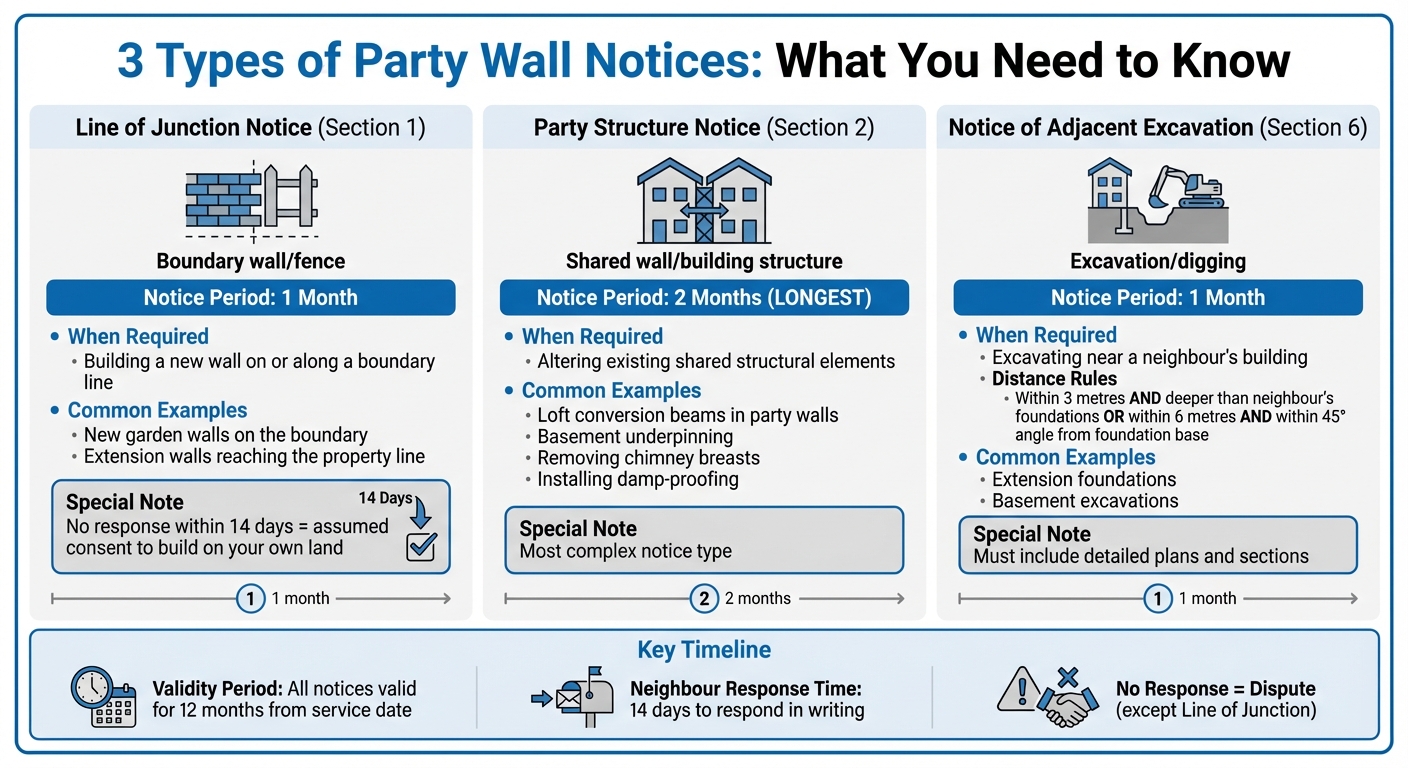
Party Wall Notice Types: Requirements and Timelines Guide
You need to serve a party wall notice if your planned construction involves building a new boundary wall, modifying a shared structure, or excavating close to a neighbour’s property. The Party Wall Act outlines three specific types of work that require a notice, each with its own rules and timelines. Routine tasks like plastering, adding electrical sockets, or putting up shelves are excluded from these requirements.
Line of Junction Notice
This notice applies when you’re constructing a new wall along a boundary line that either has no existing structure or only a boundary wall. You must issue this notice at least one month before starting the work.
You have two options: either build the wall astride the boundary (shared by both properties) or entirely on your side of the line. Typical examples include building a garden wall along the boundary or constructing an extension wall that reaches the property line.
If your neighbour doesn’t respond within 14 days to the Line of Junction notice, it is generally assumed they consent to you building the wall entirely on your own land. This approach is different from other notice types, where a lack of response usually leads to a formal dispute resolution process.
Next, let’s look at the rules for work involving shared structures.
Party Structure Notice
A Party Structure Notice is required if your project involves altering a shared structural element. You need to serve this notice at least two months before the planned start date.
Examples of works that fall under this category include loft conversions requiring support beams inserted into a party wall, basement construction with underpinning, or internal renovations like removing a chimney breast or installing damp-proofing. Even changes such as raising or thickening a party wall require this notice.
The Royal Institution of Chartered Surveyors (RICS) summarises the purpose of the Act as follows:
“The Act is designed to: enable owners to carry out works while protecting adjoining owner’s rights and avoiding unnecessary inconvenience”.
Notice of Adjacent Excavation
This notice is necessary if you plan to excavate near a neighbouring building, even if all the work happens on your land. You must serve a Notice of Adjacent Excavation at least one month before starting the excavation.
This applies if either:
- You are excavating within 3 metres of a neighbour’s property and digging deeper than their foundations (the 3-metre rule), or
- You are excavating within 6 metres, and part of your excavation falls within a 45-degree angle drawn downwards from the bottom of their foundations (the 6-metre rule).
Your notice should include detailed plans and sections showing the site layout, excavation depth, and the location of any proposed structures. This documentation helps your neighbour assess any potential impact on their property. Common scenarios include digging foundations for an extension or creating a basement within these statutory distances.
| Notice Type | Notice Period | Common Examples |
|---|---|---|
| Line of Junction | 1 Month | New garden walls, extension walls on the boundary |
| Party Structure | 2 Months | Loft conversion beams, underpinning, chimney removal |
| Adjacent Excavation | 1 Month | Extension foundations, basement excavations (3m/6m) |
Once you serve a notice, it remains valid for 12 months. If work doesn’t begin within that time, the notice expires, and you’ll need to serve a new one. This ensures neighbours aren’t left in limbo about when construction might start.
How to Prepare and Serve a Party Wall Notice
When preparing a party wall notice, it’s crucial to include all the required details outlined in the Party Wall etc. Act 1996. Missing any essential information could invalidate your notice, potentially causing delays or even legal issues. Here’s what you need to know to ensure your notice meets the necessary standards.
What to Include in a Party Wall Notice
A valid party wall notice must contain the following:
- The names and addresses of all building owners
- The property address
- A detailed description of the proposed work
- The intended start date of the work
The Act specifies:
“Before exercising any right conferred on him by section 2 a building owner shall serve on any adjoining owner a notice… stating – (a) the name and address of the building owner; (b) the nature and particulars of the proposed work… and (c) the date on which the proposed work will begin.”
For excavation work under Section 6, the notice must also include plans and sections showing the site and depth of the excavation and state whether you plan to underpin or strengthen your neighbour’s foundations. If the work involves special foundations (reinforced with metal), additional details such as plans, sections, construction information, and load specifications are required.
Although there’s no official template, your notice should be dated and clearly state that it is being served under the Party Wall etc. Act 1996.
Delivering a Party Wall Notice
After preparing the notice, you need to ensure it’s delivered correctly. There are three main methods:
- In person
- By post
- By email, but only if your neighbour has agreed to receive documents electronically and provided an email address
If you don’t know your neighbour’s name, address the notice to “The Owner” and either hand it to someone at the property or attach it to a visible part of the building.
It’s important to serve the notice to all “Adjoining Owners”, which includes freeholders and leaseholders with an interest in the property exceeding one year. If you’re unsure of the owner’s identity, you can check the Land Registry website, where the registered owner’s details are listed in the “Proprietorship Register”.
Notice Periods and Timing
The type of work you’re planning determines the notice period required:
- Line of Junction notices: At least one month
- Party Structure notices: Two months
- Adjacent Excavation notices: One month
Once served, your neighbour has 14 days to respond in writing. If they fail to respond to a Party Structure or Excavation notice within this time, a dispute is considered to have arisen, and surveyors will need to be appointed.
Notices must be served within 12 months of starting the work. Work cannot begin before the notice period ends unless your neighbour gives written consent for an earlier start date.
The Ministry of Housing, Communities & Local Government advises:
“If work starts without a notice being given, an adjoining owner can seek to stop the work through a court injunction or seek other legal redress.”
How Neighbours Can Respond to a Party Wall Notice
Once you serve a party wall notice, your neighbour has 14 days to reply in writing, which will determine the next steps you need to take.
Giving Consent
If your neighbour agrees in writing within the 14-day period, you can move ahead with the planned works once the notice period ends, and there’s no need to involve surveyors.
It’s wise for neighbours to request a Schedule of Condition to document the state of their property before work begins. If they don’t give immediate consent, they might issue a counter notice or simply fail to respond.
Counter Notices and Disputes
Neighbours can also issue a counter notice if they want adjustments or additional works that benefit their property. This must be done within one month of receiving your original notice. The counter notice needs to clearly outline the requested changes, including plans and specifications.
As GOV.UK explains:
“Your neighbour may have to meet a share of the cost… if they ask for additional works to be done that will benefit them.”
Once you receive a counter notice, you have 14 days to respond. Delays or disagreements can escalate into a dispute, requiring surveyors to step in. Both parties can agree to appoint a single, impartial surveyor to streamline the process and reduce costs. Typically, the building owner covers the surveyor fees for both sides.
| Response Option | Timeline | Next Steps | Who Pays |
|---|---|---|---|
| Consent | Within 14 days | Works proceed after the notice period; no Party Wall Award needed | No surveyor fees |
| Dissent | Within 14 days | Surveyors are appointed; Party Wall Award is prepared | Building owner pays all surveyor fees |
| Counter Notice | Within 1 month | Building owner has 14 days to respond | Costs may be shared if the works benefit the neighbour |
| No Response | After 14 days | Treated as dissent; a follow-up letter is sent | Building owner pays for the appointed surveyor |
When a Neighbour Doesn’t Respond
If your neighbour doesn’t reply within 14 days, you can’t assume they agree. GOV.UK clarifies:
“Your neighbours need to respond to the notice. You cannot assume that no response means they agree to the works.”
A lack of response is treated as dissent. In this case, you’ll need to send a follow-up letter, giving them an additional 10 days to appoint a surveyor. If they still don’t reply, you’re allowed to appoint a surveyor on their behalf to move forward with the project.
sbb-itb-b9291f4
Common Building Projects That Require Party Wall Notices
If you’re planning home improvements that involve shared walls, boundaries, or digging near a neighbour’s property, you’ll likely need to follow the rules set out in the Party Wall Act. Here are some common projects where these rules apply.
Loft Conversions and Extensions
Loft conversions often require a notice because they can involve cutting into a shared wall to fit beams, removing a chimney breast, or altering dimensions for more space. Similarly, rear or side extensions might involve building up to the “line of junction” – the boundary between your property and your neighbour’s. Even something like cutting a flashing into the side of an adjoining property needs notification. According to the Ministry of Housing, Communities & Local Government:
“You must not even cut into your own side of the wall without telling the Adjoining Owners of your intentions.”
Excavation work for these projects is also tightly regulated to ensure neighbouring foundations remain secure.
Excavations and Foundations
Digging near a neighbour’s property often triggers the need for a party wall notice, especially under the “3-metre rule” or “6-metre rule.” The 3-metre rule applies if you’re excavating within 3 metres of a neighbouring structure and digging deeper than their foundations. The 6-metre rule comes into play when excavating within 6 metres and affecting a 45° angle from the base of your neighbour’s foundations. For example, underpinning a party wall to stabilise it or to create a basement extension requires a notice. These notices must include technical drawings showing the location and depth of the proposed foundations.
Boundary Walls and Damp Proofing
If you’re building a new masonry wall that straddles a boundary or repairing an existing party wall, you’ll need to serve a notice. The same applies to inserting a damp-proof course, even if the work is limited to your side of the wall. However, lightweight structures like timber fences or concrete posts with infill panels are not covered under the Act. Minor works that don’t affect the wall’s structural integrity generally don’t require a notice.
Resolving Disputes and Consequences of Non-Compliance
If your neighbour either objects to your plans or doesn’t respond within 14 days, the situation is classified as a dispute under the Act. At this point, both parties are required to appoint surveyors to resolve the matter. You can either agree on a single “Agreed Surveyor” to act for both sides or each appoint your own surveyor. If two surveyors are involved, they must then select a “Third Surveyor” to handle any disagreements that arise between them.
Surveyors appointed under the Act are legally bound to remain neutral, no matter who appoints them. As the Royal Institution of Chartered Surveyors (RICS) explains:
“A surveyor appointed under the Act is under a duty to act impartially regardless of who appointed them.”
The surveyors will prepare a formal document known as an “Award.” This document specifies the details of the work, sets out the timelines, and often includes a Schedule of Condition, which records the state of the neighbouring property before any work begins. Once the Award is issued, both parties have 14 days to appeal it in the County Court. If no appeal is made, the Award becomes legally binding, laying out all the agreed terms and conditions.
Ignoring the Act and proceeding without a valid notice or Award can have serious legal consequences. This includes the risk of court injunctions and potential claims for trespass or nuisance. As CBG Law highlights:
“If a building owner were to proceed with works… without complying with the provisions of the Act, he might be committing a trespass or nuisance and he might be faced with an application for an interim injunction.”
Appealing to the County Court can also significantly delay your project, potentially by 6 to 12 months.
Financially, party wall disputes can be expensive. Typically, the building owner is responsible for paying both surveyors’ fees, which often average around £1,000. Failing to include a Schedule of Condition could also leave you vulnerable to claims for damage to your neighbour’s property, even if the damage was pre-existing. The Federation of Master Builders warns:
“The courts tend to take a poor view of failure to serve a party wall notice and you may be ordered to pay for repairs which, in reality, may not be your responsibility.”
To minimise the risk of disputes and delays, it’s wise to discuss your plans with your neighbours informally before issuing any formal notices. Serving notices well in advance – ideally two months for party structures and one month for excavation work – can help ensure everything proceeds smoothly. Opting for an Agreed Surveyor to represent both parties can also simplify the process and reduce costs. This proactive approach aligns with the earlier advice on serving notices correctly under the Act, helping to avoid unnecessary complications.
Party Wall Notice Templates and Examples
Building on earlier guidance, the templates and examples below show how to structure a party wall notice properly.
A valid notice must be in writing and include the owner’s details, the property address, a clear description of the work, the proposed start date, and the service date. It should also clearly state that it is being issued under the Party Wall etc. Act 1996.
Templates for Each Notice Type
There are three main types of party wall notices, each designed for specific situations and requiring particular details:
- Line of Junction Notice (Section 1): Serve this notice when planning to build a new wall on or across a boundary where no wall currently exists. Include information about the wall’s position and construction.
- Party Structure Notice (Section 3): Use this for work on an existing shared wall, such as cutting into it or removing chimney breasts. Provide detailed descriptions of the proposed alterations.
- Notice of Adjacent Excavation (Section 6): Required when excavating within 3 or 6 metres of a neighbour’s structure to a depth lower than their foundations. Include plans showing the site’s layout, excavation depth, and foundation details.
It’s a good idea to attach an acknowledgment form for the adjoining owner to confirm whether they consent or dissent. While not always mandatory for Section 1 or 3 notices, including clear drawings and specifications is highly encouraged to help your neighbour understand the potential impact. Additionally, verifying the legal names of all adjoining owners – including freeholders and leaseholders with more than one year’s interest – through the Land Registry can ensure the notice reaches the correct parties. If a neighbour’s name is unknown, addressing the notice to “The Owner” is legally acceptable.
These templates simplify the process, making it easier for both parties to prepare and review the notice.
Practical Example Scenarios
- Party Structure Notice for a loft conversion at 10 Example Street involving two steel beams in the shared wall with 12 Example Street: Issue a Party Structure Notice under Section 2(2)(f) of the Act. The notice should specify that the work will begin in two months and include a detailed description of the beam positions and sizes.
- Line of Junction Notice for building a new boundary wall to replace a wooden fence: Serve a Line of Junction Notice under Section 1. If the neighbour does not provide written consent within 14 days, you must build the wall entirely on your own property.
- Notice of Adjacent Excavation for an extension requiring foundations 2.5 metres deep within 3 metres of a neighbour’s house: Issue a Notice of Adjacent Excavation under Section 6, including a cross-section drawing that shows the new foundations’ depth compared to the neighbour’s existing ones.
Keep in mind that a notice is only valid for 12 months from the date it is served. If work doesn’t start within this period, a new notice must be issued.
How Chartered Surveyors Help with Party Wall Matters
Chartered surveyors are essential when it comes to managing party wall matters. From drafting legally sound notices to resolving disputes and ensuring adherence to the Party Wall etc. Act 1996, their expertise guides every step of the process.
One of their key responsibilities is preparing notices. Surveyors meticulously identify all relevant parties, including freeholders and leaseholders with interests exceeding one year. They ensure that every detail – technical and ownership-related – is accurately recorded. This precision is crucial, as even minor errors can render a notice invalid, potentially causing legal delays or even court injunctions.
If a neighbour dissents or fails to respond within 14 days, the surveyor steps in to draft a legally binding Party Wall Award. This document outlines critical details such as how and when the work will be carried out, permitted working hours, and measures to protect the neighbour’s property. It’s a vital tool for resolving disputes and maintaining clarity.
Before any work begins, surveyors prepare a Schedule of Condition, which is essentially a detailed record of the adjoining property’s current state. This document can be invaluable if damage claims arise later. During construction, they carry out inspections to confirm that the work complies with the Party Wall Award and, if necessary, facilitate legal access to the neighbour’s property.
To keep costs manageable, neighbours can agree to appoint a single “Agreed Surveyor” to act impartially for both parties. Surveyors typically charge between £150 and £200 per hour, with the average cost of a full Party Wall Award being around £1,000. Generally, the building owner undertaking the work is responsible for covering the surveyors’ fees. With their comprehensive support, chartered surveyors help ensure a smoother, conflict-free project.
Conclusion
Party wall notices are essential for protecting your project, your finances, and maintaining good relationships with your neighbours. The Party Wall etc. Act 1996 provides a clear legal framework that allows you to carry out necessary building work while safeguarding everyone’s interests. Ignoring these requirements could lead to court injunctions and hefty legal fees that may disrupt your plans.
To stay compliant, it’s crucial to serve the correct notice at the appropriate time, ensure all legal property owners (including leaseholders with over a year’s interest) are informed, and maintain open communication with your neighbours. The Ministry of Housing, Communities & Local Government clearly states:
“If work starts without a notice being given, an adjoining owner can seek to stop the work through a court injunction or seek other legal redress”.
Seeking professional advice can make a significant difference. RICS-chartered surveyors can guide you through the process, ensuring your notices meet legal requirements, preparing Schedules of Condition to prevent unfair damage claims, and drafting Party Wall Awards to resolve disputes. Overlooking these details without expert help can lead to costly mistakes.
The Act ensures your project can move forward, even if neighbours raise objections. By understanding your responsibilities, adhering to the required timelines, and consulting professionals as needed, you’ll handle the party wall process with ease and confidence. Following these steps helps ensure everything runs smoothly and avoids unnecessary complications.
FAQs
What should I do if my neighbour doesn’t respond to a party wall notice?
If your neighbour doesn’t respond in writing within 14 days of receiving the party wall notice, their silence isn’t considered agreement. Instead, it activates the statutory dispute resolution process outlined in the Party Wall etc. Act 1996.
At this point, both you and your neighbour must appoint a surveyor – or agree to share a single surveyor – to handle the matter. The surveyor(s) will then prepare a Party Wall Award, ensuring the process continues fairly and in line with legal requirements.
Can I begin building work if my neighbour agrees verbally but hasn’t provided written consent?
No, starting construction based on verbal consent is not allowed. The Party Wall etc. Act 1996 explicitly requires written consent from your neighbour before any work begins. While verbal agreements might help maintain a friendly relationship, they do not fulfil the legal requirements.
To prevent delays or potential conflicts, make sure all agreements are put in writing and properly served as outlined in the Act.
What should I do if my neighbour disagrees with my party wall notice?
If your neighbour objects to your party wall notice, the next step is to follow the dispute resolution process set out in the Party Wall etc. Act 1996. Start by ensuring their dissent is confirmed in writing. They have 14 days to reply to your notice, and if they wish to suggest additional works, they must issue a counter-notice within one month.
Once a dispute has been established, both you and your neighbour need to appoint a qualified party wall surveyor. Alternatively, you can mutually agree on a single surveyor to represent both sides. The appointed surveyor(s) will then create a Party Wall Award, which outlines the details of the works, the timeline, and how costs will be divided. If either party is unhappy with the award, they have the right to appeal to the county court within 14 days of receiving it.
It’s crucial to keep thorough records, including copies of all notices, replies, and communications with surveyors. If your neighbour fails to appoint a surveyor, you are legally permitted to appoint one on their behalf. Following these guidelines ensures your project adheres to the law and minimises the risk of delays or legal issues.