

If you’re planning construction near a shared wall in England or Wales, you need to understand the Party Wall etc. Act 1996. This law ensures building work is done responsibly, protecting neighbours and avoiding disputes. Here’s a quick overview:
- What is a Party Wall? A shared wall between properties (e.g., in terraced or semi-detached houses). It can also include floors, ceilings, or boundary walls.
- When do you need a Party Wall Notice? For structural changes to shared walls, building on boundaries, or excavations near another property.
- Process: Serve a notice at least 1-2 months before work starts. Neighbours have 14 days to respond.
- Agreement vs Award: If neighbours consent, no surveyor is needed (Party Wall Agreement). If they dissent or don’t reply, surveyors draft a legally binding Party Wall Award.
- Costs: Building owners typically pay all fees, including surveyor costs, which can range from £1,000 to over £10,000 for complex projects.
Failing to comply can lead to legal issues, delays, or injunctions. Always consult a professional if unsure. This often includes conducting a Party Wall Schedule of Condition to document the property’s state before work begins. Below, we explore each step in detail.
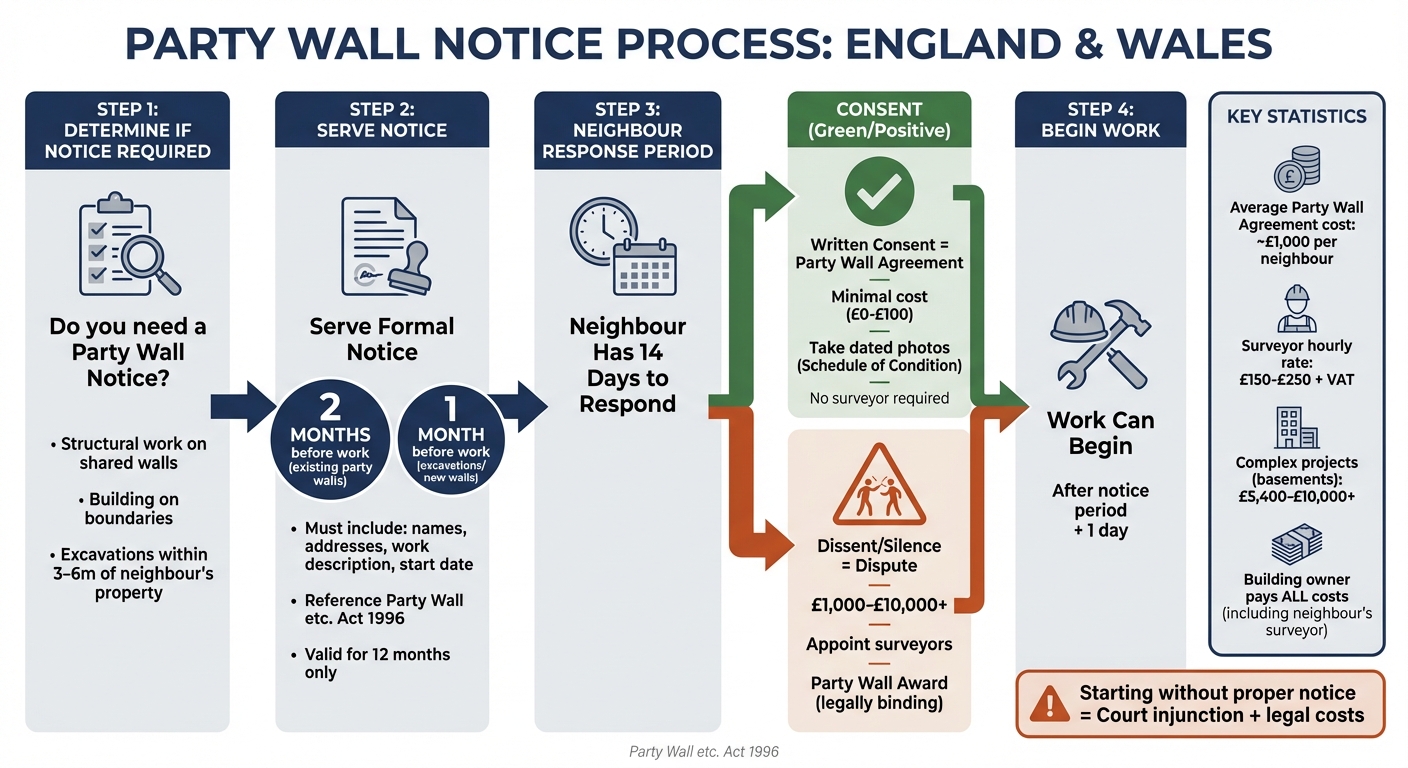
Party Wall Notice Process: Timeline and Steps for UK Property Owners
Party Wall Act for Extensions – Everything You Need to Know – What, Why, How and How Much
1. What is a Party Wall?
A party wall is a wall shared between two properties, typically found in terraced or semi-detached houses. Essentially, each property owns half the wall’s thickness.
The Federation of Master Builders explains it like this:
“A party wall is a wall that sits directly on the boundary of land between two (and sometimes more) different owners. Good examples include the walls that separate terraced or semi-detached houses.”
- Federation of Master Builders
According to the Party Wall Act, there are two main types of party walls: Type A, which straddles the boundary line between properties, and Type B, which sits entirely on one property but serves as a divider between adjoining structures. The Ministry of Housing, Communities & Local Government suggests viewing the party wall as jointly owned by both neighbours, rather than dividing it into halves or sections.
The term ‘party structures’ can also extend beyond vertical walls. For example, in flats, it includes shared floors and ceilings. A ‘party fence wall’, on the other hand, refers to a masonry garden wall but doesn’t cover wooden fences, hedges, or wire fencing.
Understanding what qualifies as a party wall is crucial because it determines your legal responsibilities under the Party Wall Act 1996. This knowledge sets the stage for distinguishing between a party wall agreement and a party wall award.
2. Party Wall Agreement vs Party Wall Award
Understanding the difference between a Party Wall Agreement and a Party Wall Award is essential, especially since these terms are often used interchangeably. However, they refer to entirely different processes, and knowing how they differ can save both time and money.
A Party Wall Agreement happens when your neighbour gives written consent to your proposed works within 14 days of receiving your Party Wall Notice. Katherine Binns, Director of Research at HomeOwners Alliance, explains:
“If neighbours assent, no surveyor is required – just record the wall’s condition. But you may opt to use one to minimise the risk of disputes later.”
- Katherine Binns, HomeOwners Alliance
This route is straightforward and cost-effective. All you need is your neighbour’s written approval and some dated photographs documenting the current condition of the shared wall.
On the other hand, a Party Wall Award is necessary if your neighbour either refuses consent or does not respond within the 14-day period. In such cases, an agreed surveyor or separate party wall surveyors must be appointed to draft a legally binding document. According to the Federation of Master Builders:
“The Party Wall Award is a legal document setting out what, how and when work can be carried out and who will pay for it (including surveyor’s fees).”
- Federation of Master Builders
This process can become more expensive, typically costing around £1,000 per neighbour. Surveyors usually charge between £150 and £200 per hour. Additionally, you’ll be responsible for covering not only your own surveyor’s fees but also those of your neighbour.
The key difference is clear: a Party Wall Agreement depends on mutual consent and involves minimal costs, while a Party Wall Award requires surveyors and incurs higher expenses, including your neighbour’s surveyor fees.
To avoid unnecessary complications, it’s always a good idea to talk to your neighbour before serving a formal notice. A friendly conversation explaining your project can go a long way in securing their written consent, potentially sparing you from the more expensive Award process. Even if you reach an informal agreement, don’t forget to take dated photographs of the shared wall for reference.
3. When You Need to Serve a Party Wall Notice
Knowing when to serve a party wall notice is essential to stay compliant with the Party Wall etc. Act 1996. Not every project requires one, so understanding the situations that do can help you sidestep potential legal headaches. Here’s a breakdown of the types of work that call for a notice.
You’ll need to serve notice for any structural work involving an existing party wall. This includes tasks like cutting into a shared wall – such as inserting steel beams for a loft conversion – removing chimney breasts, changing the wall’s dimensions, or adding a damp-proof course. On the other hand, smaller jobs like plastering, replacing electrical sockets, or drilling to hang shelves generally don’t require a notice.
Excavation work is another scenario where notice is often needed. If you’re digging within 3 metres of a neighbour’s building and going below the depth of their foundations, or if your work falls under the 6-metre rule (where a 45° line from their foundation is crossed), you’ll need to notify them. This is especially relevant for projects like extensions or basement construction.
For building directly on the boundary – such as erecting a new wall or a party fence wall – you must serve notice at least one month in advance. However, wooden fences are excluded from this requirement.
In some cases, minor work on a party wall might not need a notice. If you’re unsure, it’s always a good idea to consult a qualified building professional to clarify.
4. Party Wall Notice Requirements and Timelines
Getting the timing and details of your party wall notice right is crucial to avoid delays or potential legal issues. Once you’ve determined that a notice is necessary, you’ll need to focus on when and how to serve it. The required notice period depends on the type of work you’re planning: two months for work on an existing party wall (like cutting steel beams or underpinning) and one month for new boundary walls or excavation work.
Beyond timing, the notice itself must meet specific requirements to be valid. It should include:
- The names and addresses of all property owners involved
- The address of the property where the work will take place
- A clear description of the planned works
- The intended start date
- For excavation works, detailed plans showing the location and depth, plus any measures to protect foundations
Make sure the notice is dated and explicitly references the Party Wall etc. Act 1996.
Once the notice is served, your neighbour has 14 days to respond in writing. If they don’t reply to a notice concerning party structures or excavations within this timeframe, it automatically triggers a dispute, and you’ll need to appoint surveyors. For line of junction notices (pertaining to new boundary walls), silence is considered consent. Keep in mind that a party wall notice is only valid for 12 months – if work hasn’t started within that period, you’ll need to issue a new notice.
“If work starts without a notice being given, an adjoining owner can seek to stop the work through a court injunction or seek other legal redress.” – Ministry of Housing, Communities & Local Government
To encourage a swift response, consider including a reply form and a pre-addressed envelope with your notice. While you can serve the notice yourself using free templates, having a surveyor review it can help ensure everything is in order. Common mistakes, such as missing key structural details or using outdated forms, can lead to complications. Even with your neighbour’s written consent, construction can only begin two months and one day after approval for work on existing structures, or one month and one day for excavation projects.
sbb-itb-b9291f4
5. How to Get a Party Wall Agreement
Getting a party wall agreement doesn’t have to be complicated. Start by having an informal chat with your neighbours. Share your plans, listen to their concerns, and address any questions they might have. This step can go a long way in avoiding disputes and ensuring everyone is on the same page before moving forward with formalities.
Once you’ve had this conversation, the next step is to issue a formal Party Wall Notice to all affected neighbours. This includes both freeholders and leaseholders with leases lasting more than a year. You can find free templates online, such as those provided by the government or organisations like the HomeOwners Alliance, to draft and serve the notice yourself. Alternatively, you can hire a professional to handle it for you, which typically costs between £65 and £100. This formal notice must meet the legal requirements mentioned earlier, and you’ll need to allow for the specified notice period.
What happens next depends on your neighbour’s response. If they agree in writing (this is called “assent”), you won’t need to hire a surveyor. However, it’s a good idea to create a Schedule of Condition. This is a dated photographic record of the property’s current state, which can help protect you from future damage claims. On the other hand, if your neighbour either objects or doesn’t respond within 14 days, this is considered a dispute, and you’ll need to involve surveyors to resolve it.
In the case of a dispute, you can either agree on a single surveyor to act for both parties or appoint separate surveyors. Typical costs for standard Party Wall Awards are around £1,000 per neighbour, but more complex projects, like basement conversions, may be more expensive. The surveyor’s role is to act impartially, inspect the properties involved, and draft a legally binding Party Wall Award. This document lays out how and when the work will take place.
To avoid delays, start the process at least three months before your planned construction date. This allows enough time for notice periods and any surveyor negotiations. Keep in mind that you cannot legally begin any work covered by the Party Wall Act until you either have your neighbour’s written consent or a completed Party Wall Award. Starting early ensures you’re fully compliant and avoids the risk of a court injunction halting your project.
6. What’s Included in a Party Wall Agreement or Award
A Party Wall Award isn’t just about giving the green light for construction work – it’s a detailed legal document that covers a range of essential elements. It includes the names and addresses of both property owners, as well as the surveyors involved. Alongside this, it provides a thorough explanation of the planned work, often supported by technical drawings and engineer reports. These details serve as the foundation for outlining both practical and financial protections.
One key component is the Schedule of Condition. This is a dated photographic record, accompanied by written notes, documenting the property’s condition before any work begins. It’s an important safeguard, helping to avoid disputes over false damage claims and providing clear evidence if genuine damage occurs.
The Award also lays out practical guidelines, such as working hours (usually 8:00–17:30 on weekdays), project timelines, and arrangements for contractor access. Financial protections are another crucial inclusion, covering areas like contractor insurance and indemnity provisions.
Additionally, the document includes a time-limit clause, which typically requires work to start within one year of the agreement’s date. The Federation of Master Builders highlights its significance, stating:
“The Party Wall Award is a legal document setting out what, how and when work can be carried out and who will pay for it (including surveyor’s fees)”
- Federation of Master Builders
7. Costs, Disputes, and Getting Help from Prince Surveyors

When planning construction work, it’s vital to understand the associated costs and how disputes are handled. Here’s a closer look at what to expect.
As the building owner, you’ll be responsible for covering all costs, including your neighbour’s surveyor fees. According to Katherine Binns, Director of Research at the HomeOwners Alliance, “The average cost of a party wall agreement is around £1,000”. For simpler projects, like single-storey extensions, fees typically range between £1,000 and £2,000. Surveyors usually charge hourly rates of £150 to £250 plus VAT. However, for more complex undertakings, such as basement excavations, costs can escalate significantly – ranging from £5,400 to over £10,000. To save on expenses, you might consider appointing a single “Agreed Surveyor” who can act for both parties, rather than hiring two separate professionals.
If your neighbour refuses to respond or doesn’t reply within 14 days, this automatically triggers a dispute. When disputes arise, surveyors will prepare a legally binding Party Wall Award to protect both properties. If you’re unhappy with the Award, you have 14 days to appeal through the County Court. A notable example is the case of Nutt v Podger, where a building owner was ordered to pay £4,000 in damages for failing to follow the Party Wall etc. Act 1996. These legal safeguards ensure disputes are addressed efficiently and fairly.
Prince Surveyors offer comprehensive support throughout this process, providing expert guidance through their Chartered Surveyor Resource Centre. From serving notices to resolving disputes, their RICS-accredited professionals ensure you comply with all legal requirements, helping you avoid costly delays or injunctions. They also prepare Schedules of Condition, which document the state of neighbouring properties to protect you from unwarranted damage claims. For more complex projects, they can coordinate with structural engineers to provide the necessary technical expertise.
Choosing experienced surveyors, such as members of the Faculty of Party Wall Surveyors (FPWS), ensures high standards are upheld and your interests remain protected at every stage of the construction process.
Conclusion
Understanding the Party Wall etc. Act 1996 is essential before starting any building work that might affect shared walls or boundaries in England and Wales. This Act lays out a clear legal framework to protect both property owners and neighbours, helping to prevent disputes. As the Ministry of Housing, Communities & Local Government puts it:
“It is often helpful in understanding the principles of the Act if owners think of themselves as joint owners of the whole of a party wall rather than the sole owner of half or part of it”.
Following the proper procedures isn’t just a formality – it’s about avoiding unnecessary delays and expensive disputes. If you fail to serve notice correctly, neighbours could seek a court injunction to stop your work immediately. The Federation of Master Builders highlights the risks:
“The courts tend to take a poor view of failure to serve a party wall notice and you may be ordered to pay for repairs which, in reality, may not be your responsibility”.
Preparing a pre-work Schedule of Condition is a smart move, as it helps protect you against false damage claims.
Timelines are critical. Notices must be served at least two months in advance for work on existing party walls, or one month for excavation work. These notices are valid for one year and must include all adjoining owners, along with a written record of communication. If managing these steps feels overwhelming, seeking expert advice can simplify the process.
In cases where disputes arise or neighbours don’t respond within 14 days, having a clear and documented procedure becomes vital. This is where professional support can make a big difference. For instance, Prince Surveyors offers RICS-accredited expertise, handling everything from serving notices to preparing legally binding Party Wall Awards and documenting property conditions. Their knowledge ensures compliance with the law and helps avoid costly mistakes.
FAQs
What should I do if my neighbour ignores the Party Wall Notice?
If your neighbour fails to reply to the Party Wall Notice within 14 days, it’s treated as a dispute under the Party Wall Act. When this happens, you’ll need to appoint a surveyor to handle the matter on their behalf and move forward with a Party Wall Award.
This step allows the work to proceed lawfully while safeguarding the rights and interests of both parties. The surveyor’s role is neutral, ensuring a balanced and fair outcome for everyone involved.
Can I begin building work without a Party Wall Agreement?
No, you absolutely cannot begin construction without first serving the required party wall notice and securing your neighbour’s written consent or a formal agreement. Jumping into work without this violates the Party Wall etc. Act 1996, and you’d be legally obligated to halt all activity until you comply.
To steer clear of unnecessary delays and disagreements, it’s crucial to follow the proper steps before starting any project that might impact a shared wall, boundary, or structure.
How can I reduce the costs of a Party Wall Award?
To save on Party Wall Award expenses, aim to settle a written agreement with your neighbour before bringing in a surveyor. This approach can help you sidestep surveyor fees, which usually fall between £65 and £100 per hour. If any repairs or building work are necessary, try discussing a cost-sharing plan with your neighbour so you’re not left footing the entire bill. Keeping the conversation open and reaching agreements early can help cut costs and avoid potential conflicts.