

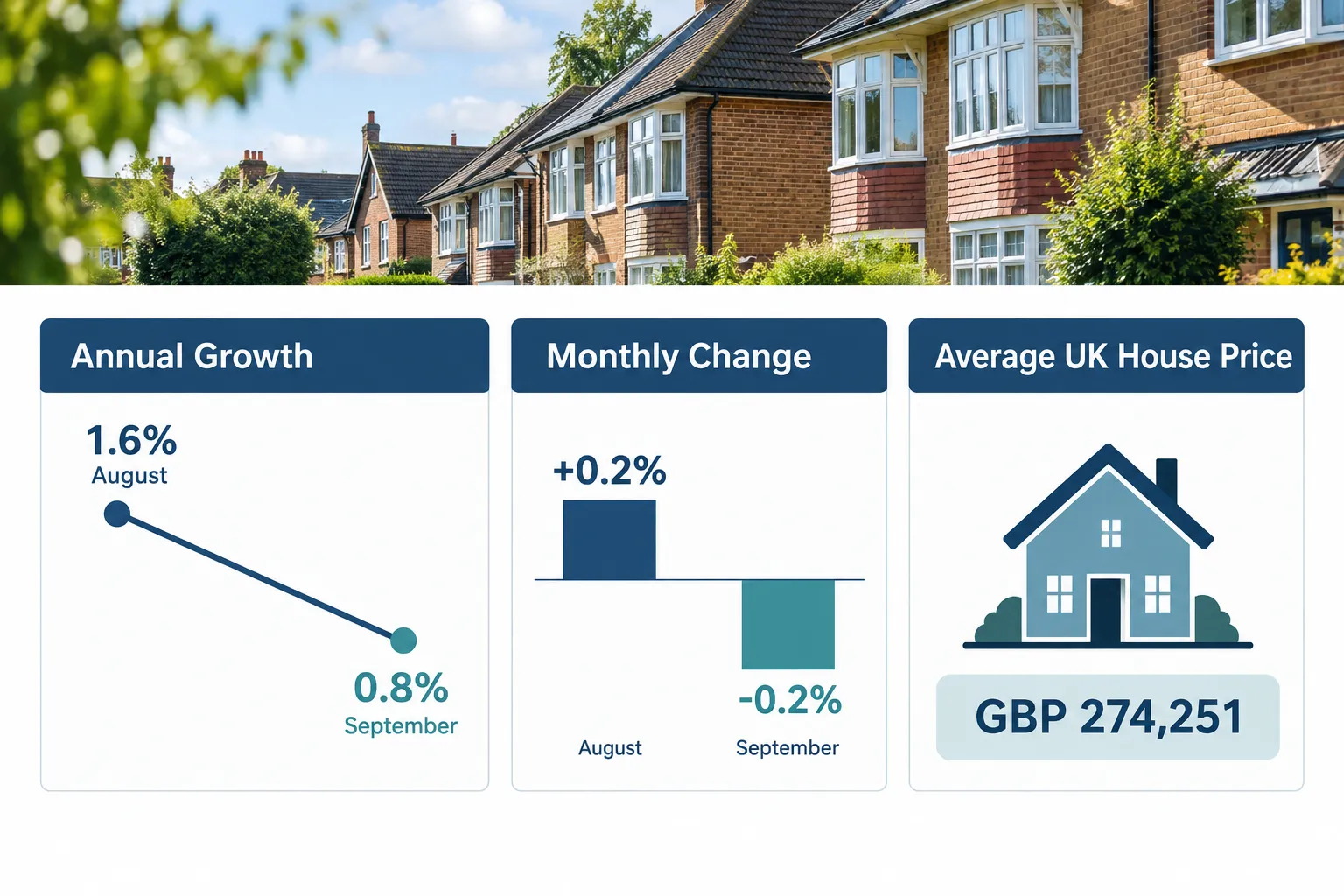
A year of steady house price gains just lost half its momentum in a single month. Nationwide's latest index, published on 1 October 2026, shows annual house price growth collapsing from 1.6% in August to just 0.8% in September. That is the sharpest monthly slowdown of the year, and it caught economists off guard, who had expected growth closer to 1.3%. For anyone buying, selling or simply watching the market from the sidelines, the headline figure tells only part of the story. The reality on the ground is more nuanced, and it creates genuine opportunity for prepared buyers.
This article breaks down what the September data actually means, why UK house price growth slows September 2026, and what practical steps buyers and sellers should take before the Budget lands on 28 October 2026.
Key Takeaways
- Nationwide's House Price Index shows annual growth falling to 0.8% in September 2026, down sharply from 1.6% in August, undershooting forecasts of roughly 1.3%.
- Prices dipped 0.2% month on month in September, reversing August's 0.2% gain; the average UK house price now stands at £274,251.
- Zoopla's parallel data confirms a slower market with 5% more homes on sale than a year ago, giving buyers more choice and leverage.
- Mortgage rates remain elevated, with average two-year and five-year fixes both near 6%, and only a handful of sub-5% deals left on the market.
- A cooling market combined with rising stock levels means buyers can afford to slow down, get a proper survey, and negotiate using real evidence rather than rushing.
What the Nationwide Figures Reveal About UK House Price Growth Slows September 2026
Nationwide's chief economist Robert Gardner pointed to a mix of global and domestic pressures behind the slowdown. Geopolitical tensions, particularly the ongoing Middle East conflict, continue to push energy prices upward. Encouragingly, Gardner noted that these higher energy costs have not yet fed through into underlying inflation in a significant way. Wage growth remains modest, but because house price growth is now running well below earnings growth, underlying affordability is actually improving for many households, even as headline price growth slows.
That is an important nuance. A slower market is not automatically bad news for buyers. It often means prices are becoming more realistic relative to what people earn, which can rebuild the gap between wages and property costs that widened sharply during previous boom periods.
Here is a snapshot of the key figures from the September 2026 release:
| Metric | August 2026 | September 2026 |
|---|---|---|
| Annual house price growth | 1.6% | 0.8% |
| Monthly change | +0.2% | -0.2% |
| Average UK house price | , | £274,251 |
| Economist forecast (annual) | , | ~1.3% (missed) |
The gap between the expected 1.3% growth and the actual 0.8% outcome is itself notable. It suggests the market is cooling faster than most forecasters anticipated, likely a combined effect of mortgage affordability pressure and buyers taking a more cautious, wait-and-see approach ahead of the Budget.
Why UK House Price Growth Slows September 2026: Rates, Inflation and Stock Levels
Three forces are working together to slow the market, and understanding each one helps explain what might happen next.
First, mortgage rates remain stubbornly high. According to Moneyfacts data from 5 October 2026, the average two-year fixed mortgage rate stands at 5.98%, while the average five-year fix is 6.00%. Excluding Northern Ireland-only products, only nine fixed-rate deals below 5% remain available across the entire market. For a typical buyer, that is a meaningful difference in monthly repayments compared with the sub-4% deals seen in earlier years.
Second, inflation and interest rate expectations are adding uncertainty. Inflation sits around 3.1%, and with Bank Rate currently at 3.75%, markets have been actively discussing whether it could rise further. Any upward move in Bank Rate tends to filter through to mortgage pricing within weeks, which keeps lenders cautious about offering deeply discounted fixed deals right now.
Third, there is simply more choice for buyers. Zoopla's own September 2026 index confirms prices are still rising nationally, just at a much slower pace than earlier in the year. Crucially, Zoopla reports 5% more homes available for sale compared with a year ago. More listings mean less competition for any single property, which shifts negotiating power toward buyers, particularly on homes that have been sitting on the market for a while.
Put together, these three factors explain why UK house price growth slows September 2026 so visibly: higher borrowing costs are dampening demand, while rising stock levels give buyers room to be selective rather than desperate.
What Buyers Can Do in October 2026
A slower market with more stock is, in practical terms, a buyer's opportunity. Reallymoving data shows the cost of moving in England reached £17,413 in 2026, with a median purchase price of £390,000. Those are significant sums, which makes it worth taking a measured approach rather than rushing into an offer.
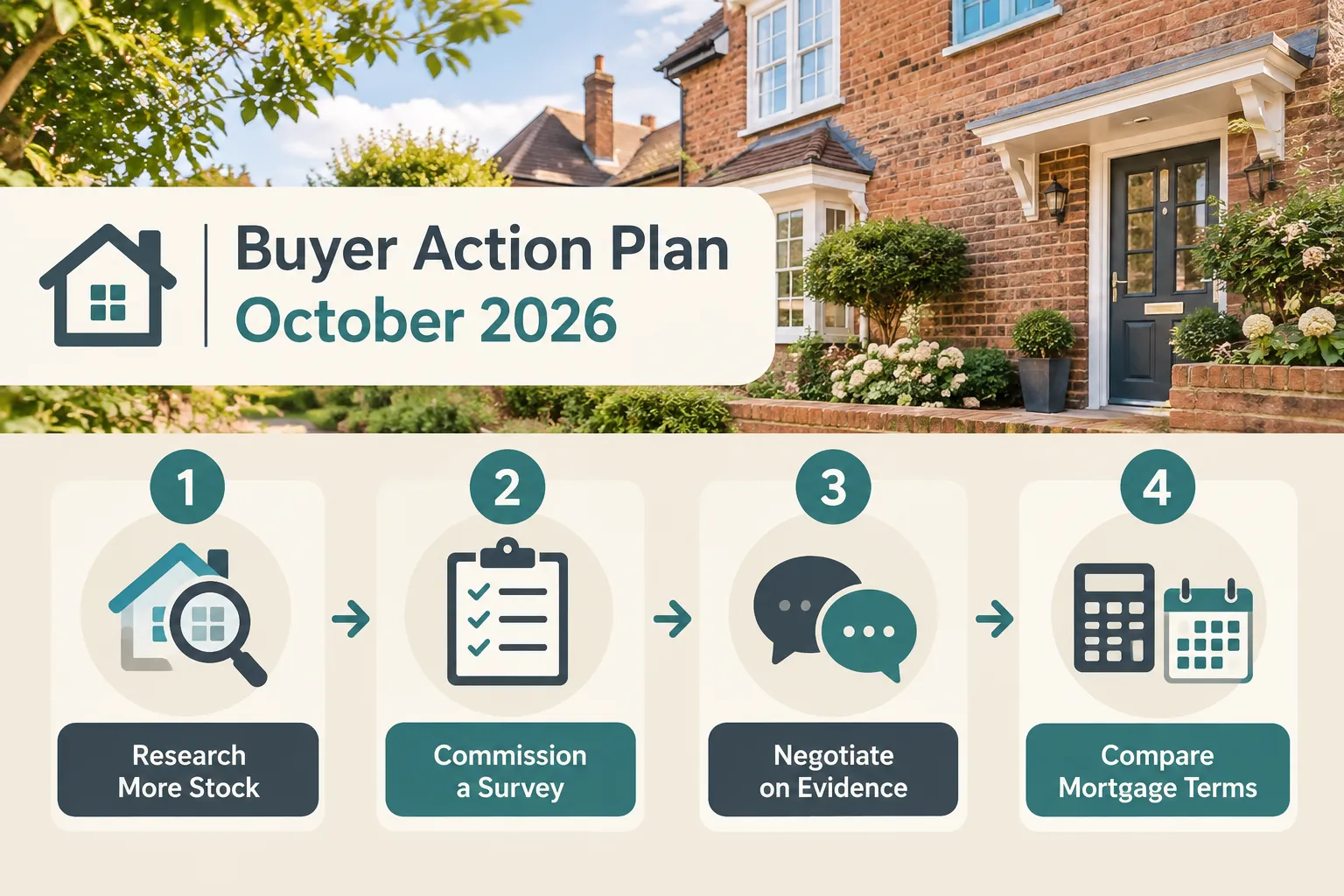
Consider this practical checklist before making an offer:
- Take your time. With more homes on the market, there is less pressure to bid quickly above asking price.
- Commission a proper survey. A RICS Level 2 or Level 3 survey can uncover issues that justify a lower offer, saving far more than the survey cost itself.
- Use survey findings to negotiate. Sellers are more likely to accept a reduced offer when it is backed by documented evidence of defects, such as damp, roof wear or structural movement.
- Compare fixed-rate terms carefully. With two-year and five-year fixes both hovering near 6%, weigh the certainty of a longer fix against the flexibility of a shorter one.
- Watch the Budget. The Budget on 28 October 2026 could influence stamp duty, mortgage support schemes or tax policy affecting property. Buyers mid-transaction should stay alert to any announcements that could change their position.
For sellers, the advice runs in parallel: fix known defects before listing rather than after a buyer's survey flags them. A property presented honestly and in good repair tends to move faster and attract fewer renegotiation requests in a market where buyers now have the upper hand on choice.
Frequently Asked Questions
Why did UK house price growth slow so much in September 2026?
Nationwide's data shows annual growth fell from 1.6% to 0.8% mainly due to high mortgage rates, cautious buyer sentiment, and rising housing stock, which together reduced competition and price pressure.
What is the average UK house price now?
According to Nationwide's September 2026 index, the average UK house price is £274,251.
Are mortgage rates likely to fall soon?
Rates remain high, with average two-year and five-year fixes near 6% as of early October 2026. With inflation around 3.1% and discussion of Bank Rate possibly rising from 3.75%, a near-term drop is not guaranteed.
Is now a good time to buy a house?
A slower market with more available stock gives buyers more negotiating leverage and less pressure to rush. Combined with improving affordability relative to wages, many buyers may find better terms than during faster-moving periods.
Should sellers wait for the market to pick up?
Not necessarily. Properties that are well-presented and free of obvious defects still sell in slower markets. Fixing issues before listing tends to produce better outcomes than waiting indefinitely.
How might the October Budget affect house prices?
The Budget on 28 October 2026 could introduce changes to stamp duty or housing policy. Buyers and sellers mid-transaction should monitor announcements closely, as policy shifts can quickly affect demand.
Conclusion
The September 2026 Nationwide figures mark a genuine turning point. UK house price growth slows September 2026 not because of a single cause, but because higher borrowing costs, cautious sentiment, and growing housing stock are all pulling in the same direction at once. For buyers, this is a moment to act deliberately rather than hesitantly: use the extra time and choice to commission surveys, negotiate with evidence, and compare mortgage deals carefully before committing. For sellers, addressing defects early and pricing realistically will matter more than ever in a market that no longer rewards urgency. Whichever side of the transaction you are on, working with a RICS chartered surveyor before the Budget lands on 28 October 2026 is one of the most practical steps available right now.