

Last updated: September 17, 2026
Quick Answer
Grey belt is now a formal NPPF planning category, and August 2026 reforms have opened thousands of acres around London and the Home Counties for housing, subject to "golden rules" on affordable homes and infrastructure [4]. On the same day the Bank of England held Bank Rate, surveyors report growing demand for Level 2 and Level 3 surveys on grey belt-adjacent stock, while mortgage pricing (not the base rate alone) is what actually decides what buyers can afford [6].
Key Takeaways
- Grey belt is a defined NPPF category covering lower-quality green belt land, formally active nationally since mid-2026 [1][4].
- August 2026 NPPF changes released large tracts of grey belt land for housing, tied to mandatory 50% affordable housing, infrastructure and green space rules [4].
- London's Draft London Plan 2026 uses grey belt through Broad Locations for Growth (BLGs), targeting the capital's edge and Home Counties boundary [3].
- The Bank of England held Bank Rate at 4% on 17 September 2026, but mortgage rates have diverged from the base rate, which matters more for affordability [6][7].
- Surveyors are seeing a surge in Level 2 HomeBuyer and Level 3 Building Survey instructions on rural and suburban homes near proposed grey belt sites [1].
- A six-year housing land supply test, with a 20% buffer for under-planning councils, is pushing more land into the "developable" bracket [8].
- The House of Lords has questioned how transformative grey belt reform will actually be, citing delivery risk [9][10].
- Buyers near grey belt boundaries face valuation uncertainty until planning status is confirmed at appeal or allocation stage.
What Is Grey Belt Housing Reform in the UK in 2026?
Grey belt housing reform refers to the 2026 change that turned "grey belt" from a policy idea into a formal land category inside the National Planning Policy Framework (NPPF), allowing councils and developers to release lower-quality green belt land for housing more easily [2][4]. It sits alongside, not instead of, the wider green belt.
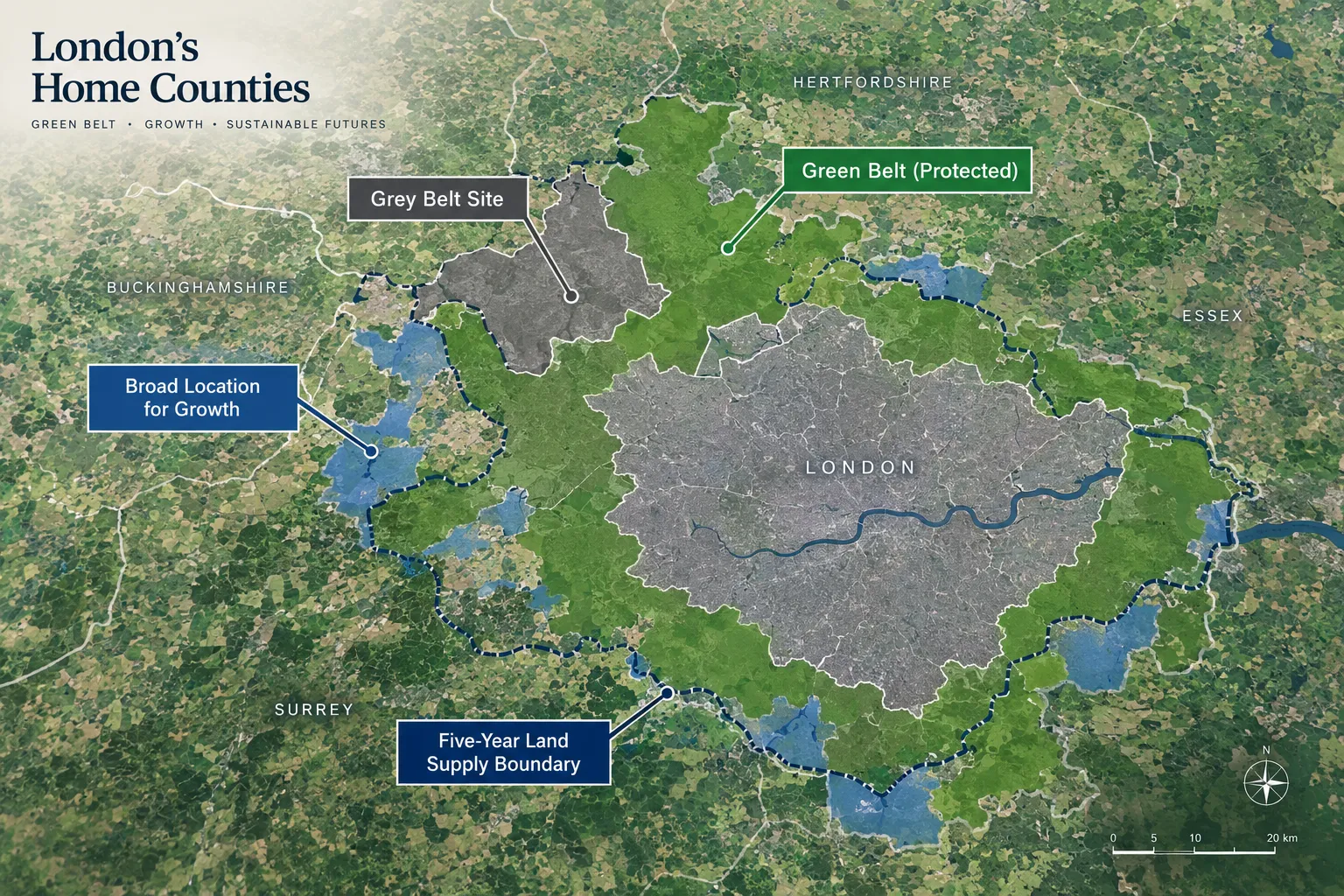
The government's official position ties grey belt release to national housing targets, arguing that England needs more homes built faster and that some green belt land no longer serves its original purpose [2]. Under the 2026 NPPF, land can be classed as grey belt if it is:
- Previously developed land within the green belt, or
- Land that makes only a limited contribution to the five purposes of green belt (openness, sprawl containment, setting of historic towns, and so on) [4].
This is a genuinely new legal hook for planners. Before 2026, "grey belt" was mostly a campaigning term. Now it is something a planning officer can point to in a decision notice, and something a surveyor has to factor into a valuation.
Decision rule: if a site is described in a council's evidence base as "limited green belt purpose" or "previously developed," treat it as a realistic grey belt candidate for planning purposes, not a certainty.
Grey Belt vs Green Belt: What Is the Difference?
Green belt is the long-standing protected ring of countryside around towns and cities meant to stop urban sprawl. Grey belt is a narrower category carved out of that green belt, covering lower-value or already-disturbed land that has less planning protection under the 2026 NPPF [4].
| Feature | Green Belt | Grey Belt |
|---|---|---|
| Planning status | Strongly protected | Formal NPPF category, easier to release [4] |
| Typical land | Open countryside, farmland | Petrol stations, car parks, disused land within green belt |
| Housing conditions | Very limited exceptions | Golden rules: 50% affordable housing, infrastructure, green space [4] |
| London relevance | Ring around Greater London | Broad Locations for Growth in Draft London Plan 2026 [3] |
Common mistake: assuming any land near the green belt boundary is automatically grey belt. It is only grey belt if a council or inspector formally assesses it as making limited contribution to green belt purposes [4].
What Changed in September 2026 Housing Policy?
By September 2026, the main policy story is confirmation rather than new announcement: the August 2026 NPPF changes are now being applied by councils, and the Bank of England's 17 September decision to hold Bank Rate at 4% has become the immediate talking point for surveyors and buyers [1][4]. Nothing structurally new was added to grey belt rules this month, but its practical effect is becoming visible on the ground.
Three things are converging in September 2026:
- Councils are updating five- and six-year land supply calculations, with a 20% buffer required for under-planning authorities, which pulls more grey belt sites into "available now" categories [8].
- Developers are testing appetite for grey belt schemes against a mortgage market that has not eased as much as the base rate suggests [6][7].
- The House of Lords has publicly questioned whether grey belt release will meaningfully shift housing numbers, adding a note of caution to bullish developer forecasts [9][10].
Edge case: a site can pass the technical grey belt test and still stall for years if infrastructure conditions (roads, schools, drainage) under the golden rules are not funded upfront.
Which London and Home Counties Areas Are Affected by Grey Belt Reform?
Grey belt reform mainly affects the outer boroughs of London and the ring of Home Counties districts that sit inside or immediately next to the historic green belt, where councils have identified low-quality land for release [3]. London's Draft London Plan 2026 formalises this through Broad Locations for Growth (BLGs), a strategic tool aimed at unlocking edge-of-city sites without redrawing the whole green belt map [3].
In practice, surveyors and buyers should watch:
- Outer London boroughs with green belt frontage (parts of Bromley, Havering, Hillingdon, Enfield and similar boundary areas).
- Home Counties districts bordering Greater London where local plans are being reviewed against the new land supply rules [8].
- Sites already flagged in call-for-sites exercises as "previously developed" or "limited purpose" green belt.
Choose to monitor a specific area if a local plan review, call for sites, or planning committee agenda has already named nearby grey belt land. Ignore vague rumours that are not tied to an actual council document.
How Does Grey Belt Reform Affect London Property Prices?
Grey belt reform affects London property prices indirectly, by increasing the pipeline of developable land at the city's edge rather than by changing prices inside established boroughs overnight. The effect is strongest on land values and new-build pricing near allocated sites, not on core London stock [1][3].
Where a site moves from "unlikely to be developed" to "formally allocated grey belt," expect:
- Land values on that specific plot to rise, reflecting new development potential.
- New-build pricing in the immediate area to be shaped by the 50% affordable housing golden rule, which can cap open-market pricing on part of a scheme [4].
- Existing nearby homes to see mixed effects: some benefit from new infrastructure, others face uncertainty until the exact scheme design and boundary are confirmed.
Example: a bungalow adjacent to a car park or disused yard inside the green belt is a more realistic grey belt candidate than a farmhouse surrounded by open fields, because previously developed land scores differently under the NPPF test [4].
Will Grey Belt Reform Increase House Supply and Make Homes More Affordable?
Grey belt reform is designed to increase housing supply by unlocking land that was previously very hard to develop, but the House of Lords and other commentators have questioned how large or fast that supply boost will actually be [2][9][10]. Affordability gains are real but partial, because the 50% affordable housing requirement applies within grey belt schemes, not across the whole market.
What is more certain:
- Government targets explicitly link grey belt release to national housebuilding numbers [2].
- The August 2026 NPPF changes are structured to unlock land "immediately," on paper, for residential schemes [4].
- Delivery still depends on infrastructure funding, five/six-year land supply calculations, and developer appetite, all of which move more slowly than policy announcements [8].
Choose optimism if a scheme already has planning consent and funded infrastructure. Stay cautious if a site is only "identified" in a call for sites, since that is an early stage with years of process ahead.
How Does the Bank of England Rate Hold Affect Property Surveyors and Buyers?
The Bank of England's decision to hold Bank Rate at 4% on 17 September 2026 matters to surveyors mainly because mortgage pricing has moved differently from the base rate, which changes what buyers can actually borrow and therefore what valuations need to reflect [6][7]. A held rate does not automatically mean stable mortgage costs.
Surveyors and valuers should note:
- Mortgage rates rose in parts of 2026 even while the base rate stayed flat, a divergence driven by swap rates and lender margins rather than the Bank Rate alone [6].
- Commentary around the September decision explicitly flagged that a future rate rise is "back on the table," adding uncertainty for anyone relying on cheaper borrowing to justify a grey belt-adjacent purchase [7].
- Valuers factor in local land supply and planning status alongside affordability data when advising on properties near allocated grey belt sites, because both variables move prices.
Common mistake: assuming a base rate hold means mortgage approvals will get easier. Underwriting criteria and swap-rate-linked fixed deals often move independently [6].
UK Grey Belt Housing Reform September 2026: What London Property Surveyors and Buyers Need to Know About Valuations and Surveys
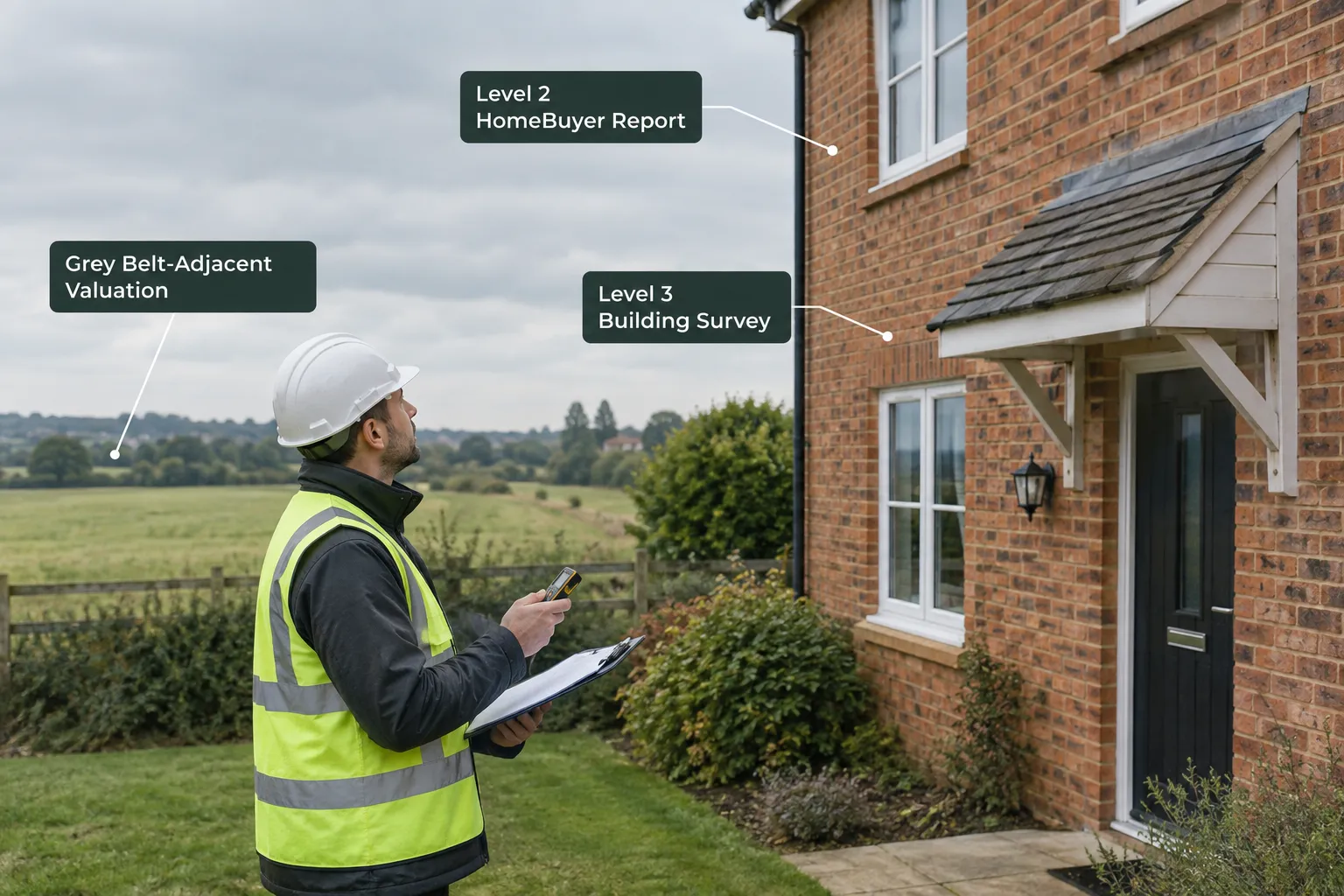
Surveyors report that grey belt-adjacent properties are generating more Level 2 HomeBuyer Report and Level 3 Building Survey instructions than a year ago, largely because buyers want independent evidence before committing near land that might be developed [1]. This is the core surveying story of UK Grey Belt Housing Reform September 2026: What London Property Surveyors and Buyers Need to Know, because planning status changes the risk profile of a property even before any building work starts.
Practical patterns surveyors are seeing:
| Survey type | When it fits grey belt-adjacent stock |
|---|---|
| Level 2 HomeBuyer Report | Standard-condition homes near identified but not yet allocated grey belt sites |
| Level 3 Building Survey | Older, rural or non-standard construction homes bordering active planning applications |
| Valuation-only report | Straightforward mortgage cases where planning risk is already priced in by the lender |
Surveyors are also flagging planning uncertainty directly in reports, noting nearby call-for-sites land or draft local plan allocations, rather than leaving buyers to find this out later [1]. Choose a Level 3 survey if the property is older, semi-rural, or likely to be affected by nearby groundworks and access changes during construction of an adjacent scheme.
Grey Belt Housing Reform Timeline, Planning Permission Process and Developer Appetite
Grey belt reform moved from concept to live policy through 2025 and 2026, with the August 2026 NPPF update marking the point where councils could start applying it to real planning applications [4]. For developers, the practical route runs through call for sites, local plan allocation or a planning application relying on the grey belt tests, then compliance with the golden rules before consent.
A simplified developer checklist:
- Identify land that is previously developed or makes limited green belt contribution.
- Check the local authority's five/six-year land supply position and 20% buffer status [8].
- Design the scheme to meet golden rules: 50% affordable housing, infrastructure, enhanced green space [4].
- Submit and expect scrutiny given ongoing House of Lords scepticism about delivery speed [9][10].
- Track London-specific routes through Broad Locations for Growth where relevant [3].
Developer appetite after the September 2026 rate hold is described as cautious rather than cold: land economics on grey belt sites are more favourable than a year ago, but higher-than-expected mortgage pricing is slowing the pace at which schemes get greenlit for construction starts [1][6].
Should You Buy Property Before Grey Belt Reform Takes Effect Locally, and How Should Homeowners Prepare?
Buying before a local grey belt allocation is confirmed can mean better prices but more planning risk, while buying after allocation usually means clearer risk but less room to negotiate on price. There is no universal right answer; it depends on the buyer's risk tolerance and timeframe.
For buyers:
- Ask for the council's latest land supply and call-for-sites documents before offering on a property near green belt boundaries.
- Commission a Level 2 or Level 3 survey that specifically comments on nearby planning activity, not just the building's condition [1].
- Budget for mortgage rates that may not track the base rate closely, given the divergence seen through 2026 [6][7].
For existing homeowners near potential grey belt land:
- Register for planning alerts from the local authority so you see call-for-sites and draft allocations early.
- Get an independent valuation if a nearby site moves from "identified" to "allocated," since this can change both value and marketability.
- Engage with local plan consultations directly rather than relying on secondhand reports, since golden rules on infrastructure and green space are decided at this stage [4].
Decision rule: buy now if the current price already reflects known planning risk and the fundamentals (location, condition, access) work without any reform upside. Wait if you are relying on reform to justify the price.
Who Benefits Most From Grey Belt Housing Reform, and Who Faces the Risks?
Developers with land near London's edge and buyers priced out of established suburbs tend to benefit most from grey belt reform, while existing homeowners immediately adjacent to allocated sites carry the most uncertainty. Both outcomes depend heavily on local implementation, not just the national policy [2][3][4].
- Likely to benefit: developers holding or optioning previously developed green belt land; first-time buyers who gain access to new, partly affordable homes under the golden rules.
- Likely to face risk: homeowners bordering large allocated sites who may see construction disruption, changed views, or valuation uncertainty during the planning process; councils under pressure to meet land supply buffers quickly.
- Mixed outcome: local authorities balancing housing targets against infrastructure funding gaps, and buyers who purchase near sites that stall for years despite being "identified" as grey belt.
"Grey belt is now a real category in the planning system, but scepticism from the House of Lords about delivery speed is a useful check on assuming every identified site will be built quickly." [9][10]
Frequently Asked Questions
What is grey belt housing reform in simple terms?
Grey belt housing reform is a 2026 change to the NPPF that lets councils release lower-quality green belt land for housing, subject to rules on affordable homes and infrastructure, rather than opening the whole green belt to development [2][4].
Is grey belt the same as green belt?
No. Green belt is the wider protected countryside ring around towns and cities. Grey belt is a narrower category within it, covering previously developed or low-value land that qualifies for easier release under the 2026 NPPF [4].
Did the Bank of England raise rates in September 2026?
No, the Bank of England held Bank Rate at 4% on 17 September 2026, though commentary noted a future rate rise remains possible [6][7].
Should I get a Level 2 or Level 3 survey on a home near a grey belt site?
A Level 2 HomeBuyer Report usually fits standard-condition homes near identified but not-yet-allocated land, while a Level 3 Building Survey suits older, rural or non-standard homes closer to active planning applications [1].
Will grey belt reform push London house prices down?
It is more likely to affect land values and new-build pricing near allocated sites than to lower prices across established London boroughs, since most core London stock is unaffected [1][3].
How long does grey belt land take to become new homes?
Timelines vary by site and council, but the process runs through land supply assessment, local plan allocation or planning application, and compliance with golden rules before construction, which can take several years even on well-located sites [4][8].
Conclusion
Grey belt housing reform is no longer a proposal; it is a working part of the NPPF, actively shaping land supply decisions around London and the Home Counties through September 2026 [4]. The Bank of England's rate hold has added a second layer of uncertainty, since mortgage pricing is not moving in lockstep with the base rate, which changes what buyers can afford on grey belt-adjacent homes right now [6][7].
Buyers should request current council land supply and call-for-sites documents before offering on any property near green belt boundaries, and commission a survey that addresses planning risk directly. Developers should stress-test scheme viability against both golden rule costs and realistic mortgage-market demand rather than the headline base rate. Surveyors should keep flagging nearby planning status in every Level 2 and Level 3 report on rural and suburban stock, since that single detail is increasingly what buyers and lenders want to see first.
References
[1] Uk Grey Belt Housing Reform September 2026 Buyers Surveyors Sep10 – surveymerchant.com
[2] Housing Targets Increased To Get Britain Building Again – gov.uk
[3] Labour Planning Reform New Towns Grey Belt London 2026 – realyse.com
[4] Can You Build In The Green Belt Grey Belt Amp The Nppf 2026 Reforms – planwiser.uk
[5] Uk Housing Market September 2026 – ireis.co.uk
[6] Base Rate Held But Mortgage Costs Rose 2026 – valuq.co.uk
[7] Rate Rise Back On The Table What It Means For Sellers 2026 – valuq.co.uk
[8] Planning Reform 2026 – northeight.co.uk
[9] Cn074jzzrkjo – bbc.com
[10] C3dky111m40o – bbc.co.uk
.cg-wrap{max-width:520px;margin:20px auto;font-family:Arial,Helvetica,sans-serif;border:1px solid #d8dee4;border-radius:10px;padding:20px;background:#fafbfc;color:#1a2530}
.cg-wrap h3{margin:0 0 10px;font-size:18px;color:#1a3a5c}
.cg-row{margin-bottom:12px}
.cg-row label{display:block;font-size:13px;font-weight:bold;margin-bottom:4px}
.cg-row input{width:100%;padding:8px;border:1px solid #c3ccd4;border-radius:6px;box-sizing:border-box;font-size:14px}
.cg-btn{width:100%;padding:10px;background:#1a3a5c;color:#fff;border:none;border-radius:6px;font-size:15px;cursor:pointer;font-weight:bold}
.cg-btn:hover{background:#12283f}
.cg-result{margin-top:16px;padding:14px;background:#eef3f7;border-radius:8px;font-size:14px;display:none}
.cg-result strong{color:#1a3a5c;font-size:17px}
.cg-note{font-size:11px;color:#5a6672;margin-top:10px}
Grey Belt Buyer: Mortgage Affordability Estimator
Estimate only. Bank Rate holds do not guarantee equivalent mortgage pricing; lenders price fixed deals off swap rates. Get independent mortgage advice before offering on grey belt-adjacent property.
function cgCalc(){
var P=parseFloat(document.getElementById(‘cg-loan’).value);
var r=parseFloat(document.getElementById(‘cg-rate’).value)/100/12;
var n=parseFloat(document.getElementById(‘cg-term’).value)*12;
if(!P||!r||!n){return;}
var M=P*r*Math.pow(1+r,n)/(Math.pow(1+r,n)-1);
var total=M*n;
var el=document.getElementById(‘cg-result’);
el.style.display=’block’;
el.innerHTML=’Approx. GBP ‘+M.toFixed(0)+’ / month
Total repayable over term: approx. GBP ‘+total.toFixed(0);
}