

By 2026, the global land survey equipment market is forecast to reach approximately USD 8.7 to 10.3 billion, depending on the methodology applied — a figure that reflects not just steady demand, but a structural shift in how the world measures, maps, and builds its physical infrastructure. The Global Land Survey Equipment Market: Growth Drivers and Investment Opportunities in 2026 is a story about technology convergence, urbanization pressure, and the rising value of precision data across construction, energy, and public infrastructure sectors.
This article examines the forces propelling that growth, the equipment categories attracting the most capital, the regional dynamics shaping investment, and what both industry professionals and investors should watch closely in the year ahead.
Key Takeaways
- The global land survey equipment market is projected to sit between USD 8.7 billion and USD 10.3 billion in 2026, with a sustained CAGR of 4–8% into the early 2030s.
- Total stations, GPS/GNSS systems, and 3D laser scanners are the three dominant product segments driving revenue growth.
- Asia-Pacific is the fastest-growing regional market, while North America retains the largest revenue share.
- Infrastructure investment programs, smart city development, and drone-assisted surveying are the primary demand catalysts.
- Investors and professionals should focus on technology integration, software-hardware bundling, and emerging market expansion as the key value creation levers.
Market Size and Forecast: What the Numbers Say for 2026
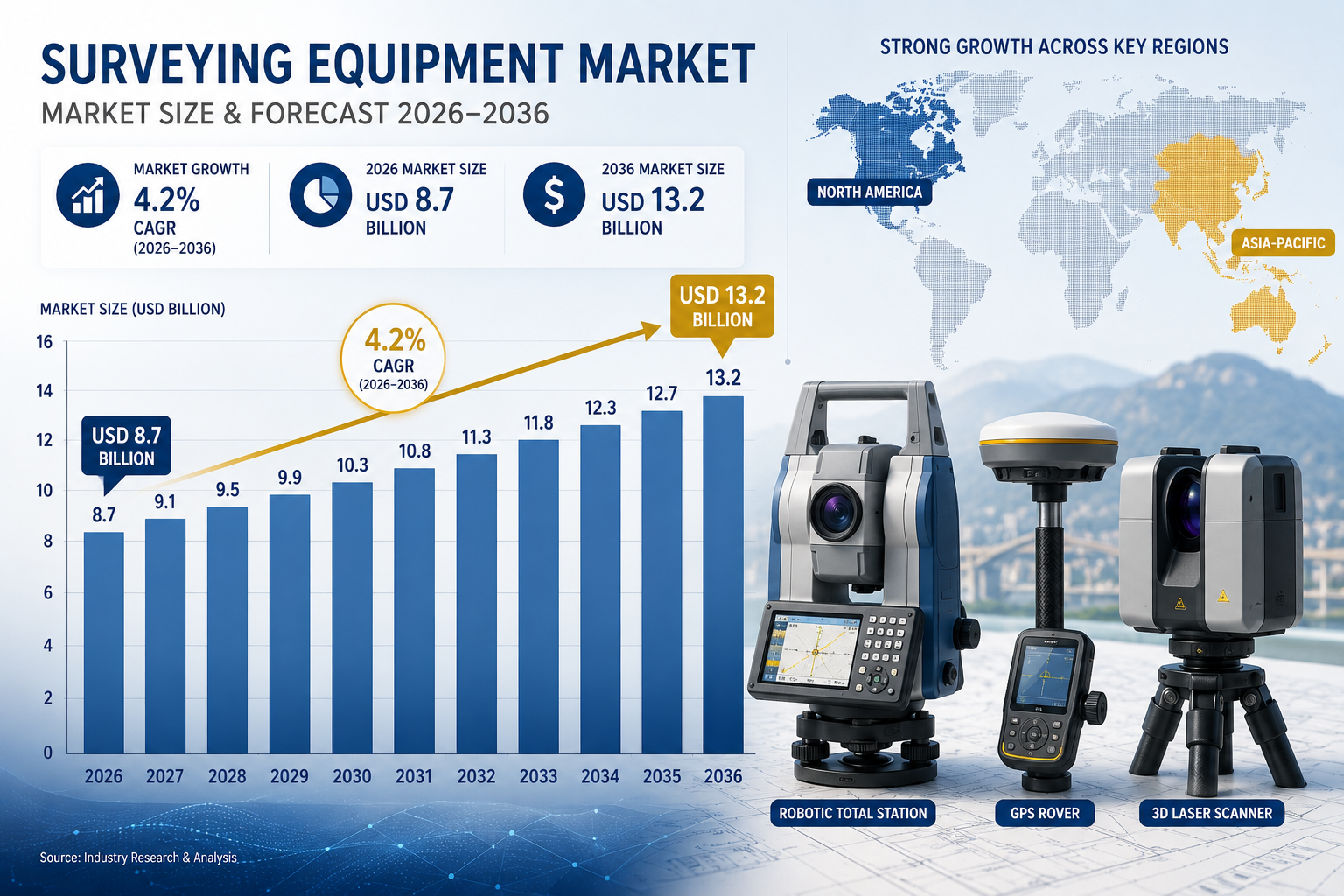
Multiple independent research firms converge on a consistent picture of the market in 2026. Future Market Insights projects the global land survey equipment market at USD 8.7 billion in 2026, expanding to USD 13.2 billion by 2036 at a 4.2% CAGR [2]. The Business Research Company estimates the market will grow from USD 8.78 billion in 2025 to USD 9.47 billion in 2026, implying a 7.8% growth rate at that stage [3]. Fortune Business Insights places the 2026 figure at USD 10.29 billion, projecting continued expansion to USD 15.21 billion by 2034 at a 5.01% CAGR [4].
MarketsandMarkets reported a USD 9.0 billion market in 2023 and projected USD 11.71 billion by 2028 at a 5.2% CAGR [1]. Across these sources, the 2026 market consistently clusters in the USD 9–10 billion range, with mid-to-high single-digit annual growth rates.
"The 2026 land survey equipment market represents a rare convergence of infrastructure stimulus, digital transformation, and geospatial data demand — conditions that rarely align this clearly."
What Is Driving This Consistent Growth Projection?
The underlying demand drivers are structural, not cyclical. They include:
- Global infrastructure investment — governments across North America, Europe, and Asia-Pacific are committing multi-year capital to roads, rail, utilities, and housing.
- Smart city and urban development programs — precise geospatial data is a prerequisite for digital twin technology and urban planning.
- Energy transition projects — solar farms, wind installations, and grid upgrades all require detailed land surveys.
- Regulatory requirements — building codes, environmental compliance, and land registration laws mandate professional survey data.
For professionals considering the scope of a full building survey and planning assessment, the quality of underlying land data directly influences the accuracy and reliability of every subsequent stage of a project.
Key Growth Drivers Shaping the Global Land Survey Equipment Market
Infrastructure Spending as the Primary Catalyst
The single most powerful driver of demand in The Global Land Survey Equipment Market: Growth Drivers and Investment Opportunities in 2026 is government infrastructure spending. The United States Infrastructure Investment and Jobs Act, the European Union's cohesion and recovery funds, and China's Belt and Road Initiative have collectively injected trillions of dollars into physical construction projects that cannot proceed without accurate land surveys.
Each kilometer of road, each utility corridor, and each new housing development requires topographic surveys, boundary delineation, and construction staking. This creates a near-inelastic demand floor for survey equipment, regardless of short-term economic fluctuations.
The Technology Upgrade Cycle
Survey equipment is undergoing a generational technology shift. Legacy optical theodolites and manual leveling instruments are being replaced by:
- Robotic total stations — self-tracking instruments that allow a single operator to conduct surveys that previously required two or three people.
- GNSS/GPS receivers — high-precision satellite-based positioning systems capable of centimeter-level accuracy.
- 3D laser scanners (LiDAR) — instruments that capture millions of data points per second, creating detailed point clouds for BIM (Building Information Modeling) integration.
- Drone-assisted survey platforms — UAVs equipped with photogrammetry and LiDAR payloads that dramatically reduce field time [10].
This technology upgrade cycle is not simply a replacement market. It is an expansion market, because new capabilities are enabling survey work in sectors — such as heritage conservation, subsurface utility mapping, and forensic engineering — that previously relied on less precise methods.
For property professionals, the availability of premium drone survey services illustrates how aerial data capture is already being integrated into mainstream building assessment workflows.
Construction and Real Estate Development Demand
Global construction output is forecast to reach USD 15.2 trillion by 2030, with the fastest growth in Asia, Africa, and the Middle East. Every construction project — from a single residential dwelling to a major commercial development — generates demand for survey services and, by extension, survey equipment.
In the UK context, chartered surveyors conducting Level 3 full building surveys increasingly rely on digital measurement tools, laser distance meters, and thermal imaging equipment that fall within the broader land survey equipment category.
Environmental Monitoring and Climate Resilience
Flood mapping, coastal erosion monitoring, and land subsidence tracking are growing applications for precision survey equipment. Governments and insurance companies are investing in continuous geospatial monitoring programs that require both the equipment and the expertise to operate it. This creates recurring demand rather than one-time project-based purchases.
Product Segments: Where Investment Is Concentrating

Total Stations
Total stations remain the backbone of the professional survey equipment market. Modern robotic total stations combine electronic distance measurement, angle measurement, and data recording in a single instrument. The integration of onboard computers, wireless connectivity, and cloud data upload has transformed them from standalone instruments into nodes in a broader digital survey workflow.
| Equipment Segment | Key Application | Growth Driver |
|---|---|---|
| Total Stations | Construction staking, boundary surveys | Infrastructure projects, BIM adoption |
| GPS/GNSS Systems | Control networks, machine guidance | Precision agriculture, infrastructure |
| 3D Laser Scanners | As-built documentation, heritage recording | BIM, digital twins, forensic surveys |
| Drone Survey Platforms | Topographic mapping, volumetric surveys | Cost reduction, safety, speed |
| Levels and Theodolites | Routine construction, road works | Emerging market growth |
GPS and GNSS Systems
GPS/GNSS receivers are the fastest-growing segment in terms of unit volume, driven by falling hardware costs and expanding satellite constellation coverage (including Galileo, GLONASS, BeiDou, and QZSS alongside GPS). Real-Time Kinematic (RTK) and Network RTK systems now deliver centimeter-level accuracy in real time, making them suitable for machine control on construction sites — a high-value application that commands premium pricing.
3D Laser Scanners and LiDAR
The adoption of 3D laser scanning is accelerating rapidly, particularly in the as-built documentation, heritage conservation, and infrastructure inspection segments. The ability to capture a complete spatial record of a structure in hours — rather than days of manual measurement — is compelling for project managers facing tight timelines and liability exposure.
For professionals involved in construction and condition surveys, 3D scanning provides a defensible, highly detailed record of a structure's condition at a specific point in time — valuable for both project management and dispute resolution.
Software and Data Services
An increasingly important revenue stream sits alongside hardware: the software platforms that process, store, and analyze survey data. Companies that bundle hardware with subscription-based data management platforms are achieving higher margins and stronger customer retention than pure hardware vendors. This software layer is attracting significant venture capital and strategic acquisition activity.
Regional Market Dynamics: North America, Asia-Pacific, and Beyond

North America: Largest Revenue Share
North America holds the largest share of the global land survey equipment market in 2026, supported by:
- A mature construction industry with high technology adoption rates.
- Large-scale federal infrastructure programs generating sustained equipment demand.
- A well-established network of professional survey firms with capital to invest in equipment upgrades.
- Strong adoption of BIM and digital construction workflows that require compatible survey technology.
The United States market is also characterized by a high proportion of machine control applications — GPS-guided earthmoving equipment that requires continuous survey-grade positioning data.
Asia-Pacific: Fastest Growth Rate
Asia-Pacific is the fastest-growing regional market, driven by:
- China — continued urbanization, infrastructure investment, and a domestic survey equipment manufacturing industry that is rapidly closing the quality gap with Western competitors.
- India — a massive national infrastructure program including roads, railways, smart cities, and housing that is generating unprecedented demand for survey services.
- Southeast Asia — rapid urbanization in Vietnam, Indonesia, and the Philippines is creating new markets for both professional survey services and equipment.
For investors, Asia-Pacific represents the highest growth opportunity, though it also carries higher execution risk due to regulatory complexity and competitive pricing pressure from local manufacturers.
Europe and the Middle East
Europe's market is characterized by strong regulatory demand — environmental impact assessments, heritage protection requirements, and building regulations all mandate professional survey work. The Middle East continues to invest heavily in mega-project infrastructure, with Saudi Arabia's Vision 2030 program alone generating substantial demand for survey equipment and services.
Investment Opportunities: Where to Focus in 2026
The Global Land Survey Equipment Market: Growth Drivers and Investment Opportunities in 2026 presents several distinct investment themes for capital allocators and industry participants:
1. Technology-integrated hardware platforms
Companies that combine precision hardware with proprietary software ecosystems are generating the strongest margins and the most defensible competitive positions. Trimble, Hexagon, and Topcon are the established leaders, but mid-tier and specialist manufacturers are gaining ground in specific niches.
2. Drone and UAV survey platforms
The drone survey segment is growing at a rate significantly above the overall market average, driven by cost advantages, safety benefits, and expanding regulatory acceptance [10]. Equipment manufacturers, software developers, and service providers in this segment all represent viable investment targets.
3. Emerging market distribution and service networks
In high-growth markets like India, Southeast Asia, and Sub-Saharan Africa, the limiting factor is often not equipment availability but trained operators and reliable service networks. Companies that invest in training infrastructure and local service capability are well positioned to capture disproportionate market share.
4. Software and data analytics
The shift from hardware-only to hardware-plus-software business models is creating significant value. Subscription revenue from cloud-based data management platforms provides recurring income that pure hardware sales cannot match.
5. Rental and equipment-as-a-service models
In markets where capital constraints limit outright equipment purchase, rental and subscription models are gaining traction. This lowers the barrier to adoption and expands the addressable market.
For property and construction professionals looking to understand how precise survey data integrates with building regulation compliance testing and project delivery, the connection between field measurement quality and regulatory outcomes is direct and consequential.
Competitive Landscape: Key Players and Market Structure
The global land survey equipment market is moderately concentrated at the top, with a small number of large multinational firms controlling significant revenue share, and a long tail of regional and specialist manufacturers [7].
Leading global manufacturers include:
- Trimble Inc. (USA) — a dominant position across total stations, GNSS, and construction technology software.
- Hexagon AB (Sweden) — strong in precision measurement, geospatial software, and industrial automation.
- Topcon Corporation (Japan) — significant share in optical instruments and machine control systems.
- Leica Geosystems (part of Hexagon) — premium positioning in laser scanning and high-precision instruments.
- Sokkia / Nikon Trimble — competitive in the mid-market total station and level segments.
Chinese manufacturers including South Surveying and Mapping Instrument and FOIF are gaining market share in price-sensitive emerging markets, creating competitive pressure on mid-range product lines from Western manufacturers.
The competitive dynamic is pushing established players to differentiate on software integration, data services, and total workflow solutions rather than hardware specifications alone.
Challenges and Risk Factors
No market analysis is complete without an honest assessment of the headwinds:
- Supply chain constraints — precision optical and electronic components remain subject to supply chain disruptions, particularly for manufacturers dependent on specific semiconductor inputs.
- Skilled labor shortage — the value of survey equipment is only realized when skilled operators are available. A global shortage of trained surveyors limits market expansion in some regions.
- Price competition from low-cost manufacturers — Chinese and other Asian manufacturers are compressing margins in mid-market segments, forcing established brands to defend premium positioning.
- Regulatory fragmentation — different national standards for survey accuracy, data formats, and professional certification create market entry barriers and increase compliance costs.
- Economic sensitivity — while infrastructure spending provides a demand floor, private construction activity is sensitive to interest rates and economic conditions.
For professionals navigating complex regulatory environments, resources like guidance on building inspections and surveys for homeowners illustrate the practical intersection of professional standards and client expectations.
Conclusion: Actionable Takeaways for 2026
The Global Land Survey Equipment Market: Growth Drivers and Investment Opportunities in 2026 presents a compelling case for sustained engagement — whether as an equipment manufacturer, a service provider, an investor, or a professional end user.
For investors: Focus on companies with strong software integration strategies, exposure to Asia-Pacific growth markets, and recurring revenue streams from data services. The hardware-only model is declining in value relative to integrated platform businesses.
For equipment manufacturers: Prioritize R&D investment in drone integration, GNSS accuracy improvements, and cloud-based data management. The next competitive battleground is workflow integration, not instrument specification.
For survey professionals and construction firms: The case for upgrading to robotic total stations, RTK GNSS, and 3D laser scanning is now primarily economic, not just technical. The productivity gains and data quality improvements generate measurable returns on investment across project types.
For policymakers and infrastructure planners: Investing in the training and certification infrastructure needed to produce qualified surveyors is as important as investing in the equipment itself. Workforce development is the binding constraint on market growth in many regions.
The market's trajectory from approximately USD 9–10 billion in 2026 toward USD 12–15 billion by the early 2030s reflects a world that is building faster, measuring more precisely, and demanding higher-quality spatial data at every stage of the built environment lifecycle. The organizations that position themselves at the intersection of precision hardware, intelligent software, and skilled professional services will capture the greatest share of that expanding value.
References
[1] Land Survey Equipment Market Report – grandviewresearch.com
[2] Land Survey Equipment Market – futuremarketinsights.com
[3] Land Survey Equipment Global Market Report – thebusinessresearchcompany.com
[4] Land Survey Equipment Market 103329 – fortunebusinessinsights.com
[5] Land Surveying Equipment Market Size Trends 2026 2033 5tyrf – linkedin.com
[6] Global Land Surveying Equipment Market 131000213 – finance.yahoo.com
[7] Top Land Survey Equipment Companies – expertmarketresearch.com
[8] Land Survey Equipment Global 43700969 – marketresearch.com
[9] Land Survey Equipment Global Strategic – researchandmarkets.com
[10] Land Surveying Equipment Market To Grow By Usd 3 02 Bn By 2026 Enhanced Applications Of Drones In Land Surveying To Boost Market Growth Technavio 301652421 – prnewswire.com