

The UK construction and property sector is forecast to require an additional 225,000 skilled workers by 2027, yet the surveying profession currently faces one of its most acute talent shortages in a generation. Against this backdrop, the Surveyor Talent Pipeline for 2026: RICS Pathways, CPD Enhancements and Recruitment in Recovery has become a defining strategic challenge for firms, educators, and the Royal Institution of Chartered Surveyors (RICS) alike. Sweeping reforms to qualification routes, a redesigned continuing professional development (CPD) framework, and a renewed push to attract diverse new entrants are reshaping how the profession grows and sustains itself.
Key Takeaways
- RICS introduced a revised CPD framework in January 2026 requiring 20 hours annually, with 10 hours of structured learning and mandatory topics covering ethics, sustainability, AI, and data technology every three years. [1]
- The new RICS Member App, launched February 2026, enables members to plan, record, and manage CPD activities digitally, improving compliance and engagement. [2]
- The 'Inspired to Hired' platform signals a strategic commitment to social mobility and broadening access to surveying careers. [2]
- Apprenticeship routes are gaining traction as a credible alternative to traditional university pathways, directly addressing skills shortages. [5]
- Firms that align their recruitment and development strategies with RICS reforms now will hold a competitive advantage as market activity recovers.
The Talent Gap Driving Sector-Wide Reform
The surveying profession does not have a perception problem so much as a pipeline problem. Demand for qualified surveyors across residential, commercial, and infrastructure sectors has rebounded sharply following the slowdown of 2023-2024, yet the supply of newly qualified professionals has not kept pace. Graduate output from accredited university programmes has remained relatively flat, while experienced mid-career surveyors have migrated to adjacent sectors or retired earlier than anticipated.
This imbalance has direct consequences for clients. Longer wait times for home survey bookings, reduced capacity for complex assessments, and upward pressure on fees all trace back to the same root cause: a profession that has not replenished its ranks quickly enough. Understanding the full scope of the Surveyor Talent Pipeline for 2026 requires examining the structural reforms RICS has put in place to address this shortfall.
Why the Recovery Phase Matters Most
When transaction volumes rise, the demand for surveys accelerates disproportionately. Buyers seeking to use an RICS survey to negotiate property prices or commission a Level 2 versus Level 3 assessment need access to competent, chartered professionals. If the talent pipeline remains thin during recovery, firms risk reputational damage and regulatory exposure. This is precisely why RICS has accelerated its qualification and CPD reforms rather than waiting for market conditions to stabilise further.
RICS Qualification Pathways: Expanding Access in 2026
The APC and Structured Graduate Routes
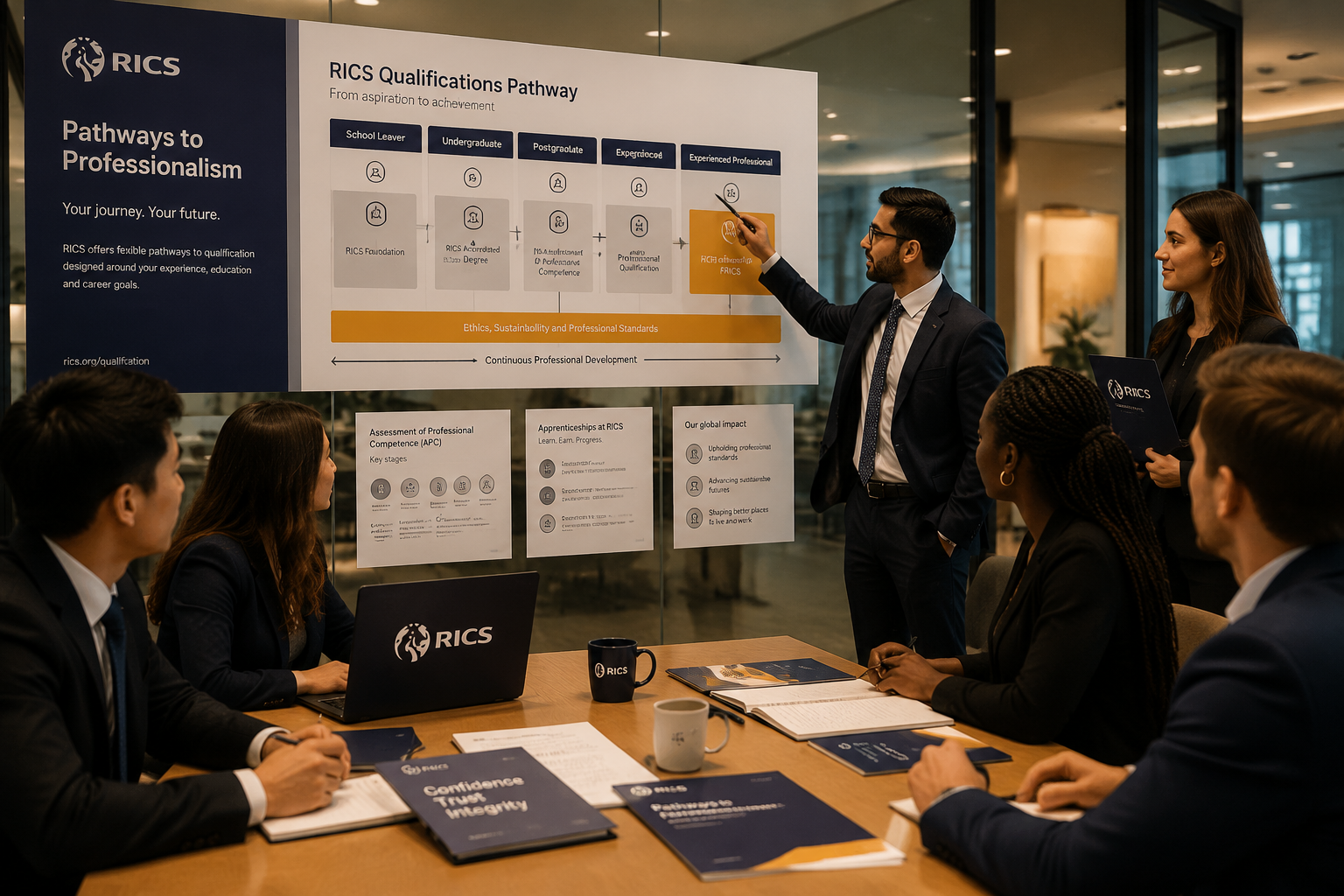
The Assessment of Professional Competence (APC) remains the primary gateway to RICS membership. Candidates typically complete a structured period of supervised practice, log competency evidence, and sit a final assessment interview. RICS has been actively reviewing this end-to-end experience as part of its broader Entry and Assessments programme, with a focus on reducing unnecessary friction for candidates while maintaining rigorous standards. [2]
Key changes in 2026 include:
- Streamlined competency recording through digital tools that integrate with the new RICS Member App
- Clearer pathway guidance for candidates working in specialist areas such as building surveying, quantity surveying, and valuation
- Faster assessment scheduling to reduce the backlog that built up during the post-pandemic period
For firms managing APC candidates, the practical implication is that structured training plans and counsellor support are more important than ever. Candidates who receive consistent mentoring progress to membership faster, reducing the gap between recruitment and full productivity.
Apprenticeship Routes: A Credible Alternative
University degree apprenticeships in surveying have grown significantly in profile and uptake. These programmes allow candidates to earn a degree-level qualification while working full-time, with employers funding training through the Apprenticeship Levy. RICS has actively supported the development of apprenticeship standards that lead directly to chartered status, making this route genuinely equivalent to the traditional graduate pathway. [5]
The appeal is mutual. Employers gain committed, work-ready candidates who develop competencies in a live commercial environment. Candidates avoid substantial student debt while earning a salary. For firms operating across London and the South East, apprenticeships offer a practical route to building local talent, including in areas served by property surveyors in Islington, Southwark, and Ealing.
Comparison of Primary RICS Entry Routes in 2026
| Route | Typical Duration | Key Advantage | Best Suited For |
|---|---|---|---|
| Graduate APC | 2-3 years post-degree | Established, widely recognised | University graduates |
| Degree Apprenticeship | 4-5 years | Earn while you learn, no tuition debt | School leavers, career changers |
| Senior Professional Assessment | Varies | Recognises prior experience | Experienced non-members |
| Academic Route | Varies | Research and teaching focus | Academia and policy roles |
The 'Inspired to Hired' Platform
In February 2026, RICS CEO Justin Young announced the launch of the 'Inspired to Hired' platform on RICS Recruit. The initiative is designed to increase awareness of surveying careers among school-age students and those from underrepresented backgrounds, with a specific focus on social mobility. [2] The platform connects prospective entrants with firms offering work experience, apprenticeships, and graduate roles, creating a structured pathway from initial interest to employment.
This matters strategically. Widening the top of the talent funnel is the only sustainable way to address long-term supply shortages. Firms that engage with the platform early will have first-mover advantage in attracting candidates who might not have previously considered a surveying career.
CPD Enhancements: The 2026 Framework in Detail
What Changed in January 2026
The revised CPD framework that came into effect in January 2026 represents the most significant overhaul of RICS continuing professional development requirements in over a decade. [1] The core structure is as follows:
- 20 hours of CPD per year for all RICS members
- 10 hours must be structured learning (formal courses, conferences, accredited webinars)
- 10 hours can be unstructured (reading, peer discussion, on-the-job learning)
- Mandatory topic areas must be covered every three years
The mandatory topics are particularly significant. Every RICS member must now demonstrate learning in:
- Ethics and professional conduct
- Sustainability and climate risk
- Artificial intelligence and digital tools
- Data and technology in the built environment
These requirements reflect the profession's evolving operating context. Net-zero building assessments, AI-powered valuation tools, and climate risk analysis are no longer niche specialisms; they are becoming core competencies for any practitioner working in the built environment. [4]
The RICS Member App: Digital CPD Management
To support compliance with the new framework, RICS launched its dedicated Member App in February 2026. [2] The app allows members to:
- Plan CPD activities against mandatory topic requirements
- Log hours in real time, including unstructured learning
- Receive personalised recommendations for relevant courses and events
- Track progress toward annual and three-year cycle targets
The practical benefit is significant. Previously, many members managed CPD records through spreadsheets or paper logs, creating administrative burden and increasing the risk of non-compliance. The app centralises this process and provides a clear audit trail, which is increasingly important given that RICS has also increased the proportion of member CPD records it audits annually. [3]
"The revised framework is not about adding bureaucracy. It is about ensuring that every chartered surveyor is genuinely equipped for the challenges the profession faces today and in the years ahead."
Flexibility Provisions
The 2026 framework also introduces meaningful flexibility for members undertaking substantial academic programmes. Members completing a master's degree or equivalent qualification can carry forward up to 10 CPD hours into the following year, acknowledging the significant learning investment such programmes represent. [1] This provision is particularly relevant for mid-career professionals upskilling in areas such as building pathology, project management, or environmental assessment.
Upcoming CPD Events and Conferences
The UK and Ireland QS and Construction Conference, scheduled for October 6-7, 2026, will deliver 6.5 hours of structured CPD across sessions addressing economic realities, technological advancement, and the evolving infrastructure pipeline. [6] The RICS Global Construction and Infrastructure Conference 2026 will similarly explore talent pipeline strategies, digital transformation, and career visibility initiatives at an international level. [7]
These events are not simply networking opportunities. They represent structured CPD hours that directly address mandatory topic requirements, making attendance a practical compliance strategy as much as a professional development one.
Recruitment in Recovery: Strategies for Firms

Understanding the Recovery Landscape
The term "recruitment in recovery" captures a specific market dynamic: firms are hiring again after a period of restraint, but they are doing so in a more competitive talent market than existed before the slowdown. Candidates have more options, salary expectations have risen, and the most qualified professionals can afford to be selective.
For firms operating across diverse London markets, from Westminster to Woolwich, the challenge is not simply finding candidates but retaining them once hired. Structured career development, clear APC support, and access to high-quality CPD are now genuine differentiators in the employment market.
Building a Structured Talent Pipeline
Firms that approach talent acquisition strategically rather than reactively will outperform those that hire only when capacity becomes critical. A structured talent pipeline approach involves several interconnected elements:
Early engagement
- Partner with universities offering RICS-accredited programmes
- Engage with the 'Inspired to Hired' platform to reach school-age prospects
- Offer paid work experience placements that convert into graduate or apprenticeship offers
Development infrastructure
- Assign experienced APC counsellors to every candidate
- Fund mandatory CPD topics through approved providers
- Encourage use of the RICS Member App from day one of employment
Retention mechanisms
- Create visible career progression frameworks
- Support post-qualification specialisation in high-demand areas such as party wall surveying or building condition assessment
- Benchmark salaries against current market rates at least annually
The Role of Specialisation in Attracting Talent
Candidates increasingly want to develop expertise rather than remain generalists throughout their careers. Firms that offer clear pathways into specialisms, whether residential surveys, commercial dilapidations, or building inspections in London, are better positioned to attract ambitious candidates who want to build a distinctive professional identity.
Specialisation also addresses a practical business need. As the complexity of surveys increases, particularly in areas such as heritage buildings, mixed-use developments, and properties with significant defect histories, the value of deep expertise over generalist knowledge becomes commercially significant.
Addressing Diversity and Social Mobility
The 'Inspired to Hired' initiative is part of a broader recognition within RICS that the profession has historically drawn from a narrow demographic base. Widening access is not simply an equity imperative; it is a talent strategy. A larger, more diverse pool of potential entrants increases the overall supply of future surveyors and brings varied perspectives that improve the quality of professional practice.
Firms can support this agenda practically by:
- Offering bursaries or salary advances to apprenticeship candidates from lower-income backgrounds
- Participating in school outreach programmes coordinated through RICS
- Reviewing job descriptions and selection criteria to remove unnecessary barriers to entry
Conclusion: Actionable Steps for 2026 and Beyond
The Surveyor Talent Pipeline for 2026: RICS Pathways, CPD Enhancements and Recruitment in Recovery is not a single challenge but a convergence of structural, regulatory, and market forces that demand a coordinated response. The reforms RICS has introduced in 2026, from the revised CPD framework to the 'Inspired to Hired' platform and the expanded Member App, provide the tools. The question is whether firms and individual professionals will use them strategically.
For firms, the priority actions are clear:
- Engage with RICS's 'Inspired to Hired' platform now, before competitor firms establish first-mover relationships with emerging talent
- Audit current APC support structures and invest in counsellor training
- Fund CPD activities that address the mandatory 2026 topics, particularly AI and sustainability, before the three-year cycle deadline approaches
- Explore degree apprenticeship partnerships with local universities as a cost-effective route to building a sustainable internal pipeline
For individual professionals:
- Download the RICS Member App and begin logging CPD activities against the new framework immediately
- Identify gaps in the mandatory topic areas and book structured learning before year-end
- Consider whether a specialist qualification or master's programme could accelerate career progression and take advantage of the CPD carry-forward provision
The recovery in UK property and construction activity creates genuine opportunity, but only for firms and professionals who have invested in their talent base during the reform period. Those who treat CPD compliance as a box-ticking exercise and recruitment as a reactive function will find themselves constrained precisely when market conditions favour growth. The surveying profession in 2026 rewards preparation.
References
[1] Revised Cpd Framework Effective 2026 New App – rics.org
[2] Update From Justin Young Rics Ceo February 2026 – rics.org
[3] Whats New In Rics Cpd Framework Rics Announces Cpd Framework Updates – rics.org
[4] Rics Modernises Cpd Framework Ai Climate Risk And Competence Notes For Surveyors – geomechanics.io
[5] Surveying University Apprenticeships – ww3.rics.org
[6] Uki Qs And Construction Conference 2026 – academy.rics.org
[7] Rics Global Construction Infrastructure Conference 2026 – academy.rics.org
How Prince Surveyors can help: explore our Level 3 building surveys or learn about our Level 2 vs Level 3 guide.