

Nearly one in three surveying firms in the UK reported unfilled vacancies lasting more than three months in the most recent RICS skills survey — and that figure is rising [6]. The Surveyor Talent Pipeline for 2026 Demand Surge: RICS Pathways, CPD and Attracting Graduates to Building Surveys has become one of the most pressing strategic conversations in the built environment sector. With planning reform, a housing delivery push, and post-pandemic retrofit obligations all converging, the profession faces a structural gap between the surveyors it has today and the volume of skilled practitioners it will need by the end of 2026 and beyond.
This article examines the scale of that gap, the RICS-approved routes available to close it, the role of continuing professional development (CPD) in retaining and upskilling existing staff, and the practical strategies firms can use to attract graduates into building survey specialisms.
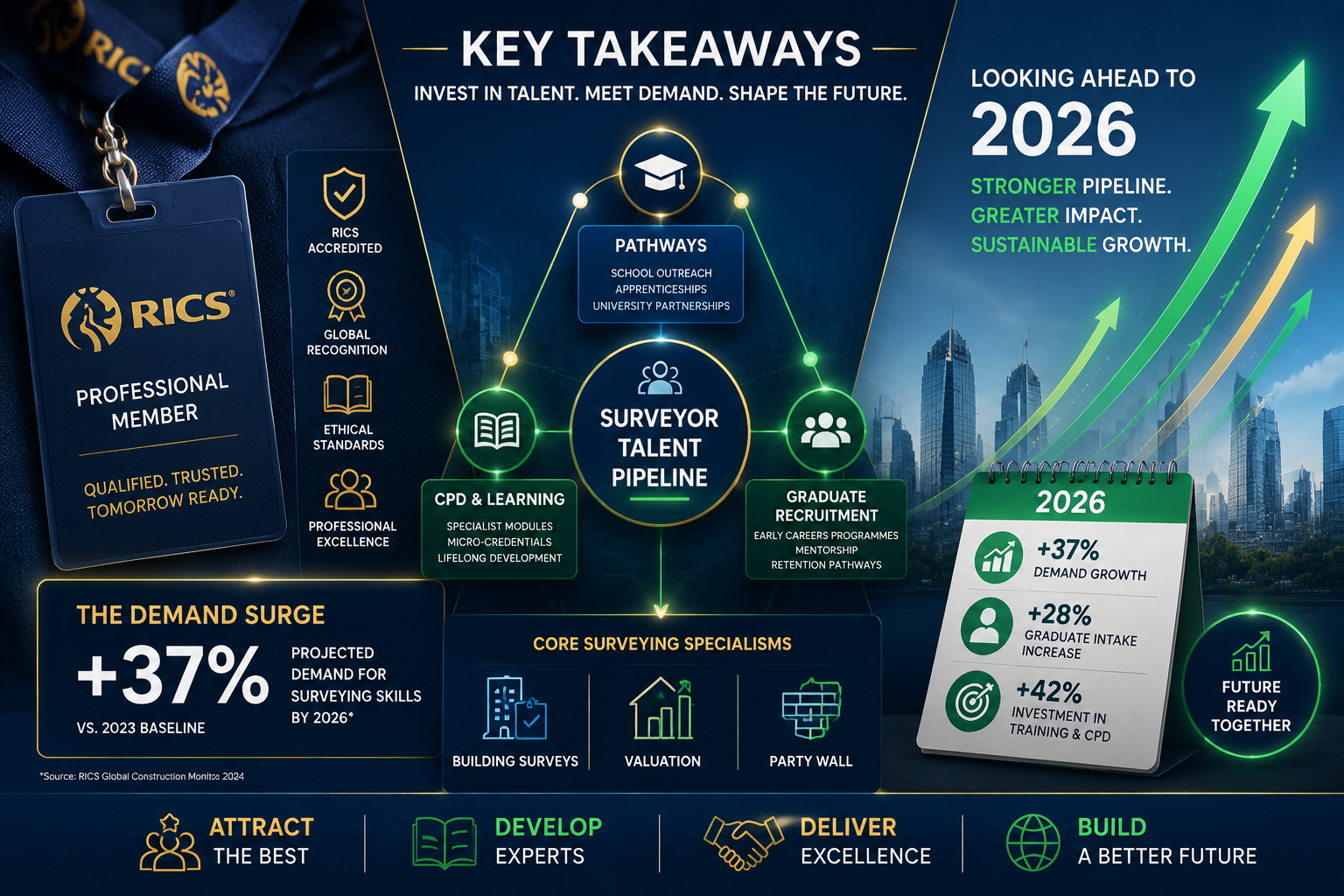
Key Takeaways
- UK surveying vacancy rates remain critically high in 2026, driven by housing reform, retrofit demand, and an ageing workforce [1][4]
- RICS has introduced new professional pathways — including a Data Analytics and Intelligence route — to widen the talent pool [2][3]
- CPD frameworks are evolving from tick-box compliance into structured digital learning journeys that support career progression
- Graduate attraction requires targeted outreach, competitive salary narratives, and clear progression to chartered status
- Firms that invest in apprenticeships, university partnerships, and internal mentoring now will be best positioned to meet 2026 demand
Understanding the 2026 Demand Surge in UK Surveying
The phrase "demand surge" is not hyperbole. The UK government's commitment to building 1.5 million homes over the current parliament, combined with mandatory energy performance upgrades and a wave of dilapidations activity as commercial leases expire post-pandemic, has created simultaneous pressure across multiple surveying specialisms [1][8].
Key demand drivers in 2026 include:
- Residential housing delivery targets requiring volume building surveyors and valuers
- Retrofit and decarbonisation programmes demanding energy-literate surveyors
- Increased dilapidations survey activity as commercial tenants vacate post-pandemic spaces
- A surge in RICS building surveys as buyers seek greater certainty in a volatile market
- Party wall and licence-to-alter work growing in line with permitted development activity
According to data from specialist recruitment platforms, quantity surveyor vacancies in the UK have increased by over 40% since 2022, with building surveyor roles following a similar trajectory [4][10]. The challenge is compounded by demographics: a significant proportion of chartered surveyors are approaching retirement age, and the profession has historically struggled to replace them at pace [6].
"The skills gap is not a future problem. It is a present crisis that will define which firms can grow and which will stall." [1]
The RICS Surveying Skills Report 2025 confirmed that technical competencies — particularly in building pathology, data interpretation, and sustainability assessment — are the areas where shortfalls are most acute [6]. This means the pipeline challenge is not simply about numbers; it is about the quality and breadth of skills entering the profession.
The Ageing Workforce Problem
The average age of a chartered building surveyor in the UK is rising. Many senior practitioners who hold deep expertise in areas such as subsidence surveys and heritage building assessment are within a decade of retirement. When they leave, they take institutional knowledge with them unless firms have invested in structured knowledge transfer.
Apprenticeship schemes and graduate programmes are the most direct antidote, but uptake has been inconsistent across the sector. Firms that treat recruitment as reactive — hiring only when a vacancy arises — are already falling behind those that treat talent pipeline development as a continuous strategic function.
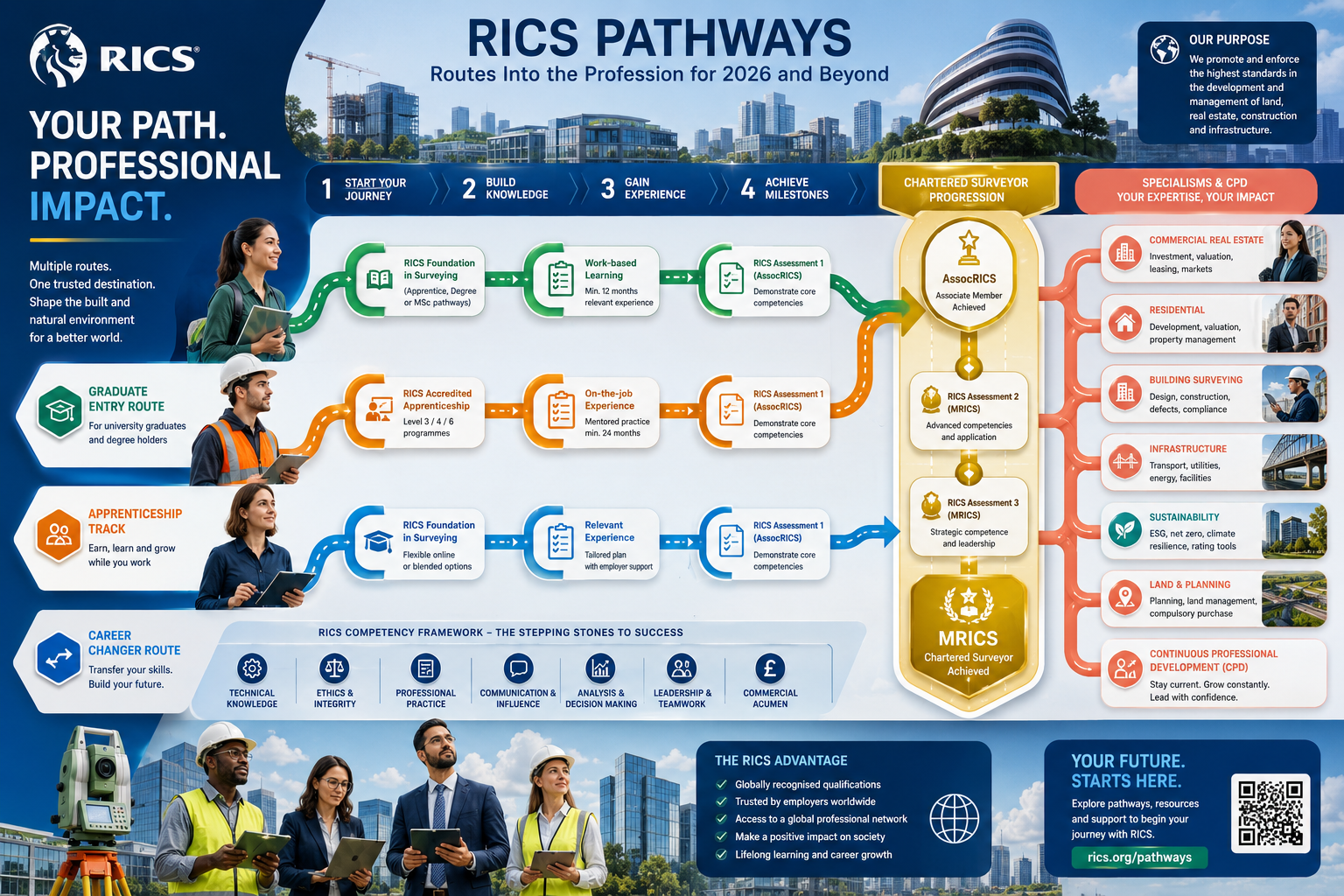
RICS Pathways: Routes Into the Profession for 2026 and Beyond

The Royal Institution of Chartered Surveyors (RICS) offers multiple entry and progression routes, and 2026 sees several of these pathways either newly launched or significantly expanded. Understanding the full menu of options is essential for firms designing their talent strategies.
The APC: Still the Gold Standard
The Assessment of Professional Competence (APC) remains the primary route to MRICS status. Candidates typically spend two years in structured training, logging competencies across technical, professional practice, and interpersonal categories before a final assessment interview. For building surveying, core competencies include building pathology, contract administration, and legal/regulatory compliance.
Firms that want to understand what a chartered building surveyor actually does will find the APC competency framework a useful reference point for job design and training plans.
AssocRICS: The Accelerated Entry Point
AssocRICS offers a faster route to professional recognition for those entering the sector mid-career or through non-traditional educational backgrounds. It requires demonstration of competence at a technician level and is increasingly used by firms recruiting from construction, architecture, and estate management backgrounds. The qualification has grown in relevance as firms look beyond the traditional surveying graduate pool.
New Pathways: Data Analytics and Beyond
In a significant development, RICS has called for expressions of interest in a new Data Analytics and Intelligence professional pathway [2]. This reflects the growing role of PropTech, automated valuation models, and AI-assisted building condition assessments in modern surveying practice.
RICS has also opened pilot programmes for additional new professional pathways, signalling a broader strategic intent to modernise the profession's entry architecture [3]. These routes are designed to attract professionals from data science, engineering, and urban planning backgrounds — disciplines that have historically not considered surveying as a career destination.
Summary of key RICS pathways relevant to building surveys:
| Pathway | Target Candidate | Typical Duration | Outcome |
|---|---|---|---|
| APC (Building Surveying) | Graduate / career changer | 24 months | MRICS |
| AssocRICS | Technician / non-graduate | 12-18 months | AssocRICS |
| Data Analytics Pathway (new) | Data/tech professional | TBC (pilot) | MRICS |
| Senior Professional Assessment | Experienced practitioner | Expedited | MRICS/FRICS |
| Academic Assessment | Academics/researchers | Variable | MRICS/FRICS |
The Global MRICS Roadmap
For internationally mobile candidates and firms with overseas operations, the Global MRICS Roadmap provides a structured pathway to mutual recognition across jurisdictions [5]. This is particularly relevant for firms recruiting from Commonwealth countries where RICS-aligned qualifications already exist. In 2026, this route is gaining traction as UK firms seek to address domestic shortfalls through international recruitment.
CPD as a Retention and Upskilling Tool
Attracting talent is only half the equation. Retaining it — and ensuring it develops the right skills for 2026 demand — requires a robust CPD strategy. The RICS mandates a minimum of 20 hours of CPD per year for all members, but the most effective firms treat this as a floor, not a ceiling.
From Compliance to Career Development
The shift in CPD culture from box-ticking to genuine professional development is one of the most positive trends in the sector. Digital learning platforms now allow surveyors to complete structured modules on topics ranging from damp surveys and thermal imaging to party wall legislation and schedule of condition reporting — all with trackable outcomes.
Countrywide Surveying Services reported a strong start to 2026 for its training academy, citing increased enrolment in both technical and compliance-focused modules as evidence that firms are investing more seriously in structured learning [7]. This is encouraging, but the sector as a whole still lacks the volume of accredited training providers needed to meet demand at scale.
Effective CPD frameworks in 2026 typically include:
- Technical modules: Building pathology, energy performance, structural assessment
- Digital skills: PropTech tools, BIM awareness, data interpretation
- Legal and regulatory updates: Planning reform, building safety legislation, lease law
- Soft skills: Client communication, report writing, expert witness preparation
- Mentoring hours: Structured one-to-one sessions with senior chartered surveyors
Digital CPD and the Remote Workforce
The post-pandemic normalisation of remote working has changed how CPD is delivered. Webinars, on-demand video modules, and virtual site visits now supplement traditional classroom training. For graduate surveyors working across multiple sites — or those based in regional offices away from major training centres — digital CPD has removed a significant barrier to continuous learning.
Firms should ensure that their CPD offer is visible and accessible from day one of employment. A new graduate who can see a clear learning roadmap from AssocRICS to MRICS to specialist accreditation is far more likely to remain with an employer than one who perceives their development as an afterthought.
Attracting Graduates to Building Surveys: Practical Strategies
The pipeline challenge ultimately begins at the point of career choice. Many talented graduates who would thrive as building surveyors simply do not consider the profession — often because they have never encountered it as a career option during their education. Addressing this requires deliberate outreach, honest salary narratives, and compelling progression stories.
University and School Engagement
RICS has actively called on firms to help bring surveying to the next generation through school visits, university partnerships, and work experience programmes [9]. Firms that engage with RICS-accredited degree programmes — at institutions such as the University of Salford, Northumbria, and the College of Estate Management — gain early access to the strongest candidates and build brand recognition among students before they enter the graduate recruitment market.
Practical engagement activities include:
- Guest lectures and site visits for built environment students
- Sponsored dissertation projects on topics relevant to the firm's specialisms
- Summer internships structured around the APC competency framework
- Participation in RICS campus events and careers fairs
- Social media content showcasing the day-to-day reality of building surveying
Salary Transparency and Career Progression
One of the most consistent barriers to graduate attraction in surveying is a perception that salaries are lower than in competing professions such as civil engineering or architecture. In reality, a chartered building surveyor with five to seven years of post-qualification experience commands a competitive package — but this story is rarely told clearly during recruitment.
Firms should publish transparent salary bands, articulate the progression from graduate to chartered to senior surveyor, and quantify the value of employer-funded APC support. The RICS Level 3 building survey specialism, for example, commands premium fees and offers graduates a clear technical niche with strong market demand.
Apprenticeships as a Pipeline Tool
The Level 6 Chartered Surveyor Degree Apprenticeship has matured significantly since its introduction and now represents one of the most effective pipeline tools available to firms. Apprentices earn while they learn, complete a recognised degree, and progress directly to the APC — all without the student debt burden that deters many potential candidates from traditional university routes.
For firms in regional markets, apprenticeships also support local talent development, reducing reliance on London-centric graduate pools and building community ties that improve long-term retention.
Diversity and Inclusion as a Pipeline Strategy
The surveying profession remains less diverse than the population it serves. Widening the talent pool to include more women, ethnic minority candidates, and those from non-traditional educational backgrounds is not just an ethical imperative — it is a practical response to a shortage. RICS data consistently shows that firms with stronger diversity metrics report lower vacancy rates, partly because they fish in a larger talent pond [6].
Targeted bursaries, flexible working arrangements, and visible role models at senior levels are among the most effective interventions. Firms should also audit their job descriptions and recruitment processes for inadvertent barriers that may deter strong candidates from applying.
Building Capacity Across Specialisms: Valuation, Party Wall, and Beyond
The talent pipeline challenge is not uniform across all surveying specialisms. Building surveys, valuations, and party wall work each have distinct skill requirements and different levels of graduate familiarity.
Valuation is one of the most technically demanding areas, requiring knowledge of RICS Red Book valuation standards and the ability to apply them across diverse property types. Graduate surveyors entering this specialism benefit enormously from structured mentoring with RICS-registered valuers who can model professional judgement in real-world scenarios.
Party wall work is a specialism that many graduates discover only after entering the profession. Firms with active party wall practices should consider creating dedicated graduate rotations through this department, supported by CPD modules on the Party Wall etc. Act 1996 and practical training in dispute resolution.
Building pathology — the diagnostic heart of a Level 3 building survey — requires hands-on site experience that cannot be replicated in a classroom. Pairing graduates with experienced surveyors on complex inspections, and debriefing those inspections in structured learning sessions, accelerates competency development faster than any formal training programme alone.
Conclusion
The Surveyor Talent Pipeline for 2026 Demand Surge: RICS Pathways, CPD and Attracting Graduates to Building Surveys is not a problem that will resolve itself. The convergence of housing reform, retrofit demand, commercial dilapidations activity, and an ageing workforce has created a structural gap that requires deliberate, multi-layered action from firms, professional bodies, and educational institutions alike.
Actionable next steps for firms and sector leaders:
- Audit your current pipeline — map existing graduate, apprentice, and APC candidate numbers against projected demand over the next three years
- Engage with new RICS pathways — explore the Data Analytics and Intelligence route and other pilot programmes as a way to attract non-traditional candidates [2][3]
- Invest in digital CPD — build structured learning roadmaps that take graduates from day one to chartered status, with clear milestones and employer support
- Formalise university partnerships — sponsor dissertations, offer placements, and attend RICS campus events to build brand recognition early [9]
- Launch or expand apprenticeships — the Level 6 Degree Apprenticeship is one of the most cost-effective pipeline tools available to firms of all sizes
- Review diversity practices — widen the talent pool by removing barriers and building visible career pathways for underrepresented groups
- Retain through development — surveyors who see a clear path to MRICS and beyond are significantly less likely to leave for a competitor
The firms that treat talent pipeline development as a strategic priority in 2026 — not a reactive HR function — will be the ones best placed to meet client demand, win new instructions, and grow sustainably through the recovery period ahead [1][8].
References
[1] Surveying In 2026 Reform Recovery And Renewed Demand – ukreiif.lrg.co.uk
[2] Rics Calls For Expressions Of Interest In New Data Analytics And Intelligence Pathway – rics.org
[3] Rics Calls Expressions Interest Pilot Programmes New Professional Pathways – rics.org
[4] The Quantity Surveyor Shortage A Technical Outlook For 2026 – onboard-jobs.co.uk
[5] Global Mrics Roadmap 2026 Quantity Surveyor – staffordlawrence.com
[6] Surveying Skills Report 2025 – rics.org
[7] Countrywide Surveying Services Reports Strong Start To 2026 For Training Academy – modernlender.co.uk
[8] 2026 Building Surveying Job Market Opportunities Chris Van Aurich E7xze – linkedin.com
[9] Help Bring Surveying To The Next Generation – rics.org
[10] Are Quantity Surveyors In Demand Uk – surveyorsuccess.co.uk
How Prince Surveyors can help: explore our Level 3 building surveys or learn about our Level 2 vs Level 3 guide.