

Last updated: July 24, 2026
Quick Answer: Smith and Knight Residential Surveying is a RICS-regulated property firm based in Roehampton, London, offering chartered surveyor services including the most detailed residential inspection available, the RICS Level 3 Building Survey. For UK homebuyers purchasing older, non-standard, or structurally complex properties, a Level 3 survey combined with party wall advice and an independent valuation provides the most complete picture of a property's true condition and market worth before exchange.
Key Takeaways
- A Level 3 Building Survey is the most thorough residential inspection available under the RICS framework, covering structural elements, defects, and maintenance needs in detail.
- A Level 2 HomeBuyer Report suits modern, standard-construction homes in good condition; a Level 3 suits older, extended, or unusual properties.
- Party wall surveying is a separate legal process under the Party Wall etc. Act 1996 and is often needed when buying terraced or semi-detached homes where neighbours plan or have carried out works.
- A building survey and a mortgage valuation serve different purposes; a valuation protects the lender, not the buyer.
- Survey findings can directly affect your negotiating position, and in some cases, your ability to secure a mortgage.
- Level 3 surveys typically take three to eight hours on site, with reports delivered within five to ten working days.
- Structural issues found in a survey are not automatically deal-breakers; they become tools for renegotiation or informed decision-making.
- Smith and Knight Property is listed on the RICS firms directory, meaning it is subject to RICS professional and ethical standards.
What Is a Level 3 Building Survey and How Does It Differ from Level 2
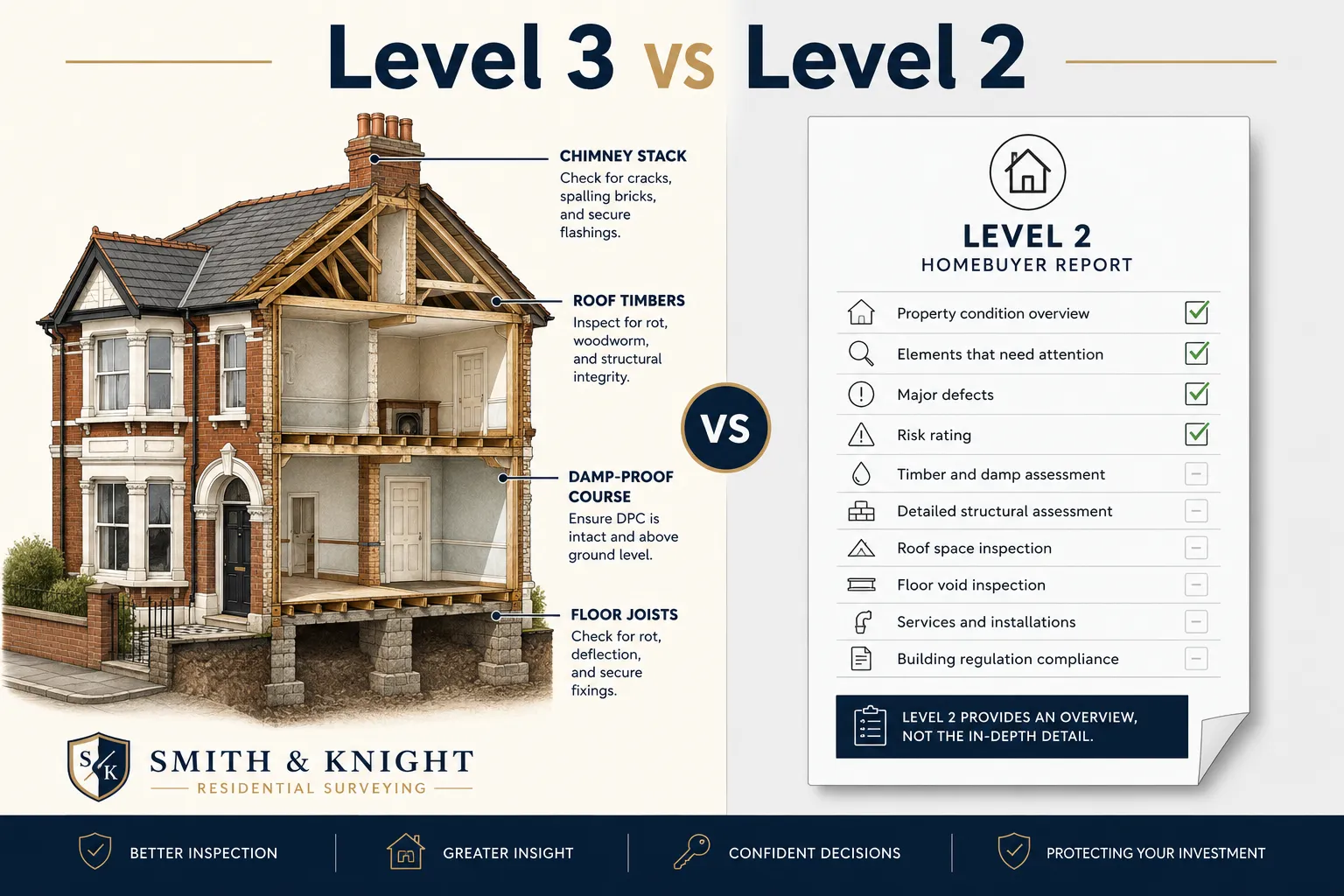
A RICS Level 3 Building Survey is the most detailed standard residential inspection available. It covers the full fabric of a property, roof structure, chimneys, walls, floors, windows, drainage, and visible services, with in-depth commentary on condition, causes of defects, and recommended remedial action. A Level 2 HomeBuyer Report, by contrast, uses a traffic-light condition rating system and is designed for properties in reasonable condition built after roughly 1900 using conventional construction.
The key differences come down to depth and scope:
- Level 2 identifies visible defects and flags urgent issues using a three-tier rating (1 = no action, 2 = monitor, 3 = urgent).
- Level 3 explains the likely cause of each defect, describes repair options, estimates maintenance implications, and flags areas needing specialist investigation.
- Level 3 is appropriate for properties pre-1900, those with extensions, non-standard construction (e.g., timber frame, thatched roofs), listed buildings, or any home showing signs of structural movement, damp, or neglect.
For a deeper look at what the inspection covers, see this detailed guide to what is a Level 3 building survey.
Decision rule: Choose Level 3 if the property is over 100 years old, has been significantly altered, shows visible cracks, or is of non-standard construction. Choose Level 2 if the property is a post-war, standard-brick home in visibly good condition.
Who Needs a Level 3 Survey vs a Level 2
A Level 3 survey is the right choice for buyers of older, extended, or structurally complex homes. A Level 2 suits buyers of modern, standard properties in good visible condition.
Specifically, choose a Level 3 if you are buying:
- A Victorian or Edwardian terraced or semi-detached house
- A property with a loft conversion, rear extension, or basement
- A listed building or property in a conservation area
- A home showing signs of cracking, damp, subsidence, or roof deterioration
- Any property where the mortgage lender's valuer has flagged concerns
Choose a Level 2 if you are buying a post-1980s new-build or a well-maintained flat in a modern block. For new-builds specifically, a snagging survey may be more appropriate than either standard level.
For a side-by-side breakdown, the complete guide to choosing between Level 2 and Level 3 covers the decision in full.
What's Included in Smith and Knight Building Surveys
Smith and Knight Residential Surveying: Level 3 Building Surveys, Party Wall Integration, and Valuation Insights represents a joined-up approach to property due diligence. As a RICS-regulated firm, Smith and Knight Property operates under the professional standards that govern all RICS member firms, which means their Level 3 survey output must meet defined technical and reporting criteria.
A standard Level 3 Building Survey from a RICS-regulated firm typically includes:
- Inspection of all accessible structural elements (roof, walls, floors, foundations)
- Assessment of damp, timber defects, and drainage
- Commentary on building materials and their condition
- Identification of building defects with likely causes
- Guidance on budgeting for repairs and restoration
- Flagging of areas requiring further specialist investigation
- Notes on statutory considerations such as planning and building regulations compliance
Note: The RICS directory listing for Smith and Knight does not specify whether the firm offers a combined Level 3 plus party wall plus valuation package. Buyers should confirm the exact scope of services directly with the firm before instructing.
Do I Need a Party Wall Survey When Buying a Terraced House
Buying a terraced house does not automatically trigger a party wall survey for the buyer. The Party Wall etc. Act 1996 is activated when a property owner intends to carry out certain works, not by the act of purchasing. However, if you plan to extend, excavate, or alter a shared wall after purchase, you will need to serve notice on adjoining owners.
There are two scenarios where party wall matters become relevant during a purchase:
- The seller has carried out recent works affecting a party wall without serving proper notice. A surveyor can check whether a party wall award exists and whether works were carried out lawfully.
- You plan works after purchase. In this case, you will need to serve notice before starting, and both parties may appoint surveyors to agree a party wall award.
Common mistake: Many buyers confuse a party wall survey (a legal process under the 1996 Act) with a building survey that inspects the shared wall as part of the property's fabric. They are different things. For more on this distinction, see top questions about party wall surveys.
What's the Difference Between the Party Wall Act and a Party Wall Survey
The Party Wall etc. Act 1996 is the legislation that governs works to shared walls, boundary walls, and excavations near neighbouring properties. A party wall survey is the process by which a chartered surveyor documents the condition of a party wall before and after works, and produces a legally binding party wall award.
In plain terms:
- The Act sets out the legal obligations, who must serve notice, what works are covered, and what happens if neighbours disagree.
- The survey is the practical step: a surveyor inspects the wall, records its condition, and the award protects both parties if damage occurs.
Ignoring the Act carries real consequences. Neighbours can seek an injunction to stop works, and the building owner can be held liable for any damage caused. For a full breakdown of what can go wrong, see consequences of ignoring the Party Wall Act.
Can a Level 3 Survey Affect My Property Valuation
Yes, survey findings can directly influence both the agreed purchase price and, in some cases, a lender's mortgage valuation. A Level 3 survey that identifies significant structural defects, damp, or roof failure gives buyers documented grounds to renegotiate the purchase price before exchange.
How this plays out in practice:
- Price reduction: Buyers can present survey findings to the seller and request a price reduction reflecting the cost of remedial works. Research consistently shows that buyers who use survey findings to negotiate achieve meaningful reductions on properties with identified defects.
- Mortgage impact: If a lender's valuer becomes aware of serious structural issues (either from the survey report or their own inspection), they may reduce the mortgage offer, impose a retention, or decline to lend until works are completed.
- Insurance implications: Some defects identified in a Level 3 report, such as subsidence history or non-standard roof construction, may affect buildings insurance premiums or eligibility.
For guidance on using survey findings in negotiations, see how to negotiate a house price down after a survey.
Do I Need Both a Survey and a Valuation
Yes, in almost every case. A mortgage valuation and a building survey serve entirely different purposes, and one does not replace the other.
| Purpose | Mortgage Valuation | Level 3 Building Survey |
|---|---|---|
| Who it protects | The lender | The buyer |
| Depth of inspection | Brief (often 20-30 mins) | Thorough (3-8 hours) |
| Covers defects | Rarely in detail | Yes, in full |
| Informs negotiation | No | Yes |
| Required by lender | Yes | No (buyer's choice) |
A mortgage valuation confirms the property is worth the loan amount. It does not tell you whether the roof needs replacing in two years or whether there is active subsidence. A Level 3 survey does both.
Edge case: Some lenders offer a "survey and valuation" combined product. Read the small print carefully, these are often still closer to a Level 2 than a Level 3, and the surveyor's primary duty remains to the lender.
How Long Does a Level 3 Building Survey Take
The on-site inspection for a Level 3 Building Survey typically takes between three and eight hours, depending on the size, age, and complexity of the property. A two-bedroom Victorian terrace might take three to four hours; a five-bedroom detached Edwardian house with outbuildings could take a full day.
After the inspection, report preparation and delivery typically takes five to ten working days, though some firms offer faster turnaround for an additional fee.
For a detailed breakdown of timings by property type, see building survey timeframes.
How Much Does a Level 3 Building Survey Cost
Level 3 Building Survey fees in the UK vary based on property size, location, and the surveying firm. As a general guide for 2026:
- Small flat or terraced house (under 100 sqm): approximately £500 to £800
- Mid-size semi-detached or detached (100-200 sqm): approximately £700 to £1,200
- Large or complex property (over 200 sqm, listed, or unusual construction): £1,000 to £2,000 or more
London and South East properties typically sit at the higher end of these ranges. These figures are estimates based on current market rates and will vary by firm and property.
Is it worth the money? For most buyers of older properties, yes. A survey costing £800 that identifies £15,000 of necessary roof repairs pays for itself many times over, either through a price reduction or by preventing a costly surprise after completion.
What Happens If a Survey Finds Structural Issues
Structural issues in a survey report are not automatically a reason to walk away. The appropriate response depends on the severity, the likely cost of remediation, and whether the seller is willing to negotiate.
Step-by-step approach:
- Read the report carefully. Level 3 reports categorise issues by urgency. Not every flagged item is critical.
- Get specialist quotes. For significant structural concerns (subsidence, roof failure, timber decay), commission a structural engineer or specialist contractor to provide a repair estimate before renegotiating.
- Negotiate or request remediation. Use the documented findings and repair quotes to request a price reduction or ask the seller to carry out works before exchange.
- Reassess your position. If the cost of remediation exceeds what you can negotiate off the price, or if the lender withdraws the mortgage offer, you may need to reconsider the purchase.
- Do not ignore the findings. Failing to act on known defects can have serious financial and safety consequences, see consequences of failing to act on survey findings.
Can I Use a Smith and Knight Survey for Mortgage Purposes
A RICS Level 3 Building Survey from a regulated firm like Smith and Knight is a condition report for the buyer, not a mortgage valuation. Most lenders require their own RICS-registered valuer to confirm the property's market value before approving a mortgage offer.
That said, some lenders will accept a combined survey and valuation product if it is carried out by a RICS-registered valuer on their approved panel. Buyers should confirm with their lender whether Smith and Knight surveyors are on that panel before instructing a combined report.
Practical tip: If you want a single visit to cover both purposes, ask the surveyor upfront whether they can produce a RICS Red Book valuation alongside the Level 3 report, and confirm your lender will accept it.
What Should I Do If My Surveyor Misses Something
If a defect is discovered after purchase that a competent surveyor should reasonably have identified during the inspection, you may have grounds for a professional negligence claim. RICS-regulated firms are required to hold professional indemnity insurance for exactly this reason.
Steps to take:
- Document the defect with photographs, contractor reports, and cost estimates.
- Review the original survey report to check whether the area was inspected, noted as inaccessible, or flagged for further investigation.
- Contact the surveying firm in writing, setting out your concern and the evidence.
- Escalate to RICS if the firm does not respond satisfactorily, RICS has a formal complaints and disciplinary process for regulated firms.
- Seek legal advice if the financial loss is significant and the firm disputes liability.
Important caveat: Surveyors are only required to inspect accessible areas. If a defect was concealed behind fitted furniture, under carpets, or in a locked roof space, it may fall outside the scope of a reasonable visual inspection.
Is a Level 3 Survey Worth the Money
For most buyers of older UK properties, a Level 3 Building Survey is one of the most cost-effective purchases in the entire transaction. The fee is modest relative to the purchase price, and the information it provides can save buyers from inheriting expensive problems or overpaying for a property in poor condition.
It is worth the cost if:
- The property is pre-1970 or of non-standard construction
- You are buying at or near your maximum budget and cannot absorb unexpected repair costs
- The property has visible signs of damp, cracking, or deferred maintenance
- You are purchasing a leasehold flat and want clarity on the building's condition beyond the lease terms
It may be less critical if you are buying a recently built property in demonstrably good condition, though even then, a Level 2 at minimum is advisable.
FAQ
What is the difference between a Level 2 and Level 3 survey?
A Level 2 HomeBuyer Report uses a traffic-light rating system and suits modern, standard-construction homes in reasonable condition. A Level 3 Building Survey provides a full structural analysis, explains the causes of defects, and recommends remedial action. Level 3 is appropriate for older, extended, or complex properties.
Does Smith and Knight offer party wall surveying alongside building surveys?
Smith and Knight Property is listed as a RICS-regulated firm. Whether they offer an integrated party wall and building survey service should be confirmed directly with the firm, as the RICS directory does not specify individual service lines.
Can I negotiate the purchase price based on a Level 3 survey?
Yes. A Level 3 report provides documented evidence of defects and their likely repair costs, which gives buyers a factual basis for price renegotiation before exchange of contracts.
How is a party wall survey different from a building survey?
A building survey inspects the physical condition of a property for the buyer's benefit. A party wall survey is a legal process under the Party Wall etc. Act 1996, carried out when works affect a shared wall or boundary. They serve different purposes and are instructed at different stages.
Do I need a survey if I'm buying a new-build?
A standard Level 2 or Level 3 survey is less relevant for brand-new homes, but a snagging survey, which checks for defects in workmanship and finish, is strongly recommended before legal completion on a new-build.
What qualifications should my surveyor have?
For a Level 3 Building Survey, look for a surveyor who is a Member or Fellow of RICS (MRICS or FRICS) with specific experience in residential building surveying. RICS-regulated firms are subject to professional standards, complaints procedures, and mandatory professional indemnity insurance.
Conclusion
Smith and Knight Residential Surveying: Level 3 Building Surveys, Party Wall Integration, and Valuation Insights covers the three pillars of informed property purchase: understanding what you are buying, protecting your legal position on shared structures, and knowing what you are paying for it.
For UK homebuyers in 2026, the practical next steps are clear:
- Identify the right survey level before instructing, use the property's age, construction type, and visible condition as your guide.
- Instruct a RICS-regulated surveyor and confirm their experience with the specific property type.
- Check party wall obligations if you plan any works after purchase, and verify whether the seller has complied with the Act for any recent alterations.
- Do not rely on the lender's valuation as a substitute for a proper condition survey.
- Use the survey report actively, read it in full, get specialist quotes for flagged defects, and use documented findings to negotiate where appropriate.
A Level 3 survey is not a bureaucratic formality. For the right property, it is the single most valuable piece of due diligence a buyer can commission.
.sk-tool{font-family:Arial,sans-serif;max-width:560px;margin:2em auto;border:2px solid #1a3a5c;border-radius:8px;overflow:hidden}
.sk-tool h3{background:#1a3a5c;color:#fff;margin:0;padding:14px 18px;font-size:1rem}
.sk-tool .sk-body{padding:16px 18px}
.sk-tool label{display:block;font-size:.9rem;font-weight:600;margin-bottom:6px;color:#1a3a5c}
.sk-tool .sk-q{margin-bottom:14px}
.sk-tool select{width:100%;padding:8px;border:1px solid #ccc;border-radius:4px;font-size:.9rem}
.sk-tool button{background:#1a3a5c;color:#fff;border:none;padding:10px 22px;border-radius:4px;cursor:pointer;font-size:.9rem;margin-top:4px}
.sk-tool button:hover{background:#2a5a8c}
.sk-result{margin-top:14px;padding:12px;border-radius:4px;font-size:.9rem;display:none}
.sk-l2{background:#e8f4e8;border-left:4px solid #2e7d32}
.sk-l3{background:#fff3e0;border-left:4px solid #e65100}
.sk-result strong{display:block;margin-bottom:4px;font-size:1rem}
Which Survey Level Do You Need?
function calcSurvey(){
var a=document.getElementById(‘age’).value,b=document.getElementById(‘build’).value,c=document.getElementById(‘cond’).value;
if(!a||!b||!c){alert(‘Please answer all three questions.’);return;}
var l3=(a===’old’||b===’nonstandard’||c===’concern’);
document.getElementById(‘res-l3′).style.display=l3?’block’:’none’;
document.getElementById(‘res-l2′).style.display=l3?’none’:’block’;
}
Tags: Level 3 building survey, Smith and Knight surveying, party wall survey, RICS building survey, residential surveying, property valuation, homebuyer survey, building defects, party wall act, chartered surveyor, survey vs valuation, UK property survey