


Last updated: July 24, 2026
Quick Answer: A party wall surveyor acting as an expert witness conducts structured site visits to document construction conditions, then prepares CPR Part 35-compliant reports that courts and tribunals can rely on as independent, impartial evidence. These reports follow strict Civil Procedure Rules requirements, covering the surveyor's qualifications, factual findings, reasoned opinions, and a signed declaration of truth. They are most commonly used in disputes over damage causation, works carried out without notice, and appeals against party wall awards.
Key Takeaways
- Party wall surveyors become expert witnesses when disputes escalate to court or formal tribunal proceedings under the Party Wall etc. Act 1996.
- CPR Part 35 governs how expert witness reports must be structured: they must be independent, clearly distinguish fact from opinion, and include a declaration of truth.
- Site visits are not a one-off event; surveyors typically attend before works begin, during construction, and after completion to build a defensible evidence trail.
- A pre-works schedule of condition is the single most important document for proving or disproving damage causation claims.
- Party wall surveyors and structural engineers serve different functions; both may be needed in complex disputes.
- Costs for party wall expert witness services vary but typically range from a few hundred pounds for a basic report to several thousand for full court-ready expert evidence.
- Failing to appoint a surveyor under the Act can expose a building owner to injunctions, damages claims, and significant legal costs.
- When hiring an expert witness, look for RICS membership, demonstrable party wall experience, and familiarity with CPR Part 35 obligations.
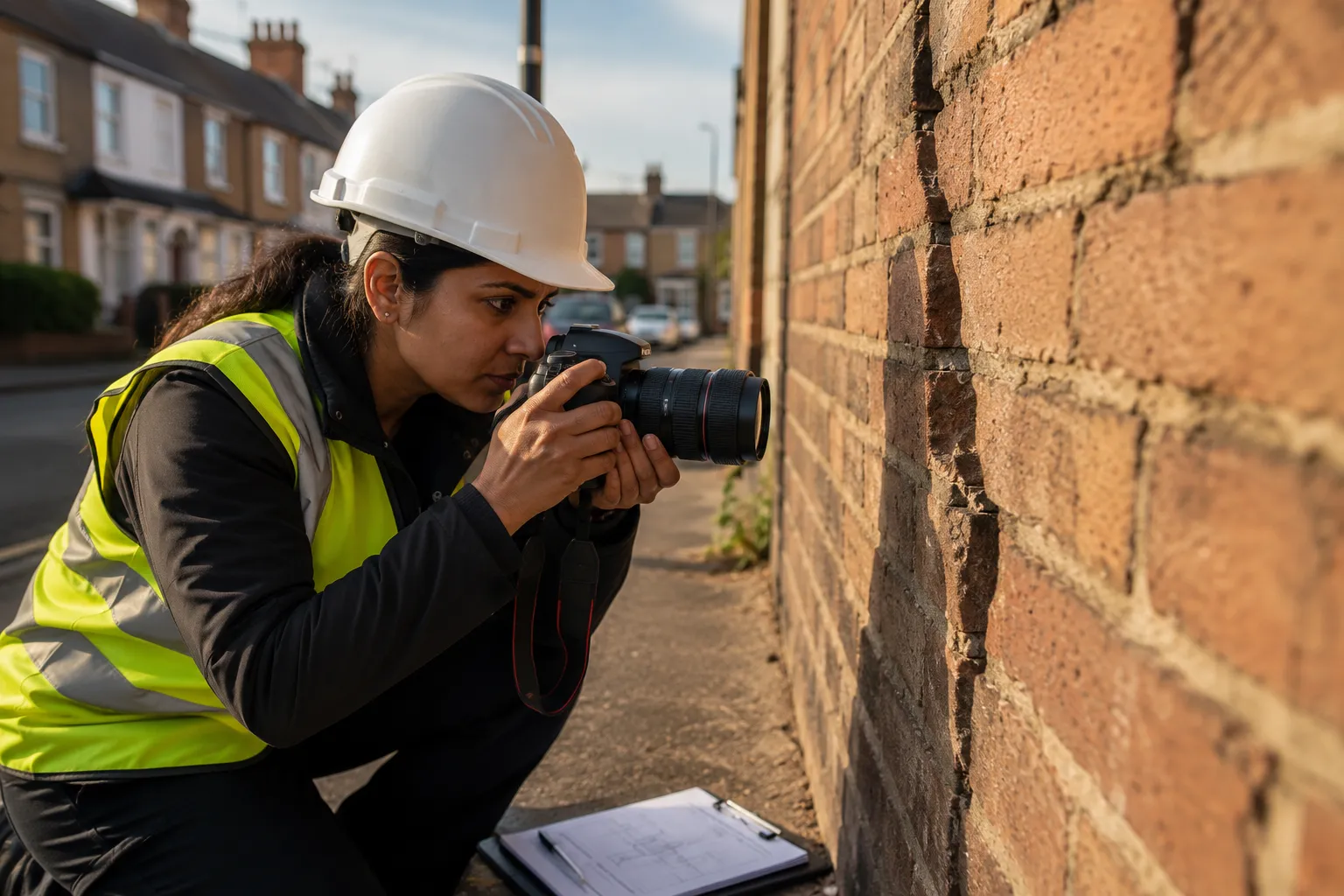
What Is a Party Wall Surveyor and What Do They Do?
A party wall surveyor is a specialist, usually a chartered surveyor, appointed to administer the Party Wall etc. Act 1996 on behalf of one or both neighbouring property owners. Their primary role is to protect both parties' legal rights during construction works that affect a shared wall, boundary, or excavation near an adjoining property.
Day-to-day, a party wall surveyor:
- Serves and receives party wall notices on behalf of building or adjoining owners
- Prepares and agrees a Party Wall Award (a legally binding document setting out how works must proceed)
- Carries out pre-works and post-works inspections to record the condition of adjoining properties
- Monitors construction activity where the Award requires it
- Resolves disputes between neighbours about the scope, method, or consequences of notifiable works
When a dispute cannot be resolved through the standard Award process, or when one party challenges an Award in court, the surveyor may be called upon to provide formal expert evidence. At that point, their role shifts from administrator to expert witness, and the requirements governing their work change significantly. For a broader overview of when you need this type of professional, see this guide on whether you need a party wall surveyor.
What Does CPR-Compliant Mean for Expert Witness Reports?
A CPR-compliant report is one that satisfies the requirements of Civil Procedure Rules Part 35, the rules that govern expert evidence in civil litigation in England and Wales. In short, an expert witness's primary duty is to the court, not to the party who instructed them.
A CPR Part 35-compliant party wall expert witness report must include:
- The expert's qualifications and relevant experience
- A clear statement of the instructions received and the facts relied upon
- A distinction between established facts, assumptions, and professional opinions
- The reasoning behind each conclusion, not just the conclusion itself
- A summary of findings
- A signed declaration confirming the report is truthful, complete, and complies with CPR Part 35
Why this matters: Courts will disregard or heavily discount a report that blurs the line between fact and opinion, or that reads as an advocate's document rather than an independent assessment. Surveyors who regularly act as expert witnesses invest considerable effort in structuring their reports to meet this standard, because a poorly structured report can undermine an otherwise strong case.
This is the foundation of what makes site visits and CPR-compliant reports so central to what surveyors do as party wall expert witnesses.
How Often Do Surveyors Visit a Construction Site for Party Wall Work?
The number of site visits depends on the complexity and duration of the works, but most party wall matters involve at least three distinct inspection stages.
Typical visit schedule:
| Stage | Purpose | Timing |
|---|---|---|
| Pre-works inspection | Record existing condition of adjoining property | Before any works begin |
| Monitoring visit(s) | Check compliance with the Award during works | During construction |
| Post-works inspection | Identify any new damage or changes | After works complete |
For straightforward loft conversions or minor alterations, a single pre-works and post-works inspection may suffice. For basement excavations or underpinning projects, which carry higher risk to neighbouring structures, monthly or even fortnightly monitoring visits are common. You can read more about the specific considerations in basement projects and party wall surveying in Surrey as a practical example.
Common mistake: Skipping the pre-works inspection is the single biggest error in party wall administration. Without a documented baseline, it becomes almost impossible to prove whether a crack or defect existed before works began or was caused by them.
How Does a Surveyor Document Damage During Site Visits?
Thorough documentation during site visits is the backbone of any credible expert witness report. A surveyor acting as an expert witness uses a systematic approach to create an evidence trail that will withstand scrutiny in court.
During a site visit, a surveyor typically:
- Photographs all existing defects with date-stamped images, including close-ups and contextual shots showing location
- Measures crack widths using calibrated crack gauges, recording dimensions in millimetres
- Prepares a written schedule of condition describing every defect, its location, and its severity
- Notes structural observations such as signs of movement, water ingress, or differential settlement
- Compares current conditions against the pre-works schedule to identify any new or worsened defects
The party wall schedule of condition is the document that makes or breaks a damage causation claim. Without one, neither side can objectively demonstrate what changed.
"A schedule of condition prepared before works begin is the surveyor's most powerful tool. It turns a subjective dispute into an objective comparison."
What Should Be Included in a CPR-Compliant Party Wall Report?
A CPR-compliant party wall expert witness report goes beyond a standard survey report. It must be structured so that a judge or arbitrator can follow the surveyor's reasoning from raw observation to reasoned conclusion.
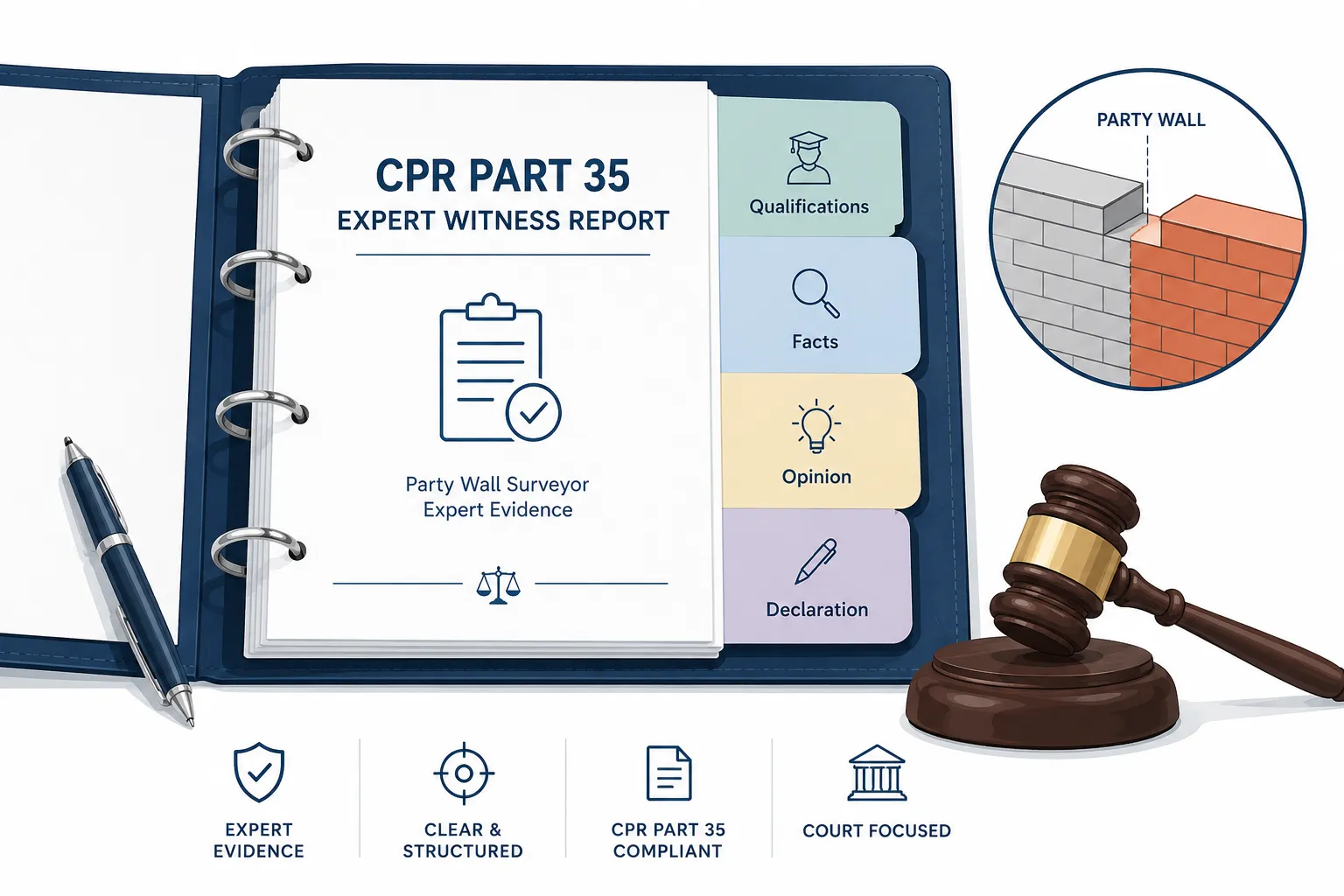
Core sections of a compliant report:
- Introduction and instructions, who appointed the expert, when, and for what purpose
- Expert's qualifications, relevant credentials, RICS membership, years of experience in party wall matters
- Documents reviewed, party wall notices, Awards, correspondence, prior schedules of condition
- Site inspection record, dates of visits, who was present, access granted or refused
- Factual findings, what was observed, measured, and photographed
- Opinion on causation, whether identified damage is attributable to the notifiable works, with reasoning
- Quantum assessment, estimated cost of remediation where relevant
- Summary of conclusions, brief, numbered, directly answering the questions posed
- Declaration of truth, signed statement per CPR Part 35
For expert witness services that meet this standard, see Prince Surveyors' expert witness reports service.
Can a Party Wall Surveyor Be Called as an Expert Witness in Court?
Yes. A party wall surveyor with appropriate qualifications and experience can be appointed as a single joint expert or as a party-appointed expert in civil proceedings. This most commonly arises in County Court claims for property damage, injunction applications, and appeals against party wall awards under Section 10(17) of the Party Wall etc. Act 1996.
Surveyors are frequently engaged in court proceedings to:
- Provide independent opinions on whether construction works caused specific damage
- Assess the technical soundness and validity of an existing party wall award
- Offer evidence in cases where works began without proper notice under the Act
- Give opinions on reasonable surveyor fees and proper professional conduct under the Act
The key qualification is not just technical knowledge but the ability to present evidence clearly, withstand cross-examination, and maintain impartiality even when instructed by one side. RICS members are bound by professional conduct rules that reinforce this obligation.
What Is the Difference Between a Party Wall Surveyor and a Structural Engineer?
A party wall surveyor administers the legal process under the Party Wall etc. Act 1996, documents conditions, and produces expert evidence on damage causation and compliance. A structural engineer designs, analyses, and certifies the structural integrity of building elements.
In practice, the two roles complement each other:
- A party wall surveyor determines whether works were notifiable, whether an Award was properly made, and whether observed damage is consistent with the notifiable works
- A structural engineer assesses whether a wall, foundation, or floor can safely bear the loads imposed by proposed or completed works
Choose a party wall surveyor if: you need an Award, a schedule of condition, or expert evidence on damage causation in a legal dispute.
Choose a structural engineer if: you need calculations, structural drawings, or a professional opinion on whether a building element is safe to alter.
In high-value disputes involving basement excavations or underpinning, both professionals are often needed. It is worth reading about how engineers and party wall surveyors interact to understand where their responsibilities overlap.
How Much Does a Party Wall Surveyor Cost?
Party wall surveyor costs vary depending on the scope of work, the complexity of the project, and whether the matter proceeds to formal expert witness proceedings.
Typical cost ranges (estimates based on current market rates in England and Wales as of 2026):
- Standard party wall notice and Award: £700 to £1,500 per surveyor appointment
- Schedule of condition: £300 to £800 depending on property size
- Expert witness report (CPR-compliant): £1,500 to £5,000 or more for complex matters
- Court attendance as expert witness: charged at an hourly or daily rate, typically £150 to £400 per hour
Costs increase significantly when works are contested, when multiple site visits are required, or when the matter proceeds to a County Court hearing. For a detailed breakdown, see this guide on party wall surveyor costs and the related article on party wall agreement costs.
Important note: Where an adjoining owner dissents to a notice, the building owner is generally responsible for the reasonable costs of the adjoining owner's surveyor. This is a statutory obligation under the Act, not a matter of negotiation.
What Happens If You Don't Get a Party Wall Surveyor?
Proceeding with notifiable works without serving proper notice or appointing a surveyor is a common and costly mistake. The Party Wall etc. Act 1996 does not include criminal penalties, but the civil consequences can be severe.
Potential consequences include:
- Injunction: A court can order works to stop immediately, sometimes requiring demolition of work already completed
- Damages claim: The adjoining owner can sue for any damage caused, and without a pre-works schedule of condition, the building owner has no baseline to dispute the claim
- Higher legal costs: Disputes that arise after works begin without notice are far more expensive to resolve than those managed proactively
- Difficulty selling: Buyers' solicitors increasingly check for party wall compliance, and missing paperwork can delay or derail a sale
For a full picture of the risks, see the article on the consequences of ignoring the Party Wall Act.
Do You Need a Party Wall Surveyor for All Construction Work?
No. The Party Wall etc. Act 1996 applies only to specific categories of work. A surveyor is needed when proposed works fall within the Act's scope and the adjoining owner does not consent in writing.
Works that trigger the Act include:
- Building on or at the line of junction between two properties
- Cutting into, raising, or underpinning a party wall or party fence wall
- Excavating within 3 or 6 metres of an adjoining building's foundations (depending on depth)
Works that do not typically trigger the Act include:
- Internal alterations that do not affect the party wall structure
- Work entirely within your own property and not near the boundary
- Routine maintenance and decoration
If you are unsure whether your project requires notice, the safest course is to consult a surveyor before works begin. See also the guide on party wall rights for a clear explanation of what the Act covers.
What Should You Look for When Hiring a Party Wall Expert Witness?
Not every party wall surveyor has the experience or training to act as an expert witness. The role requires specific skills beyond standard party wall administration.
When selecting a party wall expert witness, look for:
- RICS membership (MRICS or FRICS), this signals adherence to professional conduct standards
- Demonstrable party wall experience, ideally, a surveyor who has administered dozens or hundreds of Awards, not just a handful
- Familiarity with CPR Part 35, ask directly whether they have prepared court-ready expert witness reports before
- Experience of cross-examination, an expert who has given oral evidence in court is better prepared than one who has not
- Impartiality, be cautious of any surveyor who promises to "win your case"; a credible expert witness presents the evidence as it is
- Clear fee structure, understand how they charge for report preparation, site visits, and court attendance separately
Edge case: In some disputes, the court appoints a single joint expert agreed by both parties. In this scenario, the expert's duty to the court is even more pronounced, and both parties must be confident in their impartiality before agreeing to the appointment.
What Are Common Mistakes in Party Wall Reports?
Even experienced surveyors can produce reports that fall short of CPR Part 35 requirements. Courts and opposing counsel will look for these weaknesses.
Common mistakes to avoid:
- Mixing fact and opinion without clearly labelling which is which
- Omitting the declaration of truth required by CPR Part 35
- Failing to address the questions actually posed by the instructing solicitor or court
- Relying on hearsay (what a client told them) without identifying it as such
- Overstating certainty, using "the works caused the damage" when the evidence supports only "the works are a probable contributing factor"
- Inadequate photographic evidence, photos without scale references, date stamps, or location context
- No comparison to the pre-works schedule, making it impossible to distinguish new damage from pre-existing defects
A well-structured, CPR-compliant report avoids all of these pitfalls by following a clear methodology from the first site visit through to the final signed declaration.
How Long Does a Party Wall Survey Take?
The timeline for a party wall matter depends on the stage and complexity involved.
- Serving notice and receiving a response: The Act requires a minimum of one month's notice for party wall works and two months for line of junction works. The adjoining owner has 14 days to respond.
- Agreeing an Award: Typically 4 to 8 weeks from appointment of surveyors, though complex projects can take longer.
- Preparing a CPR-compliant expert witness report: Usually 2 to 6 weeks from the final site visit, depending on the volume of evidence and the complexity of the causation analysis.
- Full court proceedings: If a dispute proceeds to a County Court hearing, the entire process from instruction to judgment can take 6 to 18 months.
For projects involving loft conversions or extensions, understanding the timeline early helps avoid delays to the build programme. The article on top party wall agreement considerations for renovations covers this in more detail.
Frequently Asked Questions
What is a party wall expert witness?
A party wall expert witness is a surveyor, typically RICS-qualified, appointed to provide independent professional evidence in legal proceedings involving the Party Wall etc. Act 1996. Their duty is to the court, not to the party who instructed them, and their reports must comply with CPR Part 35.
Do I need a separate expert witness, or can my party wall surveyor act in both roles?
In some cases, the same surveyor can act as both the party wall administrator and the expert witness, provided they can demonstrate impartiality. However, in contested disputes, it is often cleaner to appoint a separate expert witness who was not involved in the original Award process.
What is a schedule of condition and why is it important?
A schedule of condition is a detailed written and photographic record of the state of an adjoining property before works begin. It is the primary evidence used to determine whether construction works caused or contributed to any subsequent damage.
Can a party wall award be challenged in court?
Yes. Under Section 10(17) of the Party Wall etc. Act 1996, either party can appeal a party wall award to the County Court within 14 days of service. Expert witness evidence is commonly used in these appeals to assess the technical and legal validity of the award.
What happens if works start without a party wall notice?
The adjoining owner can apply for an injunction to halt the works. The building owner will also face a damages claim with no pre-works baseline to rely on, which significantly weakens their position. Surveyors are regularly instructed to provide expert evidence in these situations.
Is a CPR-compliant report only needed for court cases?
Primarily yes, but CPR-compliant reports are also used in formal mediation, arbitration, and some insurance claim processes where independent expert evidence is required. The rigour of the CPR format also tends to produce more credible and persuasive reports in any formal dispute context.
Conclusion
Site visits and CPR-compliant reports are the twin pillars of what surveyors do as party wall expert witnesses. The site visit builds the factual record: photographs, measurements, schedules of condition, and monitoring notes that capture the true state of a property before, during, and after construction. The CPR-compliant report transforms that record into court-ready evidence, structured to meet the strict requirements of Civil Procedure Rules Part 35 and capable of withstanding cross-examination.
For UK homeowners, landlords, and property professionals, the practical takeaways are clear:
- Appoint a surveyor before works begin, not after a dispute arises. The pre-works schedule of condition is irreplaceable once works have started.
- Check your surveyor's CPR experience if there is any realistic prospect of a legal dispute. Not all party wall surveyors have prepared court-ready expert witness reports.
- Understand the costs upfront. Expert witness work is more expensive than standard party wall administration, but the cost of unresolved litigation is far higher.
- Do not ignore the Act. Proceeding without notice creates legal and financial exposure that far outweighs the cost of proper compliance.
If you are facing a party wall dispute or need an expert witness report that will hold up in court, consulting a RICS-qualified surveyor with specific CPR Part 35 experience is the most important step you can take in 2026.
.pw-tool{font-family:Arial,sans-serif;max-width:560px;margin:2em auto;border:2px solid #1a3a5c;border-radius:8px;overflow:hidden}
.pw-tool h3{background:#1a3a5c;color:#fff;margin:0;padding:14px 18px;font-size:1.05em}
.pw-tool p{margin:0;padding:10px 18px 4px;font-size:.9em;color:#444}
.pw-item{display:flex;align-items:flex-start;padding:8px 18px;border-bottom:1px solid #e5e9ee;gap:10px}
.pw-item:last-of-type{border-bottom:none}
.pw-item input[type=checkbox]{margin-top:3px;accent-color:#1a3a5c;width:16px;height:16px;flex-shrink:0}
.pw-item label{font-size:.88em;color:#222;cursor:pointer;line-height:1.4}
.pw-bar{background:#f0f4f8;padding:10px 18px;display:flex;align-items:center;gap:12px}
.pw-progress{flex:1;height:10px;background:#d0dae6;border-radius:5px;overflow:hidden}
.pw-fill{height:100%;background:#1a3a5c;border-radius:5px;transition:width .3s}
.pw-count{font-size:.82em;color:#1a3a5c;font-weight:bold;white-space:nowrap}
.pw-reset{font-size:.78em;color:#888;background:none;border:none;cursor:pointer;text-decoration:underline;padding:0}
Party Wall Expert Witness Readiness Checklist
Tick each item to track your preparation before a dispute escalates.
function upd(){var t=7,c=0;for(var i=1;i<=t;i++)if(document.getElementById('c'+i).checked)c++;document.getElementById('fill').style.width=(c/t*100)+'%';document.getElementById('cnt').textContent=c+' / '+t;}
function reset(){for(var i=1;i<=7;i++)document.getElementById('c'+i).checked=false;upd();}
Tags: party wall surveyor, expert witness report, CPR Part 35, party wall act, schedule of condition, party wall dispute, chartered surveyor, site inspection, expert witness, party wall award, property dispute, building surveyor