

A tenant reports a damp patch on a bedroom wall. Under the old system, a landlord might have weeks to respond, with no fixed clock and no real consequence for delay. From Tuesday 6 October 2026, that gap closes. Scotland damp and mould landlord duties October 2026 now carry hard deadlines, written reporting obligations and a tribunal route for tenants who are misled into leaving their homes.
The changes apply to Private Residential Tenancies across Scotland and were reported by PropertyWire on 6 October 2026, the day the rules came into force. For landlords, letting agents and homeowners renting out property anywhere in the UK, this is a signal worth reading carefully, even outside Scotland.
Key Takeaways
- From 6 October 2026, a competent person must investigate a tenant's damp or mould report within 10 working days under the new Scotland damp and mould landlord duties October 2026 framework.
- A written summary of findings must reach the tenant within 3 working days of the investigation ending.
- Remedial work for substantial damp or mould must start within 5 working days of being identified and finish as soon as reasonably practicable.
- The tenancy succession qualifying period drops from 12 months to 6 months for deaths on or after 6 October 2026.
- Tribunal awards for wrongful termination rise from a cap of 6 months' rent to a range of 3 to 36 times the relevant statutory sum.
What the New Rules Actually Require
The core of Scotland's new regime is timing. Once a tenant reports damp or mould, the landlord must ensure a competent person investigates within 10 working days. That is not a target, it is a duty.
After the investigation ends, the tenant must receive a written summary within 3 working days. If the investigation finds substantial damp or mould, remedial work must begin within 5 working days of that finding, and continue until it is reasonably complete.
Letting agents are not bystanders in this process. They must handle tenant reports promptly, keep clear records of every step, and arrange contractor access without unnecessary delay. Landlords remain responsible for making sure the investigation happens at all, even where an agent manages the property day to day.
Hazel MacIver of Propertymark summed up the shift directly: "For landlords and agents, robust processes and compliance will be essential." That is not a soft recommendation. Without a paper trail showing each deadline was met, landlords have little to show a tribunal if a dispute arises later.
Eddie Hooker of mydeposits Scotland put the practical reality even more plainly: "For landlords, the biggest practical change is that the clock will now be ticking." Once a report lands, the countdown starts immediately, not when it is convenient to look into it.
Tenancy Succession and Wrongful Termination Changes
Two further changes sit alongside the damp and mould rules, and both affect risk exposure for landlords.

First, tenancy succession. Previously, a tenant needed 12 months in the property before a qualifying family member could succeed to the tenancy after their death. From 6 October 2026, that qualifying period is cut to 6 months for tenants who die on or after that date. Landlords should expect succession claims to arise sooner in a tenancy's life.
Second, wrongful termination penalties have been significantly strengthened. Where a tenant is misled into leaving a property on invalid eviction grounds, they can now apply to the First-tier Tribunal. The award range has moved from a cap of up to 6 months' rent to a range of between 3 and 36 times the relevant sum, calculated under statute, for tenants who leave on or after 6 October 2026. This article does not estimate what that figure might be in practice, since the calculation is statutory and case-specific, but the direction of travel is clear: the ceiling has moved substantially higher.
What a Competent Person Investigation Actually Looks Like
The law requires investigation by "a competent person," but it does not spell out a checklist. In practice, a thorough damp and mould investigation should include several distinct elements, and this is where many informal inspections fall short.
A proper investigation typically covers:
- Moisture readings taken at multiple points on affected walls and floors, not just the visibly damp patch
- Thermal imaging to identify cold bridging, hidden moisture behind plaster, and insulation gaps that readings alone might miss
- Ventilation and condensation assessment, including extractor fan performance, trickle vents, and tenant heating patterns
- Differentiation between condensation and penetrating or rising damp, each of which has a completely different remedy
- External fabric checks covering render, pointing, gutters, flashing and ground levels that may be driving moisture into the building
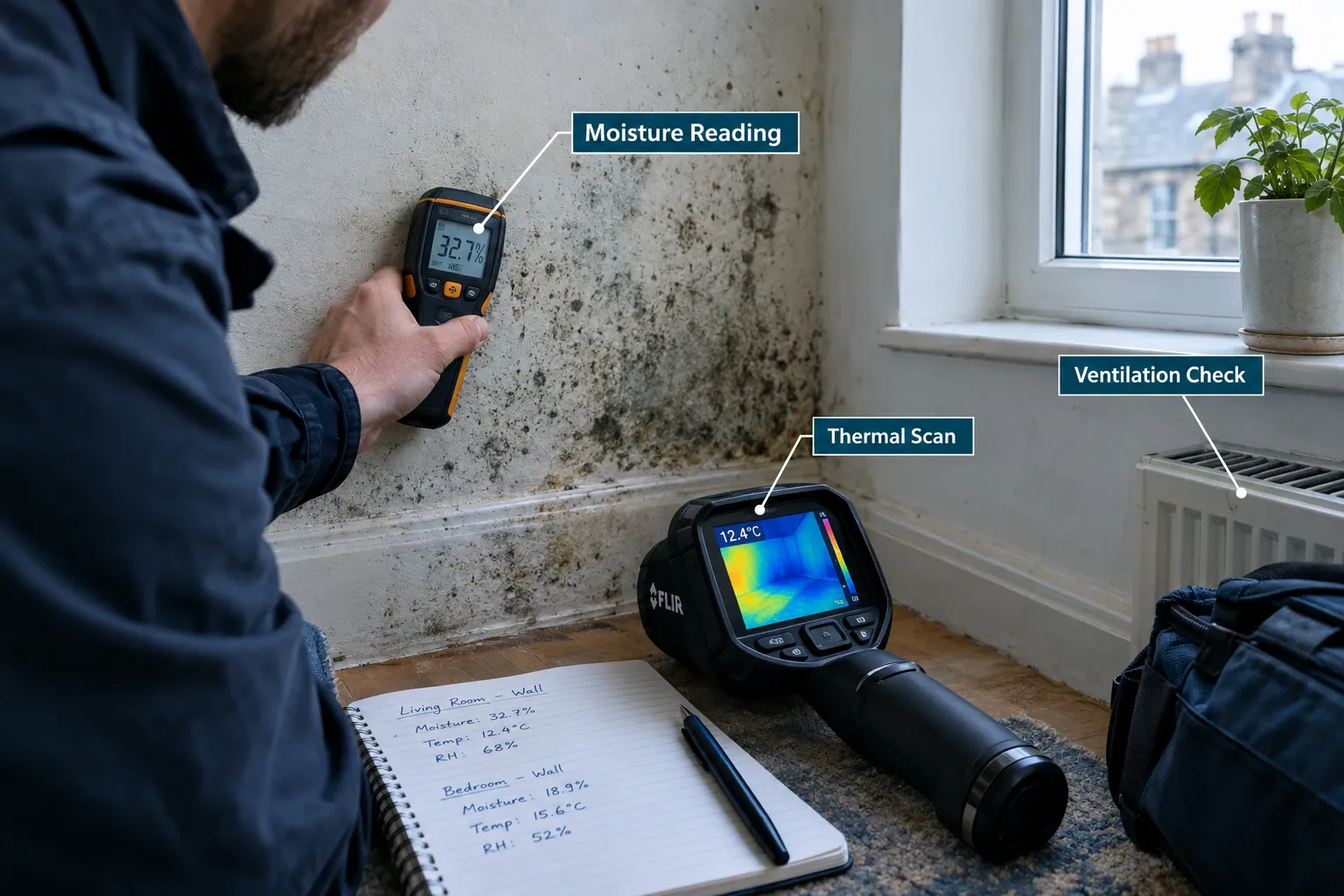
Skipping any of these steps risks misdiagnosis. Treating condensation as rising damp, for example, wastes money and leaves the real problem, usually poor ventilation or a cold bridge, untouched. Under the new timescales, a misdiagnosed first investigation can eat into the time available to deliver an effective fix.
Why a Chartered Surveyor Survey Matters Now
Scotland damp and mould landlord duties October 2026 create a new kind of exposure: not just the cost of repairs, but the risk of a tribunal finding that a landlord failed to act promptly or competently. A written summary produced by an unqualified contractor, with no supporting data, is a weak defence if a tenant escalates a complaint.
A specialist damp survey carried out by a chartered surveyor provides something a quick trade visit cannot: independent, evidence-based findings, recorded with instrumentation data and photographic proof, that stand up to scrutiny. If a case reaches the First-tier Tribunal, that record is the difference between a landlord who can demonstrate compliance and one who cannot.
"For landlords and agents, robust processes and compliance will be essential.", Hazel MacIver, Propertymark
Given the tribunal award range now stretches up to 36 times the relevant sum, the cost of a thorough, properly documented survey is modest against the risk of getting the diagnosis wrong or missing a deadline.
What This Means for You
If you let property in Scotland, the practical changes start now, not next month.
- Set up a reporting channel so tenants have a clear, dated way to report damp or mould, triggering the 10-working-day clock immediately.
- Book a competent person without delay, a chartered surveyor or suitably qualified contractor who can produce a written, data-backed report.
- Build in the 3-day summary deadline as a standing task the moment an investigation concludes.
- Pre-arrange contractor availability so remedial work can realistically start within 5 working days once substantial damp or mould is confirmed.
- Keep every record, reports, summaries, contractor correspondence and access arrangements, in case of a tribunal claim.
- Review succession and eviction paperwork given the shortened succession period and the sharply higher wrongful termination award range.
Letting agents should treat this as an operational overhaul, not a policy tweak. Hooker's warning that "the clock will now be ticking" applies to every stage of the process, not just the first report.
The Wider UK Picture
Scotland is not acting in isolation. In England, Awaab's Law introduced fixed timescales for social landlords from October 2025, and the Renters' Rights Act gives the UK government powers to extend similar requirements into the private rented sector. No specific English timescales have yet been confirmed for private landlords, but the direction is unmistakable: statutory deadlines for damp and mould are becoming the norm across the UK, not an isolated Scottish measure.
Landlords operating portfolios across Scotland and England should assume similar obligations are coming south of the border and prepare processes now rather than waiting for confirmation.
Frequently Asked Questions
What is the deadline to investigate a damp or mould report in Scotland?
A competent person must investigate within 10 working days of the tenant's report, under the rules effective from 6 October 2026.
How quickly must a tenant receive a written summary?
Within 3 working days of the investigation finishing.
When must repairs start if substantial damp or mould is found?
Remedial work must begin within 5 working days of the finding and be completed as soon as reasonably practicable.
Has the tenancy succession period changed?
Yes. The qualifying period for succession falls from 12 months to 6 months for tenants who die on or after 6 October 2026.
What happens if a tenant is wrongly persuaded to leave a tenancy?
They can apply to the First-tier Tribunal. Awards can now range from 3 to 36 times the relevant statutory sum, for departures on or after 6 October 2026.
Do these rules apply in England too?
Not directly. England has Awaab's Law for social landlords from October 2025, and the Renters' Rights Act allows government to extend similar duties to private landlords, but no specific private-sector timescales have been set yet.
Conclusion
Scotland damp and mould landlord duties October 2026 mark a clear shift from discretionary good practice to enforceable deadlines. Landlords and agents who cannot show a timely, competent investigation and a documented response now face a tribunal system with considerably higher stakes than before. The safest route is straightforward: act the moment a report arrives, use a qualified professional capable of producing a defensible written record, and keep every piece of correspondence. For portfolios that span the UK, treat this as an early warning rather than a Scotland-only concern.