

Last updated: July 24, 2026
Quick Answer: A schedule of dilapidations is a structured legal document that records alleged breaches of lease repair covenants, and in 2026 it increasingly serves as formal evidence in party wall disputes where lease-end repairs overlap with boundary structures. When a tenant's failure to maintain a property affects a shared wall or boundary element, the dilapidations schedule can form part of the evidential package used to support or defend a party wall claim. The two legal regimes remain distinct, but their evidential requirements frequently intersect.
Key Takeaways
- A schedule of dilapidations identifies specific lease covenant breaches, describes remedial works, and provides costed estimates, making it a structured evidential document suitable for use in legal proceedings, including those touching on party wall or boundary issues.
- The Party Wall etc. Act 1996 and lease dilapidations law are separate legal frameworks, but they share common ground when repairs involve shared walls, boundary structures, or adjacent foundations.
- A party wall schedule of condition and a dilapidations schedule serve different purposes but can both be used as evidence of pre-existing or post-works damage.
- Under the Civil Procedure Rules' Dilapidations Pre-Action Protocol, landlords must substantiate claims with fully quantified schedules, contractor estimates, and diminution valuations, requirements that align closely with the evidential standards expected in party wall disputes.
- Where a tenant refuses to carry out dilapidations repairs to a boundary element before party wall works begin, this creates a compounding liability that both landlords and building owners need to address early.
- Dilapidations schedules do not automatically form part of a party wall award, but surveyors can reference them as supporting evidence when assessing pre-existing damage or attributing responsibility for repair costs.
- Commissioning a chartered surveyor to prepare both documents in a coordinated way is the most effective approach when lease-end repairs and party wall works occur simultaneously or in close sequence.
What Is a Schedule of Dilapidations in Party Wall Cases
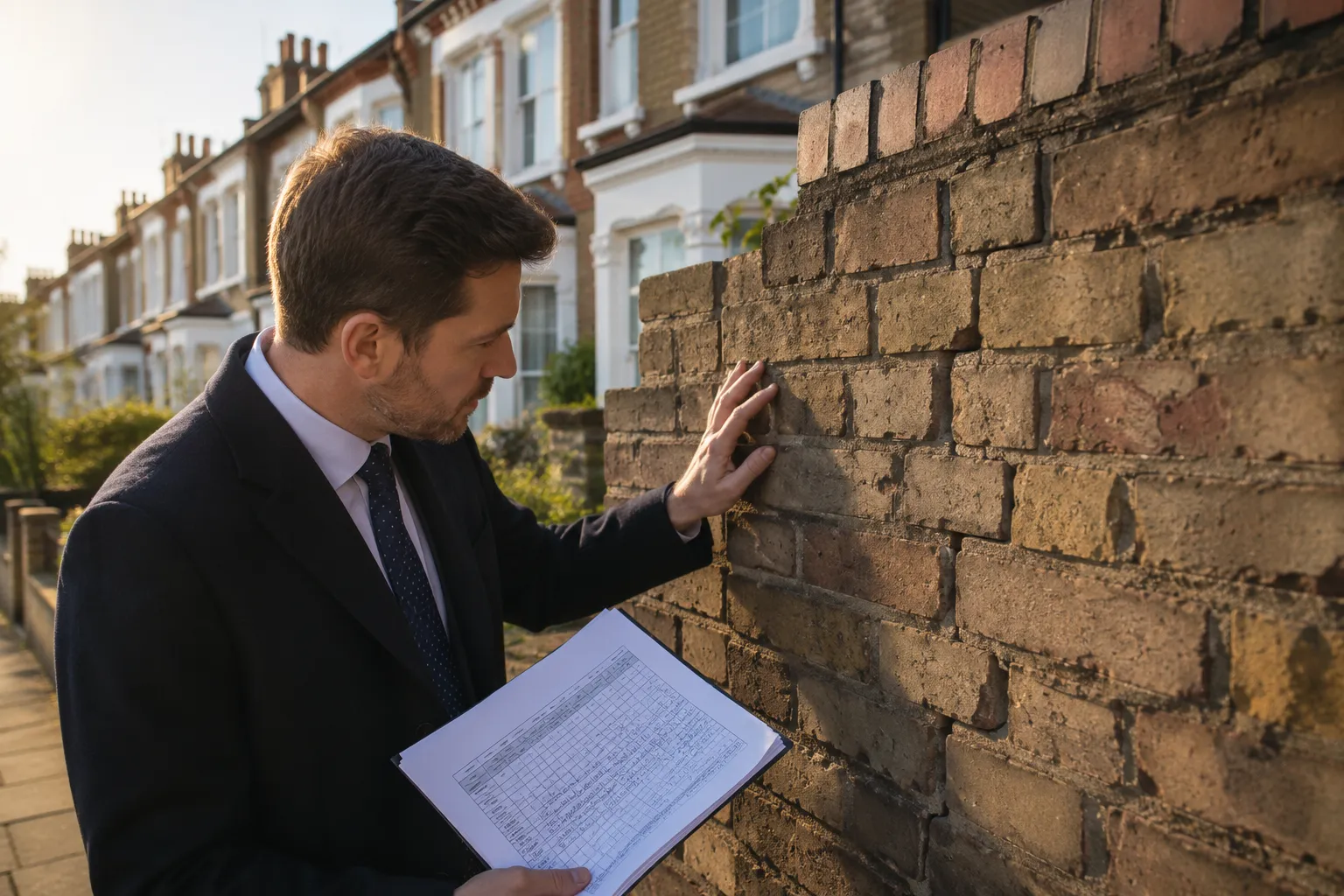
A schedule of dilapidations is a formal document prepared by a building surveyor that identifies breaches of a tenant's lease repair obligations, describes the remedial works required, and provides itemised cost estimates. In a party wall context, it becomes relevant when the disrepair documented in that schedule involves a shared wall, boundary structure, or an element governed by the Party Wall etc. Act 1996.
The RICS 2024 guidance on dilapidations defines the schedule as a document that:
- Identifies the relevant lease obligations breached
- Describes the alleged breach in specific terms
- Sets out the remedial works required or already completed
- Provides estimated or actual costs for each item
Each item is tied to a specific lease clause, which is precisely what makes the schedule useful as evidence. In party wall cases, this clause-by-clause structure allows surveyors and legal advisers to isolate which repair items relate to boundary elements and to demonstrate the condition of those elements before or after notifiable works were carried out.
Common mistake: Treating dilapidations as purely a landlord-tenant matter. When the property in disrepair shares a wall with a neighbouring owner, the condition of that wall becomes relevant to any party wall proceedings, and the dilapidations schedule is often the most detailed contemporaneous record available.
How Do Dilapidations Schedules Affect Party Wall Claims
Dilapidations schedules affect party wall claims primarily by establishing the pre-existing condition of a shared or boundary structure. If a party wall surveyor needs to determine whether damage was caused by the building owner's works or was already present, a dilapidations schedule prepared at or near lease end can provide a reliable baseline.
The party wall schedule of condition is the standard tool for recording a property's state before notifiable works begin. But where a dilapidations schedule already documents the condition of a shared wall in detail, with photographs, measurements, and costed repair items, it can supplement or corroborate the schedule of condition. This is particularly useful when:
- The dilapidations schedule predates the party wall notice and shows damage that existed before works commenced
- The tenant's failure to repair a boundary wall has left it structurally weakened, affecting the building owner's ability to carry out works safely
- A dispute arises about whether post-works damage was caused by the contractor or was pre-existing disrepair
Decision rule: If a dilapidations schedule was prepared within 12 months of the party wall works, it is worth obtaining a copy and sharing it with the appointed party wall surveyor before the schedule of condition inspection takes place.
Can You Use Lease-End Repair Obligations as Party Wall Evidence
Yes, lease-end repair obligations documented in a dilapidations schedule can be used as party wall evidence, provided the items relate to a structure covered by the Party Wall etc. Act 1996. The schedule's evidential value lies in its specificity: each entry references a lease clause, describes the defect, and quantifies the cost of remedy.
For this evidence to carry weight in a party wall dispute, it should meet the standards set out in the Civil Procedure Rules' Dilapidations Pre-Action Protocol. That means:
- Each alleged breach must be tied to a specific covenant
- Remedial costs must be "fully quantified and substantiated" by an invoice or detailed estimate
- Where the claim is based on diminution in value rather than cost of works, a formal section 18(1) valuation is required
When lease-end repairs involve a party wall or boundary structure, this evidential package effectively bridges the two legal regimes. A well-prepared dilapidations schedule, supported by dated photographs and contractor estimates, can demonstrate both the breach of lease covenant and the physical condition of the boundary element at a specific point in time.
For a broader understanding of how party wall disputes are handled, the party wall disputes guide provides useful context on the process and the evidence surveyors typically rely on.
What Is the Difference Between Dilapidations and Party Wall Damage
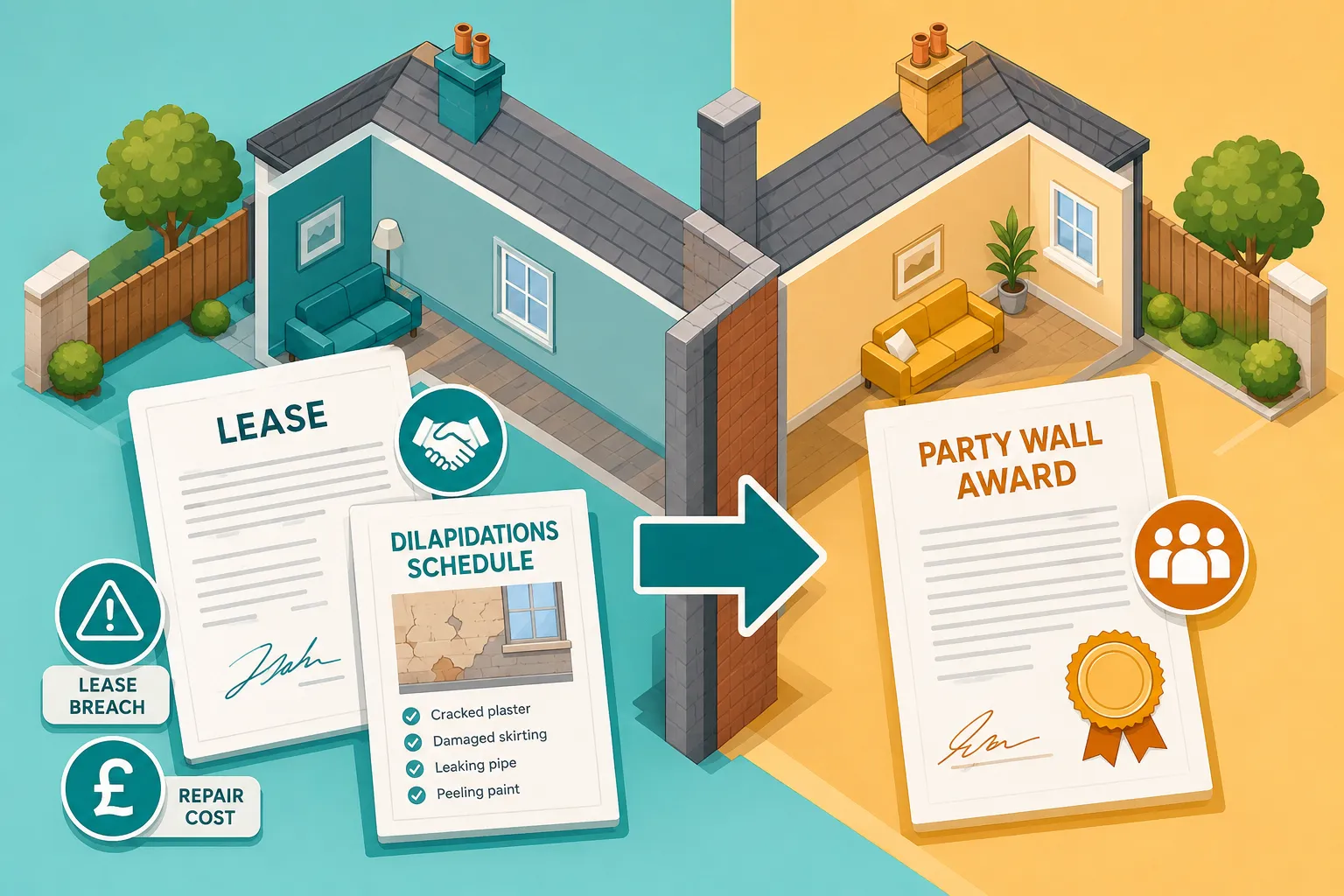
Dilapidations refers to a tenant's failure to comply with lease repair covenants, resulting in a claim by the landlord for the cost of remedying that disrepair. Party wall damage refers to physical harm caused to a shared or boundary structure as a result of notifiable works carried out under the Party Wall etc. Act 1996. The two are legally distinct but can involve the same physical structure.
| Feature | Dilapidations | Party Wall Damage |
|---|---|---|
| Legal basis | Lease covenants | Party Wall etc. Act 1996 |
| Who claims | Landlord against tenant | Adjoining owner against building owner |
| Trigger | Lease expiry or breach | Notifiable construction works |
| Evidence needed | Schedule, photos, section 18 valuation | Schedule of condition, surveyor's award |
| Governing document | Lease | Party wall award |
The key practical distinction is causation. Dilapidations are caused by the tenant's failure to maintain the property. Party wall damage is caused by the building owner's works. Where both apply to the same wall, for example, a boundary wall in disrepair that is then further damaged during excavation, the two claims must be carefully separated to avoid double recovery or misattribution of liability.
How Do You Link Boundary Works to Lease Dilapidations Claims
Linking boundary works to a lease dilapidations claim requires demonstrating that the repair obligation under the lease extends to the boundary structure in question, and that the disrepair either predates the party wall works or was caused independently of them.
The practical steps are:
- Review the lease to confirm the tenant's repairing covenant covers the boundary element (perimeter walls, fences, shared structures).
- Commission a dilapidations schedule that specifically addresses the boundary structure, with photographic evidence and costed repair items.
- Serve the schedule in accordance with the Pre-Action Protocol before or at lease expiry.
- Cross-reference with the party wall schedule of condition to establish whether the damage documented in the dilapidations schedule predates the notifiable works.
- Obtain a section 18(1) valuation if the claim is based on diminution in the reversion's value rather than the cost of works.
Where the boundary works and lease expiry occur simultaneously, this timeline becomes critical. A chartered surveyor experienced in both dilapidations and party wall matters can coordinate the two processes to ensure the evidential record is consistent. For context on the average cost of a boundary dispute, early professional advice is almost always more cost-effective than litigation.
What Counts as Admissible Evidence in Party Wall Disputes in 2026
In 2026, admissible evidence in party wall disputes includes schedules of condition, party wall awards, photographic records, structural engineer reports, contractor specifications, and, where relevant, dilapidations schedules that document the pre-existing condition of a shared structure. The Party Wall etc. Act 1996 does not specify a formal rules of evidence, but disputes referred to the courts or the First-tier Tribunal are subject to standard civil evidence principles.
For Schedules of Dilapidations as Party Wall Evidence: Linking Lease-End Repairs to Boundary Works 2026, the evidential package that carries most weight includes:
- A properly drawn schedule of dilapidations endorsed by a chartered surveyor
- Dated photographic evidence of the boundary structure's condition at lease end
- Contractor quotations and costed breakdowns for remedial works
- The lease itself, with relevant repair covenants highlighted
- A section 18(1) valuation where diminution in value is claimed
- Supporting specifications, drawings, and site notes
The dilapidations schedule is particularly persuasive because it is a contemporaneous document prepared by a professional, tied to specific contractual obligations. This makes it far more reliable as evidence of pre-existing condition than retrospective witness statements.
For more on what party wall surveyors assess and how awards are structured, the party wall awards guide is a practical reference.
When Should You Serve a Schedule of Dilapidations Before Party Wall Works
A schedule of dilapidations should ideally be served before party wall works begin when the lease is expiring or has recently expired and the boundary structure is in disrepair. Serving the schedule first establishes the documented condition of the boundary element before any works affect it, which protects both the landlord's dilapidations claim and the adjoining owner's ability to attribute post-works damage correctly.
The recommended sequence is:
- Serve the party wall notice at least two months before works begin (or one month for line of junction works).
- Commission and serve the dilapidations schedule as close to lease expiry as possible, before the party wall works commence.
- Arrange the party wall schedule of condition inspection, ensuring the surveyor is aware of the existing dilapidations documentation.
- Ensure both documents are cross-referenced so that any overlap in the structures covered is clearly identified.
If the dilapidations schedule is served after party wall works have begun, its evidential value is significantly reduced because it becomes harder to distinguish pre-existing disrepair from works-related damage. For guidance on what happens when a neighbour refuses party wall works, early legal and surveying advice is essential.
How Do Surveyors Assess Dilapidations for Party Wall Evidence
Surveyors assessing dilapidations for use as party wall evidence follow the same structured methodology as a standard dilapidations inspection, but with additional focus on boundary elements and shared structures. The assessment involves a physical inspection of the property, a review of the lease and any licences for alterations, and the preparation of a schedule that itemises each alleged breach with supporting evidence.
For boundary-related items, the surveyor will typically:
- Photograph the boundary structure from multiple angles, with scale references
- Note the specific defects (cracking, spalling, movement, missing coping, failed pointing) and their approximate extent
- Reference the relevant lease clause that requires the tenant to maintain the structure
- Obtain contractor estimates for the remedial works
- Consider whether the defects are consistent with long-term neglect (dilapidations) or recent impact (party wall damage)
This distinction between gradual deterioration and sudden damage is often the critical question in cases where the two regimes overlap. A surveyor with experience in both dilapidations and party wall matters is best placed to make this assessment credibly.
What Happens If a Tenant Refuses Dilapidations Repairs Before Party Wall Works
If a tenant refuses to carry out dilapidations repairs to a boundary structure before party wall works begin, the landlord faces a compounding liability: the boundary element enters the party wall process in a state of disrepair, which can complicate the attribution of any subsequent damage and potentially expose the landlord to claims from the adjoining owner.
In practical terms:
- The landlord should serve the dilapidations schedule promptly and follow the Pre-Action Protocol to preserve the claim.
- The party wall surveyor should be informed of the outstanding dilapidations so the schedule of condition accurately reflects the pre-existing state of the boundary structure.
- If the disrepair creates a risk to the adjoining property, the landlord may need to consider emergency repair works under the lease or under common law duties to prevent foreseeable harm.
- The landlord's dilapidations claim is not extinguished by the party wall process, but the two claims must be managed carefully to avoid double recovery.
For landlords managing blocks or shared buildings, the emergency works service can provide rapid professional support when disrepair at a boundary becomes urgent.
Can Party Wall Awards Cover Dilapidations Costs
A party wall award cannot directly award dilapidations costs, because the Party Wall etc. Act 1996 only empowers surveyors to deal with matters arising from the notifiable works. Dilapidations are a matter of lease covenant, not the Act. However, a party wall award can require the building owner to make good damage caused by the works, and if that damage overlaps with pre-existing dilapidations, the apportionment of costs between the two claims becomes a matter for careful professional judgment.
Edge case: Where a building owner's works exacerbate pre-existing disrepair in a boundary wall, the party wall award may cover the cost of restoring the wall to its pre-works condition (not to a better condition than it was before). The landlord's dilapidations claim then covers the cost of bringing the wall up to the standard required by the lease. These are separate but complementary claims.
The consequences of ignoring the Party Wall Act are significant, and attempting to use a party wall award as a backdoor route to recovering dilapidations costs is likely to be challenged and disallowed.
Do Dilapidations Schedules Need to Be Separate from Party Wall Awards
Yes, dilapidations schedules must remain separate documents from party wall awards. The two documents serve different legal purposes, are prepared under different statutory and contractual frameworks, and are addressed to different parties. Conflating them risks undermining the legal validity of both.
A dilapidations schedule is prepared by a building surveyor on behalf of a landlord, addressed to a tenant, and governed by the lease and the Civil Procedure Rules' Pre-Action Protocol. A party wall award is made by one or more party wall surveyors, addressed to the building owner and the adjoining owner, and governed by the Party Wall etc. Act 1996.
What surveyors can do, and increasingly do in 2026, is cross-reference the two documents. A party wall award may note that certain pre-existing defects are documented in a dilapidations schedule, and a dilapidations schedule may reference a party wall schedule of condition as corroborating evidence of the boundary structure's state at a given date.
For a thorough understanding of how party wall agreements work in practice, including what a party wall award can and cannot cover, professional advice from a chartered surveyor is the most reliable starting point.
What Are Common Mistakes When Linking Dilapidations to Boundary Works Claims
The most common mistakes when using Schedules of Dilapidations as Party Wall Evidence: Linking Lease-End Repairs to Boundary Works 2026 arise from poor timing, inadequate documentation, and confusion between the two legal regimes.
Frequent errors include:
- Serving the dilapidations schedule after party wall works have started, making it impossible to establish a clean pre-works baseline for the boundary structure.
- Failing to photograph boundary elements in detail at lease expiry, leaving gaps in the evidential record that the tenant or building owner can exploit.
- Attempting to recover dilapidations costs through a party wall award, which exceeds the Act's scope and will be disallowed.
- Ignoring the section 18(1) cap, which limits a landlord's dilapidations recovery to the diminution in the property's value, even where the cost of works is higher.
- Not instructing a surveyor with dual expertise in dilapidations and party wall matters, resulting in schedules that do not adequately address boundary structures or that use inconsistent terminology.
- Overlooking licences for alterations, which may modify the tenant's repairing obligations for boundary elements and affect the dilapidations claim.
For landlords and property professionals who want to understand the full scope of dilapidation protocols, early engagement with a chartered surveyor is the single most effective way to avoid these pitfalls.
Who Needs to Provide Dilapidations Evidence in Party Wall Disputes
In a party wall dispute where dilapidations are relevant, the party best placed to provide the dilapidations evidence is the landlord (or their surveyor), because the dilapidations schedule is the landlord's document. However, the adjoining owner, the building owner, and their respective party wall surveyors all have an interest in understanding what the dilapidations schedule shows about the pre-existing condition of the boundary structure.
- Landlords should proactively share the dilapidations schedule with the party wall surveyor to ensure the schedule of condition accurately reflects the boundary structure's state.
- Tenants may wish to obtain their own surveyor's assessment to challenge or respond to the dilapidations schedule, particularly if they believe some damage was caused by the building owner's works rather than their own neglect.
- Building owners should review any available dilapidations documentation before commencing notifiable works, to understand the pre-existing condition of the boundary structure and to protect themselves against inflated claims.
- Adjoining owners can use a dilapidations schedule as evidence that a boundary wall was already in poor condition before works began, which may affect the extent of the building owner's liability for post-works damage.
For anyone unsure whether they need a party wall surveyor and what that process involves, the party wall surveyor guide provides a clear overview of roles and responsibilities.
Conclusion
The intersection of dilapidations law and party wall practice is one of the more technically demanding areas of UK property surveying, and in 2026 it is increasingly relevant as lease expiries and boundary works coincide in a busy urban property market. The core principle is straightforward: a well-prepared schedule of dilapidations is a structured, clause-referenced, costed evidential document that can establish the condition of a boundary structure at a specific point in time, and that makes it genuinely useful in party wall proceedings, even though the two legal regimes remain distinct.
Actionable next steps for landlords, property owners, and professionals:
- If a lease is expiring and boundary structures are in disrepair, commission a dilapidations schedule immediately, before any party wall works begin on the adjacent property.
- Instruct a chartered surveyor with experience in both dilapidations and party wall matters to ensure the two documents are consistent and cross-referenced.
- Follow the Civil Procedure Rules' Dilapidations Pre-Action Protocol rigorously, ensuring all costs are fully quantified and substantiated.
- Share the dilapidations schedule with the party wall surveyor before the schedule of condition inspection takes place.
- Keep the two claims, dilapidations and party wall damage, legally separate, even when they involve the same physical structure.
For expert guidance on dilapidations, party wall matters, or boundary disputes, a chartered surveyor with specialist expertise in both areas is the most effective first call.
FAQ
Can a dilapidations schedule be used as evidence in a party wall dispute?
Yes. A dilapidations schedule prepared by a chartered surveyor is a structured, contemporaneous document that records the condition of a property, including boundary structures, at a specific date. It can be used as evidence of pre-existing disrepair in party wall proceedings, provided it is properly prepared and tied to specific lease covenants.
What is the difference between a schedule of dilapidations and a party wall schedule of condition?
A schedule of dilapidations records a tenant's alleged breaches of lease repair covenants and the cost of remedying them. A party wall schedule of condition records the state of a neighbouring property before notifiable works begin, to establish a baseline for any post-works damage claims. Both document physical condition, but they serve different legal purposes and are prepared under different frameworks.
Does the Party Wall etc. Act 1996 cover dilapidations claims?
No. The Party Wall etc. Act 1996 governs works to shared walls, boundary structures, and excavations near neighbouring buildings. Dilapidations are a matter of lease contract law. A party wall award cannot award dilapidations costs, and a dilapidations schedule does not replace the need for a party wall notice or award.
Who pays for a dilapidations schedule when boundary works are involved?
The landlord typically commissions and pays for the dilapidations schedule. Where the schedule is used as evidence in party wall proceedings, the costs of preparing it may form part of the landlord's overall claim, but this depends on the specific circumstances and the outcome of any dispute.
What happens if dilapidations repairs to a boundary wall are not completed before party wall works begin?
If the boundary wall is in disrepair at the start of party wall works, it becomes very difficult to separate pre-existing damage from works-related damage. The building owner may only be required to restore the wall to its pre-works condition, not to a higher standard. The landlord's dilapidations claim for the pre-existing disrepair remains separate and must be pursued through the lease framework.
Do I need a separate surveyor for dilapidations and party wall matters?
Not necessarily. A chartered surveyor with dual expertise in both areas can coordinate the two processes, ensuring the documentation is consistent and the evidential record is as strong as possible. This is often more cost-effective than instructing two separate specialists, particularly where the boundary structure is the central issue in both claims.
.cg-checker{font-family:Arial,sans-serif;max-width:560px;margin:2em auto;border:2px solid #1a3a5c;border-radius:8px;padding:20px;background:#f8fafc}
.cg-checker h3{color:#1a3a5c;margin:0 0 12px;font-size:1.1em}
.cg-checker label{display:block;margin:8px 0 4px;font-size:.9em;color:#333;font-weight:600}
.cg-checker select{width:100%;padding:7px;border:1px solid #aac;border-radius:4px;font-size:.9em;background:#fff}
.cg-btn{margin-top:14px;background:#1a3a5c;color:#fff;border:none;padding:10px 22px;border-radius:5px;cursor:pointer;font-size:.95em;width:100%}
.cg-btn:hover{background:#2a5a8c}
.cg-result{margin-top:14px;padding:12px;border-radius:5px;font-size:.9em;display:none}
.cg-result.show{display:block}
.cg-ok{background:#e6f4ea;border-left:4px solid #2e7d32;color:#1b5e20}
.cg-warn{background:#fff8e1;border-left:4px solid #f9a825;color:#5c4000}
.cg-alert{background:#fce4ec;border-left:4px solid #c62828;color:#7f0000}
Dilapidations + Party Wall Evidence Checker
Answer three quick questions to see how your dilapidations schedule and party wall situation interact.
function cgCheck(){
var l=document.getElementById(‘cg-lease’).value,
s=document.getElementById(‘cg-schedule’).value,
b=document.getElementById(‘cg-boundary’).value,
r=document.getElementById(‘cg-result’),
msg=”,cls=’cg-ok’;
if(!l||!s||!b){r.className=’cg-result cg-warn show’;r.innerHTML=’Please answer all three questions.’;return;}
if(b===’no’){msg=’Boundary structures are not involved, so the Party Wall Act is unlikely to intersect with your dilapidations claim. Focus on the lease covenants and Pre-Action Protocol.’;cls=’cg-ok’;}
else if(s===’before’&&(b===’yes’||b===’both’)){msg=’Strong position: your dilapidations schedule pre-dates the works and covers boundary elements. Share it with your party wall surveyor before the schedule of condition inspection.’;cls=’cg-ok’;}
else if(s===’after’){msg=’Caution: serving the schedule after works began weakens your ability to separate pre-existing disrepair from works-related damage. Obtain dated photographs and contractor notes to corroborate the pre-works condition.’;cls=’cg-warn’;}
else if(s===’none’&&(b===’yes’||b===’both’)){msg=’Urgent action needed: commission a dilapidations schedule immediately. Without it, you have no documented baseline for the boundary structure, and attributing damage after party wall works will be very difficult.’;cls=’cg-alert’;}
else{msg=’Your situation has mixed factors. A chartered surveyor experienced in both dilapidations and party wall matters should review your position before works proceed.’;cls=’cg-warn’;}
r.className=’cg-result ‘+cls+’ show’;r.innerHTML=msg;
}