

{"cover":"Professional landscape format (1536×1024) hero image with bold text overlay: 'Schedules of Condition: Your Best Defence Against Party Wall Damage Claims' in extra large 72pt white bold sans-serif font with dark semi-transparent overlay box, centered upper-third composition. Background shows a split-scene of a Victorian terraced house in London with visible party wall, a surveyor holding a clipboard and camera documenting crack patterns on brickwork, warm amber and charcoal color palette, editorial magazine quality, high contrast, professional architectural photography style.","content":["Professional landscape format (1536×1024) showing a close-up bird's-eye view of an open schedule of condition report document on a wooden desk, annotated photographs of wall cracks and plaster damage clipped to the pages, a red pen marking observations, a measuring tape and surveyor's notebook alongside, soft natural window light, muted grey and cream tones, clean documentary-style editorial photography.","Professional landscape format (1536×1024) depicting a party wall surveyor in a hard hat and hi-vis vest photographing hairline cracks in a brick wall with a professional DSLR camera, a numbered adhesive marker placed beside the crack for scale, a row of London terraced houses visible in the background through a construction site, golden hour lighting, deep blue and amber color scheme, realistic photojournalistic editorial style.","Professional landscape format (1536×1024) showing a split courtroom-style concept: on the left, a homeowner holding a thick folder of photographic evidence and a schedule of condition report; on the right, a disputed damaged wall with fresh cracks and fallen plaster; a bold dividing line in the centre with text 'Evidence vs No Evidence', professional legal-editorial illustration style, dark navy and white color palette, high contrast dramatic lighting."]
Roughly one in three party wall disputes that reach a surveyor involve a neighbour claiming that building works caused damage that existed long before the first brick was moved. Without a documented record of pre-existing conditions, those claims are almost impossible to disprove — and the building owner often pays. That is the core reason why schedules of condition under the Party Wall Act: your best defence against future damage claims deserve far more attention than most homeowners give them before work begins.
This article explains exactly what a schedule of condition is, how it connects to party wall notices and awards, what a thorough record looks like in practice, and how that record is used when cracks or movement are alleged after construction ends.
Key Takeaways
- A schedule of condition is a detailed photographic and written record of an adjoining property's state before building works begin.
- Although not legally mandatory under the Party Wall etc. Act 1996, it is strongly recommended by government guidance and professional bodies alike.
- The schedule is formally attached to the party wall award and becomes the baseline against which any post-works damage claim is measured.
- Good records include time-stamped photographs, written descriptions, and measurements of every existing crack, stain, or defect.
- Both building owners and adjoining owners benefit from having a schedule in place before works start.

What Is a Schedule of Condition and Why Does It Matter?
A schedule of condition is a systematic, documented record of the physical state of a property — typically the adjoining owner's property — taken immediately before notifiable building works begin. It captures every visible crack, stain, settlement mark, damp patch, and structural defect that already exists, so that the same features cannot later be attributed to the new works [8].
The Party Wall etc. Act 1996 gives adjoining owners the right to compensation if building works cause damage to their property [2]. The Act also gives building owners the right to carry out those works, subject to proper notice and, where required, a party wall award. What the Act does not do is specify precisely how pre-existing conditions should be recorded. That gap is where the schedule of condition fills a critical role.
Without a schedule, any crack that appears after works are complete is open to dispute. The adjoining owner may genuinely believe the building works caused a crack that was actually there for years. The building owner may genuinely believe the crack is pre-existing but has no evidence to prove it. A well-prepared schedule resolves that uncertainty before it becomes an expensive argument.
"A schedule of condition provides the objective baseline against which all post-works damage claims are measured. It is the single most effective tool for preventing disputes from escalating."
Government guidance on party wall matters explicitly promotes schedules as a protective measure for both parties [6]. The RICS guidance on party wall legislation and procedure similarly treats them as standard good practice [5]. In 2026, this position remains unchanged: schedules of condition are not legally mandatory, but they are the professional standard and the most practical protection available.
How a Schedule Differs from a General Survey
A standard building survey assesses the overall condition and value of a property. A schedule of condition has a narrower, more specific purpose: it records the state of defined elements — walls, ceilings, floors, and external surfaces — that are likely to be affected by the proposed works. It is not a valuation document, and it does not assess structural integrity in the same way a full structural survey would. Its sole function is to create an evidential baseline.
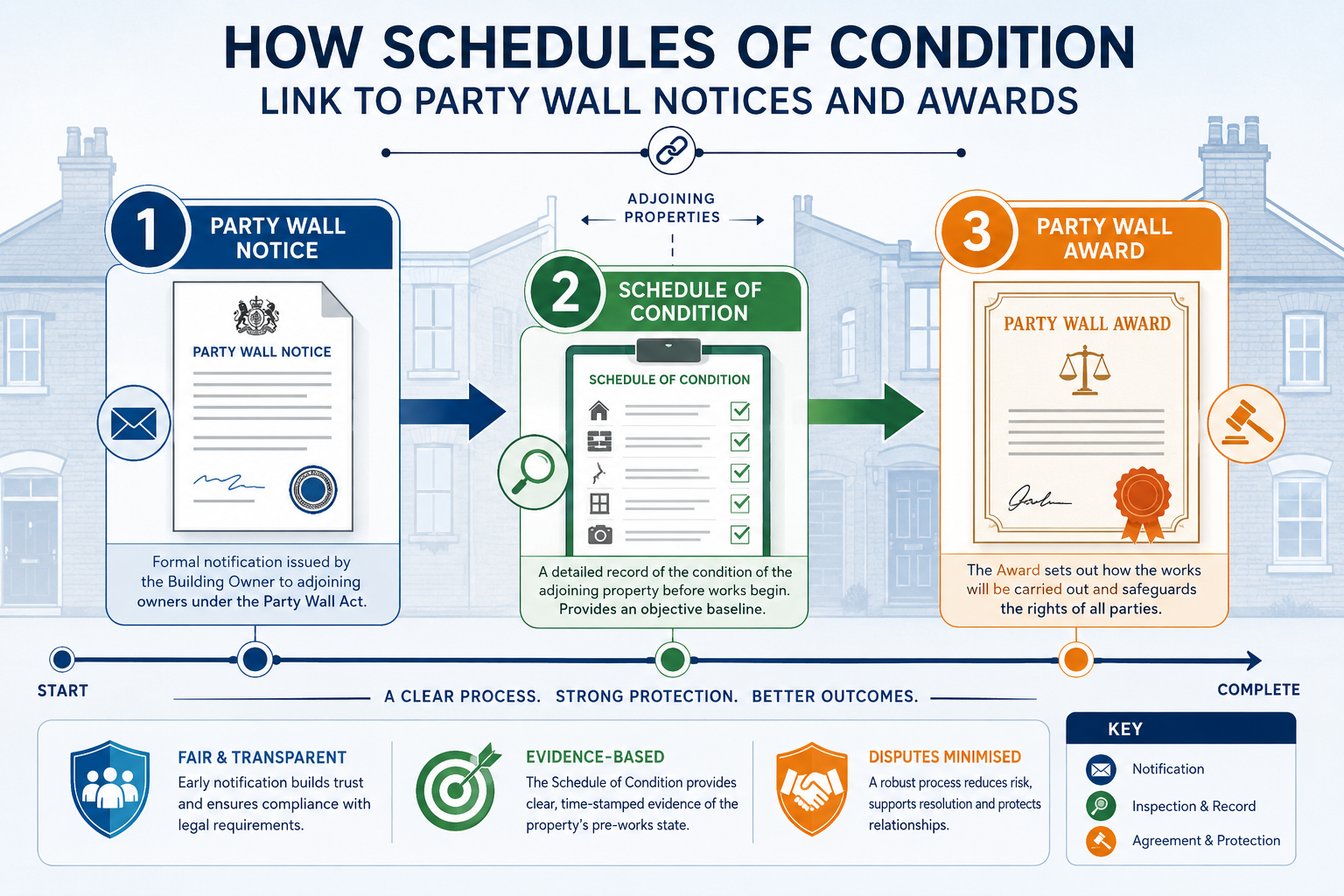
How Schedules of Condition Link to Party Wall Notices and Awards
Understanding where a schedule of condition sits within the party wall process makes it easier to see why timing matters so much.
The Party Wall Notice Stage
The process begins when a building owner serves a party wall notice on the adjoining owner. This notice sets out the proposed works and triggers the statutory framework under the Act [7]. The adjoining owner then has 14 days to consent or dissent. If they dissent — or fail to respond — a surveyor or surveyors are appointed to draw up a party wall award.
For a detailed breakdown of how notices work and how to respond, see this guide on party wall act notices and how to respond.
The Party Wall Award Stage
A party wall award is the formal document that governs how the works are to be carried out. It sets out the rights and obligations of both parties, working hours, access arrangements, and the method of construction. Critically, the schedule of condition is attached to the award as an appendix [8].
Once attached, the schedule becomes a legally referenced document. If the adjoining owner later claims that the works caused damage, the surveyor — or a court — will compare the post-works condition of the property against the schedule. If a crack appears in the schedule as pre-existing, the building owner is not liable for it. If it does not appear in the schedule, the presumption shifts toward the works having caused it [4].
This is why the schedule must be completed before works begin — ideally before the award is finalised, so it can be incorporated into the award itself.
What Happens Without a Schedule
When no schedule exists, any damage claim becomes a matter of competing assertions. The adjoining owner says the crack is new; the building owner says it was always there. Without documentary evidence, surveyors and courts must rely on circumstantial factors: the type of works, the proximity of the damage, and expert opinion on likely causation. This process is slow, expensive, and uncertain. The RICS guidance notes that the absence of a schedule significantly complicates the assessment of compensation claims [5].

What a Thorough Schedule of Condition Looks Like
The quality of a schedule of condition determines its usefulness as evidence. A few blurry photographs and a handwritten note will not withstand scrutiny in a serious dispute. A professional schedule has several defining characteristics.
Photographic Records
Photography is the backbone of any schedule. Good photographic records share the following features:
- Time-stamped images taken on a calibrated device, with metadata intact
- Scale references — a ruler, coin, or numbered adhesive marker placed beside each defect
- Multiple angles for each defect, including wide-context shots and close-up detail shots
- Systematic coverage of every room, wall face, ceiling, and floor that falls within the likely zone of influence of the works
- External coverage of the party wall face, garden walls, and any outbuildings
Photographs should be taken in good lighting. Where natural light is insufficient, supplementary lighting should be used. Dark, unclear images are of limited evidential value [4].
Written Descriptions
Photographs alone are not sufficient. Each defect should be accompanied by a written description that records:
| Element | What to Record |
|---|---|
| Location | Room, wall face, height above floor level |
| Type of defect | Hairline crack, settlement crack, damp stain, spalling plaster |
| Dimensions | Length, width, depth where measurable |
| Orientation | Horizontal, vertical, diagonal, stepped through mortar joints |
| Existing repairs | Filled cracks, painted-over staining, patched plaster |
Existing repairs are particularly important. A crack that has been filled and painted over may not be visible in photographs, but its presence should be noted in writing so that any reopening after works cannot be claimed as new damage.
Structural Elements to Prioritise
Not every surface carries equal risk. A surveyor preparing a schedule should pay particular attention to:
- Party walls and party fence walls — the most directly affected structures
- Ceilings directly below or adjacent to the works — prone to cracking from vibration
- Internal plasterwork — hairline cracks are common and easy to miss without close inspection
- External brickwork and pointing — existing defects here are frequently disputed
- Floors near the party wall — settlement and movement can manifest here
For a clear explanation of what qualifies as a party wall or party fence wall under the Act, see this guide on understanding party fence walls and the Party Wall Act definition.
Who Prepares the Schedule
In most cases, the schedule is prepared by the appointed surveyor — either the agreed surveyor acting for both parties, or the adjoining owner's surveyor. The building owner's surveyor may also contribute. The schedule should be agreed and signed by all relevant parties before it is appended to the award [8].
In some cases, particularly where the adjoining owner has consented to the works without a formal award, a schedule may still be prepared by agreement. This is strongly advisable even where the Act does not strictly require an award. For more on navigating the process without a surveyor, see this article on having a party wall agreement without a surveyor.
Using the Schedule When Damage Is Alleged After Works
The real test of a schedule of condition comes when the building works are finished and the adjoining owner reports damage. This is where schedules of condition under the Party Wall Act: your best defence against future damage claims prove their worth most clearly.
The Claims Process
When damage is alleged, the typical sequence is as follows:
- The adjoining owner notifies the building owner or their surveyor of the alleged damage.
- A post-works inspection is carried out, ideally by the same surveyor who prepared the schedule.
- The post-works condition is compared systematically against the schedule.
- Defects that appear in the schedule are confirmed as pre-existing.
- Defects that do not appear in the schedule are assessed for likely causation.
- Where causation is established, the building owner is liable for repair or compensation [6].
This process is straightforward when a thorough schedule exists. It becomes contentious — and expensive — when it does not.
Disputes and Resolution
Where the parties disagree about causation, the matter may be referred back to the appointed surveyor for determination under the award, or in more serious cases, to the county court [9]. The schedule of condition is central evidence in either forum.
Courts and surveyors alike give significant weight to a well-prepared schedule. A building owner who can point to a photograph showing a crack pre-dating the works, complete with scale reference and timestamp, is in a strong evidential position. An adjoining owner who can demonstrate that a defect does not appear anywhere in the schedule, despite thorough coverage, is equally well-placed to pursue a legitimate claim.
The Act's compensation framework is clear: building owners are liable for damage caused by their works, but not for damage that predated them [2]. The schedule of condition is the mechanism that makes that distinction practical rather than theoretical.
Common Disputes and How Schedules Resolve Them
Hairline cracks in plaster are the most frequently disputed form of alleged damage. They are ubiquitous in older properties, often invisible until disturbed by vibration, and easy to claim as new. A schedule that records every hairline crack before works begin eliminates this category of dispute almost entirely.
Settlement cracks in brickwork follow a similar pattern. Diagonal stepped cracks through mortar joints are a normal feature of older London terraces, but they are also consistent with the type of movement that excavation works can cause. Without a pre-works record, causation is genuinely ambiguous.
Damp ingress is another common area of dispute. Works that disturb a party wall can sometimes affect weatherproofing, but many properties already have latent damp issues. A schedule that records existing damp staining protects the building owner from claims that pre-existing moisture problems were caused by the works.
Practical Steps for Building Owners and Adjoining Owners in 2026
Whether acting as a building owner planning works or as an adjoining owner receiving a notice, the steps below reflect current best practice.
For building owners:
- Instruct a qualified party wall surveyor as early as possible — ideally before serving notice.
- Ensure the schedule of condition is commissioned as part of the surveyor's appointment.
- Do not allow works to start until the schedule has been completed, agreed, and appended to the award.
- Keep a copy of the schedule throughout the works and for at least six years afterwards.
For adjoining owners:
- Do not consent to works without first requesting that a schedule of condition is prepared.
- If you appoint your own surveyor, confirm that preparing the schedule is within their scope of work.
- Review the draft schedule carefully before signing — raise any omissions before works begin, not after.
- Retain your copy of the schedule and the award in a safe place.
For adjoining owners who want to understand their rights more fully, the adjoining owners section provides a clear overview of the protections available under the Act.
Building owners carrying out works can find detailed guidance on their obligations at the building owners section.
Conclusion
Schedules of condition under the Party Wall Act: your best defence against future damage claims are not a bureaucratic formality. They are a practical, evidence-based tool that protects both building owners and adjoining owners from the cost and uncertainty of unresolvable disputes. The investment of time and professional fees in preparing a thorough schedule before works begin is modest compared to the cost of defending or pursuing a damage claim without one.
Actionable next steps:
- If planning notifiable works, contact a qualified party wall surveyor before serving notice and confirm that a schedule of condition will be prepared.
- If you have received a party wall notice, do not sign a consent letter without first checking whether a schedule of condition will be prepared — and insisting on one if it will not.
- Review the schedule of condition service to understand what a professionally prepared schedule involves.
- Familiarise yourself with the types of party wall works that trigger the Act, so you know when these protections apply.
A thorough pre-works record costs relatively little. The absence of one, when a dispute arises, can cost a great deal more.
References
[1] Party Wall Agreement – hoa.org.uk
[2] Party Wall etc. Act 1996 – legislation.gov.uk
[3] Party Walls – rbkc.gov.uk
[4] Schedules of Condition for Party Wall Awards – devonpartywalls.com
[5] Party Wall Legislation and Procedure 7th Edition – rics.org
[6] The Party Wall Etc Act 1996 Explanatory Booklet – gov.uk
[7] The Life and Soul of the Party Wall Act – kingsleynapley.co.uk
[8] Schedules of Condition for Party Wall Awards – taylor-mitchell.co.uk
[9] Party Walls: Building Works – gov.uk
[10] Party Wall Etc. Act 1996 Guidance for Building Owners – partywallsurveyors.uk.com
How Prince Surveyors can help: explore our party wall surveyors or learn about our party wall surveyor costs.