

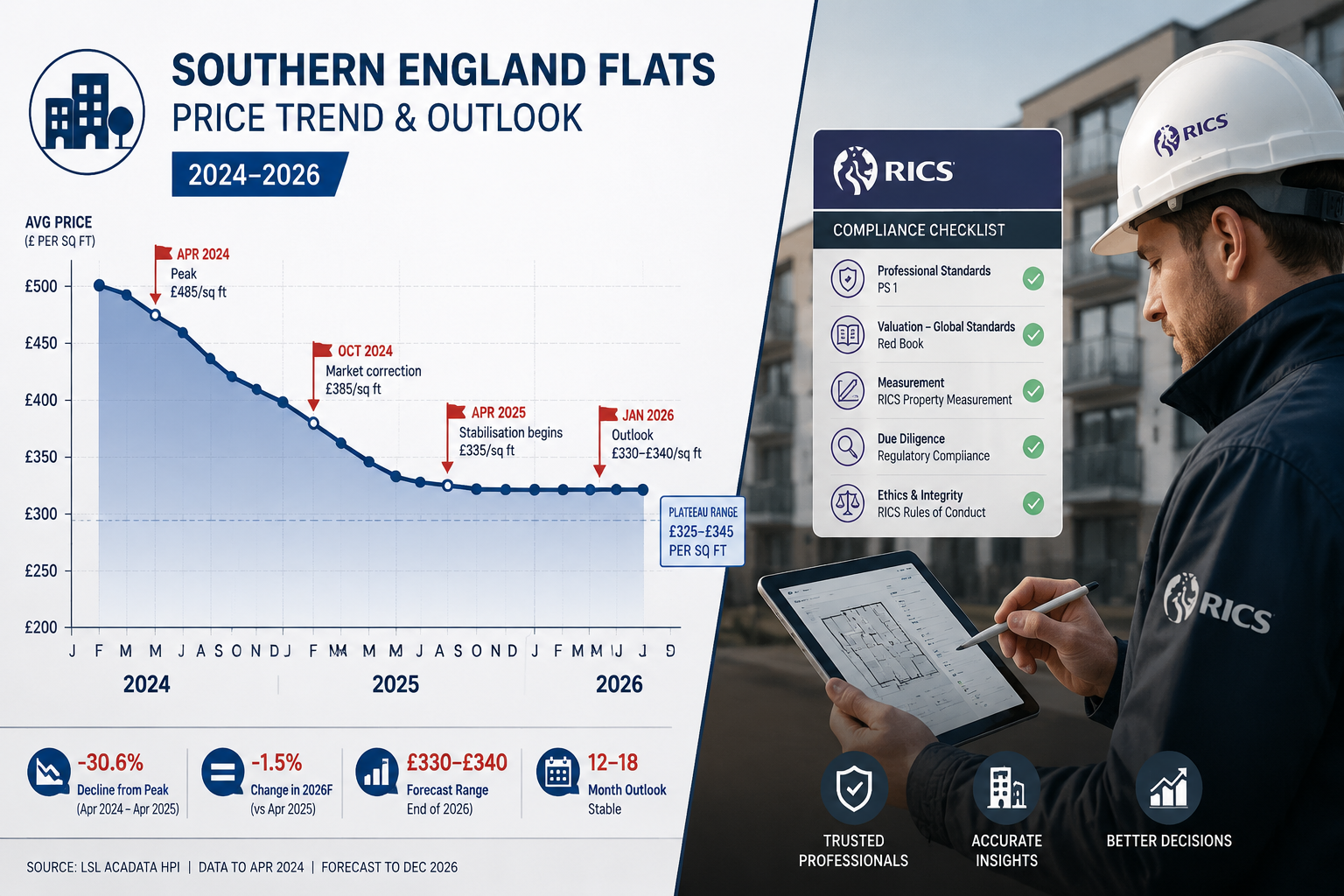
Buyer enquiries for southern England flats fell sharply between February and March 2026, then stalled rather than recovered — leaving valuers caught between stale comparables and a market that refuses to move clearly in either direction [7]. This plateau is not a temporary blip. It reflects a structural recalibration driven by post-decline lease anxiety, unresolved cladding liabilities, and deferred maintenance backlogs that accumulated during years of suppressed transaction volumes. For surveyors operating under RICS Valuation Red Flags in Stabilizing Southern Flats: 2026 Protocols for Plateaued Markets, the professional stakes are unusually high. A valuation that misreads stabilization as recovery — or treats a static price as a safe price — can expose both lender and buyer to significant financial harm.
This article sets out the key red flags RICS-registered valuers must identify in 2026, explains how updated professional standards apply to plateaued southern flat markets, and provides practical guidance on methodology, documentation, and when declining an instruction is the right call.
Key Takeaways
- Southern flat prices have stabilized at post-decline levels, but stabilization does not equal safety — lease defects, cladding issues, and maintenance arrears remain active valuation risks.
- RICS published updated cladding valuation standards in May 2026, effective November 2026, requiring clearer EWS1 assessment triggers.
- The RICS Red Book marks its 50th anniversary in August 2026, with its core principles of ethics, objectivity, and transparency more relevant than ever in plateaued markets.
- Valuers must now apply scenario-based and segmented valuation approaches rather than relying solely on direct comparable evidence.
- Knowing when to decline a high-risk instruction is a professional obligation, not an optional safeguard.
What Makes Plateaued Southern Flat Markets Uniquely Challenging
A plateaued market looks deceptively calm on the surface. Transaction volumes are low, asking prices have stopped falling, and headline data suggests equilibrium. Yet beneath that surface, the conditions that caused the decline — cladding uncertainty, short leases, service charge disputes, and buyer financing fragility — have not been resolved. They have simply been deferred.
Southern England flats, particularly those built or clad between 1990 and 2015, carry a disproportionate share of these unresolved liabilities. Unlike northern markets where price corrections were sharper but shorter, the southern market experienced a prolonged softening that left many properties in a grey zone: not actively distressed, but not genuinely marketable at their nominal asking price either.
Three structural factors define this grey zone in 2026:
-
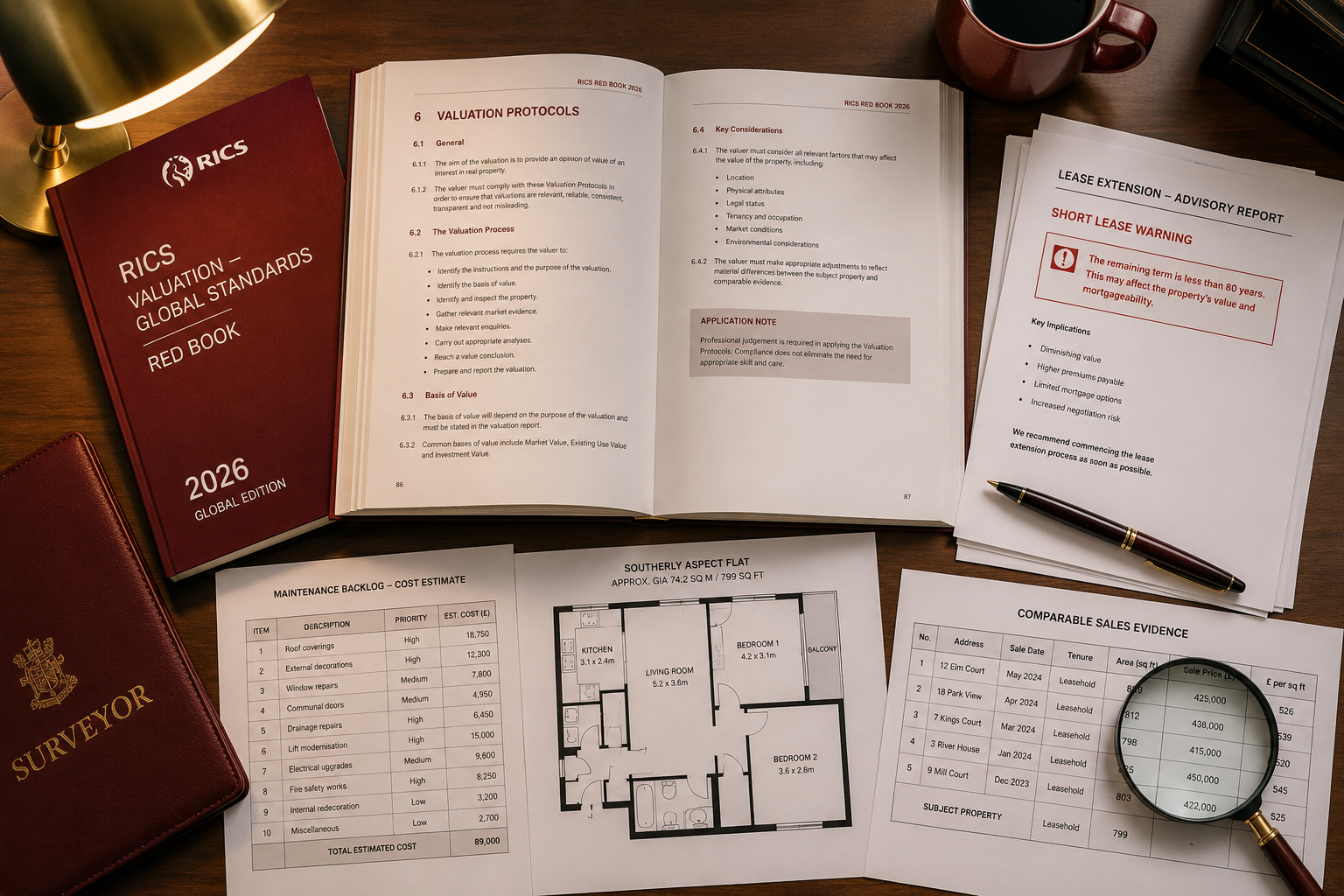
Lease erosion — A significant proportion of southern flats listed in 2026 carry leases below 80 years, the threshold at which mortgage lenders apply stricter criteria and buyers face higher lease extension costs. Understanding how to buy a flat on a short lease is essential context for any valuation in this environment.
-
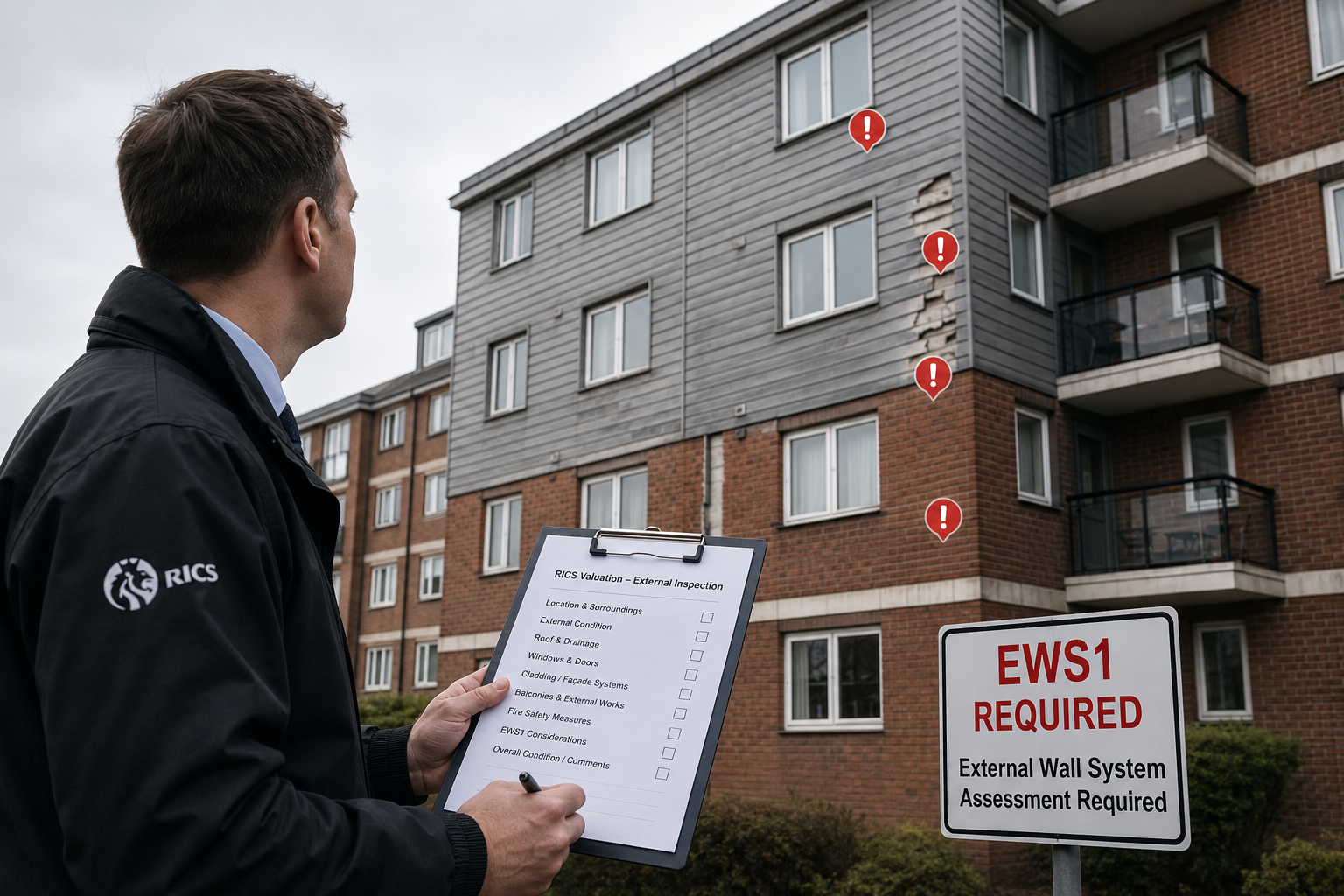
Cladding and EWS1 uncertainty — RICS published the second edition of its professional standard on secured lending valuations for multi-storey residential buildings with cladding on May 12, 2026. Effective from November 1, 2026, this standard provides updated criteria for when an EWS1 form is required, aiming for a consistent and proportionate approach [1]. In plateaued markets, buildings without a current EWS1 assessment represent a specific valuation risk that cannot be absorbed into a general market adjustment.
-
Maintenance backlogs — Years of low transaction volumes suppressed freeholder income from service charges, leading to deferred major works. Surveyors conducting a building condition assessment in 2026 are routinely encountering significant capital expenditure requirements that buyers have not priced into their offers.
"Stabilization in a distressed market is not the same as recovery. The risks that caused the decline are still present — they are simply no longer moving the headline number."
Core RICS Red Flags Valuers Must Identify in 2026
RICS Valuation Red Flags in Stabilizing Southern Flats: 2026 Protocols for Plateaued Markets can be grouped into four categories. Each requires specific evidence-gathering and documentation within the Red Book framework.
Lease and Tenure Red Flags
Lease length is the most immediately quantifiable risk in southern flat valuations. The following thresholds apply in 2026:
| Lease Remaining | Valuation Impact | Action Required |
|---|---|---|
| 80+ years | Minimal direct impact | Standard comparable analysis |
| 70–79 years | Moderate — lender restrictions begin | Lease extension cost estimate required |
| Below 70 years | Significant — limited mortgage market | Detailed lease extension valuation required |
| Below 60 years | Severe — cash buyer market only | Consider declining if comparables insufficient |
Beyond lease length, valuers must check for:
- Onerous ground rent clauses — doubling ground rents or RPI-linked escalation clauses that triggered lender withdrawal from 2020 onwards
- Absent freeholder — complicates both lease extension and building insurance
- Shared ownership complications — particularly relevant in affordable housing stock across south London and outer southern boroughs
Buyers who have not yet reviewed their leasehold property checklist before instructing a valuation often discover these issues late in the transaction, creating pressure on valuers to overlook or minimize findings.
Cladding and Fire Safety Red Flags
The updated RICS standard published in May 2026 is explicit: valuers must determine whether cladding or balcony remediation is likely to affect market value or saleability before completing a secured lending valuation [1]. The key indicators requiring investigation include:
- Buildings over 11 metres — the threshold for mandatory remediation under current legislation
- ACM, HPL, or other non-compliant cladding systems — identifiable during external inspection
- Absence of a valid EWS1 form — particularly problematic for buildings between 11 and 18 metres where assessment is not always mandatory but lenders often require it
- Outstanding building safety fund applications — where remediation is planned but unfunded
Valuers who lack specialist knowledge of fire safety assessments should consider whether they are competent to accept the instruction. This links directly to the RICS guidance on declining high-risk assignments discussed below.
Maintenance and Service Charge Red Flags
A building survey in a plateaued southern market will frequently reveal deferred maintenance that has not been reflected in the asking price. Specific red flags include:
- Section 20 notices — indicating major works are planned, with leaseholder contributions likely to run into thousands of pounds
- Reserve fund deficits — service charge accounts with insufficient reserves for foreseeable capital expenditure
- Roof, lift, or communal system age — assets approaching end of useful life without replacement funding in place
- Damp and structural issues — particularly in converted Victorian and Edwardian stock common across south London
These factors require explicit adjustment in the valuation report. Treating them as "noted but not material" is no longer acceptable under 2026 protocols.
Market Evidence Red Flags
In a plateaued market, comparable evidence is scarce and potentially misleading. Valuers must apply additional scrutiny to:
- Stale comparables — transactions completed more than three months ago may not reflect current buyer sentiment
- Distressed sales — repossessions or estate sales that completed at below-market prices can distort the comparable pool
- Off-market transactions — common in plateaued markets where sellers avoid public price exposure
- Financing-dependent comparables — sales that completed with specialist or high-LTV financing may not represent the open market
Applying 2026 RICS Protocols to Plateaued Market Valuations
The RICS Red Book celebrates its 50th anniversary in August 2026 [2]. Its foundational principles — ethics, objectivity, competence, and transparency — were designed precisely for conditions like those facing southern flat markets today. The challenge in 2026 is applying those principles when the market itself provides insufficient reliable data.
Scenario-Based Valuation
In response to the February 2026 buyer enquiry slump, surveyors developed segmented and scenario-based valuation approaches [7]. For southern flats, this means presenting:
- A base case value — assuming no material lease, cladding, or maintenance issues
- An adjusted value — reflecting identified red flags with quantified deductions
- A range — acknowledging the uncertainty inherent in a market with limited transaction evidence
This approach is consistent with the Red Book's requirement for transparency and is increasingly expected by lenders operating in plateaued markets.
Competence and the Obligation to Decline
RICS guidance published on June 26, 2026, is unambiguous: valuers must decline instructions where risks are unmanageable [3]. In the context of southern flats, unmanageable risks include:
- Insufficient local market knowledge — a valuer unfamiliar with specific micro-markets in areas such as Chelsea, Battersea, or Lewisham cannot reliably assess localized price plateaus
- Unverifiable information — where service charge accounts, building safety certificates, or lease documents cannot be obtained
- Time pressure — instructions requiring completion before adequate due diligence is possible
- Conflicts of interest — where the valuer has a prior relationship with vendor or agent
Declining an instruction is not a failure of professional service. It is, in many cases, the most professionally responsible action available.
Documentation Standards
Under 2026 protocols, valuation reports for southern flats in plateaued markets must include:
- Explicit identification of each red flag identified during inspection
- Quantified adjustments for lease length, cladding risk, and maintenance liability
- A statement of the comparable evidence used, including its age and reliability
- A market conditions commentary explaining why the current plateau affects the valuation
- Where applicable, a recommendation for specialist reports (fire safety, structural, damp)
An RICS HomeBuyer Survey provides a structured framework for this documentation, though secured lending valuations require additional lender-specific disclosures.
Regional Variations Within the Southern Flat Market
The southern England flat market is not homogeneous. Valuers applying RICS Valuation Red Flags in Stabilizing Southern Flats: 2026 Protocols for Plateaued Markets must account for significant micro-market variation.
Inner south London (Battersea, Chelsea, Fulham) experienced the sharpest price corrections between 2022 and 2024, driven by stamp duty changes and the retreat of overseas investors. By 2026, these markets have stabilized at levels approximately 12–18% below 2021 peaks, with cladding and fire safety issues concentrated in the large-scale residential developments built during the 2000s and 2010s.
Outer south London and commuter belt (Lewisham, Bexley, and similar areas) show a different pattern: lower absolute price levels but proportionally larger maintenance backlogs in older converted stock. Lease erosion is more prevalent here, with a higher proportion of flats approaching the 70-year threshold.
Coastal and commuter towns present a third pattern. Markets such as those served by Southend-on-Sea property surveyors saw pandemic-era price inflation that has since unwound, leaving a cohort of recently purchased flats now valued below their acquisition price — a specific risk for remortgage valuations.
Each of these sub-markets requires locally calibrated comparable evidence and a clear understanding of the specific lease and building safety profile typical for that area. An RICS survey that supports price negotiation is particularly valuable in these conditions, where buyers often lack the technical knowledge to identify and quantify the red flags described above.
The Role of Professional Standards in 2026
The April 2026 RICS response to the IVSC Exposure Draft consultation signals that the Red Book 2028 will incorporate further refinements to valuation methodology for complex residential assets [4]. Valuers working in plateaued markets today are, in effect, piloting the approaches that will be codified in that next edition.
The February 2026 RICS article on valuing properties in extreme conditions is also relevant, even though southern flat markets are not "extreme" in the disaster or conflict zone sense [5]. The methodological principles — adapting standard approaches when market evidence is insufficient, exercising heightened professional judgment, and documenting uncertainty explicitly — apply directly to a plateaued market where comparables are scarce and buyer behavior is unpredictable.
Key professional obligations for 2026:
- Accept instructions only within demonstrated areas of competence
- Apply the Red Book's transparency requirements rigorously, particularly regarding market conditions commentary
- Document all identified red flags with supporting evidence
- Provide quantified rather than qualitative adjustments wherever possible
- Recommend specialist reports rather than attempting to absorb specialist risk into a general valuation
Conclusion and Actionable Next Steps
The convergence of lease erosion, unresolved cladding liabilities, and deferred maintenance has created a valuation environment in southern England that demands more rigorous professional practice, not less. Stabilization in a post-decline market is not a signal to relax scrutiny — it is a signal to apply it more carefully.
For RICS-registered valuers working with southern flats in 2026, the following steps are essential:
-
Audit your competence before accepting instructions. If local market knowledge, cladding assessment capability, or access to reliable comparables is insufficient, decline or refer.
-
Apply the updated cladding standard from day one. The May 2026 RICS guidance on EWS1 assessment criteria [1] should be integrated into inspection checklists immediately, ahead of the November 2026 effective date.
-
Use scenario-based valuations for all plateaued market instructions. A single-point valuation without a range or scenario commentary does not adequately represent current market conditions.
-
Quantify every red flag. Lease deductions, maintenance liability estimates, and cladding risk adjustments must appear as specific figures in the report, not as general caveats.
-
Document your reasoning for comparable selection. In a thin market, the choice of comparables is itself a professional judgment that requires explicit justification.
-
Advise clients to commission specialist reports where needed. A valuation report that identifies a red flag but does not recommend follow-up action leaves the client — and the valuer — exposed.
The 50th anniversary of the RICS Red Book [2] is a timely reminder that the standards underpinning professional valuation were built to withstand exactly the kind of market complexity that southern flat buyers and lenders face in 2026. Applying those standards rigorously, with the regional and asset-specific adjustments that plateaued markets demand, is both the professional and the practical response.
References
[1] Valuation Of Properties In Multi Storey Multi Occupancy Residential Buildings With Cladding – rics.org
[2] Red Book 50 – rics.org
[3] When Valuers Should Decline Assignment – ww3.rics.org
[4] Red Book Global – rics.org
[5] Real Estate Valuation Extreme Conditions – ww3.rics.org
[7] Valuing Properties Amid February 2026 RICS Buyer Enquiry Slump North South Surveyor Strategies – manchestersurveyors.com
How Prince Surveyors can help: explore our independent damp surveys or learn about our Level 3 building survey.