

Last updated: July 24, 2026
Quick Answer: The RICS Sustainability Report 2025 establishes a structured, seven-step framework that surveyors must apply when conducting building surveys involving retrofit projects. In 2026, this framework directly shapes how retrofit valuations are prepared, what data surveyors must collect, and how energy performance is factored into property value assessments. Any homeowner, landlord, or buyer commissioning a building survey on a property earmarked for retrofit work should understand these standards before instructing a surveyor.
Key Takeaways
- The RICS Sustainability Report 2025 formalises a seven-step workflow for surveyors, with retrofit decision-making at its core.
- Retrofit valuations under the 2026 framework require a whole-building assessment scope and a minimum 20-year investment horizon.
- Surveyors must collect at least three years of utility bills alongside a full condition survey of the building envelope.
- RICS sustainability standards are currently voluntary for most residential surveys, but are becoming a market expectation and are mandatory in certain commercial and public-sector contexts.
- A sustainability-focused building survey typically costs 15-30% more than a standard Level 3 survey, depending on property size and complexity.
- Energy Performance Certificates and RICS sustainability reports serve different purposes and are not interchangeable.
- Older buildings, including Victorian and Edwardian stock, are explicitly within scope for RICS 2025 sustainability assessments.
- Software tools such as PHPP, SAP 10, and Elmhurst Energy's suite are recommended for quantifying retrofit performance metrics.
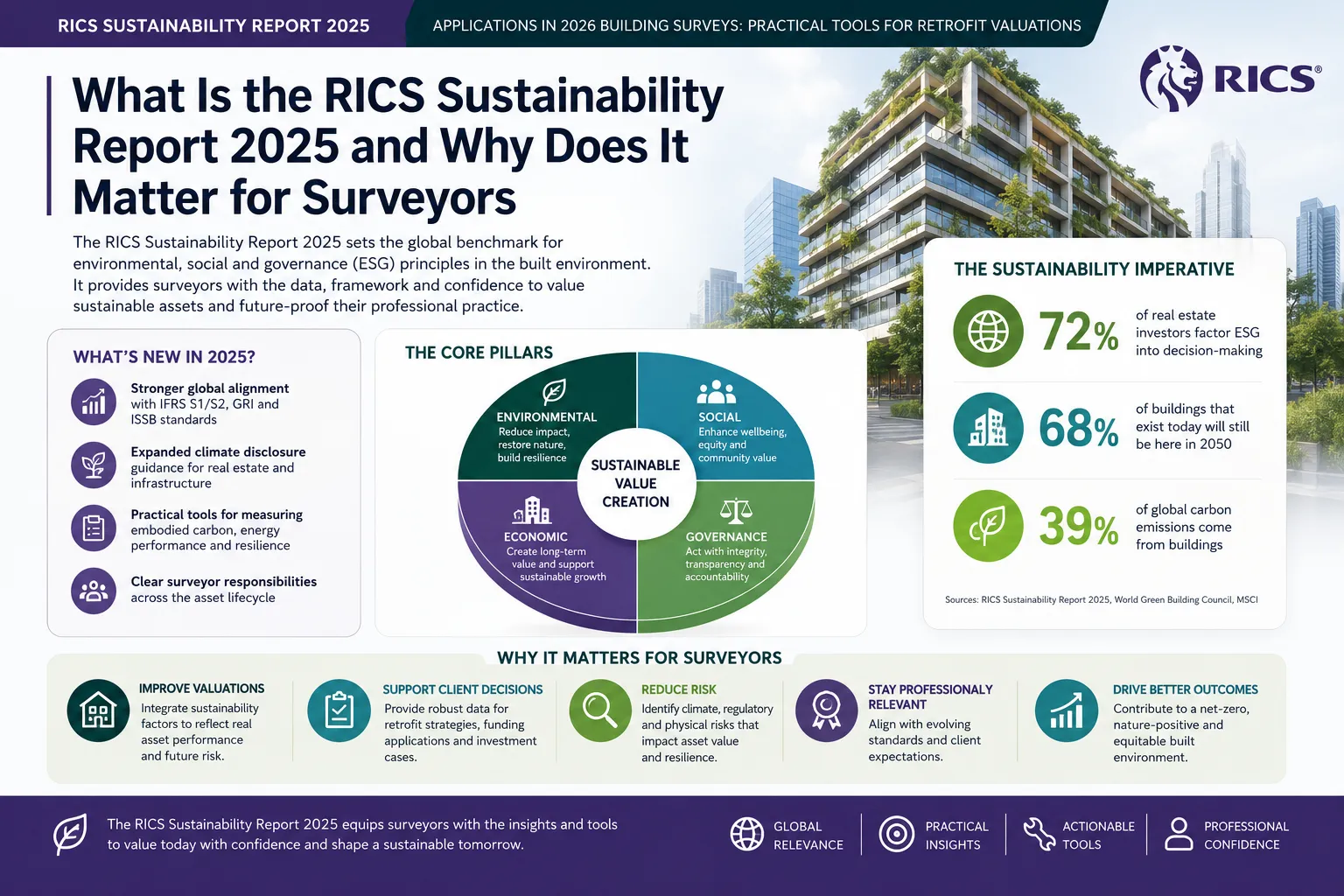
What Is the RICS Sustainability Report 2025 and Why Does It Matter for Surveyors
The RICS Sustainability Report 2025 is a professional guidance document published by the Royal Institution of Chartered Surveyors that updates the standards surveyors must follow when assessing, reporting on, and valuing buildings through a sustainability lens. It matters because it shifts sustainability from a supplementary note in a survey report to a core analytical requirement.
For surveyors working in 2026, the report does three things. First, it provides a structured methodology, a seven-step workflow, for integrating energy performance, carbon risk, and retrofit potential into building surveys. Second, it sets minimum data requirements that surveyors must meet before forming retrofit-related opinions of value. Third, it aligns UK surveying practice with the broader trajectory of UK government net-zero policy and mortgage lender green finance criteria.
The primary drivers behind the report are risk mitigation and asset value preservation. Properties that cannot meet minimum energy standards face regulatory risk, reduced lettability, and potential valuation discounts. Surveyors who ignore sustainability factors in their assessments now face professional liability exposure.
For homeowners and landlords, this means that a building survey commissioned in 2026 from a competent chartered surveyor should include sustainability commentary as standard, not as an optional add-on.

What Are the Key Changes in RICS Standards for 2025 and 2026 Sustainability Assessments
The 2025 report represents a meaningful shift from previous RICS guidance, which treated sustainability as a contextual observation rather than a structured assessment requirement. The key changes surveyors and clients need to understand are:
Mandatory whole-building scope. Previous guidance allowed surveyors to comment on individual elements such as insulation or glazing in isolation. The 2025 framework requires a whole-building approach, fabric, services, and occupancy patterns must all be considered together.
20-year investment horizon. Retrofit valuations must now be framed against a 20-year operational cost model, not just the immediate capital cost of works. This changes how payback periods are calculated and presented.
Utility bill evidence requirement. Surveyors are expected to request and review at least three years of utility bills as part of the data-gathering phase. This provides a baseline for operational energy use that theoretical models alone cannot supply.
Carbon risk reporting. The 2025 report introduces explicit guidance on flagging stranded asset risk, the possibility that a property's value could be impaired by future energy regulations if retrofit works are not undertaken.
Alignment with EPC reform. As the UK government continues to reform the Energy Performance Certificate regime, RICS 2025 guidance positions surveyor assessments as a complement to (not a replacement for) EPCs, with surveyors expected to cross-reference EPC data against observed building conditions.
For a broader overview of how these changes interact with standard building survey practice, the RICS building survey guide for homebuyers provides useful context.
How Do I Use RICS Sustainability Guidelines in Building Surveys for Retrofit Projects
Applying RICS Sustainability Report 2025 guidance in a 2026 building survey follows a seven-step process. Surveyors should work through each stage systematically, and clients commissioning surveys should expect to see evidence of this structure in their final report.
Step 1: Define the assessment scope. Confirm the whole-building boundary and identify all building systems within scope, fabric, heating, ventilation, hot water, and renewables.
Step 2: Gather baseline data. Collect at least three years of utility bills, the current EPC, any existing retrofit assessments, and planning history. Review the EPC and MEES implications for building surveys to understand the regulatory baseline.
Step 3: Conduct a condition survey of the building envelope. Assess the thermal performance of walls, roof, floors, and openings. Note any moisture, air leakage, or structural issues that would affect retrofit feasibility.
Step 4: Model retrofit scenarios. Using approved software tools (see the tools section below), model at least two retrofit pathways, typically a fabric-first approach and a fabric-plus-services approach.
Step 5: Assess financial viability. Calculate capital costs, projected energy savings, and payback periods over the 20-year horizon. Factor in available grant funding such as the Great British Insulation Scheme or ECO4.
Step 6: Identify risks and constraints. Flag planning constraints (listed building consent, conservation area restrictions), structural risks, and any materials that require specialist assessment, such as asbestos. The asbestos building surveys service is relevant here for pre-1985 properties.
Step 7: Report and recommend. Produce a structured report that presents findings, retrofit options, cost estimates, and a clear opinion on how sustainability factors affect current and future value.
How Do Retrofit Valuations Work Under the New RICS Sustainability Framework
A retrofit valuation under the RICS 2025 framework is not simply a standard valuation with an energy section bolted on. It is a structured opinion of value that explicitly accounts for the cost of bringing a property to a target energy standard, the risk of regulatory non-compliance, and the market premium or discount associated with the property's current energy performance.
Three components drive a retrofit valuation:
- Current market value, the open market value of the property in its existing condition and energy rating.
- Retrofit cost adjustment, a deduction or allowance reflecting the capital expenditure required to meet a target EPC band (typically Band C or above for residential lettings compliance).
- Green premium or brown discount, an adjustment reflecting market evidence that energy-efficient properties command higher prices or rents, and that low-rated properties face increasing buyer resistance.
Surveyors are expected to support their adjustments with comparable market evidence where available. In areas where green premium data is thin, surveyors should state this clearly and apply a conservative range rather than a precise figure.
For clients seeking a standalone property valuation, the independent property valuation service offers a starting point for understanding how valuations are structured.
What Tools and Metrics Does RICS 2025 Recommend for Measuring Building Sustainability
RICS 2025 does not mandate a single software platform but identifies a set of approved methodologies and recommends that surveyors use tools capable of producing outputs consistent with UK regulatory standards.
Recommended tools and methodologies:
| Tool | Primary Use | Applicable Building Type |
|---|---|---|
| SAP 10 | Regulatory energy modelling | Residential (new and existing) |
| PHPP | Passive house and deep retrofit modelling | Residential and small commercial |
| SBEM | Non-domestic energy assessment | Commercial and mixed-use |
| Elmhurst Energy suite | EPC production and retrofit planning | Residential |
| IES VE | Dynamic simulation for complex buildings | Commercial and large residential |
Key metrics surveyors must report under RICS 2025:
- Operational energy intensity (kWh/m2/year), actual or modelled energy use per unit floor area.
- Space heating demand, a fabric efficiency indicator that isolates the building envelope's thermal performance.
- Carbon emissions intensity (kgCO2e/m2/year), aligned with net-zero pathway benchmarks.
- Estimated retrofit capital cost, expressed as a range per square metre and as a total project cost.
- Projected payback period, calculated over the 20-year horizon required by RICS 2025.
Surveyors should also cross-reference their modelled outputs against actual utility bill data to identify any significant performance gap, a common issue in older UK housing stock where theoretical EPC ratings often overestimate real-world energy performance.
What Is the Difference Between RICS Sustainability Reports and Energy Performance Certificates
RICS sustainability reports and Energy Performance Certificates serve different purposes and should not be treated as substitutes for each other. An EPC is a standardised regulatory document that rates a property's energy efficiency on an A-to-G scale using a prescribed calculation methodology (SAP for residential properties). It is produced by an accredited energy assessor, not necessarily a chartered surveyor, and it focuses on a single metric: the energy efficiency rating.
A RICS sustainability report, by contrast, is a professional opinion document. It uses EPC data as one input among many, combines it with a physical condition survey, utility bill analysis, and retrofit cost modelling, and produces a nuanced assessment of a property's sustainability performance, retrofit potential, and associated financial risks.
Key differences at a glance:
- Who produces it: EPC, accredited energy assessor. RICS report, chartered surveyor.
- Regulatory status: EPC, legally required for sale or let. RICS sustainability report, voluntary (with exceptions).
- Scope: EPC, standardised, asset-rated. RICS report, whole-building, operational, and forward-looking.
- Output: EPC, A-to-G rating and recommendation list. RICS report, structured professional opinion with retrofit costings and valuation commentary.
For properties where both documents are available, surveyors should note any material discrepancy between the EPC rating and observed building performance, as this can be significant for buyers and lenders.
Are RICS 2025 Sustainability Standards Mandatory or Voluntary for Building Surveys
For most residential building surveys in 2026, RICS 2025 sustainability standards are voluntary rather than legally mandatory. However, the distinction is becoming less meaningful in practice for three reasons.
First, RICS members are bound by the institution's Rules of Conduct, which require surveyors to act competently and in accordance with current professional guidance. Ignoring the 2025 framework when conducting a survey on a property with clear retrofit implications could constitute a professional competence failure.
Second, mortgage lenders, particularly those offering green mortgage products, are increasingly requiring sustainability assessments that align with RICS 2025 methodology as a condition of lending. This makes the standards effectively mandatory for a growing share of transactions.
Third, in the commercial and public sectors, many procurement frameworks and lease agreements now require sustainability assessments that meet RICS standards. For social housing providers and local authorities, compliance is often contractually required.
Where RICS 2025 sustainability standards are effectively mandatory:
- Commercial property surveys for institutional clients
- Social housing stock condition surveys
- Public sector building assessments under net-zero commitments
- Properties subject to Minimum Energy Efficiency Standards (MEES) compliance requirements
For residential clients, commissioning a Level 3 full building survey from a surveyor who applies RICS 2025 sustainability methodology provides significantly better protection than a standard survey that omits sustainability analysis.
Can RICS 2025 Sustainability Standards Be Applied to Older Buildings
Yes, RICS 2025 sustainability standards apply explicitly to older buildings, and in fact the guidance dedicates specific sections to the challenges of assessing pre-1919 solid-wall construction, Victorian and Edwardian terraces, and listed or conservation area properties. The framework does not assume a modern building baseline.
For older properties, surveyors must account for:
- Solid wall construction, where standard cavity wall insulation is not applicable and alternative measures (internal or external wall insulation) carry greater cost and disruption.
- Breathable fabric requirements, many pre-1919 buildings use lime mortar and permeable materials that require breathable insulation solutions to avoid moisture damage.
- Heritage constraints, listed buildings and those in conservation areas may face planning restrictions on external alterations, limiting retrofit options and increasing costs.
- Embodied carbon, RICS 2025 introduces guidance on embodied carbon assessment, recognising that demolition and rebuild is rarely the sustainable choice for older stock.
The building materials assessments service is particularly relevant for older properties where material identification is a prerequisite for retrofit planning.
A common mistake surveyors make with older buildings is applying modern energy modelling assumptions without adjusting for the actual thermal mass and moisture behaviour of traditional construction. This leads to overoptimistic retrofit savings projections that do not materialise in practice.
How Much Does a Sustainability-Focused Retrofit Survey Cost Compared to a Standard Survey
A sustainability-focused building survey that applies RICS 2025 retrofit methodology typically costs 15-30% more than a standard Level 3 building survey on the same property. The additional cost reflects the extra time required for utility bill analysis, retrofit scenario modelling, and the preparation of sustainability commentary within the report.
As a rough guide for a typical three-bedroom London terraced house in 2026:
- Standard Level 3 building survey: approximately £800,£1,200
- Sustainability-enhanced Level 3 survey: approximately £1,000,£1,600
- Full retrofit assessment with valuation commentary: approximately £1,500,£2,500
These are indicative ranges. Actual costs vary by property size, age, complexity, and surveyor. For context on how building survey costs are structured more broadly, the cost of a measured building survey guide provides a useful framework for understanding what drives professional fees.
The additional cost of a sustainability-enhanced survey is almost always justified for properties where retrofit works are planned, where the buyer is applying for a green mortgage, or where the property's EPC rating is below Band D and MEES compliance is a concern.
What Common Mistakes Do Surveyors Make When Valuing Retrofits Using RICS Guidelines
Even experienced surveyors make avoidable errors when applying RICS 2025 sustainability methodology to retrofit valuations. Awareness of these pitfalls helps clients ask better questions and assess the quality of the reports they receive.
The most common mistakes:
-
Relying solely on EPC data without physical verification. EPCs are modelled assessments, not measured ones. A surveyor who bases retrofit recommendations on EPC data alone, without inspecting the actual building fabric, risks significant error, particularly in older properties where actual performance diverges sharply from modelled performance.
-
Ignoring occupancy patterns. RICS 2025 explicitly requires surveyors to consider operational energy use, which is affected by how a building is occupied. A property used as a single-person home has very different energy demand from the same property used as a family home or HMO.
-
Underestimating retrofit costs for pre-1919 stock. Solid wall insulation, heritage-compliant glazing, and breathable insulation systems cost significantly more than standard modern retrofit measures. Surveyors who apply generic cost rates to older buildings routinely underestimate total project costs.
-
Failing to flag planning constraints. A retrofit plan that requires external wall insulation on a listed building or in a conservation area may not be achievable without listed building consent or planning permission. Omitting this risk from a survey report is a serious professional failing. The statutory considerations service addresses this directly.
-
Not presenting retrofit scenarios as ranges. Given the uncertainty in energy modelling and construction costs, presenting a single-point estimate for retrofit savings or costs is misleading. RICS 2025 guidance recommends presenting scenarios as ranges with stated assumptions.
Who Needs a RICS Sustainability Report for Their Building Survey in 2026
Not every property transaction requires a full RICS 2025 sustainability assessment, but the following groups have a clear practical need for one in 2026.
Homebuyers purchasing pre-2000 properties. Properties built before 2000 are significantly more likely to have poor fabric performance and to require retrofit investment to meet future energy standards. A sustainability-enhanced survey gives buyers a clear picture of likely retrofit costs before exchange.
Landlords with properties below EPC Band C. The UK government's trajectory for MEES regulations means that residential rental properties will need to reach Band C to remain lettable. Landlords with Band D, E, F, or G properties face material financial risk without a clear retrofit plan.
Buyers using green mortgage products. Many lenders offering preferential green mortgage rates require sustainability assessments aligned with RICS 2025 methodology as part of their underwriting process.
Commercial property owners and occupiers. The commercial sector faces stricter and earlier MEES compliance deadlines. Any commercial building survey in 2026 should incorporate RICS 2025 sustainability methodology as standard.
Developers and housing associations. Organisations undertaking retrofit programmes at scale need RICS-aligned assessments to satisfy grant funding requirements and demonstrate value for money to funders and regulators.
If you are unsure which type of survey is appropriate for your property and circumstances, the guide to choosing the right building survey provides a clear decision framework.
How Does the RICS 2025 Report Affect Property Valuation and Resale Value
The RICS 2025 framework formalises what market data has been suggesting for several years: energy performance has a measurable effect on property values. Surveyors applying the 2025 methodology are expected to reflect this in their valuations through explicit green premium and brown discount adjustments.
Green premium: Properties with EPC ratings of Band A or B command a price premium over equivalent Band D properties. Market evidence from UK residential transactions suggests this premium has been growing year-on-year as buyer awareness of energy costs increases, though the premium varies significantly by location and property type.
Brown discount: Properties rated Band E, F, or G face an increasing valuation discount, driven by buyer awareness of high running costs, lender caution, and the capital cost of bringing the property up to regulatory standards.
Retrofit uplift: Where a property has recently undergone verified retrofit works, with documented evidence of improved energy performance, surveyors can apply a retrofit uplift to reflect the capital invested and the improved operational cost profile. RICS 2025 guidance requires this uplift to be supported by comparable market evidence rather than assumed as a pound-for-pound return on investment.
For landlords and developers, understanding how retrofit investment translates into valuation uplift is essential for making sound capital allocation decisions. The budgeting for repairs and restoration guide provides practical context for estimating retrofit costs in advance of a formal valuation.
Retrofit Valuation Assessment Tool
.rv-wrap{font-family:Arial,sans-serif;max-width:480px;margin:0 auto;background:#f4f7fb;border-radius:10px;padding:22px 20px;box-sizing:border-box}
.rv-wrap h3{margin:0 0 14px;font-size:1.05rem;color:#1a2e4a}
.rv-row{margin-bottom:12px}
.rv-row label{display:block;font-size:.85rem;color:#344;margin-bottom:4px;font-weight:600}
.rv-row select,.rv-row input{width:100%;padding:7px 9px;border:1px solid #c5d0de;border-radius:6px;font-size:.9rem;box-sizing:border-box;background:#fff}
.rv-btn{background:#1a2e4a;color:#fff;border:none;padding:10px 20px;border-radius:6px;font-size:.95rem;cursor:pointer;width:100%;margin-top:6px}
.rv-btn:hover{background:#2a4a6a}
.rv-result{margin-top:14px;background:#fff;border-left:4px solid #2a7a4a;border-radius:6px;padding:12px 14px;font-size:.88rem;color:#1a2e4a;display:none}
.rv-result strong{display:block;font-size:1rem;margin-bottom:6px;color:#2a7a4a}
Retrofit Valuation Impact Estimator
function rvCalc(){
var epc=document.getElementById(‘rv-epc’).value;
var type=document.getElementById(‘rv-type’).value;
var val=parseFloat(document.getElementById(‘rv-val’).value);
var res=document.getElementById(‘rv-result’);
if(!epc||!type||!val||val<50000){res.style.display='block';res.innerHTML='Please complete all fields.‘;return;}
var disc={AB:0,C:0,D:0.03,E:0.06,FG:0.10};
var cost={flat:[5000,15000],terrace:[12000,28000],semi:[15000,32000],detached:[20000,45000]};
var d=disc[epc];
var c=cost[type];
var discount=Math.round(val*d/1000)*1000;
var msg=”;
if(d===0){msg=’Low retrofit risk.This property is already at or near target energy performance. Estimated brown discount: none. Estimated retrofit cost to maintain Band C+: £’+c[0].toLocaleString()+’, £’+c[1].toLocaleString()+’.’;}
else{msg=’Estimated brown discount: £’+discount.toLocaleString()+’Based on a ‘+Math.round(d*100)+’% market discount for EPC ‘+epc+’ properties. Estimated retrofit cost to reach Band C: £’+c[0].toLocaleString()+’, £’+c[1].toLocaleString()+’. A RICS sustainability survey is strongly recommended.’;}
res.style.display=’block’;res.innerHTML=msg;
}
Frequently Asked Questions
What is the RICS Sustainability Report 2025 in simple terms?
It is a professional guidance document from the Royal Institution of Chartered Surveyors that tells surveyors how to assess, report on, and value buildings with sustainability and energy performance as core considerations. It sets out a seven-step methodology and minimum data requirements for retrofit-related building surveys.
Do I need a RICS sustainability assessment when buying a house in 2026?
It is not a legal requirement for residential purchases, but it is strongly advisable if the property was built before 2000, has an EPC rating below Band C, or if you plan retrofit works. Lenders offering green mortgages may also require it as part of their underwriting process.
How long does a sustainability-enhanced building survey take?
A sustainability-enhanced Level 3 survey on a typical three-to-four bedroom house takes approximately one day on site, plus additional time for utility bill analysis and retrofit modelling. Expect the full report to be delivered within five to ten working days of the inspection.
Can a standard EPC replace a RICS sustainability report?
No. An EPC provides a standardised regulatory rating based on a modelled assessment. A RICS sustainability report is a professional opinion that combines physical inspection, utility bill analysis, retrofit cost modelling, and valuation commentary. They serve different purposes and are complementary, not interchangeable.
What happens if I ignore sustainability factors when selling a property?
Properties with poor energy ratings increasingly face buyer resistance, lender caution, and valuation discounts. Sellers who cannot demonstrate a credible retrofit plan for low-rated properties may find their asking price challenged or their buyer pool reduced, particularly as MEES regulations tighten.
Are listed buildings exempt from RICS 2025 sustainability requirements?
No. Listed buildings and properties in conservation areas are within scope for RICS 2025 sustainability assessments. However, the framework acknowledges that planning constraints may limit retrofit options, and surveyors must identify these constraints explicitly and model alternative retrofit pathways that are achievable within heritage restrictions.
Conclusion
The RICS Sustainability Report 2025 is not a document to file away and forget. In 2026, its practical applications in building surveys and retrofit valuations are reshaping how chartered surveyors assess properties, how lenders approach green mortgages, and how buyers and landlords calculate the true cost of ownership.
Actionable next steps for different readers:
- Homebuyers: When instructing a surveyor, ask explicitly whether their survey methodology incorporates RICS 2025 sustainability standards and whether they will provide retrofit cost estimates alongside the standard condition report.
- Landlords: Commission a sustainability-enhanced survey on any rental property currently rated below Band D. The cost of the survey is modest compared to the financial risk of MEES non-compliance or a forced sale at a brown discount.
- Property professionals: Ensure your survey reports explicitly address the seven-step RICS 2025 workflow, include utility bill evidence, and present retrofit scenarios as costed ranges rather than single-point estimates.
- All clients: Do not treat an EPC as a substitute for a professional sustainability assessment. The two documents answer different questions and both have a role in informed property decision-making.
For properties in London and the South East, where energy costs and regulatory scrutiny are particularly acute, commissioning a full Level 3 building survey from a surveyor who applies RICS 2025 sustainability methodology is the single most effective step a buyer or landlord can take to protect their investment in 2026.
Tags: RICS sustainability report 2025, retrofit valuations, building survey 2026, energy performance certificates, MEES compliance, chartered surveyor, green mortgage, EPC reform, building survey retrofit, sustainability assessment, RICS standards, property valuation