

The UK built environment sector is forecast to need over 50,000 additional qualified surveyors by the end of the decade, yet the pipeline of chartered professionals has struggled to keep pace with surging demand driven by housing reform, net-zero retrofit targets, and rapid digitalisation. Against this backdrop, RICS Matrics Trainee Pathways 2026: Building the Next Generation of Chartered Surveyors has never been more strategically important. The Royal Institution of Chartered Surveyors (RICS) is responding with a suite of reformed qualification routes, pilot programmes for emerging specialisms, and a renewed commitment to early-career support that collectively redefine what it means to enter the profession in 2026.
Key Takeaways
- RICS has launched pilot pathways in Residential Retrofit Surveying, Sustainability Advisory, and Data, Analytics and Intelligence to address critical skills gaps.
- The legacy 2015 Chartered Assessment Pathways closed on 30 November 2025, making it essential for all candidates to transition to updated routes.
- Apprenticeship and degree-apprenticeship routes are expanding as viable, debt-reducing alternatives to traditional university entry.
- The first UK and Ireland assessment session of 2026 began in April with 133 candidates, signalling a healthy and growing pipeline.
- RICS Matrics provides peer networks, mentoring, and award recognition to retain and develop early-career talent across all pathways.
Why 2026 Is a Pivotal Year for RICS Trainee Pathways
Several forces are converging to make 2026 a watershed moment for those entering or progressing through chartered surveying qualifications.
First, the formal closure of the 2015 Chartered Assessment Pathways on 30 November 2025 means every active candidate must now operate under the updated sector pathway framework [3]. This is not a minor administrative change. The new framework aligns competencies more closely with contemporary practice, including sustainability obligations, digital tools, and client-facing advisory skills that were far less prominent a decade ago.
Second, the UK government's ongoing housing and infrastructure reform agenda is generating unprecedented demand for qualified surveyors across residential, commercial, and public-sector work. Building inspections and surveys for homeowners are rising in volume as buyers and lenders alike seek greater certainty in a volatile market. Surveyors who hold current, recognised qualifications are better positioned to meet this demand and command stronger fee income.
Third, the profession is actively recruiting a broader talent pool. RICS and its Matrics network are targeting graduates, career changers, and apprentices simultaneously, recognising that no single entry route can fill the gap alone.
"The profession's strength lies in its diversity of entry points and its commitment to rigorous, relevant assessment — not in gatekeeping talent."
The New RICS Sector Pathways: What Has Changed
From Generic to Specialist Routes
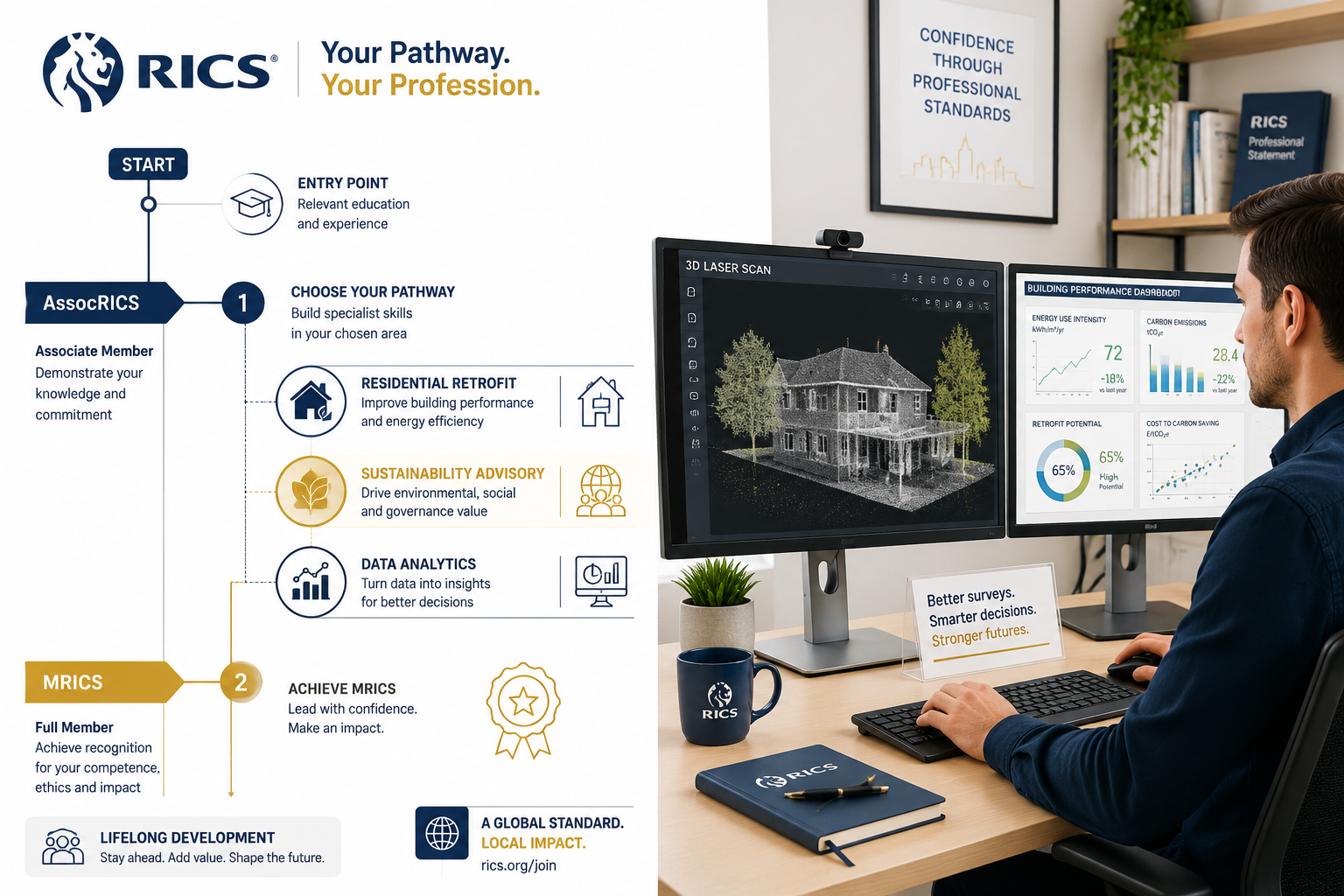
The updated RICS membership framework moves away from broadly defined pathways toward sector-specific competency maps. Candidates now select a pathway that reflects their actual area of practice, ensuring that the skills assessed are directly relevant to the work they perform day-to-day.
The core routes remain:
| Pathway Level | Qualification | Typical Duration |
|---|---|---|
| Associate | AssocRICS | 12-24 months |
| Chartered | MRICS (via APC) | 24-48 months |
| Fellowship | FRICS | Post-MRICS |
Each level now has clearly defined mandatory and optional competencies, structured logbooks, and a final assessment interview [8].
Three Pilot Pathways Reshaping the Profession
RICS is currently piloting three new pathways that reflect where the built environment is heading, not where it has been.
1. Residential Retrofit Surveying (AssocRICS)
This pathway addresses the enormous demand created by the UK's net-zero ambitions. Millions of existing homes require energy efficiency upgrades, and surveyors with specialist retrofit knowledge are in short supply. The pathway equips candidates with competencies in fabric-first retrofit assessment, moisture risk, ventilation strategy, and compliance with evolving energy performance standards. Understanding EPC ratings and Minimum Energy Efficiency Standards is central to this route.
2. Sustainability Advisory (Chartered Surveyor)
This chartered-level pathway targets professionals advising clients on the sustainability performance of their built assets. Competencies span carbon measurement, ESG reporting, green finance, and whole-life cost modelling. The pathway recognises that sustainability is no longer a niche specialism but a core client expectation [1].
3. Data, Analytics and Intelligence
Perhaps the most forward-looking of the three pilots, this pathway integrates AI, machine learning, and advanced data analytics into surveying practice. RICS announced the programme in response to clear market signals that data-driven decision-making is reshaping how property is valued, managed, and transacted [2]. Candidates on this route are expected to demonstrate proficiency in data interpretation, proptech tools, and the ethical use of automated systems [9].
RICS is seeking 30 candidates for the initial assessment cohorts across these pilots. Employers and individuals interested in participating are encouraged to express their interest directly through RICS channels [1].
The Assessment Process: APC, Structured Training, and What to Expect
Understanding the APC in 2026
The Assessment of Professional Competence (APC) remains the primary route to MRICS status. It is a structured programme combining on-the-job experience with documented competency development, culminating in a final assessment interview before a panel of senior chartered surveyors.
The first UK and Ireland Chartered assessment session of 2026 commenced on 13 April, with 133 candidates undertaking their interview assessments [6]. Further sessions are scheduled throughout the year, providing multiple windows for candidates who are ready to sit.
Key components of the APC include:
- Structured training record: A logbook documenting hours spent against mandatory and optional competencies.
- Critical analysis: A written submission of approximately 3,000 words analysing a project or case from the candidate's practice.
- Final assessment interview: A 60-minute panel interview covering the critical analysis, competency diary, and professional ethics.
- Counsellor and supervisor sign-off: Employer-side validation that the candidate has met the required standard in practice.
Candidates who are considering specialist areas such as building defects surveys or construction and condition assessments will find that practical site experience is weighted heavily in the assessment.
AssocRICS: The Associate Route
For those earlier in their careers or transitioning from adjacent fields, AssocRICS offers a structured but less extensive route to formal RICS membership. The associate qualification is valued by employers as evidence of technical competence and professional commitment, and it serves as a natural stepping stone toward full MRICS status.
The new Residential Retrofit Surveying pathway sits at this level, making it accessible to tradespeople, energy assessors, and junior surveyors who want to formalise their expertise without committing immediately to the full APC journey [8].
Apprenticeships and Alternative Entry Routes
Degree Apprenticeships: Earning While Learning
The UK government's push to expand vocational routes into professional careers has created a genuine alternative to the traditional three-year undergraduate degree followed by the APC. Degree apprenticeships in surveying allow candidates to earn a salary, avoid tuition debt, and work toward both a degree and RICS membership concurrently [5].
Several leading surveying firms now run structured degree apprenticeship programmes in partnership with universities, providing trainees with rotational placements across different service lines. This model is particularly effective for attracting candidates from non-traditional backgrounds who may be deterred by the cost of full-time higher education.
School Leaver and Technician Routes
RICS also supports entry at technician level, allowing school leavers to begin building their competency portfolio before committing to a full qualification pathway. This broadens the profession's talent pipeline considerably and aligns with RICS Matrics' diversity and inclusion objectives.
For those exploring early careers programmes in the surveying sector, understanding which entry route best suits individual circumstances — academic background, employer support, financial position — is the critical first decision.
RICS Matrics: The Network Behind the Next Generation
What RICS Matrics Does
RICS Matrics is the official network for student and newly qualified members of RICS, typically those within five years of qualification. It operates across regional committees and provides a structured support ecosystem that complements the formal qualification process [7].
Core Matrics activities include:
- Peer support groups: Regular forums where trainees share APC experiences, tips, and resources.
- Mentoring: Pairing junior professionals with experienced chartered surveyors for guided career development.
- Networking events: Regional and national events connecting trainees with potential employers, collaborators, and future clients.
- CPD workshops: Structured learning sessions aligned with RICS competency requirements.
The Matrics Surveyor Awards 2026
Recognition matters in any profession, and the RICS Matrics Surveyor Awards 2026 provide a high-profile platform for early-career professionals to gain visibility. The nomination period for the 2026 awards has closed, with shortlisted candidates due to be announced on 27 July 2026 [4]. These awards celebrate individuals making significant contributions to the built environment across categories including sustainability, innovation, and community impact.
Winning or being shortlisted for a Matrics award carries real career weight, signalling to employers and clients that a candidate is not merely competent but genuinely outstanding within their cohort.
For those interested in attending industry events and building professional networks, upcoming events in the surveying sector offer valuable opportunities to connect with Matrics members and senior practitioners alike.

Digital Competencies and the Future of Surveying Practice
Why Digital Skills Are Now Non-Negotiable
The launch of the Data, Analytics and Intelligence pathway is the clearest signal yet that RICS views digital fluency as a core professional competency, not an optional extra. Across every service line — from residential valuations to large-scale commercial asset management — data is reshaping how surveyors work, advise, and are judged by their clients [9].
Trainees entering the profession in 2026 should expect to encounter:
- Building Information Modelling (BIM): Digital representations of physical and functional characteristics of buildings.
- Automated Valuation Models (AVMs): Data-driven tools that supplement traditional comparative valuation methods.
- Drone and remote sensing technology: Increasingly used for roof surveys and large-scale condition assessments.
- Proptech platforms: Software tools for property management, transaction management, and client reporting.
- AI-assisted report writing: Tools that assist in drafting and checking survey reports for consistency and compliance.
Understanding what a measured building survey involves and how digital measurement tools are transforming that process is a practical example of how technology is already embedded in day-to-day surveying work.
CPD in the Digital Age
Continuing Professional Development (CPD) requirements have been updated to reflect the growing importance of digital and sustainability competencies. RICS members are expected to complete a minimum of 20 hours of CPD per year, with a proportion directed toward formal, verifiable learning. In 2026, many CPD providers are offering online modules specifically targeting AI literacy, data ethics, and proptech application — areas that were absent from CPD catalogues just a few years ago.
Choosing the Right Pathway: A Practical Framework
Selecting the most appropriate RICS pathway is a decision that benefits from structured thinking. The following framework helps candidates and their employers align on the right route.
Step 1 — Define your current role and sector. Are you working in residential surveying, commercial property, construction, or a cross-cutting advisory role? The sector pathway framework is designed so that your competencies map directly to your daily practice.
Step 2 — Assess your academic and professional background. Graduates with RICS-accredited degrees may be eligible to enter the APC directly. Those without a relevant degree may need to complete a conversion course or enter via the AssocRICS route first.
Step 3 — Evaluate employer support. The APC requires a structured employer commitment, including a designated counsellor and supervisor. Candidates whose employers are not RICS-regulated may need to seek an external counsellor arrangement.
Step 4 — Consider the new pilot pathways. If your work involves retrofit, sustainability advisory, or data analytics, the new pilot pathways may offer a more directly relevant qualification than a traditional sector route.
Step 5 — Engage with Matrics early. Joining the Matrics network at the start of your training — not just at the end — provides access to resources, peer support, and mentoring that significantly improve APC pass rates.
For those considering whether a career in surveying is the right fit, understanding why property owners hire surveyors and the breadth of work the profession covers can help clarify the long-term career opportunity.
Sector Growth, Talent Demand, and Career Prospects
The case for entering the surveying profession in 2026 is compelling on economic grounds alone. Housing reform, the retrofit agenda, infrastructure investment, and commercial property transformation are all generating sustained demand for qualified professionals. Firms operating across open roles in chartered surveying are actively competing for talent, offering structured training contracts, competitive salaries, and clear progression frameworks.
Newly qualified MRICS surveyors in the UK typically command starting salaries between £35,000 and £50,000, with significant upward progression as experience and specialisms develop. Those who qualify through the new sustainability or data analytics pathways may find premium demand for their skills given the relative scarcity of chartered professionals in these areas.

Conclusion
RICS Matrics Trainee Pathways 2026: Building the Next Generation of Chartered Surveyors represents the most significant evolution of the profession's qualification framework in a decade. The closure of legacy pathways, the launch of three targeted pilot programmes, the expansion of apprenticeship routes, and the integration of digital competencies into core assessment criteria collectively signal a profession that is adapting with genuine urgency to the demands of the built environment.
For trainees and aspiring surveyors, the actionable steps are clear:
- Transition immediately if still operating under the 2015 pathway framework — it has now closed.
- Explore the new pilot pathways in Retrofit, Sustainability, and Data Analytics if your practice aligns with these emerging specialisms.
- Engage with RICS Matrics from day one of your training to access mentoring, peer support, and award opportunities.
- Invest in digital skills as a non-negotiable part of your CPD plan, not an afterthought.
- Consider apprenticeship routes if the cost or timing of traditional university study is a barrier.
The profession needs skilled, diverse, and digitally capable chartered surveyors. The pathways to get there have never been more varied, more relevant, or more accessible.
References
[1] Rics Calls Expressions Interest Pilot Programmes New Professional Pathways – rics.org
[2] Rics Calls For Expressions Of Interest In New Data Analytics And Intelligence Pathway – rics.org
[3] Sector Pathways – rics.org
[4] Matrics Surveyor Awards – rics.org
[5] Surveying University Apprenticeships – ww3.rics.org
[6] Session One 2026 Uki Assessments Are Now Underway – rics.org
[7] Matrics – rics.org
[8] Join Rics – rics.org
[9] Rics Announces New Data Pathway Become Chartered Surveyor – buildingengineer.org.uk