


Last updated: July 24, 2026
Quick Answer: A retrospective building survey is a professional property inspection carried out after you have already completed a purchase. If serious defects emerge post-completion, your first step is to commission a RICS-accredited Level 3 survey to document the condition, then take legal advice on whether misrepresentation or surveyor negligence claims apply. Acting quickly matters because strict time limits govern your options.
Key Takeaways
- Retrospective building surveys and valuations after buying can identify serious defects that were missed or concealed before completion.
- The legal principle of "caveat emptor" (buyer beware) applies in England and Wales, meaning post-exchange recourse against sellers is limited but not impossible.
- Misrepresentation, fraud, or surveyor negligence are the main legal routes available to buyers who discover hidden defects after purchase.
- Time limits for legal claims typically range from six years (contract claims) to three years (personal injury linked to defects), so prompt action is essential.
- A retrospective valuation can establish how much a defect has reduced the property's market value, which is critical evidence in any claim.
- Buildings insurance rarely covers pre-existing defects, but specialist policies and legal expenses cover may help.
- Defects rated "Red" under the RICS traffic light system, including structural movement, severe damp, and dangerous electrical installations, are serious enough to warrant immediate action.
- Skipping a pre-purchase survey, or relying on a mortgage valuation alone, is the single biggest reason buyers find themselves in this position.
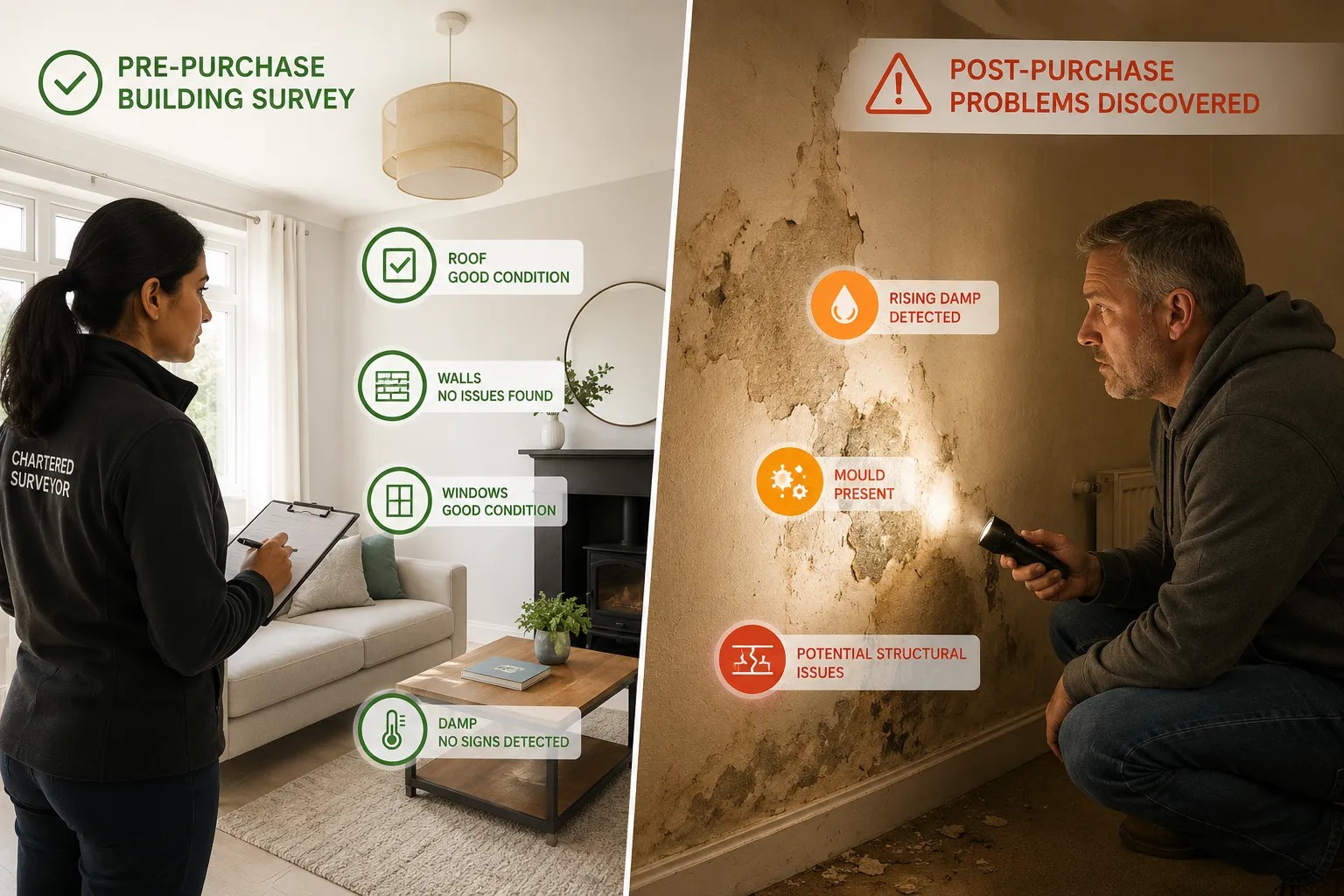
What Is a Retrospective Building Survey and When Do You Need One
A retrospective building survey is a full structural and condition inspection of a property you already own, commissioned after the purchase has completed. It serves the same purpose as a pre-purchase survey but is used to document defects discovered post-completion, establish their likely cause and age, and provide evidence for legal or insurance purposes.
You need one in any of the following situations:
- You skipped a survey before buying and have since noticed cracks, damp, or structural movement.
- You had a lower-level survey (such as a Level 1 or Level 2 HomeBuyer Report) and now suspect it missed significant problems.
- A contractor, builder, or neighbour has flagged a serious issue you were unaware of.
- You are considering a legal claim against the seller, your conveyancer, or your original surveyor and need documented evidence.
- You want to understand repair costs before deciding whether to sell, renovate, or pursue a claim.
A retrospective survey is also useful if you are a landlord who acquired a property without a thorough inspection and now face compliance questions. For a detailed breakdown of what a comprehensive inspection covers, see this guide to Level 3 Full Building Surveys.
Choose a retrospective survey if: you have discovered a defect that materially affects habitability, safety, or value, and you need an independent professional opinion backed by a written report.
Should You Get a Retrospective Survey If You Didn't Get One Before Buying
Yes, and the sooner the better. A surprising number of buyers either waive their survey to speed up a transaction or rely on a basic mortgage valuation, which assesses lending risk rather than property condition. Research from RICS-accredited firms suggests that around 94% of HomeBuyer Survey reports identify at least one significant defect, so the risk of missing something without a proper inspection is high.
If you are now living in the property and noticing problems, a retrospective survey gives you:
- An independent, professional record of the defect's existence and likely age.
- An assessment of whether the defect was pre-existing at the time of sale.
- Repair cost estimates that can support renegotiation or legal claims.
- Guidance on what further specialist investigations are needed.
It is worth understanding the difference between a Level 2 and Level 3 survey before commissioning one, as the depth of reporting varies considerably. For most retrospective cases involving serious defects, a Level 3 Full Building Survey is the appropriate choice.
What Defects Qualify as Serious Enough to Take Action On
Serious defects are those that affect structural integrity, habitability, safety, or market value in a material way. Under the RICS traffic light rating system, "Red" condition ratings flag issues requiring urgent or immediate attention.
Common serious defects found in retrospective surveys include:
- Structural movement: Diagonal cracks, sloping floors, or sticking doors can indicate subsidence, heave, or inadequate foundations.
- Severe damp and moisture ingress: Penetrating damp, rising damp, or condensation-related mould that has damaged wall fabric, timbers, or insulation. Damp is one of the most frequently missed pre-purchase issues.
- Roof defects: Failed flashings, deteriorated coverings, or structural roof spread that allows water ingress.
- Timber decay and infestation: Active woodworm, wet rot, or dry rot in floor joists, roof timbers, or structural beams.
- Dangerous electrical installations: Outdated wiring, lack of RCD protection, or non-compliant consumer units.
- Asbestos-containing materials: Particularly in properties built before 2000, where undisclosed asbestos in insulation boards, floor tiles, or roof sheets poses a health risk. See the asbestos building surveys guide for more detail.
- Unpermitted structural alterations: Removed load-bearing walls, unsupported openings, or extensions built without building regulations approval.
A defect is "serious enough to act on" if repair costs are significant (generally above £5,000 as a rough working threshold), if it poses a safety risk, or if it would have materially affected your decision to buy or the price you paid.
What's the Difference Between a Survey Done Before vs After Buying a House
The core inspection process is identical, a chartered surveyor examines the structure, fabric, and services of the building. The critical difference lies in purpose and legal context.
| Aspect | Pre-Purchase Survey | Retrospective Survey |
|---|---|---|
| Timing | Before exchange of contracts | After completion |
| Primary purpose | Inform buying decision / price negotiation | Document defects, support claims |
| Negotiation leverage | High, can renegotiate or withdraw | Limited, transaction is complete |
| Legal use | Rarely needed | Often central to a claim |
| Urgency | Moderate | High if defects are dangerous |
A pre-purchase survey gives you the power to walk away or negotiate a price reduction before you are committed. A retrospective survey, by contrast, is primarily an evidential tool. It cannot undo the purchase, but it can establish what the property's condition was at the time of sale, which is the foundation of any misrepresentation or negligence claim.
For context on how survey reports are structured, the questions to ask during a building survey resource covers what a thorough inspection should address.
How Long After Buying a House Can You Get a Survey Done
There is no legal deadline on commissioning a retrospective survey, you can arrange one at any point after completion. However, the longer you wait, the harder it becomes to prove that a defect was pre-existing at the time of sale rather than something that developed or worsened under your ownership.
Practical guidance:
- Commission a survey as soon as you suspect a serious problem, ideally within the first 12 months of ownership.
- If you intend to pursue a legal claim, act within six years of completion for contract-based claims (the standard Limitation Act 1980 period in England and Wales).
- For claims based on fraudulent misrepresentation, the six-year period runs from the date you discovered (or could reasonably have discovered) the fraud.
- Surveyor negligence claims follow a similar six-year limitation period from the date of the negligent survey.
Prompt action also matters because some defects worsen quickly, a leaking roof or active dry rot can cause exponential secondary damage within months. The consequences of failing to act on building issues are often more costly than the original defect.
Do Sellers Have to Disclose Known Defects Before You Buy
In England and Wales, the principle of "caveat emptor" (buyer beware) means sellers are not generally required to volunteer information about defects. However, they must not actively misrepresent the property's condition. The distinction between non-disclosure and misrepresentation is legally significant.
What sellers must do:
- Answer pre-contract enquiries (via the TA6 Property Information Form) honestly and accurately.
- Not make false statements about the property's condition, planning history, or known defects.
- Disclose disputes, notices, and known issues when directly asked.
What sellers are not required to do:
- Proactively reveal defects they were never asked about.
- Investigate problems they are unaware of.
If a seller ticked "not known" on a TA6 form for a defect they clearly knew about, that may constitute misrepresentation under the Misrepresentation Act 1967. If they made a positive false statement, for example, claiming a roof was recently replaced when it had not been, that is stronger grounds for a claim.
Can You Sue the Seller If a Survey Finds Defects After Purchase
Yes, in certain circumstances, but the legal bar is not low. The key routes are misrepresentation, fraudulent concealment, and breach of contract. A straightforward claim that "the seller didn't tell me about the damp" will not succeed unless you can show the seller actively lied or made a false statement in the pre-contract paperwork.
The main legal routes:
- Misrepresentation Act 1967: If the seller made a false statement of fact that induced you to buy, you may claim damages or rescission. Innocent, negligent, and fraudulent misrepresentation are all covered, with different remedies.
- Fraudulent concealment: If a seller deliberately hid a defect (for example, by painting over damp or covering cracks with plasterboard), this can amount to fraud and extends the limitation period.
- Negligence against your surveyor: If you commissioned a pre-purchase survey and the surveyor failed to identify a defect that a competent professional should have spotted, you may have a claim against the surveying firm.
- Conveyancer negligence: If your solicitor failed to raise appropriate enquiries or missed a red flag in the paperwork, a professional negligence claim may apply.
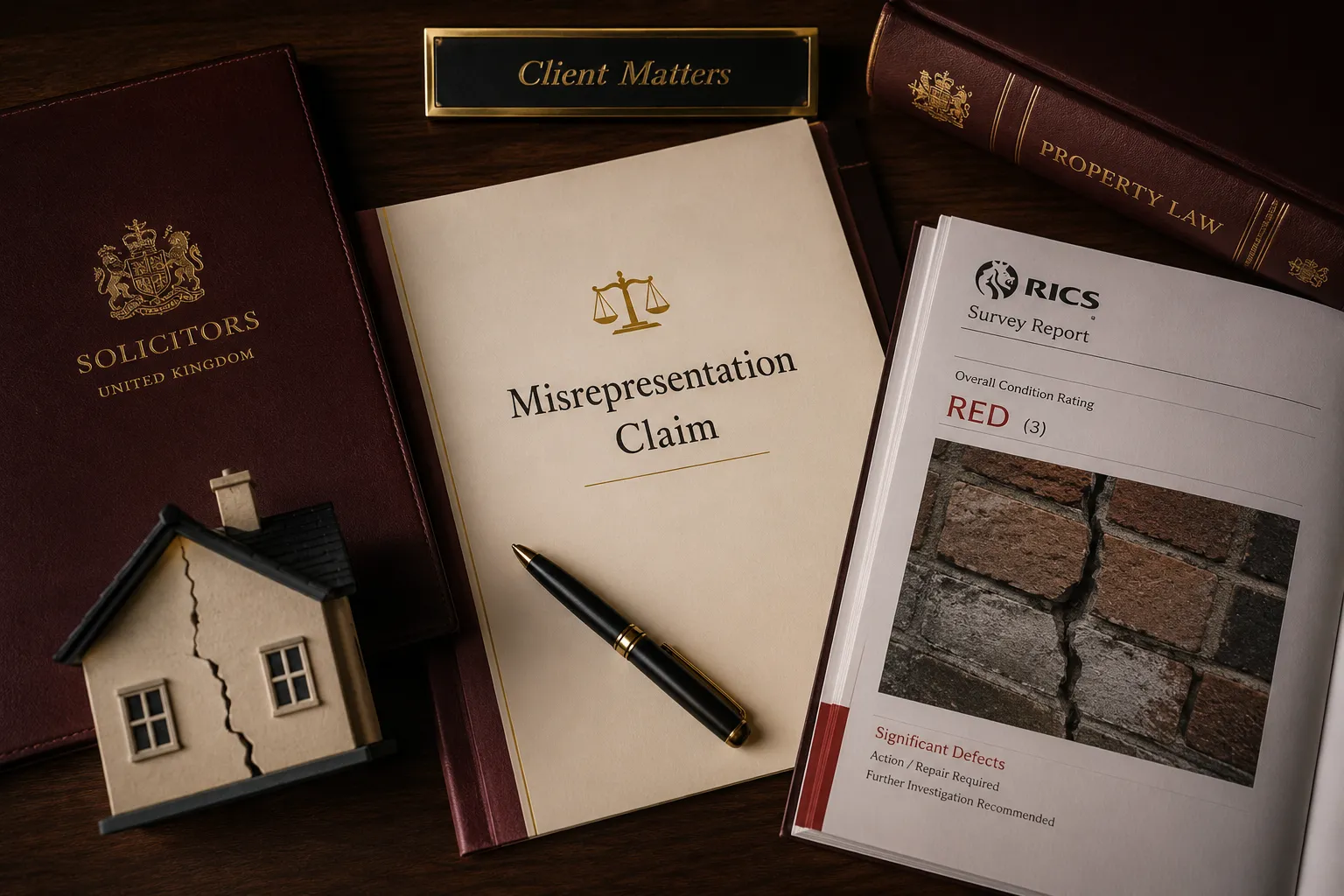
Getting a retrospective survey report that establishes the defect was pre-existing is essential evidence for any of these routes. Legal advice from a solicitor specialising in property disputes should be sought before proceeding.
What's the Time Limit for Disputing a Property Sale Due to Hidden Defects
The standard limitation period for contract and misrepresentation claims in England and Wales is six years from the date of completion, under the Limitation Act 1980. For claims in tort (such as surveyor negligence), the period is also six years from the date the damage occurred, or three years from when you knew (or ought to have known) about the damage, whichever is later, subject to a 15-year longstop.
Key time limits at a glance:
- Misrepresentation (contract): 6 years from completion.
- Fraudulent misrepresentation: 6 years from discovery of the fraud.
- Surveyor negligence: 6 years from the negligent act, or 3 years from knowledge (whichever is later).
- Personal injury caused by a defect (e.g., asbestos exposure): 3 years from knowledge.
Do not delay. Even if a claim feels uncertain, consulting a solicitor early preserves your options. A retrospective survey commissioned promptly also creates a contemporaneous record that strengthens your position.
Can You Get Your Money Back If a Post-Purchase Survey Finds Major Problems
Full rescission (getting all your money back and unwinding the transaction) is rare and difficult to achieve once completion has occurred. It requires proving fraudulent misrepresentation or a fundamental breach of contract, and courts are reluctant to unwind completed property transactions.
More commonly, buyers recover damages, a financial sum representing the difference between what they paid and what the property was actually worth given its true condition, plus the cost of necessary repairs. This is where a retrospective valuation becomes critical.
A retrospective valuation is a formal assessment of what the property was worth at the date of purchase, taking the defects into account. It is produced by a RICS-registered valuer and provides the financial evidence needed to quantify a claim. For context on how valuations work, the independent property valuation guide explains the process in plain terms.
Realistic outcomes from a successful claim:
- Damages covering the cost of repairs.
- Compensation for the diminution in value caused by the defect.
- Recovery of professional fees and legal costs (in some cases).
How Does a Retrospective Valuation Affect Your Property's Worth
A retrospective valuation does not change the current market value of your property, it establishes what the property was worth on a specific past date, typically the date of purchase, had the defects been known. This "as if known" valuation is the foundation of calculating financial loss in a dispute.
If the retrospective valuation shows the property was worth significantly less than the purchase price given its actual condition, that gap forms the basis of a damages claim. Forensic appraisal services can also assess how design flaws or construction errors specifically reduced value, which is particularly relevant in cases involving unpermitted structural alterations.
A current market valuation may also be needed to assess whether the property has lost further value since purchase due to ongoing deterioration, particularly relevant if you are considering selling rather than repairing.
How Much Does a Retrospective Building Survey Cost
A retrospective building survey costs broadly the same as a pre-purchase Level 3 Full Building Survey, because the scope of inspection is comparable. Fees vary by property size, age, location, and complexity.
Indicative fee ranges (2026 estimates, England and Wales):
- Standard residential property (2-3 bedrooms): approximately £500,£900.
- Larger or older properties (4+ bedrooms, pre-1900 construction): approximately £900,£1,500+.
- Listed buildings or properties with complex defects: fees can exceed £1,500, and specialist sub-consultants (structural engineers, asbestos surveyors) may be needed in addition.
A Level 3 inspection typically takes up to eight hours on-site, with the final report delivered within one to two weeks depending on complexity. If a retrospective valuation is required alongside the survey, this will add to the overall cost but is often essential for legal purposes.
Bear in mind that the cost of a survey is almost always a fraction of the cost of undetected repairs or a failed legal claim. For a detailed look at what a Level 3 report covers, see what's in a Level 3 survey.
What Should You Do First If Your Survey Reveals Structural Issues
If a retrospective survey identifies structural problems, follow these steps in order:
- Obtain the full written report and note all Red-rated items. Do not begin repair work until you have legal advice, as this can affect your ability to claim.
- Commission a structural engineer's report if the surveyor recommends further investigation. Diagonal cracks, sloping floors, or evidence of subsidence require specialist assessment.
- Get written repair quotes from at least two reputable contractors. These quotes quantify your financial loss and strengthen any renegotiation or legal claim.
- Consult a property disputes solicitor before contacting the seller, your original surveyor, or your conveyancer. Anything you say or do at this stage can affect your legal position.
- Check your buildings insurance policy for any relevant cover, and notify your insurer promptly, late notification can invalidate a claim.
- Consider urgent safety measures if the defect poses an immediate risk (for example, a dangerous roof structure or confirmed asbestos in a friable state). Safety takes priority, but document everything before and after.
For urgent or dangerous building issues, the urgent building issues guidance provides further detail on prioritisation.
What Are Common Defects Found in Retrospective Surveys That Buyers Miss
Several categories of defect are consistently overlooked in pre-purchase inspections, either because buyers opted for a lower-level survey, or because the defects were concealed or not yet visible.
Most commonly missed defects:
- Damp behind finishes: Sellers sometimes redecorate immediately before marketing, masking damp staining. A retrospective survey using moisture meters and thermal imaging can reveal what paint conceals.
- Roof structure problems: Visible from inside the loft but often not inspected if a buyer does not commission a full survey. Sagging purlins, spread rafters, and inadequate support are frequently missed.
- Drainage defects: Collapsed or root-invaded drains are invisible without a CCTV drain survey. Symptoms (slow drainage, damp at ground level) may only emerge after months of use.
- Unpermitted alterations: Removed walls, garage conversions, and loft conversions without building regulations sign-off. These create both structural risk and legal complications on resale.
- Electrical and plumbing age: Outdated wiring (aluminium wiring, old rubber-insulated cables) or lead pipework that a basic survey may not flag in detail.
- Boundary and party wall issues: Encroachments or party wall damage that only become apparent after moving in. The Party Wall Act guide explains the implications.
Can You Claim on Your Buildings Insurance for Defects Found After Purchase
Generally, no. Standard buildings insurance covers sudden, accidental damage, not pre-existing defects or gradual deterioration. Insurers will typically decline claims for damp, rot, or structural movement that existed before the policy inception or that developed gradually over time.
Exceptions and alternatives:
- Legal expenses insurance: Some home insurance policies include legal expenses cover that can fund a misrepresentation or surveyor negligence claim. Check your policy schedule carefully.
- Latent defects insurance: Available on new-build and recently converted properties, this covers structural defects that were hidden at the time of construction. It typically runs for 10 years from practical completion.
- Specialist indemnity policies: For issues such as lack of building regulations consent, indemnity insurance can be purchased to protect against enforcement action, though it does not fund repairs.
If you are unsure whether a defect might be covered, notify your insurer in writing as soon as you become aware of the issue. Failing to notify promptly is a common reason claims are declined.
Interactive Tool: Post-Purchase Defect Action Planner
.cg-planner{font-family:Arial,sans-serif;max-width:560px;margin:2em auto;background:#f8f9fb;border:1px solid #d0d7e2;border-radius:8px;padding:20px;box-sizing:border-box}
.cg-planner h3{margin:0 0 4px;font-size:1.1em;color:#1a2a4a}
.cg-planner p.cg-sub{margin:0 0 14px;font-size:.85em;color:#555}
.cg-planner label{display:block;margin-bottom:8px;font-size:.9em;color:#222;cursor:pointer}
.cg-planner input[type=checkbox]{margin-right:8px;accent-color:#1a5276}
.cg-result{margin-top:16px;padding:12px;border-radius:6px;font-size:.88em;line-height:1.5;display:none}
.cg-result.show{display:block}
.cg-result.urgent{background:#fdecea;border-left:4px solid #c0392b;color:#7b241c}
.cg-result.moderate{background:#fef9e7;border-left:4px solid #d4ac0d;color:#7d6608}
.cg-result.low{background:#eafaf1;border-left:4px solid #27ae60;color:#1e8449}
.cg-btn{margin-top:12px;background:#1a5276;color:#fff;border:none;padding:9px 20px;border-radius:5px;cursor:pointer;font-size:.9em}
.cg-btn:hover{background:#154360}
.cg-reset{background:none;border:none;color:#1a5276;font-size:.82em;cursor:pointer;margin-left:12px;text-decoration:underline}
Post-Purchase Defect Action Planner
Tick all that apply to your situation, then click Assess.
function cgAssess(){
var c1=document.getElementById(‘c1’).checked,
c2=document.getElementById(‘c2’).checked,
c3=document.getElementById(‘c3’).checked,
c4=document.getElementById(‘c4’).checked,
c5=document.getElementById(‘c5’).checked,
c6=document.getElementById(‘c6′).checked;
var score=0,msg=”,cls=”;
if(c1)score+=3;if(c2)score+=2;if(c3)score+=2;if(c4)score+=2;if(c5)score+=1;if(c6)score+=1;
if(score>=6){cls=’urgent’;msg=’Urgent action recommended. Commission a RICS Level 3 survey immediately, seek a structural engineer if cracks are present, and consult a property disputes solicitor before contacting the seller. Do not begin repairs until you have legal advice.’;}
else if(score>=3){cls=’moderate’;msg=’Act promptly. A retrospective building survey is advisable to document the defect. Gather contractor repair quotes and check whether the seller made any written representations. Legal advice is worth seeking if the defect is material.’;}
else{cls=’low’;msg=’Lower urgency, but do not ignore it. Monitor the issue and consider a condition survey to establish a baseline. If the defect worsens or repair costs are significant, revisit your legal options, the 6-year limitation period applies.’;}
var el=document.getElementById(‘cg-out’);
el.className=’cg-result show ‘+cls;el.innerHTML=msg;
}
function cgReset(){
[‘c1′,’c2′,’c3′,’c4′,’c5′,’c6’].forEach(function(id){document.getElementById(id).checked=false;});
var el=document.getElementById(‘cg-out’);el.className=’cg-result’;el.innerHTML=”;
}
Frequently Asked Questions
Can I commission a retrospective building survey on a property I already own?
Yes. There is no restriction on commissioning a building survey after completion. A RICS-accredited surveyor can inspect your property at any time and produce a formal report documenting its condition, the nature of any defects, and recommended remedial action.
What is the difference between a retrospective survey and a retrospective valuation?
A retrospective survey assesses the physical condition of the property, identifying defects, their cause, and repair costs. A retrospective valuation establishes what the property was worth at a specific past date (usually the purchase date) given its actual condition. Both are often needed together when pursuing a legal claim.
Does a mortgage valuation protect me if defects are found after purchase?
No. A mortgage valuation is carried out for the lender's benefit to confirm the property is adequate security for the loan. It does not assess condition in detail and offers no protection to the buyer. Relying on it instead of commissioning an independent survey is one of the most common and costly mistakes buyers make.
What if the original surveyor missed the defect, can I claim against them?
Yes, if the defect was visible and a competent surveyor exercising reasonable skill and care should have identified it. You would need to show the surveyor was negligent, that you relied on their report, and that you suffered financial loss as a result. The limitation period is generally six years from the date of the negligent survey.
Will carrying out repairs before getting legal advice affect my claim?
Potentially, yes. Completing repairs before the defect has been independently assessed and documented can make it harder to prove its pre-existing nature and extent. Always commission a retrospective survey and take legal advice before starting remedial work, unless there is an immediate safety risk.
How long does a retrospective Level 3 building survey take?
The on-site inspection typically takes up to eight hours for a standard residential property, depending on size and complexity. The written report is usually delivered within one to two weeks of the inspection. For a detailed look at survey timeframes, see the building survey timeframes guide.
Can retrospective building surveys and valuations after buying help with insurance reinstatement claims?
A survey can document the extent of damage and inform repair cost estimates, which supports an insurance reinstatement valuation. However, standard buildings insurance does not cover pre-existing defects. Specialist insurance reinstatement cost valuations are a separate service used to ensure your sum insured is adequate going forward.
Conclusion
Discovering serious defects after buying a property is stressful, but it is not a dead end. Retrospective building surveys and valuations after buying exist precisely for this situation, to document what went wrong, establish when the problem arose, and provide the evidence needed to pursue a remedy.
Actionable next steps:
- Commission a RICS Level 3 Full Building Survey from a chartered surveyor as soon as you suspect a serious problem. Do not delay.
- Obtain a retrospective valuation if you intend to pursue a financial claim, this quantifies your loss.
- Gather all pre-purchase documentation: the TA6 Property Information Form, any survey reports, and written correspondence with the seller or agent.
- Get two or three written repair quotes from reputable contractors to establish the cost of remediation.
- Consult a solicitor specialising in property disputes before contacting the seller, your original surveyor, or your conveyancer.
- Check your buildings insurance policy for legal expenses cover.
- Act within the six-year limitation period, do not assume you have unlimited time.
The cost of a thorough retrospective survey is modest compared to the potential value of a successful claim or the cost of repairs you might otherwise absorb alone. Professional advice, taken early, is the most effective tool available to any buyer who finds themselves in this position.
Tags: retrospective building survey, post-purchase defects, building survey after buying, RICS Level 3 survey, property defects legal claim, misrepresentation property, surveyor negligence, structural defects, retrospective valuation, caveat emptor, hidden defects, buildings insurance defects