

Last updated: July 24, 2026
Quick Answer: Restrictive covenants are legally binding obligations attached to land that limit how a property can be used or developed. When disputes arise over their impact on value, expert witness surveyors must quantify that impact in a way courts and tribunals will accept, a task that is far more complex than a standard market appraisal, because the evidence must survive rigorous legal scrutiny.
Key Takeaways
- Restrictive covenants can reduce a property's market value by a material amount, but the precise figure depends on enforceability, the nature of the restriction, and comparable evidence.
- Expert witnesses in covenant disputes must meet strict standards of independence and methodology; courts will reject opinions that lack transparent reasoning or comparable evidence.
- Covenants can be modified or discharged under Section 84 of the Law of Property Act 1925, but compensation is set by valuation evidence presented to the Upper Tribunal (Lands Chamber).
- The distinction between a restrictive covenant and an easement matters significantly for valuation purposes, they affect value in different ways.
- Common appraiser mistakes include ignoring enforceability questions, failing to find true comparables, and conflating the covenant's legal status with its market impact.
- Engaging a specialist expert witness surveyor early in a dispute reduces the risk of flawed evidence being challenged or excluded.
- Documentation, including title deeds, historic conveyances, and planning history, is essential before any covenant valuation can begin.
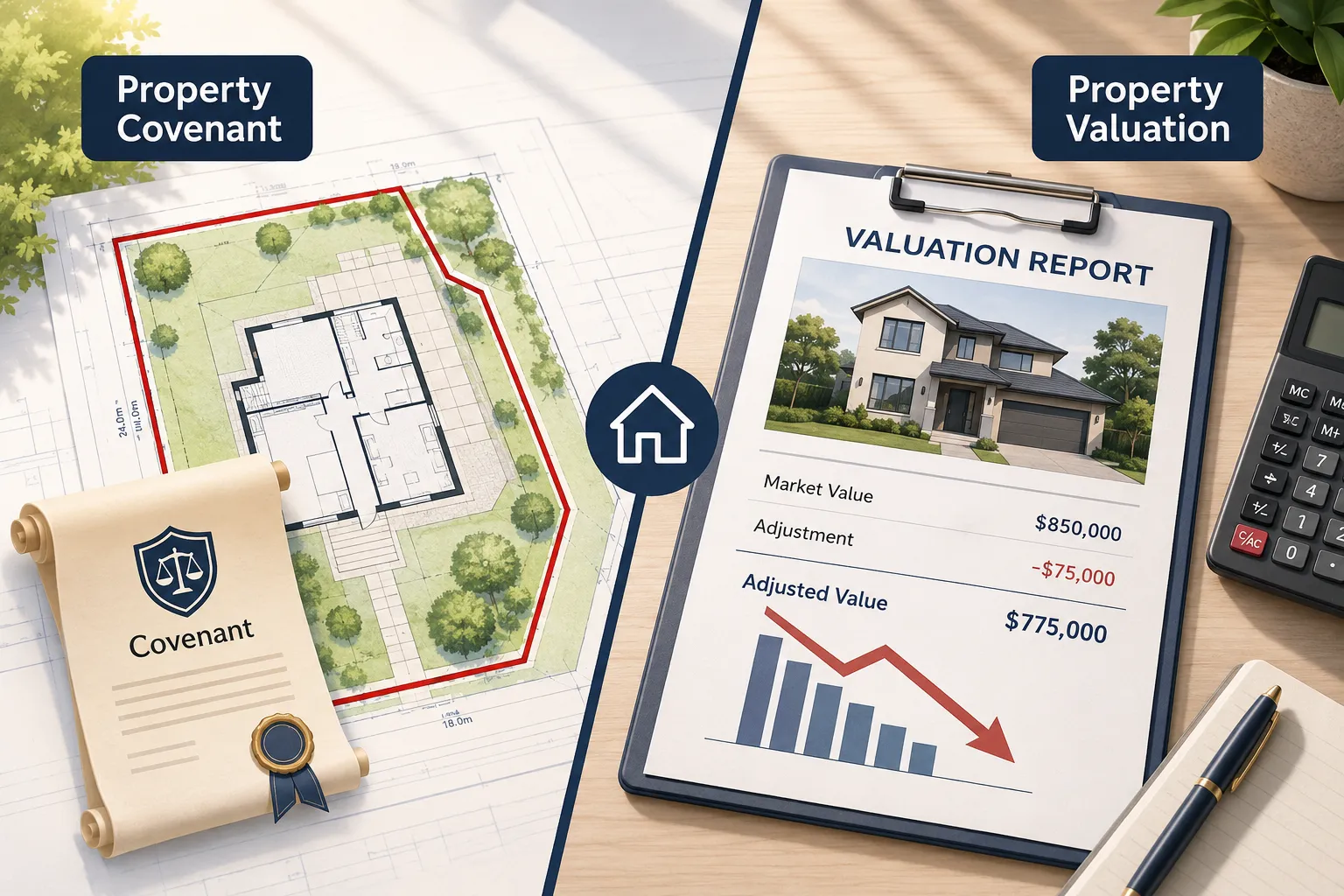
What Are Restrictive Covenants and How Do They Affect Property Value
A restrictive covenant is a private legal obligation written into a property's title that restricts what the owner can do with the land. Common examples include prohibitions on building additional structures, running a business from the property, or subdividing the plot. These obligations bind not just the original parties but future owners, provided certain legal conditions are met.
The effect on value depends on three factors:
- The nature of the restriction: A covenant preventing any development on a plot with planning potential can reduce value substantially. A covenant requiring the owner to maintain a boundary fence has minimal impact.
- Enforceability: A covenant that is technically on the title but practically unenforceable (because the benefiting land cannot be identified, for example) has little or no market impact.
- Buyer perception: Even a covenant of questionable enforceability can deter buyers and reduce competition at sale, which suppresses price.
For a fuller picture of how legal and physical factors interact during a valuation, see this guide on the top things assessed during a property valuation.
How Do Restrictive Covenants Impact Real Estate Appraisals
Restrictive covenants affect appraisals by narrowing the pool of potential buyers, limiting permitted uses, and sometimes blocking the highest-value development scenario entirely. A standard market valuation must account for all encumbrances on title, and a covenant is one of the most significant.
In practice, appraisers approach covenant impact in two ways:
- The "before and after" method: Value the property as if the covenant did not exist, then value it subject to the covenant. The difference represents the diminution in value.
- Comparable evidence: Find sales of similar properties with and without equivalent restrictions and extract the implied discount the market applies.
Both methods have weaknesses. The before-and-after approach requires a hypothetical scenario that courts may scrutinise closely. Comparable evidence is often thin, because covenant terms are rarely identical across transactions. A chartered surveyor instructed as an expert witness must explain and defend whichever method is used.
What Makes Restrictive Covenants Hard to Value as an Expert Witness
Valuing a restrictive covenant as an expert witness is genuinely difficult because the task sits at the intersection of legal analysis and market evidence, two disciplines that do not always align neatly.
Key challenges include:
- Enforceability uncertainty: The covenant's legal status may be contested. A valuer cannot simply assume it is enforceable or unenforceable; the opinion must be conditional or must engage with the legal arguments.
- Thin comparable market: There are rarely enough direct comparables to produce a statistically robust adjustment.
- Conflicting expert opinions: In contested cases, both sides instruct experts who reach different conclusions. Courts closely scrutinise the methodology behind each opinion, and a poorly reasoned report will be given little weight.
- Owner testimony versus expert evidence: A recurring challenge in tribunal proceedings is reconciling what the property owner believes their land is worth with what the market evidence actually supports. Expert witnesses must present objective, evidence-based opinions that are independent of their client's interests.
Courts and tribunals expect expert witnesses to comply with Civil Procedure Rules Part 35 and the associated Practice Direction. Any departure from independence, or any failure to acknowledge contrary evidence, can result in the opinion being discounted or excluded entirely.
For disputes involving development potential specifically, a property development valuation from a qualified chartered surveyor provides the foundation needed for expert witness work.
What Is the Difference Between Restrictive Covenants and Easements in Property Valuation
Restrictive covenants and easements are both encumbrances on land, but they affect value in fundamentally different ways and require different valuation approaches.
| Feature | Restrictive Covenant | Easement |
|---|---|---|
| Nature | Prohibits an activity | Grants a right to use land |
| Who benefits | Neighbouring landowner | Specific person or dominant land |
| Value impact | Usually reduces burdened land value | Can reduce or increase value depending on type |
| Valuation method | Diminution or release premium | Market rent or access premium |
| Discharge route | Section 84, LPA 1925 | Rarely dischargeable without agreement |
An easement granting a right of way across a garden, for example, reduces the burdened owner's value but may increase the benefiting land's value. A restrictive covenant preventing development reduces the burdened owner's value but protects the amenity, and therefore the value, of neighbouring properties. Expert witnesses must be clear about which encumbrance they are valuing and use the appropriate methodology for each.
When Should You Hire an Expert Witness for Restrictive Covenant Disputes
An expert witness surveyor is needed whenever a restrictive covenant dispute moves beyond negotiation and into formal proceedings, whether that is the Upper Tribunal (Lands Chamber), a county court, or an arbitration.
Specific triggers include:
- An application to modify or discharge a covenant under Section 84 of the Law of Property Act 1925
- A claim for damages following an alleged breach of covenant
- A dispute over the premium payable to release a covenant
- A mortgage lender requiring a formal opinion on the covenant's impact before proceeding
- A planning application where the covenant conflicts with the proposed use
Instructing an expert witness early, before positions become entrenched, gives the surveyor time to gather proper comparable evidence and produce a report that meets the procedural requirements of the relevant tribunal. Late instruction is one of the most common reasons expert evidence is weakened.

How Do Courts Challenge Expert Witness Opinions on Covenant Valuations
Courts and tribunals challenge expert opinions on covenant valuations primarily by testing the independence, methodology, and comparability of the evidence presented.
Common lines of challenge include:
- Lack of comparable transactions: If the expert relies on a small number of comparables, the opposing party will argue those comparables are not truly analogous.
- Failure to address enforceability: An opinion that values a covenant without engaging with whether it is actually enforceable will be questioned.
- Advocacy rather than independence: Expert witnesses who appear to argue their client's case rather than assist the tribunal will have their credibility undermined under cross-examination.
- Inconsistent methodology: Using different methods for the "before" and "after" valuations without explanation creates logical inconsistencies that opposing counsel will exploit.
Tribunal cases involving covenant modification, such as proceedings before the Upper Tribunal (Lands Chamber), demonstrate that valuation evidence is scrutinised in detail. The tribunal will often prefer the expert who acknowledges uncertainty and explains their reasoning transparently over one who presents an artificially precise figure without qualification.
How Do You Calculate the Cost of a Restrictive Covenant Violation
The cost of a restrictive covenant violation is calculated as the greater of: the diminution in value to the benefiting land, or the profit made by the party in breach. Courts apply different measures depending on the remedy sought.
Diminution in value: The reduction in the market value of the land that benefits from the covenant, measured as the difference between its value with the covenant intact and its value after the breach.
Wrotham Park damages (negotiating damages): Where a court awards damages in lieu of an injunction, it may assess what a reasonable buyer and seller would have agreed as a release fee, typically expressed as a percentage of the developer's anticipated profit from the breach.
Injunction: In serious cases, the court may order the breach to be remedied (for example, demolition of an unauthorised structure), which makes the financial calculation secondary.
For anyone facing a potential breach scenario, an independent property valuation from a RICS-registered surveyor is the essential starting point before any legal action is taken.
Can Restrictive Covenants Be Removed or Modified
Yes. Under Section 84 of the Law of Property Act 1925, an application can be made to the Upper Tribunal (Lands Chamber) to modify or discharge a restrictive covenant. The applicant must satisfy one or more statutory grounds, including that the covenant is obsolete, that it impedes reasonable use of the land, or that its modification would not injure those entitled to enforce it.
The process involves:
- Identifying all parties who benefit from the covenant
- Serving notice on those parties
- Submitting valuation evidence to support the application
- Attending a hearing where both sides present expert evidence
- Receiving the tribunal's determination, which may include a compensation award
Compensation, where awarded, is based on the diminution in value of the benefiting land, which is why expert valuation evidence is central to the outcome. A covenant that appears minor in legal terms may still attract significant compensation if the benefiting land's value is materially affected.
How Do You Prove a Restrictive Covenant Is Outdated or Unenforceable
A covenant may be unenforceable for several reasons, and proving this requires both legal and valuation analysis working together.
Grounds for unenforceability include:
- The original benefiting land cannot be identified
- The covenant was not properly annexed to the benefiting land at the time it was created
- The character of the neighbourhood has changed so fundamentally that the covenant's purpose no longer exists (the "obsolescence" ground under Section 84)
- The covenant was not registered against the title at the Land Registry
Valuation's role in obsolescence arguments: Even where a covenant is technically still enforceable, a surveyor can provide evidence that the area has changed so significantly, through commercial development, changes in permitted use, or planning policy shifts, that the restriction no longer serves its original purpose. This evidence supports the legal argument for discharge.
For properties in areas undergoing significant change, it is worth reviewing current property market legislation changes that may affect how covenants are interpreted and applied.
What Documentation Do You Need to Value a Restrictive Covenant
A thorough covenant valuation requires a specific set of documents before any analysis can begin. Missing documentation is one of the most common causes of delay in expert witness proceedings.
Essential documents:
- The original conveyance or transfer deed containing the covenant
- Current and historic title registers and title plans from HM Land Registry
- Any deeds of variation or releases relating to the covenant
- Planning history for the burdened and benefiting land
- Evidence of any previous breaches and how they were treated
- Comparable sales evidence from the local market
- Any correspondence between the parties regarding the covenant
Helpful supporting documents:
- Historic Ordnance Survey maps showing the original estate layout
- Planning policy documents and local development plans
- Evidence of neighbourhood character changes over time
The more complete the documentation, the more defensible the valuation opinion will be under cross-examination.
What If a Restrictive Covenant Was Not Properly Recorded
If a restrictive covenant was not properly registered against the title at HM Land Registry, it may not bind a purchaser who buys the property for value without notice of it. For registered land (which covers the vast majority of titles in England and Wales), a covenant that is not entered as a notice on the charges register of the burdened title will generally not be enforceable against a new owner.
This has significant valuation implications:
- A covenant that is unregistered has no market impact on the burdened property, because a buyer can take free of it
- The original covenantor may still have personal liability to the covenantee, but that is a contractual matter rather than a property valuation issue
- Where a covenant was historically unregistered but has since been noted on title, the date of registration matters for determining who is bound
Expert witnesses should always verify the registration status of a covenant before forming any opinion on its market impact. An opinion based on a covenant that turns out to be unregistered will not withstand challenge.
Common Mistakes Appraisers Make with Restrictive Covenants
Several errors appear repeatedly in covenant valuation work, and understanding them helps both property owners and their legal advisers assess the quality of the expert evidence they receive.
The most frequent mistakes are:
- Treating enforceability as certain: Assuming a covenant is fully enforceable without legal analysis, or conversely dismissing it as unenforceable without proper evidence
- Using inadequate comparables: Relying on sales that differ in material ways, location, covenant terms, property type, without making explicit adjustments
- Ignoring the benefiting land: Focusing only on the burdened property and failing to assess the impact on the land that benefits from the covenant
- Conflating insurance with valuation: Restrictive covenant indemnity insurance is a risk management tool, not a valuation of the covenant's impact. Its premium does not represent the covenant's market value
- Failing to update the report: Using stale market data in a fast-moving market, or failing to revisit the opinion when new comparables emerge before the hearing
A full building survey can also reveal physical constraints that interact with covenant restrictions, for example, a covenant preventing extension of a property that already has structural limitations affecting its development potential.
How Much Does It Cost to Get an Expert Witness for Covenant Valuation
The cost of an expert witness report for a restrictive covenant dispute in the UK varies depending on the complexity of the case, the seniority of the surveyor, and the amount of work required to gather comparable evidence and prepare a court-compliant report.
Typical cost ranges (as a general guide, not a fixed benchmark):
- A straightforward expert witness report for a residential property: approximately £1,500 to £3,500
- A complex case involving commercial land, development potential, or multiple benefiting parties: £5,000 to £15,000 or more
- Attendance at a tribunal hearing, including preparation and travel: charged additionally, often at a daily rate
These figures are indicative. The actual cost depends on the surveyor's experience, the location of the property, and the volume of comparable research required. Always obtain a written fee proposal before instructing an expert witness, and confirm whether the fee covers report preparation only or also includes attendance at hearings.
For context on the broader valuation services available from chartered surveyors, the full range of RICS valuation services provides a useful reference point.
.cg-tool{font-family:Arial,sans-serif;max-width:520px;margin:2rem auto;padding:1.5rem;border:1px solid #d0d7e2;border-radius:8px;background:#f8fafc}
.cg-tool h3{margin:0 0 1rem;font-size:1.1rem;color:#1a2e4a}
.cg-tool label{display:block;font-size:.85rem;color:#374151;margin:.75rem 0 .25rem}
.cg-tool select,.cg-tool input{width:100%;padding:.45rem .6rem;border:1px solid #b0bec5;border-radius:5px;font-size:.9rem;box-sizing:border-box}
.cg-btn{margin-top:1.1rem;width:100%;padding:.6rem;background:#1a2e4a;color:#fff;border:none;border-radius:5px;font-size:.95rem;cursor:pointer}
.cg-btn:hover{background:#2a4a6e}
.cg-result{margin-top:1rem;padding:.85rem;background:#e8f0fe;border-radius:6px;font-size:.9rem;color:#1a2e4a;display:none}
.cg-result strong{display:block;font-size:1.05rem;margin-bottom:.35rem}
Covenant Impact Estimator
Indicative only. Always seek a RICS-qualified expert witness for formal proceedings.
function cgCalc(){
var v=parseFloat(document.getElementById(‘cg-val’).value);
var t=parseFloat(document.getElementById(‘cg-type’).value);
var e=parseFloat(document.getElementById(‘cg-enf’).value);
var r=document.getElementById(‘cg-result’);
if(!v||isNaN(v)||!t){r.style.display=’block’;r.innerHTML=’Please complete all fields.‘;return;}
var impact=Math.round(v*t*e);
var pct=Math.round(t*e*100);
r.style.display=’block’;
r.innerHTML=’Estimated value reduction: £’+impact.toLocaleString()+’Approx. ‘+pct+’% of property value. This is an indicative range only, a chartered surveyor expert witness will use comparable market evidence to determine the actual figure for your specific covenant and property.’;
}
Frequently Asked Questions
What is a restrictive covenant in simple terms?
A restrictive covenant is a legal rule written into a property's title deeds that prevents the owner from doing certain things with the land, such as building an extension, running a business, or subdividing the plot. It binds future owners as well as the original buyer.
Does a restrictive covenant always reduce property value?
Not always. A covenant that is unenforceable, that restricts something the owner would never do anyway, or that applies to all properties in a development equally may have no measurable market impact. Value reduction depends on enforceability, the nature of the restriction, and how buyers in that market perceive the risk.
How long does a restrictive covenant last?
In England and Wales, restrictive covenants do not expire automatically. They can remain on title indefinitely unless formally discharged by the Upper Tribunal (Lands Chamber) or released by the party entitled to enforce them. Age alone does not make a covenant unenforceable, though it may support an obsolescence argument.
What is the difference between a restrictive covenant and a planning restriction?
A restrictive covenant is a private legal obligation between landowners. A planning restriction is imposed by a local authority under public law. Both can limit what you do with a property, but they operate independently, removing one does not remove the other.
Can I get indemnity insurance instead of removing a covenant?
Yes. Restrictive covenant indemnity insurance is widely available and protects against the financial consequences of a covenant being enforced. However, it does not remove the covenant from title, and some lenders and buyers may still require the covenant to be formally discharged. Insurance premiums are not a proxy for the covenant's impact on market value.
How do I find out if my property has a restrictive covenant?
Check the title register and title plan at HM Land Registry. The charges register will show any covenants noted against the title. For older properties, the original conveyance documents held by your solicitor may contain covenant terms that predate Land Registry registration.
Conclusion
Restrictive covenants in property valuations present some of the most technically demanding challenges in the expert witness field. The combination of legal uncertainty, thin comparable evidence, and the high stakes of tribunal proceedings means that poorly prepared valuation evidence can collapse under scrutiny, with significant financial consequences for the party relying on it.
Actionable next steps for property owners and professionals:
- Obtain the full title register and original conveyance documents before instructing any expert.
- Seek legal advice on enforceability before commissioning a valuation, the two analyses must work together.
- Instruct a RICS-qualified chartered surveyor with specific experience in expert witness work and covenant disputes, not just general market appraisals.
- Ensure the expert witness report complies with Civil Procedure Rules Part 35 from the outset.
- If the dispute involves development potential, commission a property development valuation alongside the covenant analysis.
- Consider whether an independent property valuation at an early stage could support a negotiated settlement and avoid tribunal costs entirely.
Resolving restrictive covenant disputes efficiently depends on the quality of the valuation evidence. Engaging the right expert early is the single most effective step any party can take.