

UK county courts are currently handling a backlog of civil cases that stretches months — sometimes well over a year — before a hearing date is even assigned. For homeowners locked in a party wall dispute, that delay is not just frustrating; it is expensive, damaging to neighbourly relationships, and entirely avoidable. Resolving Party Wall Disputes Without Court: Mediation and Arbitration in 2026 has become the practical standard that property professionals, government guidance, and RICS-accredited bodies all recommend. This article explains how those alternatives work, when to use them, and how to get the best outcome without ever setting foot in a courtroom.
Key Takeaways
- The Party Wall etc. Act 1996 provides a built-in, non-court dispute resolution mechanism through the surveyors' award process.
- Mediation and arbitration are now formalised, RICS-approved alternatives for challenging or supplementing a party wall award.
- Mediation typically costs a fraction of litigation and preserves the working relationship between neighbours.
- Arbitration produces a binding decision faster than court proceedings and is well suited to technical or financial disputes.
- Early engagement with a qualified party wall surveyor remains the single most effective way to prevent disputes escalating.
Why Courts Are the Wrong First Step for Party Wall Disputes
The instinct to "take it to court" is understandable when a neighbour ignores a notice, causes damage, or refuses to engage. However, litigation for party wall matters is widely regarded by practitioners as a last resort — and for good reason.
The costs add up fast. Legal fees for a contested party wall case in the High Court can easily reach five figures before a judgment is issued. When the disputed sum involves repair costs or a relatively modest financial remedy, the economics rarely justify the route [3].
The process is slow. Court timetables in England and Wales remain under significant pressure. A party wall dispute that could be resolved in mediation within a few weeks may take 12 to 18 months to reach a final hearing [9].
Relationships suffer permanently. Neighbours who litigate rarely maintain a workable relationship afterward. Given that party walls are, by definition, shared structures, a permanently hostile neighbour creates ongoing practical problems for both parties.
"The most effective resolution is one that both parties can live with — and that does not require a judge to impose it."
The good news is that the Party Wall etc. Act 1996 already contains a structured, non-court mechanism. Understanding it is the foundation of everything else.
How the Party Wall Act Builds In Dispute Resolution
Under the Party Wall etc. Act 1996, when a building owner proposes notifiable works — such as excavations near a boundary, work on a shared wall, or new building on a boundary line — they must serve formal party wall notices on adjoining owners. If consent is not given, a dispute is deemed to have arisen, and surveyors are appointed to resolve it through a binding document called a party wall award.
This award process is itself a form of structured dispute resolution. It is not a court process. It is a statutory mechanism that sits entirely outside the civil litigation system. For the majority of party wall matters, the award resolves everything — the scope of works, protective measures, access rights, and compensation for any damage [3].
For a detailed look at how awards are structured and what they cover, see this guide on party wall awards.
Mediation: The Fastest Route to Resolution in 2026
When the award process itself becomes contentious — or when a dispute arises about matters not fully captured in an award — mediation is the recommended next step before any formal legal challenge [2].
What Mediation Involves
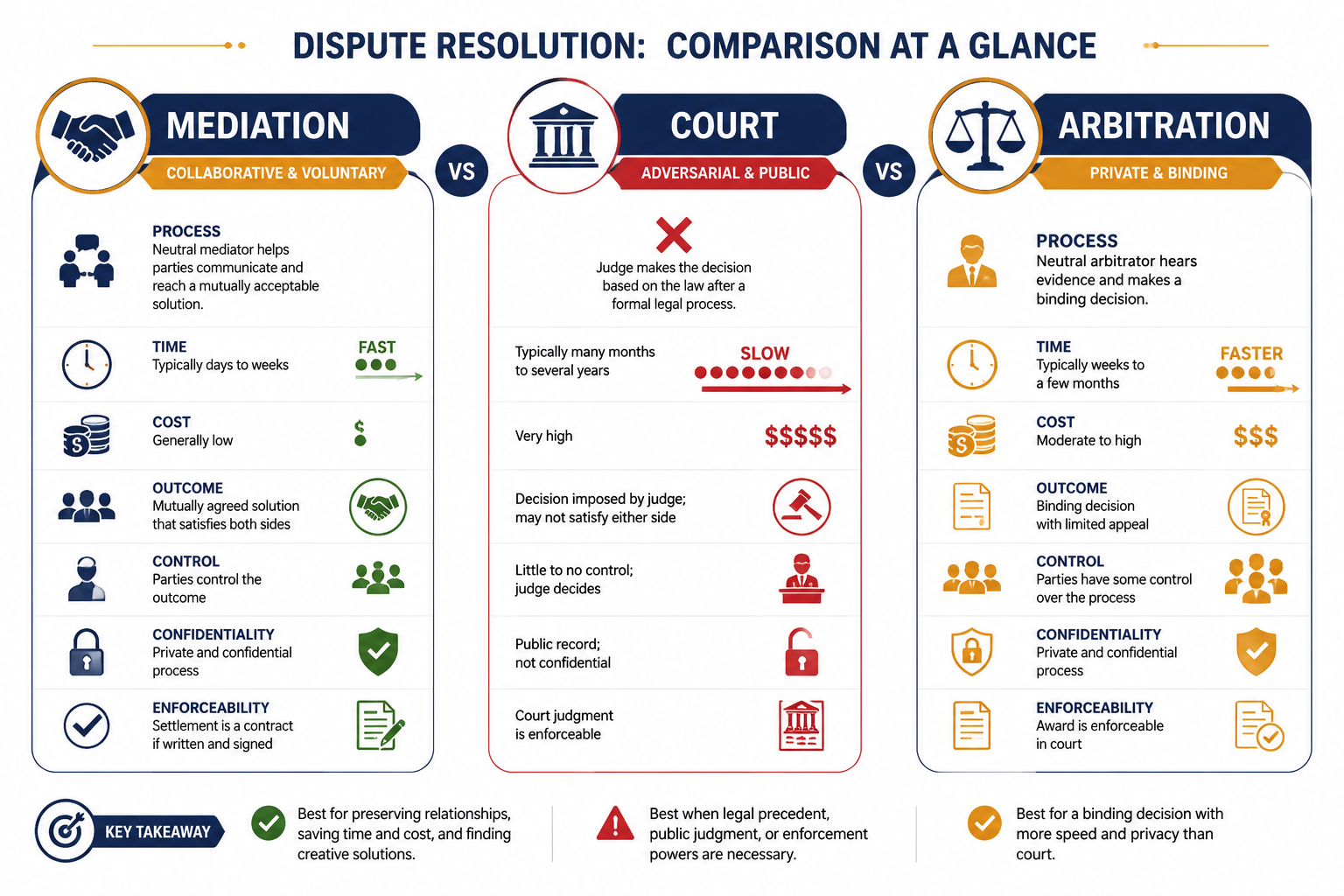
Mediation is a facilitated negotiation. A neutral third party — the mediator — helps both sides communicate, identify their real interests, and reach a voluntary agreement. The mediator does not impose a decision. Both parties retain control of the outcome.
In a party wall context, mediation typically covers:
- Disagreements about the scope or interpretation of an existing award
- Disputes about damage caused by notifiable works
- Disagreements over costs and who should bear them
- Situations where one party believes the award was procedurally flawed but does not want the expense of a court challenge
Specialist party wall practices have formalised mediation services specifically for these scenarios, recognising that a general civil mediator may lack the technical knowledge to understand structural drawings or schedule of condition reports [2].
The Cost and Time Advantage
The financial case for mediation is compelling. A half-day mediation session with a specialist party wall mediator typically costs between £800 and £2,500 per party — a fraction of the legal costs associated with challenging an award in court. Resolution rates for property mediation in the UK consistently exceed 70%, meaning the majority of cases that enter mediation do not proceed further [7].
For homeowners already concerned about expenditure, the guide on how to keep party wall costs down offers practical strategies that complement a mediation-first approach.
When Mediation Is Particularly Effective
Mediation works best when:
- Both parties are willing to engage, even if they disagree strongly
- The dispute has a relational component (neighbours who will continue to live next to each other)
- The technical facts are broadly agreed but the interpretation or financial remedy is contested
- Speed is a priority — for example, when building works are ongoing and delays are costly
Mediation is less suited to situations where one party is entirely unresponsive or where there is a genuine legal question about the validity of the award that requires a binding ruling.
Arbitration: Binding Decisions Without the Courtroom
Where mediation fails, or where the parties need a binding decision on a technical or legal point, arbitration offers a structured alternative to court proceedings [4].
How Arbitration Works in Party Wall Matters
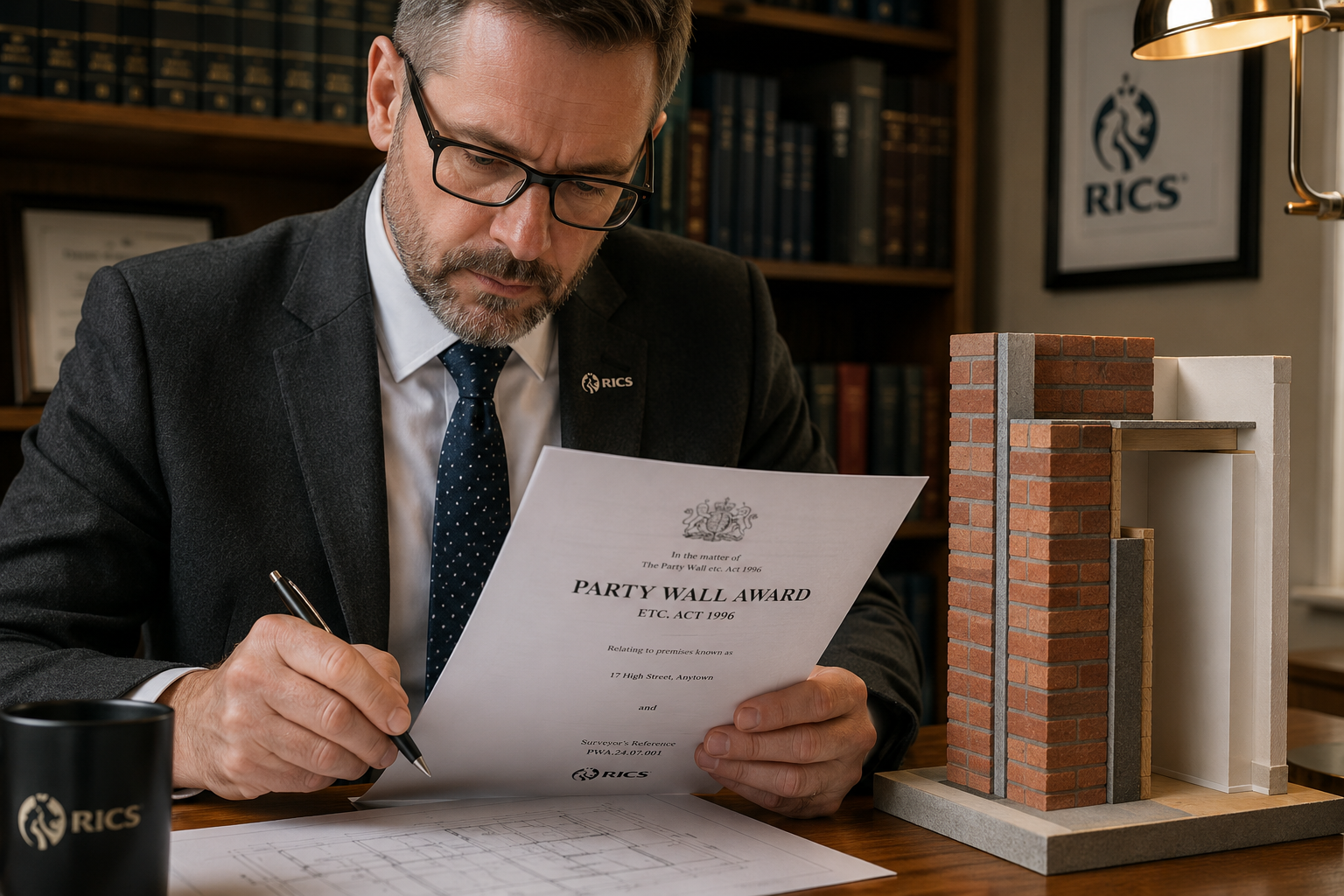
Arbitration involves an independent arbitrator — often a senior RICS-accredited surveyor or a specialist construction lawyer — who hears both sides and issues a binding award. Unlike mediation, the arbitrator's decision is final and enforceable. It can only be challenged in court on very narrow grounds, such as a serious procedural irregularity or a point of law [5].
The RICS Dispute Resolution Service (DRS) provides a formal framework for arbitration in property disputes, including those arising from party wall matters. The DRS appoints arbitrators with relevant technical expertise, which is a significant advantage over general civil court judges who may have limited familiarity with construction practice [6].
Key features of arbitration in 2026:
| Feature | Arbitration | Court Litigation |
|---|---|---|
| Average timeline | 3 to 6 months | 12 to 24 months |
| Binding outcome | Yes | Yes |
| Technical expertise of decision-maker | High (specialist arbitrator) | Variable |
| Privacy | Yes (private proceedings) | No (public record) |
| Typical cost | Moderate | High |
| Flexibility of process | High | Low |
Med-Arb: A Hybrid Approach Gaining Traction
A growing number of party wall practitioners in 2026 are recommending a "med-arb" process — mediation first, with a pre-agreed fallback to arbitration if mediation does not produce a settlement. This hybrid approach is increasingly recognised in international dispute resolution practice as an efficient way to combine the relationship-preserving benefits of mediation with the certainty of a binding arbitral decision [10].
The practical advantage for party wall disputes is significant: both parties know from the outset that the process will reach a conclusion, which incentivises genuine engagement in the mediation phase.
Resolving Party Wall Disputes Without Court: The Step-by-Step Process in 2026
Whether a dispute arises before an award is issued or after, the following framework reflects current best practice for resolving party wall disputes without court involvement.
Step 1: Serve the correct notices
Many disputes begin because notices were not served properly or at all. Understanding what party wall notices are and how to respond is the essential starting point. A correctly served notice prevents a large category of disputes from arising in the first place.
Step 2: Appoint surveyors promptly
Once a dispute is deemed to have arisen, both parties should appoint surveyors without delay. An adjoining owner who has not yet appointed a surveyor can find guidance on the role of an adjoining owner's surveyor and what to expect from the process.
Step 3: Use the award process fully
The award is the primary resolution mechanism. A well-drafted award addresses the vast majority of potential disputes before they escalate. A party wall contract template and guide on party wall awards can help both parties understand what a comprehensive award should contain.
Step 4: Attempt mediation before escalating
If a dispute remains after the award is issued — or if the award process itself has broken down — mediation should be the next step. Both parties should agree on a mediator with specialist party wall knowledge. The RICS DRS and specialist party wall consultancies both provide accredited mediators [6].
Step 5: Consider arbitration for binding resolution
If mediation does not resolve the matter, arbitration through the RICS DRS or a specialist construction arbitration body provides a faster, cheaper, and more technically informed alternative to court [4] [5].
Step 6: Reserve court action for genuine legal questions
Court proceedings remain appropriate where there is a fundamental legal question about the validity of an award, a serious allegation of fraud or misconduct, or where enforcement of an arbitral award is required. In practice, these situations are rare [9].
Practical Tips for Homeowners Facing a Party Wall Dispute in 2026
The following guidance applies whether the dispute is just beginning or has already reached an impasse.
- Document everything from day one. Photographs, written communications, and a schedule of condition report prepared before works begin are invaluable in any dispute resolution process. Learn more about the importance of a schedule of condition in protecting your position.
- Do not ignore notices or correspondence. Silence does not protect an adjoining owner — it typically accelerates the process in the building owner's favour.
- Choose a mediator with party wall expertise. A general civil mediator may not understand the technical language of a structural engineer's report or the legal framework of the 1996 Act.
- Understand the costs before committing to a process. The costs of party wall work and the process page provides a clear breakdown of what each stage typically involves financially.
- Seek specialist advice early. The earlier a qualified party wall surveyor is involved, the lower the probability that a dispute will escalate to the point where mediation or arbitration is needed at all.
The Role of RICS and Professional Bodies in 2026
The Royal Institution of Chartered Surveyors (RICS) plays a central role in formalising dispute resolution for party wall matters in 2026. The RICS Dispute Resolution Service offers adjudication, arbitration, and mediation services specifically designed for property disputes, with panels of accredited specialists who understand both the legal and technical dimensions of party wall cases [6].
For building owners and adjoining owners alike, using a RICS-regulated surveyor provides an additional layer of professional accountability. If a surveyor acts improperly or negligently, the RICS complaints and disciplinary process provides a further avenue of redress that does not require court action.
The Construction Dispute Resolution services provided by bodies such as the American Arbitration Association also reflect a global trend toward specialist, non-court resolution of construction and property disputes — a trend that is equally evident in the UK market [5].
Conclusion: Act Early, Choose the Right Process, Avoid the Courts
Resolving Party Wall Disputes Without Court: Mediation and Arbitration in 2026 is not simply a cost-saving strategy — it is the approach that produces better outcomes for most parties in most circumstances. The award process under the Party Wall etc. Act 1996 resolves the vast majority of disputes without any external intervention. Where it does not, mediation and arbitration offer structured, expert-led, and cost-effective pathways to resolution.
Actionable next steps for homeowners in 2026:
- If works are planned, serve the correct notices and appoint a qualified surveyor before any dispute arises.
- If a dispute has already arisen, request mediation in writing before taking any legal action.
- Contact the RICS Dispute Resolution Service to identify an accredited arbitrator if mediation is unsuccessful.
- Keep detailed records throughout — they are your strongest asset in any dispute resolution process.
- Consult a specialist party wall surveyor at the earliest possible stage to assess the options available.
The courts will always be there as a final backstop. In the overwhelming majority of party wall disputes, they should never need to be used.
References
[1] Trends And Developments – practiceguides.chambers.com
[2] Mediation And Arbitration – partywallconsultancy.co.uk
[3] Common Party Wall Disputes And How To Resolve Them Effectively – partywallslimited.com
[4] Dispute Resolution – tftconsultants.com
[5] Construction – adr.org
[6] Drs Services – rics.org
[7] Mediation In Boundary Wall Disputes – propertyhealthcheck.ie
[9] If You Cant Agree – gov.uk
[10] The Court Of Cassation Changes Its Precedent On Post Mediation Arbitration Med Arb Agreements – fepartners.com.tr
How Prince Surveyors can help: explore our party wall surveyors or learn about our party wall surveyor costs.