

Construction disputes arising from party wall damage cost UK property owners an estimated £47 million annually in legal fees and remediation works. As urban development intensifies in 2026, the integration of Real-Time Sensors for Party Wall Risk Detection: Pre-Notice Protocols in 2026 Urban Projects represents a fundamental shift from reactive damage assessment to proactive risk management. This technological evolution enables surveyors to identify structural vulnerabilities, moisture ingress, and vibration anomalies before formal party wall notices are served—transforming compliance workflows and protecting both building owners and adjoining property interests.
The convergence of wireless sensor networks, real-time locating systems (RTLS), and RICS-compliant documentation protocols has created unprecedented opportunities for early intervention in party wall scenarios. Modern sensor technology now captures baseline structural conditions weeks or months before excavation, foundation work, or structural alterations commence, establishing irrefutable evidence of pre-existing conditions while monitoring incremental changes throughout construction phases.
Key Takeaways
- Early detection systems using vibration, moisture, and crack monitoring sensors identify party wall risks 4-6 weeks before traditional visual surveys, enabling proactive mitigation strategies
- RICS-compliant integration of sensor data into pre-notice protocols strengthens party wall awards and provides defensible evidence in dispute resolution scenarios
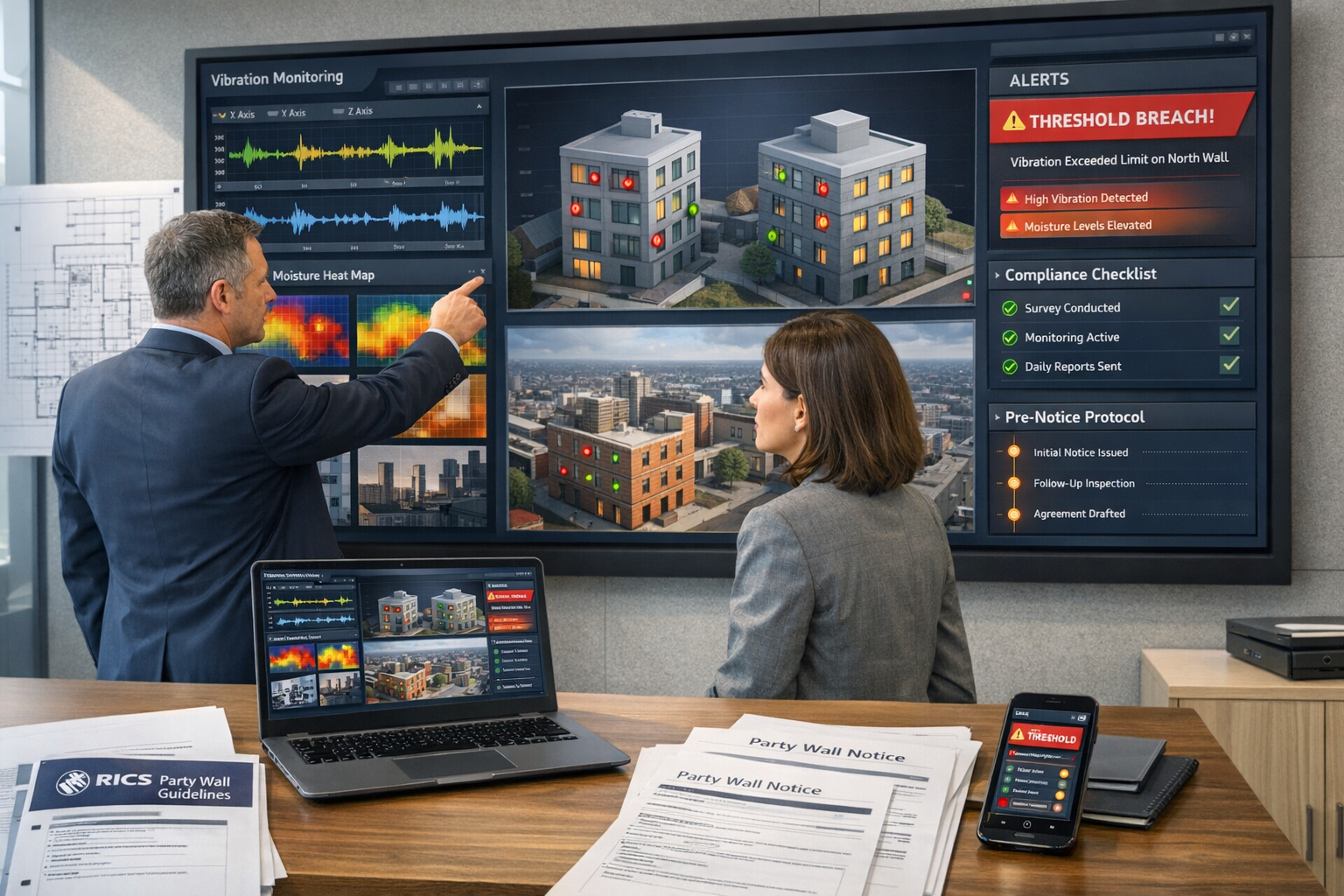
- Real-time monitoring dashboards allow surveyors and building owners to track structural conditions continuously, triggering automated alerts when thresholds are exceeded
- Cost reduction of 30-40% in party wall dispute resolution through documented baseline conditions and continuous monitoring records
- Regulatory compliance is enhanced through digital audit trails that demonstrate due diligence in protecting adjoining owner interests
Understanding Real-Time Sensors for Party Wall Risk Detection: Pre-Notice Protocols in 2026 Urban Projects
The application of real-time sensor technology to party wall management represents a convergence of construction monitoring, legal compliance, and risk mitigation strategies. Unlike traditional condition surveys that capture a single moment in time, sensor-based systems provide continuous data streams that reveal patterns, trends, and anomalies invisible to periodic visual inspections.
The Technology Foundation
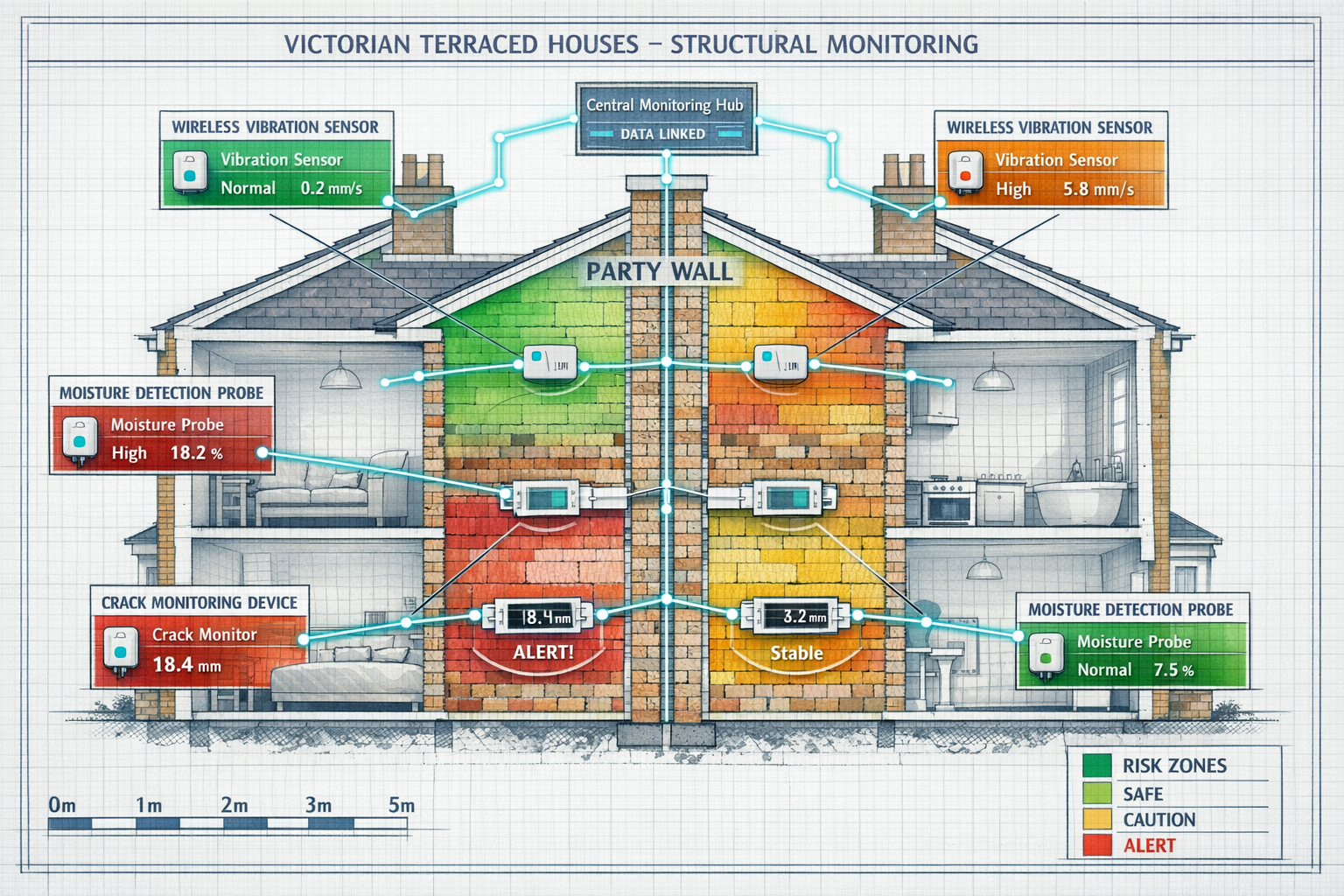
Real-time locating systems (RTLS) form the backbone of modern party wall monitoring infrastructure. These systems use wireless sensor networks to track multiple parameters simultaneously across building facades and internal structures[1]. Key sensor categories deployed in 2026 party wall applications include:
- Vibration sensors: Accelerometers and seismometers detect ground-borne vibrations from excavation, piling, and demolition activities, measuring frequency, amplitude, and duration
- Moisture sensors: Capacitance and resistance-based probes monitor humidity levels within masonry, identifying water ingress from damaged damp-proof courses or compromised weatherproofing
- Crack monitoring devices: Digital displacement sensors track movement across existing cracks with micron-level precision, distinguishing between seasonal movement and construction-induced damage
- Tilt sensors: Inclinometers measure angular deviation in walls and chimneys, detecting subsidence or heave before visible structural distress appears
- Environmental monitors: Temperature, humidity, and air pressure sensors provide contextual data that explains seasonal structural movement patterns
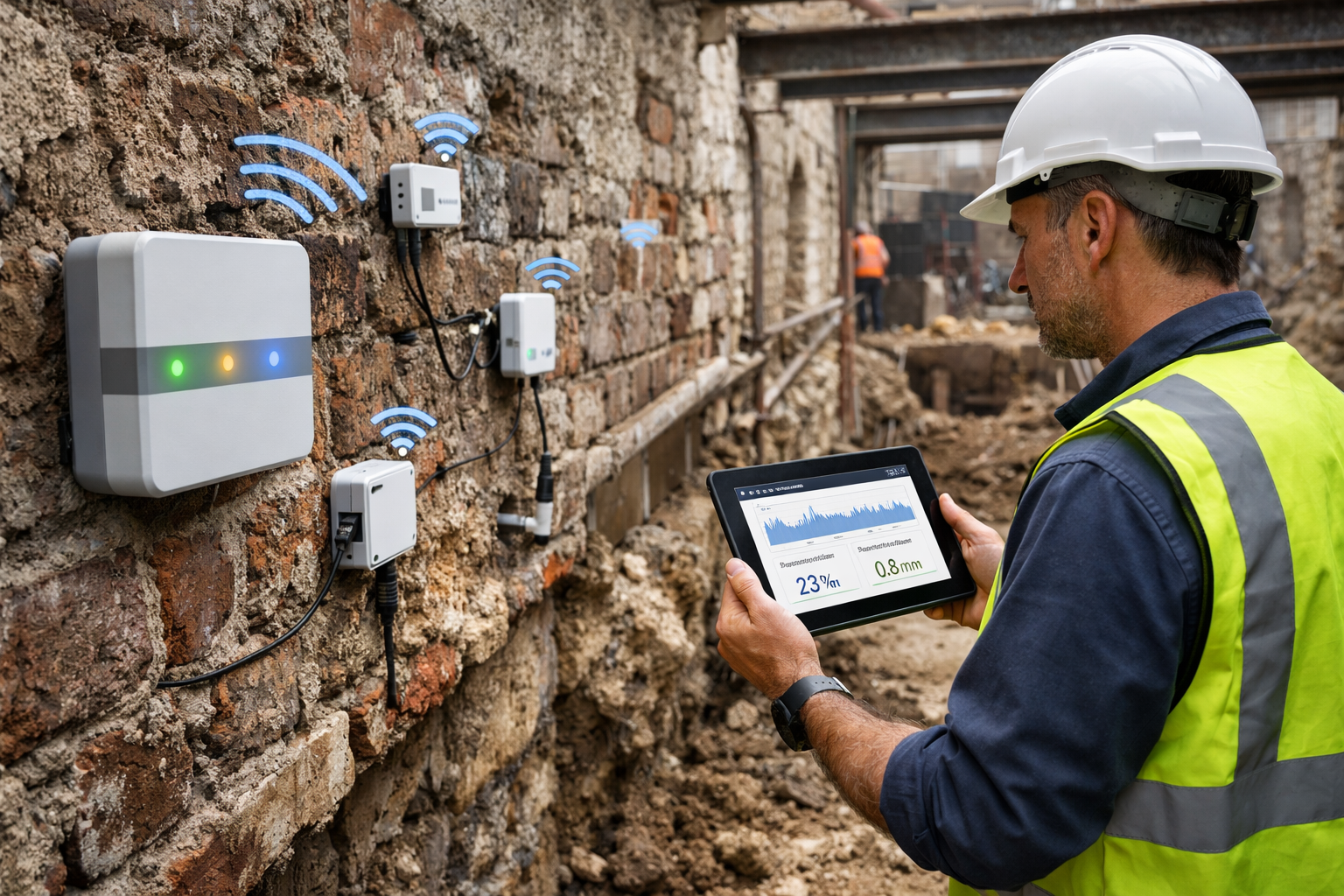
The wireless transmission capabilities of modern sensor arrays eliminate the need for intrusive cabling through occupied properties. Battery-powered devices with 2-5 year operational lifespans can be rapidly deployed across multiple properties, creating comprehensive monitoring networks that feed data to cloud-based platforms accessible to surveyors, building owners, and party wall surveyors simultaneously.
Integration with Pre-Notice Protocols
Traditional party wall procedures under the Party Wall Act 1996 require building owners to serve formal notices on adjoining owners before commencing notifiable works. However, these notices typically contain limited information about existing structural conditions or proposed monitoring arrangements. The integration of real-time sensors into pre-notice protocols addresses several critical gaps:
Baseline condition establishment: Sensors installed 4-8 weeks before notice service capture comprehensive baseline data on structural stability, moisture levels, and existing crack patterns. This documentation protects building owners from spurious claims while giving adjoining owners confidence that changes will be detected.
Enhanced notice content: Modern party wall notices increasingly reference attached sensor monitoring plans, specifying equipment locations, measurement parameters, alert thresholds, and data access arrangements for all parties. This transparency reduces disputes and demonstrates good faith compliance with statutory obligations.
Continuous compliance verification: Real-time monitoring provides ongoing evidence that construction activities remain within agreed parameters specified in party wall awards. Automated alerts notify surveyors immediately when vibration or movement thresholds are approached, enabling intervention before damage occurs.
Understanding the consequences of ignoring the Party Wall Act becomes even more critical when sensor evidence can document exactly when and how damage occurred, making liability determinations more straightforward but also more consequential for non-compliant parties.
Sensor Deployment Strategies for Urban Construction Projects
Effective implementation of Real-Time Sensors for Party Wall Risk Detection: Pre-Notice Protocols in 2026 Urban Projects requires strategic planning that balances comprehensive coverage with practical constraints of access, cost, and data management. Urban construction projects present unique challenges due to property density, varied building ages, and complex ownership structures.
Site Assessment and Sensor Specification
The deployment process begins with a comprehensive site assessment conducted by qualified surveyors familiar with both party wall legislation and monitoring technology. This assessment identifies:
| Assessment Factor | Evaluation Criteria | Impact on Sensor Selection |
|---|---|---|
| Building age and construction | Victorian/Edwardian solid wall vs. modern cavity construction | Determines sensor mounting methods and moisture measurement techniques |
| Existing structural conditions | Visible cracks, previous movement, foundation type | Influences baseline measurement requirements and alert thresholds |
| Proposed works scope | Excavation depth, structural alterations, demolition activities | Dictates sensor density and measurement frequency |
| Access arrangements | Adjoining owner cooperation, occupied vs. vacant properties | Affects wireless vs. wired solutions and installation scheduling |
| Environmental factors | Soil type, water table level, tree proximity | Requires additional subsidence and moisture monitoring |
For basement excavations, which represent the highest-risk party wall scenario, sensor deployment typically includes:
✅ Foundation-level vibration monitoring at 3-5 meter intervals along affected party walls
✅ Multi-point crack monitoring on all visible structural cracks exceeding 1mm width
✅ Tilt sensors on chimney stacks and gable walls within 6 meters of excavation
✅ Moisture sensors at damp-proof course level and below ground level where accessible
✅ Settlement monitoring using precision leveling or laser-based displacement sensors
Installation Timing and Baseline Data Collection
The timing of sensor installation critically affects the value of collected data. Best practice protocols in 2026 recommend:
Pre-notice installation (6-8 weeks before notice service): Captures seasonal movement patterns and establishes robust baseline conditions unaffected by construction activities. This extended baseline period distinguishes pre-existing structural behavior from construction-induced changes.
Post-notice, pre-commencement installation (2-4 weeks before works begin): Acceptable when early installation proves impractical, though provides less comprehensive baseline data. Requires careful documentation of existing conditions through traditional survey methods to supplement sensor records.
Phased installation (progressive deployment as works advance): Appropriate for large projects where risk zones evolve as construction progresses, such as multi-phase basement excavations or sequential demolition works.
The baseline data collection period should encompass at least one complete weather cycle to capture moisture and temperature-related movement patterns. Properties on clay soils experiencing seasonal shrinkage and swelling require longer baseline periods (8-12 weeks) to distinguish normal seasonal movement from construction impacts.
When neighbours refuse party wall works, sensor data demonstrating minimal risk can facilitate negotiations by providing objective evidence that proposed works pose limited threat to structural integrity.
RICS-Compliant Integration into Surveyor Workflows
The professional standards established by the Royal Institution of Chartered Surveyors (RICS) provide the framework within which sensor technology must operate to maintain legal validity and professional credibility. Integration of Real-Time Sensors for Party Wall Risk Detection: Pre-Notice Protocols in 2026 Urban Projects into established surveyor workflows requires careful attention to documentation standards, data governance, and professional responsibilities.
Data Management and Documentation Standards
RICS guidance emphasizes the importance of contemporaneous records and defensible documentation in party wall matters. Sensor-based monitoring systems enhance compliance through:
Automated data logging: Continuous recording eliminates gaps in monitoring records and provides timestamped evidence of conditions throughout construction phases. Cloud-based storage with redundant backups ensures data preservation for the statutory limitation period (6 years for most construction disputes, 12 years for sealed party wall awards).
Calibration and verification protocols: Professional-grade sensors require regular calibration against known standards to maintain measurement accuracy. RICS-compliant workflows include quarterly calibration certificates, annual third-party verification, and documented sensor replacement schedules.
Access control and data integrity: Multi-party access to monitoring dashboards must maintain data integrity while providing transparency. Read-only access for building owners and adjoining owners, with annotated write access reserved for appointed surveyors, ensures that raw data remains unaltered while allowing professional interpretation and commentary.
Report generation and evidence compilation: Modern monitoring platforms generate automated reports summarizing key metrics, threshold exceedances, and trend analysis. These reports integrate seamlessly with traditional party wall schedules of condition, providing quantitative support for qualitative observations.
The cost of party wall surveyors increasingly includes sensor deployment and monitoring services, with typical fees ranging from £800-£2,500 depending on property size, sensor density, and monitoring duration. This investment often proves cost-effective compared to post-damage dispute resolution expenses.
Alert Protocols and Intervention Procedures
Real-time monitoring systems derive their primary value from enabling timely intervention before minor issues escalate into significant damage. Effective alert protocols balance sensitivity (detecting genuine concerns) with specificity (avoiding false alarms that erode confidence in the system).
Tiered alert thresholds provide graduated responses appropriate to risk levels:
🟢 Green status: All parameters within normal ranges, automated weekly summary reports to all parties
🟡 Amber alert: Measurements approaching but not exceeding agreed thresholds, notification to appointed surveyor for review within 24 hours
🟠 Orange alert: Threshold exceeded but within safety margins, mandatory site inspection within 12 hours and notification to all parties
🔴 Red alert: Critical threshold exceeded indicating imminent or actual damage, immediate work stoppage and emergency site inspection
Threshold values are established during the party wall award negotiation process, incorporating:
- Industry standard guidelines (e.g., BS 7385 for vibration damage risk)
- Building-specific factors (age, condition, construction type)
- Seasonal adjustment factors for moisture and temperature-related movement
- Cumulative impact considerations for prolonged exposure to sub-threshold conditions
When alerts trigger, the appointed surveyor's responsibilities include immediate data review, site inspection if warranted, consultation with structural engineers when necessary, and documentation of findings and recommendations. This rapid response capability distinguishes modern sensor-enhanced practice from traditional periodic inspection approaches.
For projects involving loft conversions requiring party wall agreements, ceiling-mounted vibration sensors detect excessive loading or structural stress on shared walls during construction, providing early warning of potential issues.
Case Study Applications in 2026 Urban Projects
Recent implementations of sensor-based monitoring in high-density urban environments demonstrate the practical benefits of this technology:
Central London basement project: A four-story Victorian terrace conversion involving 4.5-meter basement excavation beneath the existing structure utilized 23 sensors across three adjoining properties. Real-time monitoring detected a 2mm settlement event during temporary works installation, triggering immediate work suspension and engineering review. The issue was traced to inadequate shoring support, which was rectified before any structural damage occurred. The sensor data provided clear evidence that the building owner responded appropriately, avoiding potential liability claims.
Manchester multi-unit development: A new-build project adjacent to Grade II listed buildings employed perimeter vibration monitoring to ensure piling activities remained within heritage protection limits. Continuous data logging demonstrated compliance with stringent vibration limits (peak particle velocity <3mm/s), providing heritage authorities with confidence that construction activities posed no threat to historic fabric.
Birmingham terraced house renovation: Structural alterations to party walls for open-plan living spaces incorporated crack monitoring on all affected properties. Six-week baseline data revealed pre-existing seasonal movement patterns of 0.5-0.8mm, establishing that post-construction movement of 0.3mm remained well within normal parameters and was unrelated to the notifiable works.
These examples illustrate how sensor technology transforms party wall practice from reactive damage assessment to proactive risk management, benefiting all parties through reduced uncertainty and enhanced protection.
Technology Selection and Procurement Considerations
The rapid evolution of monitoring technology presents both opportunities and challenges for surveyors and building owners selecting appropriate systems for Real-Time Sensors for Party Wall Risk Detection: Pre-Notice Protocols in 2026 Urban Projects. Understanding the technical specifications, cost structures, and vendor capabilities ensures optimal system performance and value.
Sensor Technology Comparison
Different sensor technologies offer varying advantages depending on project requirements:
Wired systems: Traditional wired sensors provide the most reliable data transmission and eliminate battery replacement concerns. However, installation requires cable routing through properties, which may prove impractical in occupied buildings or where access is restricted. Wired systems excel in permanent installations for long-duration projects (12+ months) or where maximum data reliability is essential.
Wireless IoT sensors: Battery-powered wireless sensors using LoRaWAN, NB-IoT, or proprietary mesh networks offer rapid deployment with minimal property intrusion. Modern devices achieve 2-5 year battery life with hourly measurement intervals, suitable for most party wall monitoring applications. Wireless systems provide the flexibility to expand monitoring coverage as projects progress and can be easily relocated if initial placement proves suboptimal.
Hybrid systems: Combining wired backbone infrastructure with wireless sensor nodes provides the reliability of wired systems with the flexibility of wireless deployment. Hybrid approaches work well for large projects where central monitoring stations can be established with wireless sensors distributed across multiple properties.
Emerging technologies: Fiber optic sensing systems using distributed acoustic sensing (DAS) and distributed temperature sensing (DTS) offer continuous measurement along entire cable lengths, effectively creating thousands of virtual sensors from a single fiber installation. While currently more expensive than discrete sensors, fiber optic systems provide unparalleled spatial resolution for critical applications.
The integration of robotic technology for building surveys complements sensor networks by providing visual documentation synchronized with quantitative sensor data, creating comprehensive multi-modal monitoring records[4].
Vendor Evaluation and System Integration
Selecting monitoring system vendors requires assessment of both technical capabilities and professional service standards:
Technical criteria:
- Measurement accuracy and resolution appropriate to application requirements
- Data transmission reliability and redundancy provisions
- Battery life and power management for wireless systems
- Environmental protection ratings (IP65+ for exterior installations)
- Calibration procedures and certification documentation
- Integration capabilities with existing surveyor software platforms
Service criteria:
- Installation expertise and property access management
- Training and support for surveyors and building owners
- Data hosting security and backup provisions
- Report generation and customization capabilities
- Maintenance and sensor replacement responsiveness
- Dispute resolution support and expert witness availability
Leading monitoring system providers in 2026 offer turnkey solutions encompassing sensor supply, installation, data management, and reporting services. Pricing models vary from equipment purchase with subscription data services to fully inclusive rental arrangements. Typical costs for a standard terraced house party wall monitoring installation range from £1,200-£3,500 for 6-month monitoring periods.
When evaluating whether you need a party wall surveyor, the availability of sensor monitoring technology may influence the decision, particularly for higher-risk works where objective data provides valuable protection for all parties.
Legal and Regulatory Considerations
The deployment of monitoring technology in party wall scenarios intersects with multiple legal frameworks beyond the Party Wall Act 1996 itself. Understanding these broader considerations ensures compliant implementation and maximizes the evidential value of collected data.
Data Protection and Privacy Compliance
Sensor data collection on residential properties engages UK GDPR and Data Protection Act 2018 requirements. Key compliance considerations include:
Lawful basis for processing: Party wall monitoring typically relies on "legitimate interests" as the lawful basis for data processing, balancing the building owner's need to demonstrate compliance with statutory obligations against adjoining owners' privacy rights. Proper documentation of this balancing test is essential.
Data minimization: Sensor systems should collect only data necessary for party wall risk assessment. Cameras or acoustic sensors that might capture private activities within properties require explicit consent and raise significant privacy concerns generally inappropriate for party wall applications.
Transparency and access rights: All parties must receive clear information about what data is collected, how it is used, retention periods, and their rights to access collected data. Monitoring agreements should explicitly address these requirements.
Data security: Cloud-based data storage must employ appropriate encryption, access controls, and backup procedures to prevent unauthorized access or data loss. Vendors should provide evidence of ISO 27001 certification or equivalent information security standards.
Evidential Standards and Dispute Resolution
The admissibility and weight of sensor data in party wall disputes or subsequent litigation depends on proper documentation and chain of custody maintenance. Best practices include:
Calibration documentation: Regular calibration certificates from UKAS-accredited laboratories or equivalent demonstrate measurement accuracy and reliability. Courts and arbitrators give greater weight to properly calibrated instruments with documented traceability to national standards.
Metadata preservation: Timestamps, sensor identifiers, and measurement conditions form essential context for interpreting data. Modern systems automatically capture this metadata, but export procedures must preserve it when data is transferred between platforms or presented as evidence.
Expert interpretation: Raw sensor data requires professional interpretation to translate measurements into meaningful conclusions about structural behavior and damage causation. RICS-qualified surveyors or chartered engineers provide this interpretive expertise, connecting quantitative data to qualitative assessments of structural condition.
Contemporaneous records: The real-time nature of sensor monitoring creates powerful contemporaneous evidence of conditions throughout construction phases. This temporal precision often proves decisive in determining whether damage occurred during notifiable works or resulted from other causes.
Understanding common misconceptions about party wall agreements helps property owners appreciate how sensor monitoring enhances rather than replaces traditional surveyor expertise and statutory procedures.
Future Developments and Industry Trends
The trajectory of sensor technology development and its integration into party wall practice continues to accelerate, with several emerging trends likely to shape practice in the coming years:
Artificial intelligence and predictive analytics: Machine learning algorithms trained on thousands of monitoring datasets can identify subtle patterns indicating developing problems before human analysts detect them. Predictive models forecast likely outcomes based on current trends, enabling even earlier intervention.
Augmented reality integration: AR applications overlay sensor data onto live camera views of properties, allowing surveyors to visualize invisible phenomena like vibration propagation or moisture distribution during site inspections. This technology bridges the gap between abstract data and physical reality.
Blockchain-based data verification: Distributed ledger technology provides tamper-evident records of sensor data, enhancing evidential value by demonstrating that historical data has not been altered after collection. This capability may become particularly valuable in high-stakes disputes.
Standardization and certification: Industry bodies are developing standards for party wall monitoring systems, including minimum technical specifications, installation protocols, and data reporting formats. Certification schemes will help property owners and surveyors identify systems meeting professional standards.
Integration with Building Information Modeling (BIM): Sensor data increasingly feeds into BIM platforms, creating dynamic digital twins of buildings that update in real-time based on actual measured conditions. This integration supports more sophisticated structural analysis and risk assessment.
The evolution of construction project management responsibilities increasingly includes oversight of monitoring systems and interpretation of sensor data, requiring expanded technical competencies across the construction industry.
Practical Implementation Guidance
For building owners, surveyors, and construction professionals seeking to implement Real-Time Sensors for Party Wall Risk Detection: Pre-Notice Protocols in 2026 Urban Projects, the following practical guidance supports successful deployment:
Pre-Project Planning Checklist
✅ Engage qualified surveyors early: Involve party wall surveyors during project planning phases, before architectural designs are finalized, to identify monitoring requirements and incorporate them into project timelines and budgets.
✅ Conduct preliminary risk assessment: Evaluate proposed works against building age, construction type, soil conditions, and proximity to adjoining properties to determine appropriate monitoring scope.
✅ Budget adequately: Allocate 1-3% of construction budget to monitoring systems and surveyor fees, recognizing that this investment provides significant protection against dispute costs.
✅ Establish access agreements: Negotiate access to adjoining properties for sensor installation before serving party wall notices, as monitoring arrangements often facilitate notice acceptance.
✅ Select appropriate technology: Match sensor types, measurement frequencies, and system capabilities to specific project risks rather than adopting one-size-fits-all approaches.
Ongoing Monitoring Best Practices
📊 Review data regularly: Weekly review of monitoring dashboards by project managers identifies trends and potential issues before alerts trigger, supporting proactive management.
🔧 Maintain equipment properly: Schedule regular sensor inspections, battery replacements, and calibration checks according to manufacturer recommendations to ensure continuous data quality.
📱 Communicate transparently: Share monitoring reports with adjoining owners at agreed intervals (typically monthly) to maintain trust and demonstrate ongoing compliance.
⚠️ Respond promptly to alerts: Establish clear escalation procedures ensuring that alerts receive immediate attention from appropriate personnel with authority to pause works if necessary.
📝 Document interventions: Maintain detailed records of all alert responses, site inspections, and corrective actions taken, as this documentation proves essential if disputes arise.
For those wondering what party wall rights they have, sensor monitoring provides objective evidence supporting those rights by documenting actual impacts of construction activities on adjoining properties.
Cost-Benefit Analysis and Return on Investment
The decision to implement comprehensive sensor monitoring involves weighing upfront costs against potential benefits and risk reduction. A realistic cost-benefit analysis considers:
Direct costs:
- Sensor hardware purchase or rental: £800-£3,500 for typical residential project
- Installation and commissioning: £400-£800 labor costs
- Data subscription services: £50-£150 per month
- Surveyor monitoring and reporting: £500-£1,500 for project duration
- Total typical project cost: £2,000-£6,000 for 6-month monitoring period
Quantifiable benefits:
- Avoided dispute resolution costs: £5,000-£25,000+ for legal fees and expert witnesses
- Reduced insurance premiums: 10-15% reduction on project insurance with monitoring systems
- Faster dispute resolution: 40-60% reduction in time to settlement when objective data available
- Reduced damage remediation: Early detection prevents minor issues escalating to major repairs
- Enhanced project certainty: Reduced contingency requirements and schedule buffers
Qualitative benefits:
- Improved neighbor relations through transparency and demonstrated care
- Enhanced professional reputation for building owners and contractors
- Reduced stress and anxiety for all parties through objective monitoring
- Stronger legal position if disputes arise despite monitoring
- Demonstration of best practice compliance with professional standards
The return on investment becomes particularly compelling for higher-risk projects involving deep excavations, structural alterations to party walls, or work on older buildings where pre-existing conditions are uncertain. Even a single avoided dispute typically justifies monitoring costs many times over.
Understanding dilapidations protocols provides useful context for how comprehensive condition documentation protects parties in various property-related scenarios, with party wall monitoring representing a specialized application of these principles.
Conclusion
The integration of Real-Time Sensors for Party Wall Risk Detection: Pre-Notice Protocols in 2026 Urban Projects represents a fundamental evolution in how construction professionals approach party wall compliance and risk management. By shifting from reactive damage assessment to proactive continuous monitoring, sensor technology provides unprecedented visibility into structural behavior throughout construction phases, enabling early intervention that protects all parties' interests.
The convergence of wireless sensor networks, cloud-based data platforms, and RICS-compliant professional workflows creates a robust framework for managing party wall risks in increasingly complex urban development scenarios. As building density increases and construction activities intensify, the ability to objectively monitor structural conditions in real-time becomes not merely advantageous but essential for responsible development.
Key Implementation Principles
Successful deployment of sensor-based monitoring requires attention to several critical success factors:
Early integration: Incorporating monitoring into pre-notice planning rather than treating it as an afterthought ensures adequate baseline data collection and demonstrates good faith compliance with statutory obligations.
Professional oversight: Technology enhances rather than replaces professional surveyor expertise. Proper interpretation of sensor data within the context of building behavior and construction activities remains fundamentally a professional judgment exercise.
Transparent communication: Sharing monitoring data with all parties builds trust and facilitates dispute resolution when issues arise, transforming potentially adversarial relationships into collaborative problem-solving.
Appropriate technology selection: Matching sensor capabilities to specific project risks avoids both under-monitoring that misses critical issues and over-monitoring that generates excessive data without proportionate value.
Actionable Next Steps
For building owners planning construction projects affecting party walls:
- Consult qualified surveyors at least 3 months before anticipated construction commencement to assess monitoring requirements and develop deployment strategies
- Request monitoring proposals from at least two vendors to compare technical approaches, service offerings, and pricing structures
- Incorporate monitoring costs into project budgets and timelines, recognizing that early investment prevents larger downstream costs
- Establish data governance protocols addressing access rights, alert procedures, and reporting schedules before sensor installation
- Document baseline conditions thoroughly through combined traditional surveys and sensor monitoring to establish clear pre-construction conditions
For surveyors and construction professionals:
- Develop technical competencies in sensor technology, data interpretation, and monitoring system management through continuing professional development
- Establish vendor relationships with reputable monitoring system providers to support rapid deployment when projects require
- Integrate monitoring protocols into standard party wall procedures and template documents to streamline implementation
- Build case study evidence documenting successful monitoring applications to demonstrate value to clients and adjoining owners
- Stay informed about emerging technologies and evolving professional standards through RICS guidance and industry publications
The future of party wall practice increasingly relies on objective, real-time data to supplement professional judgment and traditional survey methods. Building owners, surveyors, and construction professionals who embrace these technologies position themselves at the forefront of best practice, delivering superior outcomes for all stakeholders while reducing risks and costs associated with urban development projects.
By implementing comprehensive sensor monitoring as standard practice for higher-risk party wall scenarios, the construction industry can significantly reduce the incidence of disputes, protect historic and modern building stock, and facilitate the urban densification necessary to meet housing and development needs in 2026 and beyond.
References
[1] What Is The Real Time Locating System – navigine.com
[2] Intrusion Detection System – acresecurity.com
[3] Best Occupancy Sensors For Workplace – butlr.com
[4] Technology For Early Property Insight In 2026 Building Surveys Reducing Delays In Complex Valuations – nottinghillsurveyors.com