

Last updated: July 24, 2026
Quick Answer: A follow-up building survey after major repairs is a targeted re-inspection carried out by a chartered surveyor to confirm that identified defects have been properly remediated and no longer pose a risk to the property or its value. It differs from an initial survey in scope and focus, but it carries real weight for buyers, lenders, insurers, and valuers. Without it, even well-executed repairs can leave a property in limbo, difficult to sell, finance, or insure at full market value.
Key Takeaways
- Re-surveying after major repairs is not the same as a full building survey, it is a focused re-inspection of previously identified defects.
- The timing of a follow-up survey matters: most surveyors recommend waiting at least 3 to 6 months after structural or damp-related repairs before re-inspecting.
- Foundation repairs, damp remediation, roof replacements, and structural interventions almost always require a formal re-survey before a property can be sold or re-mortgaged.
- Newly remediated defects can still affect valuation if documentation is incomplete, engineering certificates, guarantees, and building control sign-offs are essential.
- A surveyor can legitimately decline to clear a defect as resolved if access is restricted or if visible evidence suggests the repair may have failed.
- If new defects are found during a re-survey, they must be reported and may trigger further investigation or specialist advice.
- Insurance providers and mortgage lenders increasingly require re-survey evidence before restoring standard cover or approving lending on repaired properties.
- The cost of a follow-up survey is typically lower than a full Level 3 building survey, but varies by defect type, property size, and access requirements.
What Is a Follow-Up Building Survey After Major Repairs?
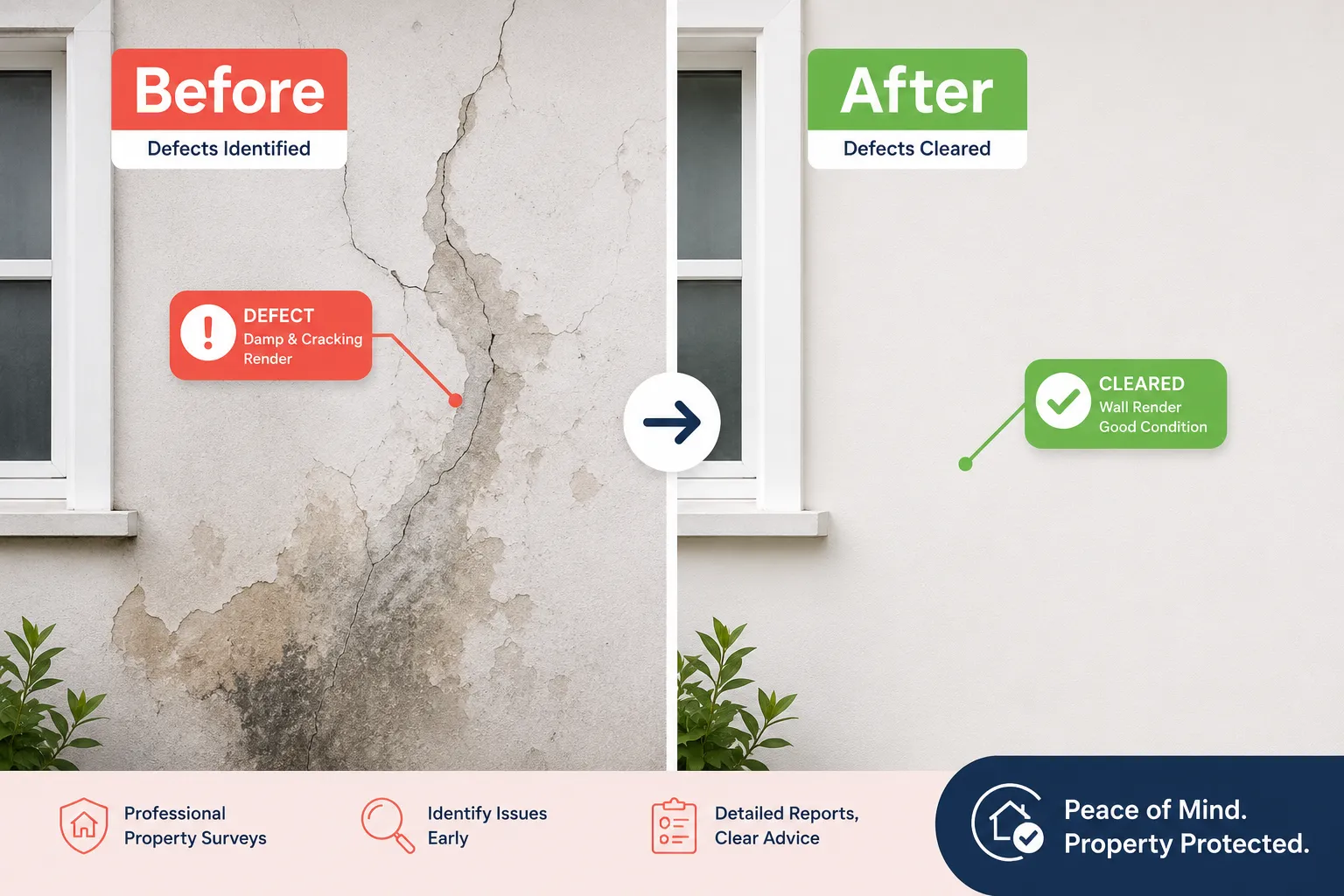
A follow-up building survey, sometimes called a re-inspection or defect clearance survey, is a targeted assessment carried out after significant repair work has been completed on a property. Its primary purpose is to verify that the defects identified in an earlier survey have been properly addressed and that the building is now in the condition claimed.
Unlike an initial Level 3 full building survey, which assesses the entire property from roof to foundations, a re-survey focuses on the specific areas where defects were found and repairs were carried out. It does not reassess the whole building or guarantee long-term performance, it confirms whether the observed condition has materially changed since the original inspection.
Re-surveying after major repairs is relevant to:
- Homeowners preparing to sell after remediation work
- Buyers who made an offer subject to repairs being completed
- Landlords restoring properties after structural or environmental defects
- Lenders and valuers who need updated evidence before releasing funds
How Long After Repairs Should You Get a Re-Survey Done?
The right interval depends on the type of repair. For most structural and damp-related work, a minimum of 3 to 6 months is advisable before commissioning a re-survey. This allows time for materials to cure, for seasonal moisture cycles to reveal any residual issues, and for any early signs of repair failure to become visible.
| Repair Type | Recommended Wait Before Re-Survey |
|---|---|
| Damp-proof course / damp remediation | 3-6 months |
| Structural crack stitching or underpinning | 6-12 months |
| Roof replacement or major re-roofing | 1-3 months |
| Foundation repair / underpinning | 6-12 months |
| Timber treatment (rot or woodworm) | 3-6 months |
| Cosmetic or surface repairs | Immediate to 4 weeks |
For cosmetic fixes and clearly visible replacements, such as new windows or replaced guttering, a shorter interval or even a straightforward walk-through inspection may be sufficient. The key question is whether the repair is genuinely verifiable through visual inspection or whether it involves concealed building elements.
Do I Need a New Survey After Foundation Repair?
Yes, foundation repair is one of the defect types that almost always requires a formal re-survey before a property can be sold, re-mortgaged, or fully insured. Foundation issues can significantly affect property valuations, and proper documentation is essential to mitigate any residual negative impact.
A re-survey following foundation work should be supported by:
- A structural engineer's completion certificate confirming the scope and standard of work
- Building control sign-off where underpinning or significant structural intervention was carried out
- A long-term guarantee from the specialist contractor (typically 10 to 25 years)
- Photographic evidence taken during and after the repair process
Without this documentation, a valuer has no reliable basis to treat the defect as resolved. The property may still be valued at a discount, or a lender may decline to offer a standard mortgage product. For more on how defects are assessed in context, see our guide to building pathology and defect analysis.
How Do Newly Fixed Defects Affect Property Valuation?
Remediated defects can still affect valuation, but the extent depends on the quality of documentation, the nature of the original defect, and how recently the repair was completed. A surveyor or valuer will treat a well-documented, professionally remediated defect very differently from one where only verbal assurances are available.
Factors that support full value restoration after repair:
- Independent engineer's or specialist contractor's report confirming the repair
- Building regulations compliance certificate where applicable
- Transferable guarantee or warranty
- No visible evidence of recurrence at the time of re-inspection
- Adequate time elapsed for the repair to be properly tested
Factors that may still suppress value:
- Repair carried out without building control notification
- No independent verification of the work
- History of recurring defects at the same location
- Stigma associated with certain defect types (e.g., Japanese knotweed, subsidence)
It is worth noting that some defect types carry a residual stigma even after successful remediation. Subsidence history, for example, may still be disclosed in property information forms and can affect buyer confidence regardless of repair quality. An independent property valuation after major repairs gives sellers a realistic picture of where the market stands.
What Is the Difference Between a Re-Survey and an Initial Survey?
An initial building survey assesses the full condition of a property at a point in time. A re-survey is narrower: it revisits specific defects or areas of concern identified previously and evaluates whether those issues have been resolved.
The practical differences matter for buyers and sellers:
- Scope: Initial surveys cover the whole property; re-surveys focus on previously flagged defects.
- Purpose: Initial surveys inform purchase decisions; re-surveys confirm repair outcomes.
- Output: Initial survey reports are comprehensive condition documents; re-survey reports are typically shorter, targeted clearance or update letters.
- Cost: Re-surveys are generally less expensive than full surveys, though costs vary by complexity.
A re-survey is not a substitute for a full survey if significant time has passed since the original inspection or if the property has been substantially altered. If you are unsure which level of assessment is appropriate, our guide on which building survey you need covers the options in detail.
Can a Surveyor Refuse to Clear Defects as Resolved?
Yes, and this is an important professional boundary. A chartered surveyor can, and should, decline to confirm that a defect has been resolved if access to the repaired area is restricted, if visible evidence suggests the repair may have failed, or if the documentation provided is insufficient to support a clearance opinion.
Surveyors are not obliged to recommend further investigation solely because an area was inaccessible during a normal inspection. However, if there is visible evidence of a defect, staining, cracking, movement, or moisture, they must flag it, regardless of whether a repair was claimed to have taken place.
Common reasons a surveyor may decline to clear a defect:
- The repaired area has been concealed behind new finishes with no supporting documentation
- Visible signs of recurrence are present (e.g., fresh damp staining near a treated area)
- The repair was carried out by an unqualified contractor with no verifiable record
- The time elapsed since repair is insufficient to assess durability
This is a professional liability issue as much as a technical one. Clearing a defect without adequate evidence exposes the surveyor to claims if the repair subsequently fails.
How Much Does a Follow-Up Survey Cost?
Follow-up survey costs in the UK typically range from around £200 to £600 for a focused re-inspection, though more complex cases, particularly those involving structural or specialist defects, can cost considerably more. The final figure depends on the number of defects being re-assessed, the property size, access requirements, and whether specialist equipment such as damp meters, thermal imaging, or drone inspection is needed.
For context, a full Level 3 building survey on a typical UK property generally costs between £600 and £1,500 or more depending on size and location. A targeted re-inspection of two or three specific defects will usually sit well below that range.
Factors that push re-survey costs higher:
- Structural defects requiring specialist input (e.g., engineer attendance)
- Properties with restricted access or complex layouts
- Multiple defect types requiring different inspection methods
- Formal written clearance reports required by a lender or insurer

What Happens If Defects Reappear After Survey Clearance?
If a defect recurs after a surveyor has issued a clearance opinion, the situation becomes legally and financially complex. The first step is to establish whether the recurrence is a failure of the original repair, a new but related defect, or an entirely separate issue.
Practical steps to take if a defect reappears:
- Document the recurrence with dated photographs and written records.
- Contact the original repair contractor, most specialist guarantees include a call-back obligation.
- Notify your insurer if the property is covered under a buildings insurance policy that includes the defect type.
- Commission a new specialist inspection to determine the cause and extent of the recurrence.
- Review the original surveyor's report to establish whether the clearance was conditional or absolute.
If the surveyor's clearance was based on information provided by the seller or contractor that later proves to be inaccurate, there may be grounds for a professional negligence claim. This is why thorough documentation at every stage of the repair and re-inspection process is so important. For guidance on what to do when building problems persist, see our resource on building problems and solutions.
Should I Get a Re-Survey Before Selling After Major Work?
Yes, commissioning a re-survey before listing a property after major repairs is strongly advisable. It gives sellers credible, independent evidence that defects have been resolved, which supports the asking price and reduces the risk of a buyer's surveyor flagging the same issues and triggering a renegotiation.
A pre-sale re-survey also:
- Reduces the likelihood of a sale falling through due to survey findings
- Provides documentation that can be included in the legal pack
- Demonstrates transparency to buyers, which can accelerate the conveyancing process
- Supports the valuation evidence provided to the estate agent
The alternative, selling without a re-survey and hoping a buyer's surveyor does not identify the repair history, is a poor strategy. Property information forms require disclosure of known defects and material repairs, and failure to disclose can have legal consequences after completion.
How Do Insurance Companies Treat Re-Surveyed Properties?
Insurers treat re-surveyed properties more favourably than those with unverified repair histories, but their approach varies by defect type and the quality of evidence provided. For high-risk defect categories, subsidence, flood damage, structural movement, many insurers will require a formal re-survey report and specialist guarantee before restoring standard cover or agreeing to insure a property at all.
Key points for property owners dealing with insurers after major repairs:
- Provide the insurer with all repair documentation, including contractor certificates and any building control approvals.
- A formal re-survey report from a chartered surveyor carries more weight than a contractor's own sign-off.
- Some insurers will impose ongoing monitoring requirements (for example, annual re-inspection of crack monitors) as a condition of cover.
- Specialist insurance may be needed for properties with a history of subsidence, even after successful underpinning.
For properties in blocks or managed developments, the block management insurance process may also require updated survey evidence, particularly following Section 20 major works.
What Defects Need Re-Surveying vs. Which Do Not?
Not every repair requires a formal re-survey. The deciding factor is whether the repair involves concealed building elements, structural integrity, or issues that could recur or affect value and safety.
Defects that typically require formal re-survey:
- Subsidence, settlement, or underpinning
- Damp-proof course installation or injection
- Structural crack repairs and wall stitching
- Roof structure repairs (as distinct from surface re-covering)
- Timber treatment for rot or woodworm in structural members
- Asbestos removal or encapsulation (see asbestos building surveys)
- Foundation repair of any kind
Defects that may not require a formal re-survey:
- Replacement of surface roof coverings (tiles, slates) with no structural involvement
- Repointing of external brickwork (visible and verifiable)
- Replacement of guttering, downpipes, or fascias
- Internal decoration and plastering over minor surface cracks
- Window or door replacement
The distinction matters because commissioning an unnecessary re-survey adds cost and delay, while skipping a necessary one can create serious problems at the point of sale or refinancing.
Can You Get a Mortgage After Major Repairs Without a Re-Survey?
In most cases involving significant structural or damp-related repairs, a mortgage lender will require updated survey evidence before completing a loan offer. This is particularly true for properties that were previously valued "subject to repairs" or where the original mortgage valuation flagged defects as conditions of lending.
Some lenders will accept a contractor's completion certificate and guarantee for lower-risk repairs. For structural work, especially underpinning or foundation repair, an independent structural engineer's sign-off and a chartered surveyor's re-inspection report are typically required.
If a property was purchased with a retention (where part of the mortgage funds are held back pending completion of repairs), the lender will almost certainly require a formal re-inspection before releasing the retained amount. This process is time-sensitive and worth planning ahead. For a broader overview of survey types and their role in the purchase process, see our full building survey vs homebuyer survey comparison.
How Do You Prove Defects Were Properly Remediated?
Proving that defects were properly remediated requires a clear paper trail assembled at the time of the repair, not retrospectively. The most compelling evidence package combines independent verification with contractor documentation.
A strong remediation evidence file should include:
- Scope of works document prepared before the repair began
- Photographs taken during the repair process (not just before and after)
- Contractor's completion certificate and company registration details
- Any specialist guarantee or warranty, including its terms and transferability
- Building regulations completion certificate where applicable
- Structural engineer's or specialist consultant's sign-off
- A chartered surveyor's re-inspection report confirming the defect is no longer active
The absence of any of these items does not automatically mean a repair is inadequate, but it does make it harder for a surveyor, valuer, or lender to treat the defect as fully resolved. Sellers who have carried out major work should assemble this documentation before marketing the property. For guidance on budgeting and planning repair work, our resource on budgeting repairs and restoration is a useful starting point.
What If the Surveyor Finds New Issues During a Re-Survey?
A re-survey is scoped to assess previously identified defects, but a competent surveyor will flag any new defects that are visible during the inspection. This is a professional obligation, not an optional extra.
New issues found during a re-survey fall into two categories:
- Related defects, problems that appear to stem from the same root cause as the original defect, suggesting the repair may have been incomplete or that the underlying issue is more extensive than originally assessed.
- Unrelated new defects, separate issues that have developed since the original survey, unconnected to the repaired area.
In either case, the surveyor will document the new findings in their report and may recommend further specialist investigation. This does not necessarily derail a sale or re-mortgage, it depends on the severity and nature of the new defect. For areas where further investigation is warranted, see our guidance on areas of further investigation.
.cg-checker{font-family:Arial,sans-serif;max-width:520px;margin:2em auto;background:#f4f7fb;border-radius:10px;padding:24px;box-sizing:border-box}
.cg-checker h3{margin:0 0 6px;font-size:1.1rem;color:#1a2e4a}
.cg-checker p.cg-sub{font-size:.85rem;color:#555;margin:0 0 18px}
.cg-checker label{display:block;margin-bottom:10px;font-size:.9rem;color:#333;cursor:pointer}
.cg-checker input[type=checkbox]{margin-right:8px;accent-color:#1a6fbf}
.cg-btn{display:block;width:100%;padding:11px;background:#1a6fbf;color:#fff;border:none;border-radius:6px;font-size:1rem;cursor:pointer;margin-top:14px}
.cg-btn:hover{background:#155a9e}
.cg-result{margin-top:16px;padding:14px;border-radius:7px;font-size:.92rem;display:none}
.cg-ready{background:#e6f4ea;color:#1b5e20;border:1px solid #a5d6a7}
.cg-caution{background:#fff8e1;color:#7b5800;border:1px solid #ffe082}
.cg-notready{background:#fdecea;color:#7f1d1d;border:1px solid #ef9a9a}
Re-Survey Readiness Checker
Tick each item you have in place. See if your repaired property is ready for re-survey.
function cgCheck(){
var items=document.querySelectorAll(‘.cg-item’);
var checked=0;
items.forEach(function(i){if(i.checked)checked++;});
var el=document.getElementById(‘cg-result’);
el.style.display=’block’;
el.className=’cg-result’;
if(checked===6){el.classList.add(‘cg-ready’);el.innerHTML=’Ready for re-survey. Your documentation is strong. A chartered surveyor should be able to assess and clear the defects with confidence.’;}
else if(checked>=3){el.classList.add(‘cg-caution’);el.innerHTML=’Almost ready. You have some documentation in place, but gaps remain. Address the missing items before commissioning a re-survey to avoid delays or a conditional clearance.’;}
else{el.classList.add(‘cg-notready’);el.innerHTML=’Not yet ready. Key documentation is missing. A surveyor may be unable to clear defects as resolved without adequate evidence. Gather the missing items first.’;}
}
FAQ: Re-Surveying After Major Repairs
Q: Is a re-survey the same as a snagging survey?
No. A snagging survey is typically used on new-build properties to identify unfinished or substandard work before legal completion. A re-survey after major repairs is a targeted re-inspection of specific defects on an existing property to confirm they have been properly remediated.
Q: Who commissions the re-survey, the buyer or the seller?
Either party can commission a re-survey, but it is most commonly done by the buyer (to verify repairs promised by the seller) or by the seller (to provide pre-sale evidence that defects have been resolved). Lenders may also require one independently.
Q: Can the same surveyor who did the original survey carry out the re-survey?
Yes, and in many cases this is preferable because the surveyor already has detailed knowledge of the original defects. However, some lenders or insurers may require an independent re-inspection from a different firm to avoid any perceived conflict of interest.
Q: How long does a re-survey inspection take?
For a focused re-inspection of two or three specific defects, the on-site inspection typically takes one to two hours. More complex cases involving multiple defect types or specialist equipment may take longer. The written report usually follows within three to five working days.
Q: Does a re-survey guarantee the repair will not fail in future?
No. A re-survey confirms the condition of the repair at the time of inspection. It cannot guarantee future performance. This is why contractor guarantees and warranties are important, they provide recourse if a repair fails after the surveyor has cleared it.
Q: What if the seller refuses to allow a re-survey before exchange?
A seller who refuses access for a re-survey after claiming repairs have been completed is a significant red flag. Buyers should consider whether to proceed and, if they do, should ensure the contract includes warranties or retentions related to the repair work. Legal advice is strongly recommended in this situation.
Conclusion
Re-surveying after major repairs is not a bureaucratic formality, it is a practical safeguard for everyone involved in a property transaction or ownership decision. For buyers, it confirms that the defects they were told about have genuinely been fixed. For sellers, it provides credible evidence that supports the asking price and reduces the risk of a sale collapsing. For lenders and insurers, it is often a condition of doing business at all.
Actionable next steps:
- Assemble your repair documentation before commissioning a re-survey, contractor certificates, guarantees, building control sign-offs, and photographic records.
- Wait the appropriate interval for your defect type before booking a re-inspection (see the table above).
- Engage a RICS-accredited chartered surveyor with experience in the specific defect type being assessed.
- If foundation, structural, or damp defects are involved, ensure the re-survey report is formal and written, not just a verbal clearance.
- Share the re-survey report with your solicitor, lender, and insurer as appropriate to avoid delays at the point of sale or refinancing.
For complex defect histories or properties with multiple repair types, a full Level 3 building survey may be more appropriate than a targeted re-inspection. A chartered surveyor can advise on the right approach for your specific circumstances.
Tags: re-surveying after major repairs, follow-up building survey, building defects remediation, property valuation after repairs, chartered surveyor, foundation repair survey, damp remediation re-inspection, RICS building survey, structural defect clearance, property re-inspection, building survey UK, defect documentation