

Over 97% of the 516 high-rise buildings identified as having dangerous Aluminium Composite Material (ACM) cladding have now begun or completed remediation in the UK — yet hundreds of thousands of mid-20th century properties still carry hidden structural and fire safety risks that no funding scheme has fully addressed [1]. For buyers, lenders, landlords, and housing managers dealing with buildings constructed between the 1930s and 1970s, RAAC and Cladding Remediation Surveys: 2026 Priorities for Mid-20th Century UK Properties is not a bureaucratic checklist — it is a financial and safety imperative.
The convergence of an accelerating remediation programme, a newly established Remediation Enforcement Unit, and a recovering property market has made 2026 a pivotal year. Surveyors, lenders, and local authorities are all raising the bar on what constitutes an adequate pre-purchase or stock condition inspection for this building era.
Key Takeaways
- RAAC (Reinforced Autoclaved Aerated Concrete) was used extensively in UK buildings from roughly 1950 to 1990 and has a design life of only about 30 years, making detection in surveys critical.
- By March 2026, 90% of identified ACM-clad high-rise buildings had completed remediation, but mid-rise and sub-11m buildings face significant funding gaps [1][2].
- The Cladding Safety Scheme expanded in early 2026 to cover 11-18m buildings, doubling completion rates in Q1 2026 compared to Q1 2025 [2].
- Non-cladding fire safety defects — including compartmentation failures and inadequate fire doors — remain underfunded and are frequently missed in standard surveys.
- A thorough building survey covering RAAC, cladding type, fire safety systems, and latent defects is now essential for any mid-20th century UK property transaction or asset management decision.
Understanding RAAC: What It Is and Why It Matters in 2026
The Material and Its Failure Mechanism
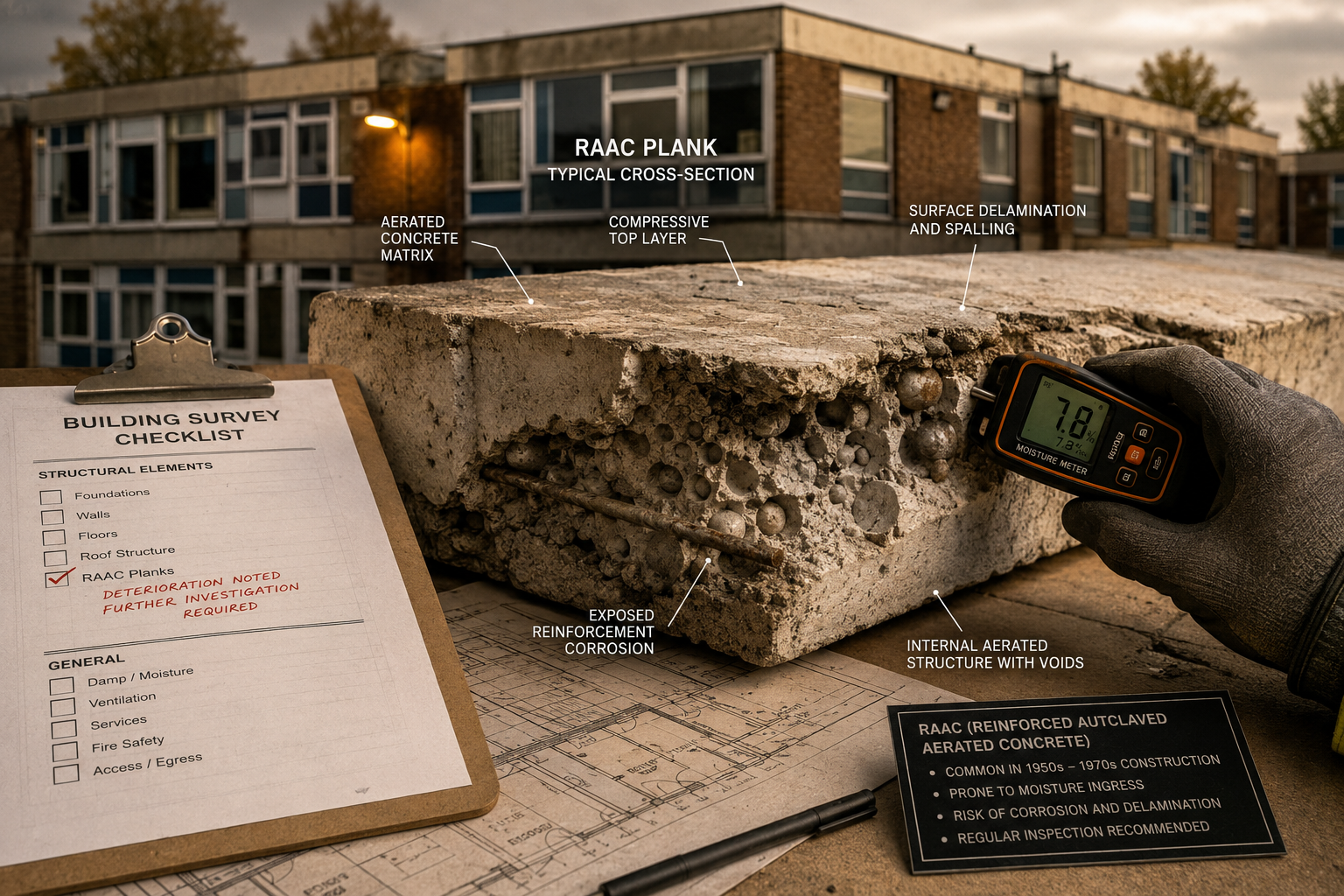
Reinforced Autoclaved Aerated Concrete — universally abbreviated as RAAC — is a lightweight, bubbly form of concrete that was manufactured in plank form and used widely in UK public and residential buildings from approximately 1950 to 1990. It was favoured for flat roofs, floors, and occasionally walls in schools, hospitals, housing blocks, and commercial buildings because it was cheap, quick to install, and offered modest thermal insulation.
The critical problem is structural longevity. RAAC has a recognised design life of around 30 years [4]. Most RAAC installations in UK buildings are now between 35 and 75 years old — well beyond that threshold. Unlike conventional reinforced concrete, RAAC:
- Has very low tensile strength, meaning it can fail suddenly without visible warning signs
- Is highly susceptible to moisture ingress, which accelerates corrosion of the embedded steel reinforcement
- Can delaminate or collapse under loads that standard concrete would handle easily
- Is difficult to identify visually without specialist knowledge or testing
When RAAC fails, it tends to do so catastrophically and without significant prior deflection — a characteristic that makes it particularly dangerous in occupied buildings.
The Building Eras Most at Risk
The table below summarises the construction periods and building types most likely to contain RAAC:
| Construction Period | Typical Building Types | RAAC Application |
|---|---|---|
| 1950-1960 | Schools, hospitals, low-rise housing | Flat roof planks, floor decks |
| 1960-1975 | System-built housing blocks, civic buildings | Roof panels, internal floors |
| 1975-1990 | Retail units, light industrial, some residential | Roof decks, mezzanine floors |
Properties built before 1950 or after 1990 are generally outside the primary risk window, though some late installations occurred into the early 1990s. Surveyors conducting inspections of any building within this date range should treat RAAC detection as a mandatory checklist item, not an optional investigation [6].
RAAC Detection: What a Survey Must Include
A standard Level 2 RICS Homebuyer Survey will not always identify RAAC conclusively. For buildings in the at-risk era, a Level 3 building survey or a specific defect report focused on structural materials is strongly advisable.
Key survey actions for RAAC detection:
- Visual inspection of exposed roof and floor structures for the characteristic bubbly, lightweight concrete texture
- Tap testing of planks to identify hollow or delaminated sections
- Moisture meter readings at plank edges and junctions
- Review of original building drawings and specifications where available
- Intrusive investigation (opening up) where access is limited but risk is high
If RAAC is confirmed or strongly suspected, the surveyor should recommend an immediate structural engineer's assessment. The presence of RAAC can halt mortgage lending and, in some cases, render a property unmortgageable until a remediation plan is in place [4].
Cladding Remediation in 2026: Regulatory Landscape and Funding Reality
Where the Programme Stands
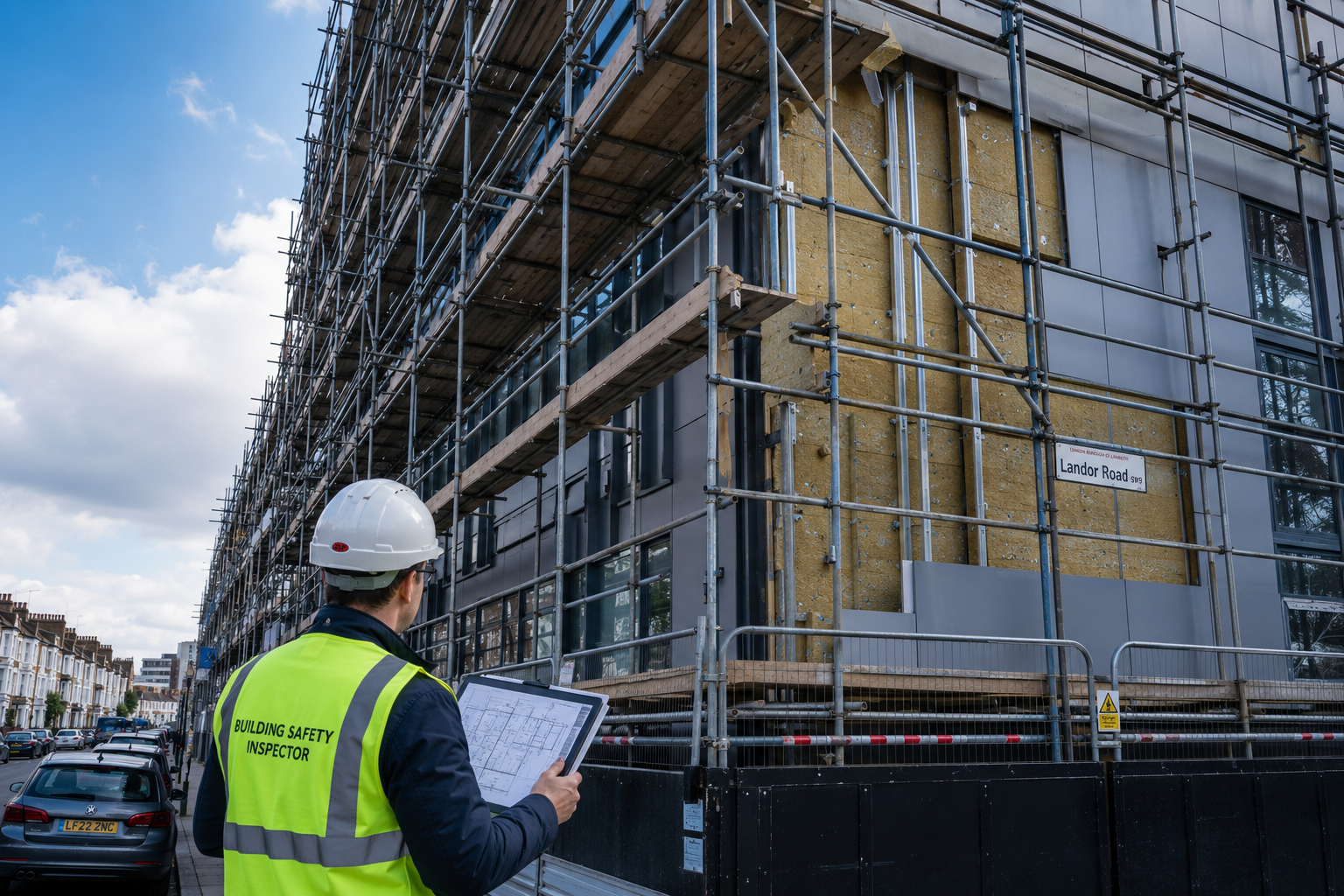
The pace of cladding remediation has accelerated significantly. By 31 March 2026, 90% of the 516 identified ACM-clad high-rise buildings had completed remediation, with the remaining 7% having at least initiated works [1]. The average project completion time fell from 4.2 years to 2.8 years by Q1 2026, reflecting improved contractor coordination and clearer funding pathways [2].
The Cladding Safety Scheme (CSS) expanded its scope in early 2026 to include mid-rise residential buildings in the 11-18 metre height band. This was a significant policy shift. Completion rates across this newly included cohort doubled in Q1 2026 compared to the same quarter in 2025 [2].
The Building Safety Fund had allocated £5.1 billion towards remediation by early 2026 [5]. However, substantial challenges remain:
- Contractor capacity constraints continue to create delays on complex projects
- Cost disputes between developers, freeholders, and the fund remain unresolved in many cases
- Non-cladding fire safety defects (compartmentation, fire doors, cavity barriers) are largely excluded from major funding streams [2]
The Remediation Enforcement Unit
In May 2026, the Building Safety Regulator (BSR) launched its Remediation Enforcement Unit, an intervention specifically designed to unblock stalled projects. The unit's initial focus covers approximately 600 high-risk buildings over 18 metres with ACM or High-Pressure Laminate (HPL) cladding systems [3]. This represents a shift from voluntary compliance to active enforcement — a signal that the regulatory environment is hardening for building owners who have delayed action.
"The establishment of the Remediation Enforcement Unit signals a clear shift: building owners who have delayed remediation without good cause can now expect formal intervention rather than continued extensions." [3]
The Persistent Funding Gap
Despite progress at the top of the risk register, two significant gaps remain:
1. Sub-11m buildings remain entirely excluded from the major government funding schemes. Leaseholders in buildings under 11 metres with unsafe cladding have no equivalent financial protection, leaving them personally exposed to remediation costs [2].
2. Non-cladding defects — including failed compartmentation, inadequate fire doors, missing cavity barriers, and defective smoke ventilation systems — receive far less funding attention. These defects are common in mid-20th century construction and can be equally dangerous in a fire event.
For surveyors and property owners, this gap means that a building receiving a clean bill of health on cladding alone is not necessarily safe or financially unencumbered.
Cladding Types: A Quick Reference for Surveyors
| Cladding Type | Risk Level | Funding Eligibility (2026) |
|---|---|---|
| ACM (Category 3 – unmodified polyethylene core) | Highest | BSF / CSS (18m+) |
| High-Pressure Laminate (HPL) | High | BSF / CSS (18m+) |
| Expanded Polystyrene (EPS) render systems | Moderate-High | CSS (11-18m, limited) |
| Timber cladding on high-rise | Moderate | Case by case |
| Brick slip / masonry | Lower | Generally not funded |
Survey Checklists and Cost-Benefit Analysis for Mid-20th Century Properties
The 2026 Survey Checklist for 1930s-1970s Buildings
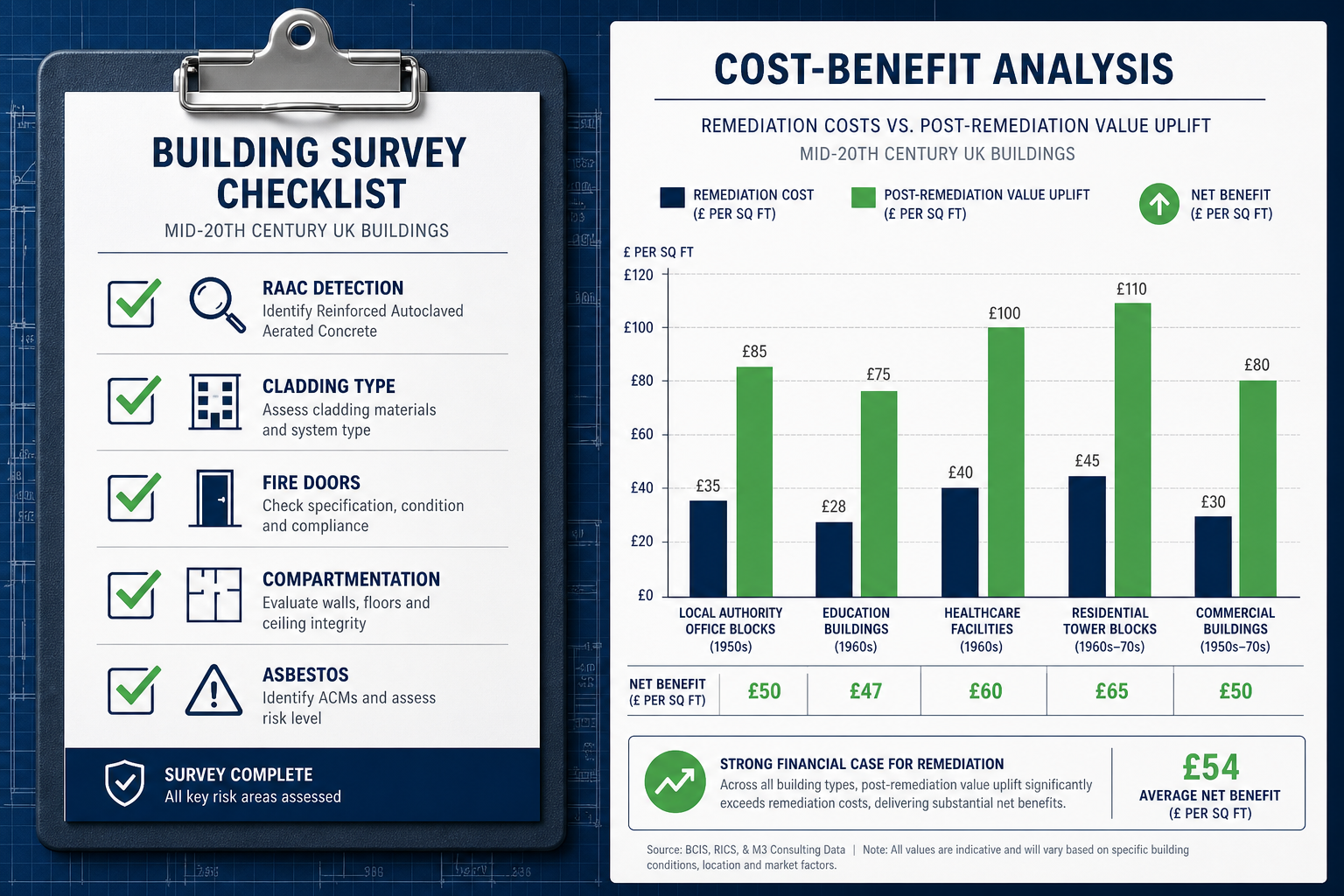
A comprehensive survey of a mid-20th century UK property must go well beyond standard condition reporting. The following checklist reflects the current priorities for RAAC and Cladding Remediation Surveys: 2026 Priorities for Mid-20th Century UK Properties, drawing on updated guidance from the RICS and the Building Safety Regulator.
Structural and Material Defects
- Confirm construction date and original specification
- Identify roof and floor construction type (specifically test for RAAC planks)
- Check for non-standard construction methods (no-fines concrete, large panel system, Cornish unit, BISF)
- Inspect for signs of concrete carbonation, spalling, or reinforcement corrosion
- Review any existing structural surveys or engineer's reports
Cladding and External Wall Systems
- Identify external wall cladding material and system type
- Check for EWS1 (External Wall Survey) form status — essential for mortgage lending on multi-storey buildings
- Confirm whether building height triggers CSS or BSF eligibility
- Look for evidence of previous remediation or interim fire safety measures (waking watches, alarm upgrades)
- Inspect cavity barriers and fire stopping at junctions
Fire Safety Systems (Non-Cladding)
- Assess fire door condition and self-closing mechanisms on all communal doors
- Check compartmentation integrity at floor/ceiling junctions and service penetrations
- Review fire alarm and detection system type and last service date
- Confirm sprinkler system presence (mandatory for new high-rise; retrofitting increasingly required)
- Check smoke ventilation system in stairwells and corridors
Additional Hazardous Materials
- Commission an asbestos survey for any pre-2000 building — asbestos was used extensively in mid-20th century construction in insulation boards, floor tiles, artex, and pipe lagging
- Check for lead paint on pre-1970s surfaces
- Identify any polychlorinated biphenyl (PCB) containing materials in electrical equipment
Condition and Latent Defects
- Inspect flat roof coverings and drainage (common in RAAC-era buildings)
- Assess solid floor slabs for moisture, heave, or settlement — a solid floor slab survey may be warranted
- Check window frames and reveals for thermal bridging and condensation damage
- Review services (electrical, plumbing, gas) for compliance and condition
For housing associations, local authorities, and private landlords managing multiple units, a stock condition survey provides a systematic approach to prioritising remediation across an entire portfolio.
The EWS1 Form: Still Relevant in 2026
The External Wall Survey (EWS1) form remains a lender requirement for many flats in multi-storey buildings. Despite some lenders relaxing requirements for lower-risk buildings, the EWS1 process is still the primary mechanism by which mortgage valuers assess cladding risk. A building without a valid EWS1 form — or with an EWS1 rating of B2 (unsafe, requiring remediation) — will face severe restrictions on mortgage lending and resale.
Buyers of flats in any building over four storeys should verify EWS1 status before exchange. Sellers should obtain an updated form if the existing one is more than five years old or if remediation works have been completed since the last assessment.
Cost-Benefit Analysis: Is Remediation Worth It?
The financial case for remediation in a stabilising market is now clearer than it was in 2022-2023. Consider the following indicative figures for a mid-rise residential block:
| Scenario | Estimated Cost | Value Impact |
|---|---|---|
| RAAC roof replacement (per m2) | £180-£350 | Restores mortgageability; significant uplift |
| ACM cladding removal and replacement | £300-£600 per m2 | Essential for sale/remortgage; EWS1 upgrade |
| Fire door replacement (per door) | £800-£1,500 | Required for compliance; reduces insurance premium |
| Compartmentation remediation | £15,000-£60,000 per building | Reduces fire risk; may be lender-required |
| Full external wall remediation (CSS-funded) | Potentially nil cost to leaseholders | Full value restoration |
Post-remediation, buildings are increasingly becoming insurable again at standard market rates, reversing a period when some blocks faced insurance premiums five to ten times the normal level [2]. Leaseholder protections introduced under the Building Safety Act 2022 have also improved certainty, reducing the risk of unexpected cost recovery from qualifying leaseholders [2].
The net conclusion: for mid-20th century properties with identified defects, the cost of a thorough survey and targeted remediation is almost always lower than the long-term cost of an unsaleable or uninsurable asset.
Choosing the Right Survey Type
Not every property requires the same level of investigation. The table below provides a guide:
| Property Type | Recommended Survey | Key Focus Areas |
|---|---|---|
| Pre-1990 flat in multi-storey block | Level 3 Building Survey + EWS1 check | Cladding, fire safety, RAAC |
| 1950s-1970s detached or semi-detached house | Level 3 Building Survey | RAAC (if flat roof), asbestos, services |
| 1930s-1940s terraced house | Level 2 or Level 3 depending on condition | Structural, services, asbestos |
| Housing association stock (multiple units) | Stock Condition Survey | Prioritised defect schedule across portfolio |
| Commercial / mixed-use (pre-1990) | Specific Defect Report or full Building Survey | RAAC, cladding, fire safety |
For buyers unsure whether a Level 2 or Level 3 survey is appropriate, the guidance in do you need a survey when buying a house provides a practical framework. For properties with known or suspected defects, a RICS specific defect survey can target investigation precisely where it is needed most.
Conclusion: Actionable Next Steps for 2026
The regulatory and market environment in 2026 has created both urgency and opportunity for anyone involved with mid-20th century UK properties. The headline progress on ACM cladding remediation is real, but it masks a more complex picture: thousands of buildings still carry RAAC, non-cladding fire safety defects, and hazardous materials that standard surveys may not fully capture.
Actionable steps for buyers, owners, and managers:
-
Commission a Level 3 building survey for any pre-1990 property, particularly those with flat roofs, system-built construction, or external cladding. Do not rely on a Level 2 survey for buildings in the RAAC risk era.
-
Verify EWS1 status before exchanging contracts on any flat in a multi-storey building. If no valid form exists, factor in the cost and timeline of obtaining one.
-
Check CSS and BSF eligibility for buildings between 11 and 18 metres. The 2026 expansion of the Cladding Safety Scheme means funding may now be available where it was not previously.
-
Do not overlook non-cladding defects. Fire doors, compartmentation, and cavity barriers are frequently defective in mid-20th century buildings and are largely outside current funding programmes. Budget for these separately.
-
Commission an asbestos survey for any pre-2000 building before undertaking any intrusive investigation or remediation works.
-
For portfolio managers, a stock condition survey provides the structured data needed to prioritise remediation spend and demonstrate compliance to regulators and insurers.
-
Monitor enforcement activity. The BSR's Remediation Enforcement Unit is now active. Building owners who have delayed remediation without a credible plan should seek professional advice immediately [3].
The property market's gradual stabilisation in 2026 rewards those who act on survey findings decisively. Buildings with a clear remediation plan and a valid safety certificate are trading; those without are not. The survey is not a cost — it is the foundation of every sound decision that follows [6].
References
[1] Building Safety Remediation Monthly Data Release March 2026 Accessible Version – gov.uk
[2] UK Cladding Remediation 2026 Q1 Update Pace Accelerates – magnus-opifex.co.uk
[3] BSR Remediation Enforcement Unit Cladding – constructionmagazine.uk
[4] First Time Buyer Building Surveys In 2026 Prioritizing Cladding RAAC And Affordability Driven Risk Assessment – canterburysurveyors.com
[5] Cladding Remediation Programme Progress 2026 – magnus-opifex.co.uk
[6] Building Survey Priorities In 2026 Market Recovery RAAC Cladding And Latent Defects For Stabilising Prices – nottinghillsurveyors.com
How Prince Surveyors can help: explore our Level 3 building surveys or learn about our Level 2 vs Level 3 guide.