

Fifty-six percent of damp and mould complaints analysed by the Housing Ombudsman resulted in findings of maladministration, a figure that rose to 64% for complaint handling alone [6]. Behind almost every one of those failures was the same root problem: the wrong professional was sent to diagnose a complex building defect. Understanding professional damp investigation in UK homes, and specifically when you need a chartered surveyor instead of a contractor, is no longer a niche concern for landlords. It is a practical and financial necessity for homeowners, buyers, and tenants alike.
Key Takeaways
- A chartered surveyor provides an independent, evidence-based diagnosis of the moisture source; a contractor typically provides a quote for a solution they sell.
- RICS guidance explicitly recommends seeking a surveyor experienced in building pathology for significant damp problems, and specifically one who can deliver a JPS22-compliant inspection [1].
- Typical fees for a professional damp survey in the UK range from approximately £250 to over £600 depending on property size and complexity [2].
- Awaab's Law and Housing Ombudsman decisions in 2026 are driving a clear regulatory shift toward chartered surveyor-led investigations for complex or persistent damp cases [8][9][10].
- Using a contractor report where an independent surveyor's report is needed can weaken legal claims, inflate remediation costs, and leave the underlying moisture source unresolved.
Understanding the Damp Problem: Why Diagnosis Matters More Than Treatment
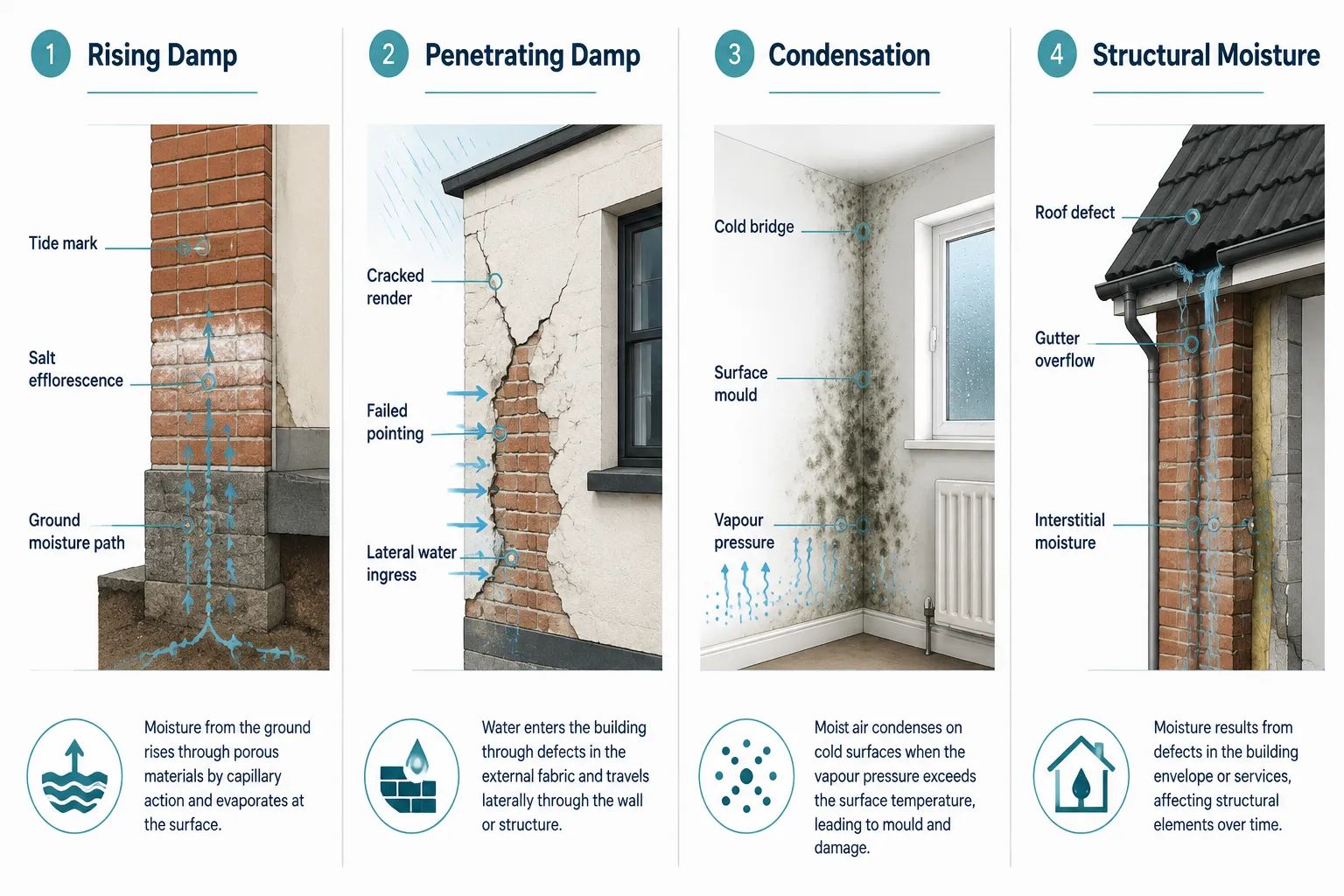
Damp in UK homes is rarely a single, simple phenomenon. The term covers at least four distinct mechanisms, rising damp, penetrating damp, condensation, and structural moisture ingress, and in older or period properties, two or more mechanisms often operate simultaneously. Treating the wrong type, or treating a symptom rather than its cause, is not just ineffective; it can actively accelerate building deterioration and create health risks for occupants.
RICS guidance is unambiguous on this point: mould treatments address symptoms only, and the moisture source must be properly understood before any contractor is instructed for remedial works [1]. This is the core reason why professional damp investigation in UK homes, when conducted by a chartered surveyor rather than a contractor, produces fundamentally different and more reliable outcomes.
The four main damp mechanisms in UK residential buildings:
| Type | Common Signs | Typical Locations |
|---|---|---|
| Rising damp | Tide marks, salt staining, peeling skirting | Ground-floor walls, solid floors |
| Penetrating damp | Localised staining after rainfall | External walls, around windows |
| Condensation | Surface mould, streaming windows | Bathrooms, kitchens, cold corners |
| Structural moisture | Variable staining, timber decay | Rooflines, parapets, sub-floors |
A contractor with a commercial interest in selling a chemical damp-proof course or a tanking system has an inherent incentive to identify rising damp even where the evidence is ambiguous. Industry commentary increasingly warns against contractor-led surveys that recommend extensive chemical treatments without robust evidence of a specific moisture mechanism [1][8]. This is not to suggest that all contractors act in bad faith, but the structural conflict of interest is real, and it is precisely why independent chartered surveyor reports carry greater weight in legal, insurance, and negotiation contexts.
What a JPS22-Compliant Inspection Delivers
The Joint Position Statement 2022 (JPS22) sets the standard for impartial damp and mould inspections. A JPS22-compliant report is produced by a surveyor with no commercial interest in selling remediation products, and it commits to proportionate recommendations, meaning the surveyor will not recommend expensive interventions unless the evidence clearly supports them [1].
RICS advises homeowners to ask specifically whether a prospective surveyor can deliver a JPS22-compliant inspection [1]. This single question filters out the majority of contractor-led assessments and ensures the report will be treated as credible by solicitors, mortgage lenders, insurers, and housing tribunals.
When Professional Damp Investigation in UK Homes Requires a Chartered Surveyor Instead of a Contractor
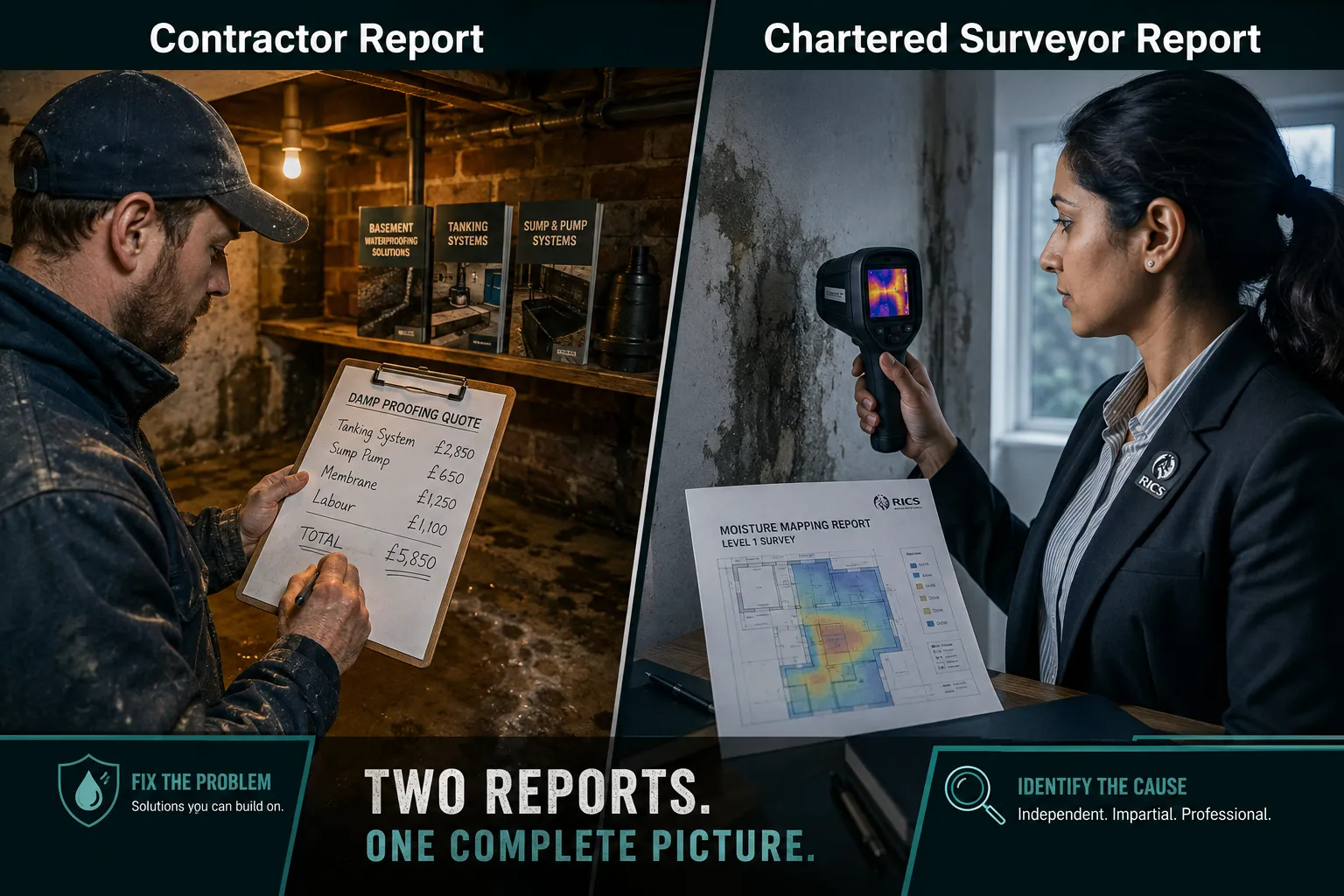
The distinction between contractor and surveyor is not always obvious to homeowners, and the marketing language used by some damp-proofing companies deliberately blurs the line. Understanding the specific circumstances where a chartered surveyor is not just preferable but essential is the most practical knowledge a property owner can have.
Situations That Demand Independent Chartered Surveyor Involvement
1. Persistent damp despite repeated repairs
If a contractor has attended two or more times and the problem has returned, this is a strong signal that the root cause has not been identified. The Housing Ombudsman's Spotlight report on damp and mould, which examined 410 complaints across 142 landlords, found that repeated superficial works without proper diagnosis was one of the most common failure modes [6]. An independent chartered surveyor can break this cycle by conducting a structured moisture-movement assessment.
2. Complex or mixed damp mechanisms
Where condensation, penetrating damp, and possible rising damp are all present, a contractor is unlikely to have the diagnostic tools or training to distinguish between them reliably. Building pathology, the systematic investigation of how moisture moves through a building fabric, is a specialist discipline, and RICS notes that even general RICS membership does not guarantee relevant expertise in this area [1]. Homeowners should specifically seek a surveyor with demonstrable experience in damp and building pathology.
3. Health concerns linked to mould exposure
Where occupants, particularly children, elderly residents, or those with respiratory conditions, are experiencing health impacts attributable to mould, the stakes are significantly higher. Under Awaab's Law and the Social Housing (Regulation) Act 2023, registered social landlords are required to treat serious damp and mould as an emergency hazard, investigate within 10 days, and complete repairs within five working days for emergency cases [8]. For complex cases within this framework, specialist inspections by chartered surveyors are strongly implied as the appropriate escalation route.
4. Legal disputes, insurance claims, and property transactions
A contractor's report is rarely accepted as independent evidence in legal or insurance contexts. Where damp is a factor in a property purchase negotiation, a boundary dispute, a landlord-tenant dispute, or an insurance claim, an independent chartered surveyor's report carries the professional weight and impartiality that courts, ombudsmen, and insurers require [1][11]. This is particularly relevant for buyers considering a Level 3 building survey for a property with suspected defects, where damp findings can significantly affect valuation and negotiation.
5. Period, heritage, or unusual construction types
Older buildings with solid masonry walls, lime mortar, or non-standard construction behave very differently from modern cavity-wall homes. RICS guidance specifically highlights surveyor involvement for period and heritage properties, where moisture dynamics are complex and inappropriate modern interventions (such as cement render or chemical injection) can cause serious long-term damage [1].
6. Structural implications
Where damp is associated with timber decay, lintel corrosion, or potential structural movement, a chartered surveyor has the professional competence to assess the structural risk and recommend further specialist investigation if needed. A contractor does not.
"The cause of damp must be properly understood before contractors are instructed for remedial works. Mould treatments only address symptoms.", RICS Consumer Guide on Damp and Mould [1]
When a Contractor Is Sufficient
Not every damp problem requires a chartered surveyor. For straightforward, well-understood issues, a clearly identified leaking pipe, a recently blocked gutter causing localised staining, or simple condensation in a well-ventilated modern flat where the cause is obvious, a competent contractor can diagnose and remedy the problem without the additional cost of a surveyor's report [1][8]. The key test is whether the cause is genuinely certain and uncontested. If there is any doubt, the cost of an independent survey is almost always justified.
Cost, Process, and What to Expect From a Professional Damp Survey
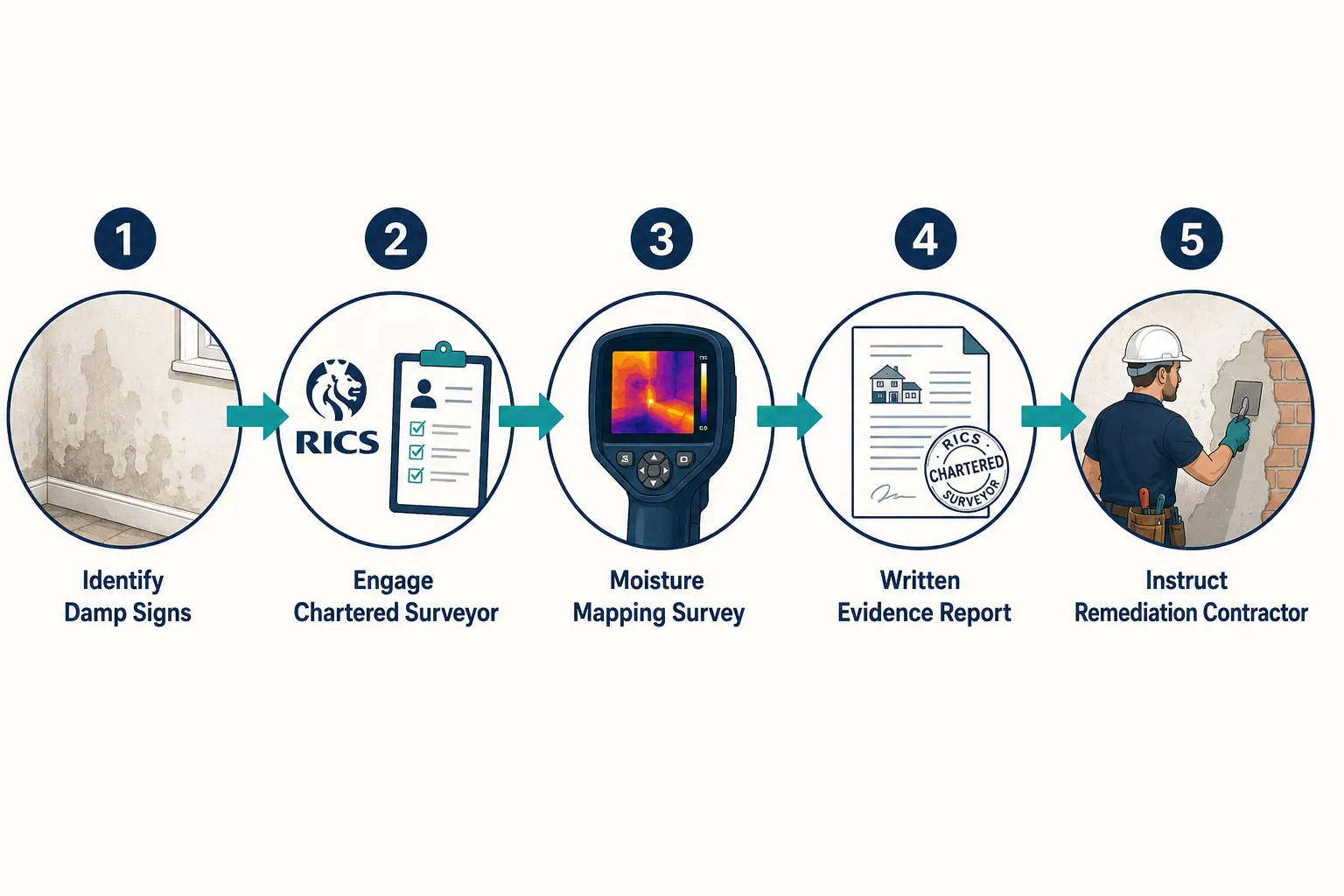
One of the most common reasons homeowners skip an independent survey is uncertainty about cost and process. In practice, the fees are modest relative to the potential cost of misdiagnosed remediation works.
Typical Fees for a Professional Damp Survey in the UK (2026)
According to a 2026 guide to damp survey costs, typical fees break down as follows [2]:
- Small flats or modern homes: approximately £250 to £350
- Standard three-bedroom houses: approximately £350 to £500
- Larger or older/period properties: £500 to £600 or more, with higher fees where intrusive investigation or sub-floor inspection is required
These fees normally include detailed moisture mapping, assessment of the building fabric, and a written, evidence-based report [2]. By contrast, a contractor-led "damp survey" is frequently offered at low or no cost, because the contractor's revenue comes from the remediation works they recommend, not the diagnostic report itself.
What a Chartered Surveyor's Damp Investigation Involves
A professional damp investigation by a chartered building surveyor typically includes:
- Pre-visit review of available documentation, including previous survey reports, maintenance records, and planning history.
- Visual inspection of all accessible areas, including roof spaces, sub-floor voids, and external envelope.
- Moisture mapping using calibrated electronic moisture meters and, where appropriate, thermal imaging cameras to identify cold bridges and moisture gradients.
- Fabric assessment examining construction type, condition of pointing, render, flashings, gutters, and drainage.
- Condensation risk analysis considering ventilation, heating patterns, and occupancy.
- Written report with photographic evidence, moisture readings, diagnosis of moisture mechanisms, and proportionate remediation recommendations.
This structured approach is what distinguishes a professional damp investigation from a contractor visit. The report produced is an independent professional document that can be relied upon by solicitors, mortgage lenders, and housing tribunals.
The Regulatory Landscape in 2026
The regulatory pressure on landlords and property managers to commission independent surveys has intensified considerably. Housing Ombudsman decisions in 2026 continue to criticise landlords for failing to act on damp survey recommendations. In a September 2026 decision involving Southern Housing, the Ombudsman found maladministration partly because of delays in acting on damp and mould survey recommendations, with the decision stating that complex cases should be escalated promptly to specialist diagnosis [9]. Learning from Severe Maladministration reports published in January 2026 again identified inspections, timeliness, and proper use of specialist surveyors as recurring weaknesses [10].
For landlords, this regulatory environment makes the case for chartered surveyor-led investigations not just professionally sound but legally prudent. For tenants and private homeowners, it reinforces the value of insisting on independent professional investigation when a landlord or seller provides only a contractor's assessment.
The broader professional context is also evolving rapidly. As demand for qualified building surveyors grows, understanding chartered surveyor workload management and scaling building survey operations is increasingly relevant to how quickly homeowners and landlords can access specialist damp investigation services.
Choosing the Right Chartered Surveyor
Not all chartered surveyors have specialist expertise in damp and building pathology. RICS is explicit that its membership alone does not guarantee relevant experience in this area [1]. When selecting a surveyor for a damp investigation, the following checks are recommended:
- Confirm RICS membership and ask specifically about experience in damp, mould, and building pathology.
- Ask whether the surveyor can produce a JPS22-compliant inspection report.
- Confirm the surveyor has no commercial relationship with any damp-proofing contractor or product supplier.
- Request examples of previous damp investigation reports or references from similar properties.
- Check whether the surveyor carries professional indemnity insurance adequate to the value of the property.
For rental properties, the RICS home survey updates post-retrofit summit 2026 and enhanced protocols for energy efficiency compliance are also relevant, as damp and insulation defects are increasingly assessed together under evolving EPC requirements.
Landlords managing larger portfolios should also be aware that building survey checklists for landlord compliance and risk mitigation under stricter rental regulations in 2026 now include damp and mould as a primary compliance category.
For buyers assessing properties with potential damp issues, the essential building survey checklists for 2026 EPC retrofit mandates and fire safety compliance provide useful context on how damp findings interact with broader building condition assessments.
Where damp has structural implications, particularly in older properties with basement conversions or shared walls, Party Wall Act compliance considerations for basement conversions may also be relevant, as moisture ingress from neighbouring properties can complicate both diagnosis and remediation.
Conclusion
The evidence from regulatory decisions, RICS guidance, and Housing Ombudsman reports in 2026 points consistently in one direction: professional damp investigation in UK homes requires a chartered surveyor instead of a contractor whenever the cause of moisture is unclear, persistent, disputed, or carries health, structural, or legal implications.
A contractor can fix a defect once it is properly identified. Only an independent chartered surveyor with building pathology expertise can reliably identify what that defect actually is, and produce a report that stands up to scrutiny from lenders, insurers, courts, and ombudsmen.
Actionable next steps for homeowners, buyers, and landlords:
- If damp has returned after contractor treatment, commission an independent JPS22-compliant survey before instructing further works.
- When purchasing a property with visible damp staining, request a Level 3 building survey from a chartered surveyor rather than relying on a seller-provided contractor assessment.
- Ask any prospective damp surveyor directly whether they have a commercial interest in the remediation products they recommend, if yes, seek an alternative.
- For rental properties, review current Housing Ombudsman guidance and ensure complex damp cases are escalated to specialist chartered surveyor investigation, not left with routine maintenance contractors.
- Budget realistically: a professional damp survey costing £350 to £600 can prevent remediation expenditure running into thousands of pounds based on a misdiagnosis.
The cost of getting the diagnosis right is always lower than the cost of getting the remediation wrong.
References
[1] Damp And Mould – rics.org
[2] How Much Is A Damp Survey For A UK Home Your 2026 Guide – amssurveys.co.uk
[3] Follow Up Spotlight On Damp And Mould – housing-ombudsman.org.uk
[4] Spotlight On Damp And Mould – housing-ombudsman.org.uk
[6] Spotlight Report Damp And Mould Final – housing-ombudsman.org.uk
[7] Damp And Mould Follow Up Report Final 2.2.23 – housing-ombudsman.org.uk
[8] Damp Mould Moisture Movement Consumer Guide – ww3.rics.org
[9] Southern Housing 202432773 – housing-ombudsman.org.uk
[10] January 2026 – housing-ombudsman.org.uk