

Nearly 11 million people in England live in privately rented homes, yet until 2026, millions of tenants had no single, free, and legally backed route to challenge their landlord's decisions on rent, property condition, or valuation disputes. That gap is now closing fast. The Private Rented Sector Ombudsman: Chartered Surveyor Roles in Resolving 2026 Landlord-Tenant Valuation Disputes sits at the heart of the most significant shake-up of the rental market in a generation, driven by the Renters' Rights Act and its phased rollout across England.
For landlords, tenants, and property professionals alike, understanding how the new ombudsman scheme works — and specifically how chartered surveyors provide the impartial, evidence-based valuations that underpin fair outcomes — is no longer optional. It is essential.
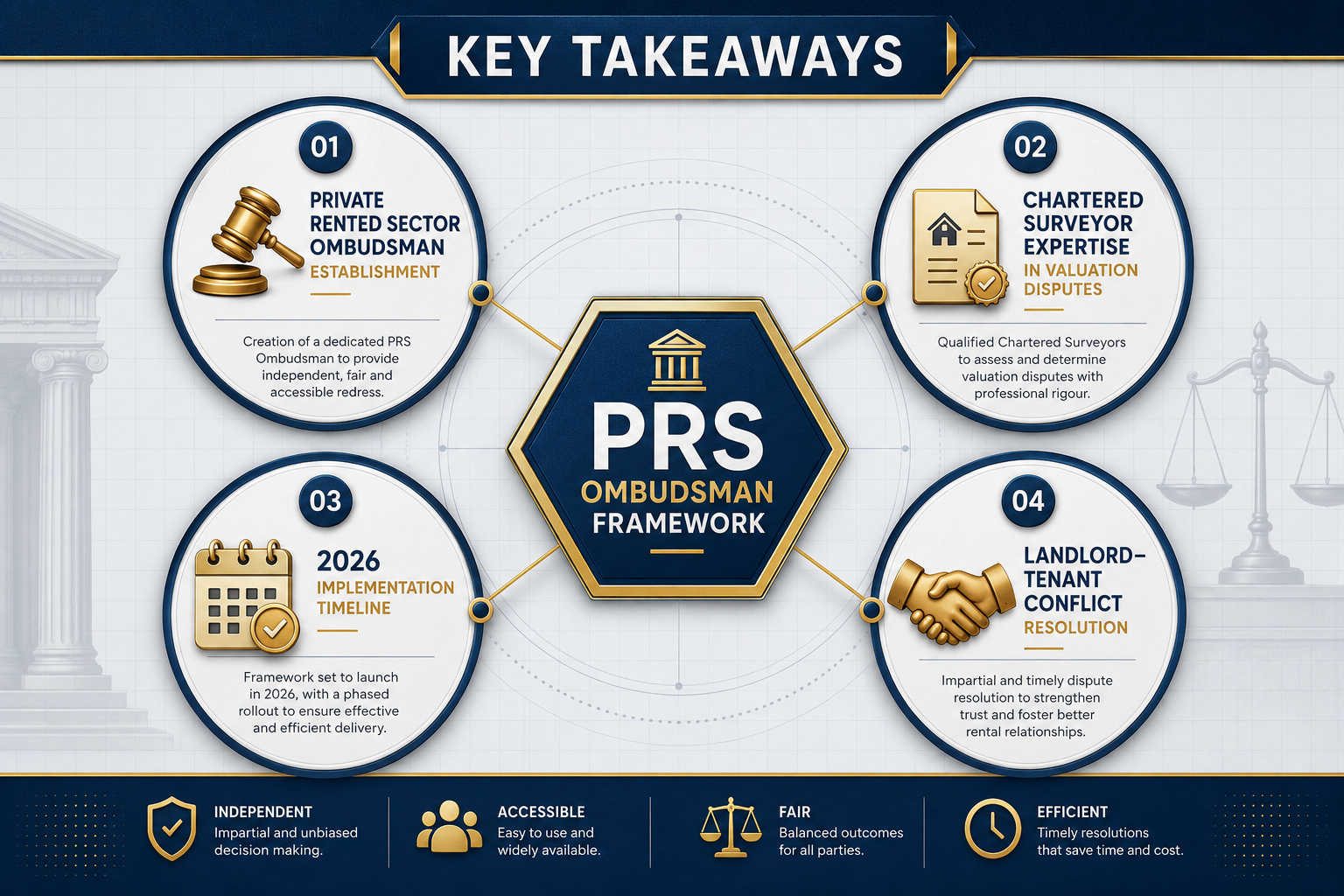
Key Takeaways
- The PRS Landlord Ombudsman is being introduced under the Renters' Rights Act, with Phase 1 live from 1 May 2026 and the ombudsman service expected in late 2026 [3][5].
- All private landlords in England will be legally required to join the scheme, with mandatory membership anticipated from 2028 [2][3].
- Non-compliance carries civil penalties of up to £7,000 for first offences, rising to £40,000 for repeat breaches, plus potential criminal prosecution [3][10].
- Chartered surveyors provide independent, RICS-compliant valuation reports that serve as critical evidence in ombudsman complaint investigations.
- Early preparation — including obtaining professional valuations and documenting property condition — significantly reduces the risk of a complaint escalating.
The Renters' Rights Act and the Birth of the PRS Ombudsman
What the Legislation Actually Creates
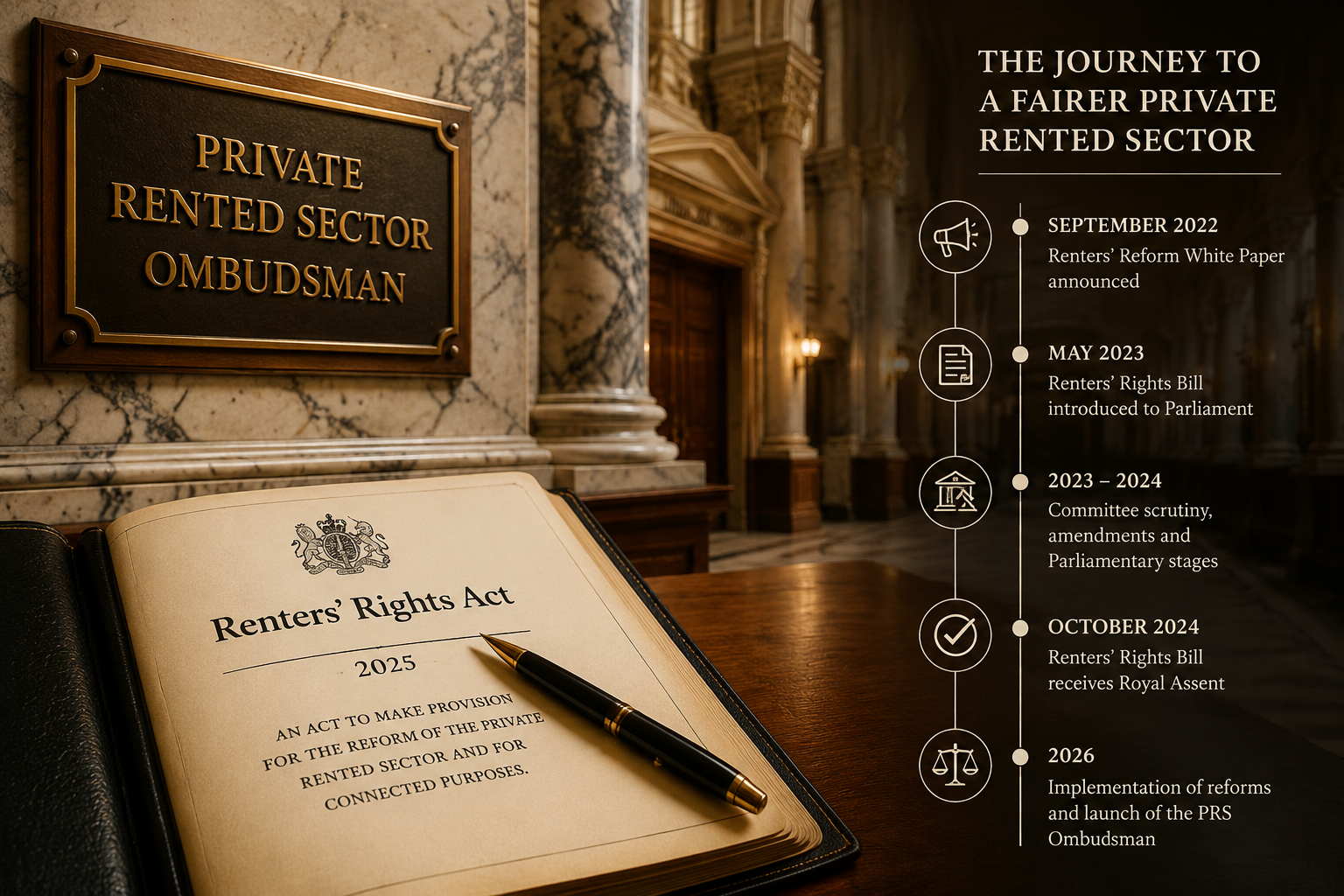
The Renters' Rights Act represents a fundamental restructuring of the private rented sector in England. Phase 1 of the Act came into force on 1 May 2026, abolishing fixed-term assured shorthold tenancies, ending Section 21 "no-fault" evictions, and introducing a new periodic tenancy framework [3][5]. Phase 2, expected to begin in late 2026, will introduce two further pillars: the PRS Database and the PRS Landlord Ombudsman [3][5][10].
The ombudsman is not a voluntary code of practice. It is a statutory body with real enforcement powers, designed to resolve disputes between private landlords and their tenants without the need for court proceedings [2][5].
"The new PRS Landlord Ombudsman will give tenants a free, impartial route to challenge landlord conduct — and landlords who ignore it face penalties that can reach £40,000." [3][10]
Who Must Join and When
Every private landlord in England must register with both the PRS Ombudsman and the new PRS Database once the scheme is fully operational. This applies regardless of:
- Portfolio size (one property or one hundred)
- Whether the landlord uses a letting agent
- The type of tenancy in place [2][3][5][10]
Mandatory membership for all landlords is currently expected to commence in 2028, once the government is satisfied the ombudsman service is fully operational and adequately resourced [2][3]. However, the scheme's infrastructure will be active and accepting cases from late 2026 onward, meaning early preparation is advisable now.
Penalties for Non-Compliance
The consequences of failing to register are significant and deliberately graduated:
| Offence | Maximum Penalty |
|---|---|
| Failure to register (first offence) | £7,000 civil penalty |
| Repeat non-registration | £40,000 civil penalty |
| Serious or persistent breaches | Criminal prosecution |
| Operating while expelled from scheme | Exposure to Rent Repayment Orders |
Tenants can also apply for Rent Repayment Orders, potentially reclaiming up to 12 months' rent — and in certain circumstances, up to two years' rent — where a landlord has failed to comply with the scheme's requirements [1][3][12].
For landlords in areas such as North London or Surrey, where rental values are high, the financial exposure from a Rent Repayment Order alone makes compliance a straightforward business decision.
How the Ombudsman Handles Valuation Disputes
The Complaint Journey: From Landlord to Ombudsman
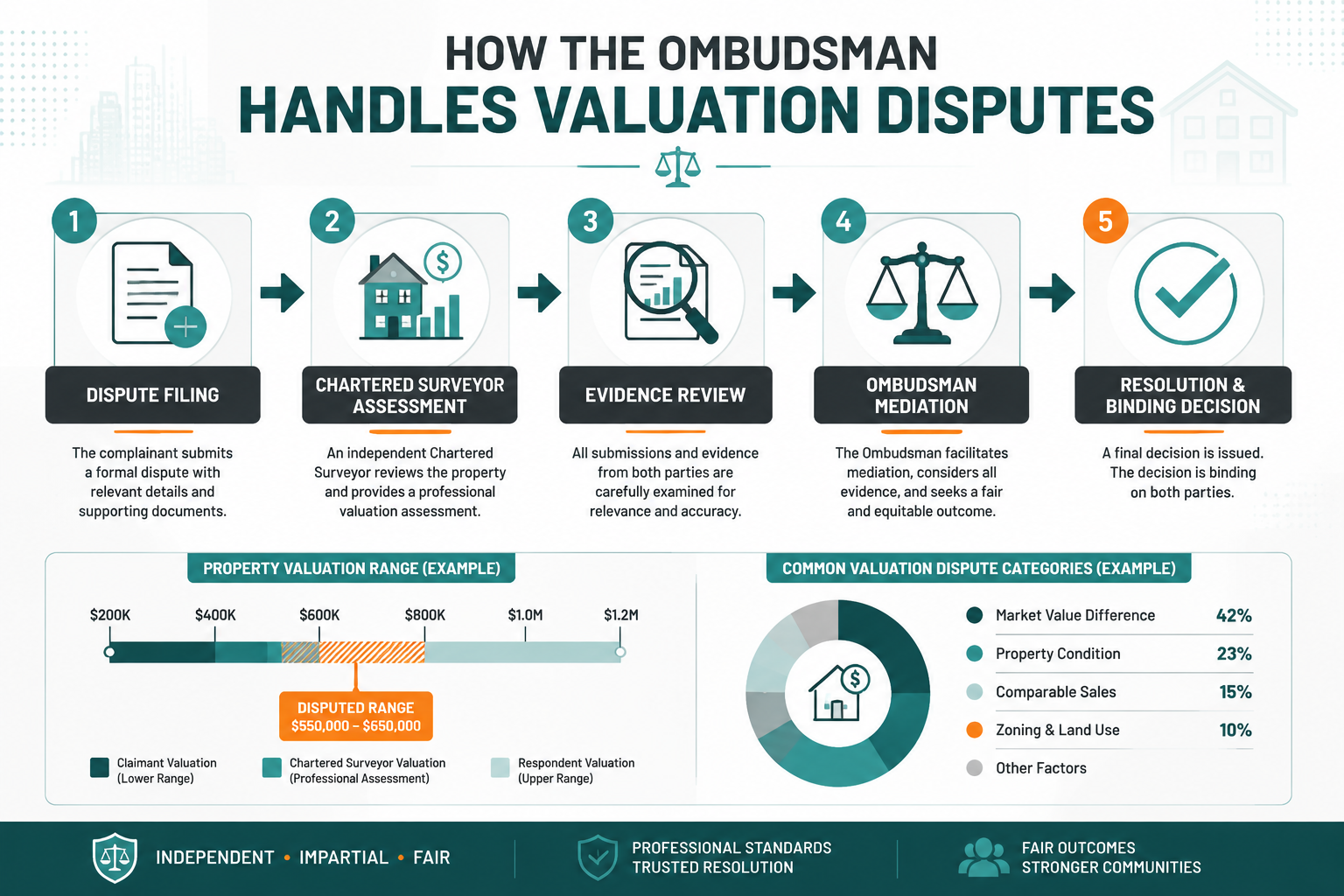
The complaint process follows a clear, structured path. Understanding each stage helps both landlords and tenants prepare effectively.
Step 1 — Internal Complaints Procedure
Before a tenant can approach the ombudsman, they must first raise the complaint directly with the landlord through a documented internal process. Landlords are expected to maintain a clear, written complaints procedure. If the complaint is not resolved within a reasonable period — commonly around eight weeks — the tenant may escalate to the ombudsman at no cost [2][12].
Step 2 — Ombudsman Jurisdiction Check
The ombudsman will first confirm that the complaint falls within its remit: that the landlord is registered, the tenancy is covered, and the internal process has been exhausted [2][3].
Step 3 — Evidence Gathering
Both parties submit evidence. For valuation-related disputes — such as disagreements over deposit deductions, rent review levels, or the assessed condition of a property at the end of a tenancy — this is where chartered surveyor reports become decisive [2][12].
Step 4 — Determination
The ombudsman reviews all evidence and determines whether the landlord acted reasonably. Outcomes can include financial awards, required actions, apologies, or changes to landlord practice [2][5].
Why Valuation Disputes Are Among the Most Common
Valuation-related disagreements arise at multiple points in a tenancy:
- Deposit deductions: Disputes over whether damage exceeds fair wear and tear, and the cost of remediation
- Rent review challenges: Tenants contesting whether a proposed rent increase reflects genuine market value
- Dilapidations at lease end: Commercial and residential landlords seeking to recover the cost of restoring a property to its original condition
- Insurance reinstatement values: Disagreements over whether a property is adequately insured at the correct rebuild cost
Each of these scenarios benefits — and in many cases requires — an independent, RICS-compliant valuation from a qualified chartered surveyor. An understanding of dilapidations and their financial implications is particularly relevant for landlords managing end-of-tenancy disputes.
The Role of Chartered Surveyors as Independent Expert Witnesses
Chartered surveyors occupy a unique position in the ombudsman process. Their reports are not simply supporting documents — they are often the single most persuasive piece of evidence the ombudsman will consider.
A well-prepared RICS-compliant valuation report will typically include:
- Comparable market evidence supporting or challenging a stated rental or capital value
- Condition assessment at a specific date, with photographic evidence
- Cost of works schedules quantifying repair or reinstatement costs
- Professional opinion on whether a landlord's proposed deductions or rent level are reasonable
For landlords and tenants in areas with volatile rental markets — such as East London, Islington, or Richmond — having an independent property valuation conducted before a dispute escalates can mean the difference between a swift resolution and a costly, prolonged investigation.
Preparing for the PRS Ombudsman: Practical Steps for Landlords and Tenants
What Landlords Should Do Now
The window between Phase 1 (May 2026) and the expected mandatory membership date (2028) is not a period for inaction. Landlords who use it well will be significantly better positioned when the ombudsman begins accepting cases.
1. Commission a baseline property valuation
Obtaining a professional valuation at the start of each tenancy — and at each renewal — creates a defensible record of market value. This is particularly important for rent review disputes. Reviewing what factors are assessed during a property valuation provides a useful foundation for understanding what evidence the ombudsman will expect.
2. Document property condition thoroughly
A detailed schedule of condition, prepared by a chartered surveyor at the start and end of a tenancy, provides objective evidence that is far more persuasive than landlord-prepared inventories alone.
3. Establish a written complaints procedure
The ombudsman will expect landlords to have a documented internal complaints process. Without one, a tenant can escalate directly, removing the landlord's opportunity to resolve the matter informally [2][12].
4. Understand insurance reinstatement values
Disputes over under-insurance are increasingly common. An insurance reinstatement cost valuation ensures the property is insured at the correct rebuild cost, removing a potential source of conflict.
5. Register promptly when the scheme opens
Waiting until mandatory registration in 2028 is a high-risk strategy. Early registration demonstrates good faith and avoids the risk of being caught by the penalty regime [3][10].
What Tenants Should Know
Tenants approaching the ombudsman with a valuation-related complaint should:
- Keep all written correspondence with the landlord
- Obtain independent evidence of market rents or property condition where possible
- Allow the full internal complaints period (approximately eight weeks) to elapse before escalating [2][12]
- Understand that the ombudsman's process is free and does not require legal representation
The Chartered Surveyor's Preparation Checklist
For surveyors instructed to support ombudsman cases, the following elements are essential in any report intended for submission as evidence:
| Report Element | Purpose in Ombudsman Context |
|---|---|
| RICS Red Book compliance statement | Confirms methodology meets professional standards |
| Date-specific comparable evidence | Establishes market value at the relevant time |
| Photographic schedule of condition | Provides objective record of property state |
| Quantified schedule of dilapidations | Supports or challenges deposit deduction claims |
| Signed declaration of independence | Confirms no conflict of interest |
Surveyors operating across South East London, Essex, and Hampshire are already seeing increased demand for dispute-ready valuation reports as landlords and tenants prepare for the ombudsman's launch.
The Broader Impact on the Private Rented Sector
A Shift Toward Evidence-Based Dispute Resolution
The introduction of the PRS Landlord Ombudsman marks a decisive shift away from adversarial, court-based dispute resolution toward a faster, evidence-led model. For this model to function fairly, the quality of expert evidence submitted by both parties must be high.
This is precisely why the Private Rented Sector Ombudsman: Chartered Surveyor Roles in Resolving 2026 Landlord-Tenant Valuation Disputes cannot be reduced to a compliance checkbox. Chartered surveyors are not simply report writers in this context — they are the mechanism through which fair outcomes become possible [4][8].
Implications for Letting Agents
Letting agents are not exempt from the ombudsman's reach. Where an agent manages a property on behalf of a landlord, the landlord remains responsible for compliance, but agents who fail to advise their clients of the new obligations — including the need for professional valuations — face reputational and legal exposure [2][5][10].
The PRS Database as a Complementary Tool
The PRS Database, introduced alongside the ombudsman in Phase 2, will hold records of all registered landlords, their properties, and their compliance history [3][5][10]. This creates a transparent public record that tenants can check before signing a tenancy agreement, and which the ombudsman can reference when assessing a landlord's conduct history [4][10].
Landlords with a strong compliance record — supported by professional valuations, documented complaints procedures, and timely registration — will be clearly distinguishable from those who have repeatedly attracted complaints.
Conclusion
The Private Rented Sector Ombudsman: Chartered Surveyor Roles in Resolving 2026 Landlord-Tenant Valuation Disputes is not a distant regulatory concept. Phase 1 of the Renters' Rights Act is already in force, and the ombudsman service is expected to be operational before the end of 2026 [3][5]. Mandatory membership for all private landlords follows in 2028, with penalties for non-compliance that are substantial and enforceable [2][3][10].
The landlords, tenants, and property professionals who act now — commissioning independent valuations, establishing documented processes, and understanding the ombudsman's evidence requirements — will be the ones who navigate disputes quickly and cost-effectively.
Actionable next steps:
- Commission a baseline RICS-compliant valuation for each rental property before the ombudsman service opens
- Establish a written internal complaints procedure immediately
- Engage a qualified chartered surveyor to prepare condition schedules at the start and end of each tenancy
- Register with the PRS Ombudsman and PRS Database as soon as the scheme accepts applications
- Seek professional advice on dilapidations, rent review methodology, and insurance reinstatement values to remove the most common sources of valuation dispute
The ombudsman's arrival is an opportunity as much as an obligation. Those who prepare well will resolve disputes faster, protect their rental income, and build the kind of documented compliance record that the PRS Database will make publicly visible for years to come.
References
[1] Landlord Private Rented Sector Ombudsman Uk – letsafeuk.co.uk
[2] Prs Landlord Ombudsman – augustapp.com
[3] Renters Reform Bill Your Guide To The New Private Renters Ombudsman – blog.goodlord.co
[4] The New Era Of Renting Landlord Ombudsman Prs Database Explained – chbl.uk
[5] Renters Rights Act The New Private Rented Sector Ombudsman – mydeposits.co.uk
[8] Private Rented Sector Consolidated Volume I For Website – parliament.uk
[10] Prs Database Ombudsman And More – forsters.co.uk