

Nearly one in three party wall notices in urban areas leads to a dispute — yet fewer than 1% of those disputes ever reach a courtroom [1]. That gap between conflict and litigation is not accidental. It is the product of structured, professional negotiation tactics that resolve issues locally, protect relationships, and save property owners significant time and money. Understanding pre-court dispute settlement strategies for party wall and valuation conflicts is therefore not just useful knowledge — in 2026, it is essential for any property owner, developer, or surveyor operating in a competitive urban market.
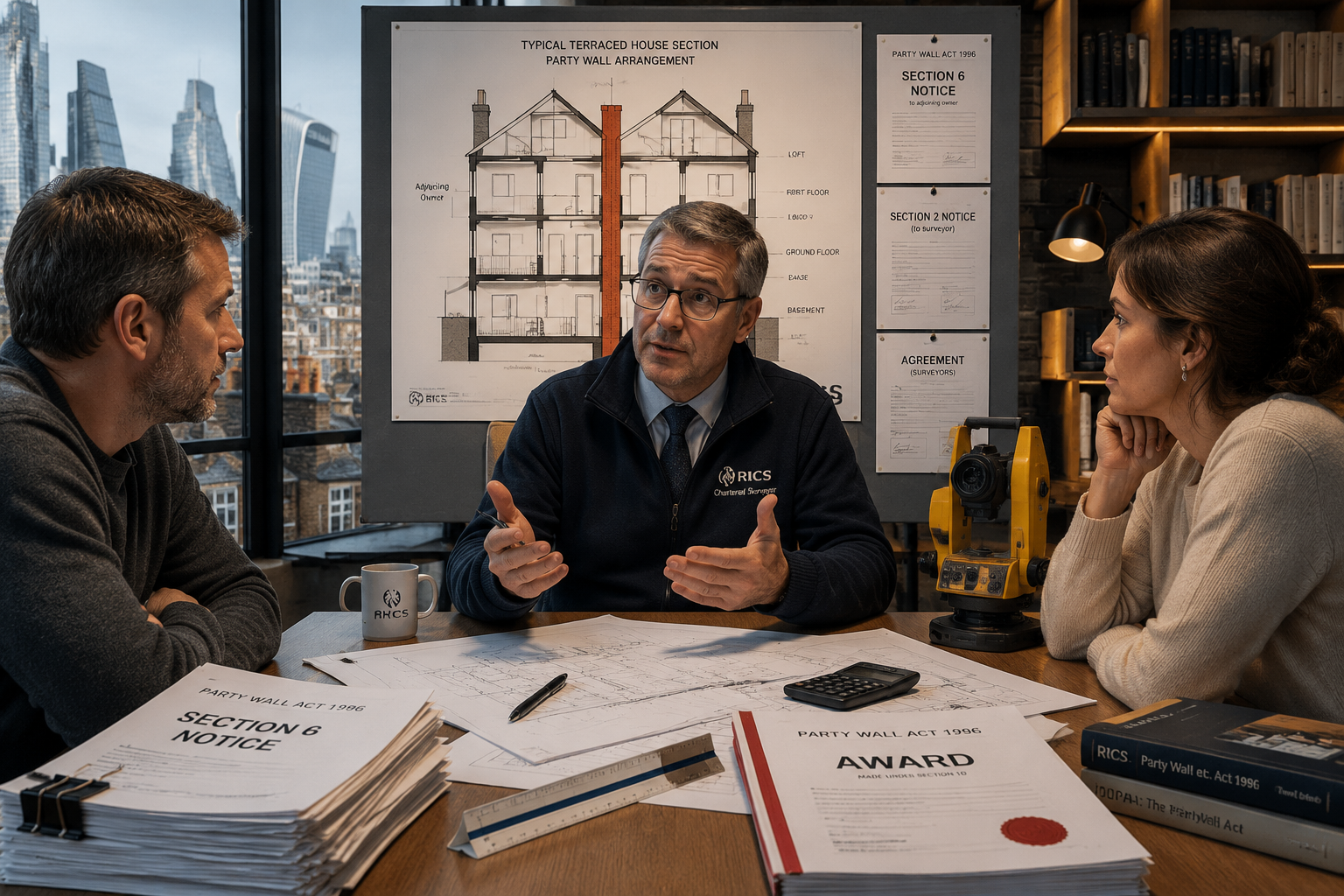
Key Takeaways
- The Party Wall etc. Act 1996 provides a statutory framework that resolves most disputes without court involvement, primarily through surveyor-drafted awards.
- Mediation, early neutral evaluation, and expert determination are the three most effective pre-court tools for both party wall and valuation conflicts.
- Unresolved party wall matters can reduce property valuations by 0.5% to 5%, making early resolution a direct financial priority.
- Appointing an agreed surveyor or using a three-surveyor panel early in a dispute dramatically reduces costs and timelines.
- Proactive communication, thorough documentation, and prompt service of formal notices are the simplest and most overlooked dispute-prevention tactics.
Why Pre-Court Dispute Settlement Strategies for Party Wall and Valuation Conflicts Matter in 2026
London has seen a 34% surge in party wall disputes over the past two years, driven largely by a rise in basement excavations and loft conversions [3]. As urban density increases and permitted development rights encourage more ambitious projects, the friction between neighbouring property owners has intensified. At the same time, courts are actively discouraging parties from litigating disputes that could be resolved through alternative dispute resolution (ADR), making pre-court settlement not just preferable but often mandatory before a judge will hear a case [4].
Valuation conflicts add another layer of complexity. Disputes over property value arise in contexts ranging from divorce settlements and probate to lease extensions, rent reviews, and compulsory purchase. When a party wall dispute and a valuation disagreement overlap — for example, when a neighbour's excavation works depress the value of an adjoining property — the stakes are amplified considerably.
The good news is that a well-structured pre-court approach, guided by qualified surveyors and clear legal frameworks, can resolve the vast majority of these conflicts before they become expensive legal battles.
The Statutory Foundation: Using the Party Wall etc. Act 1996 as a Resolution Tool
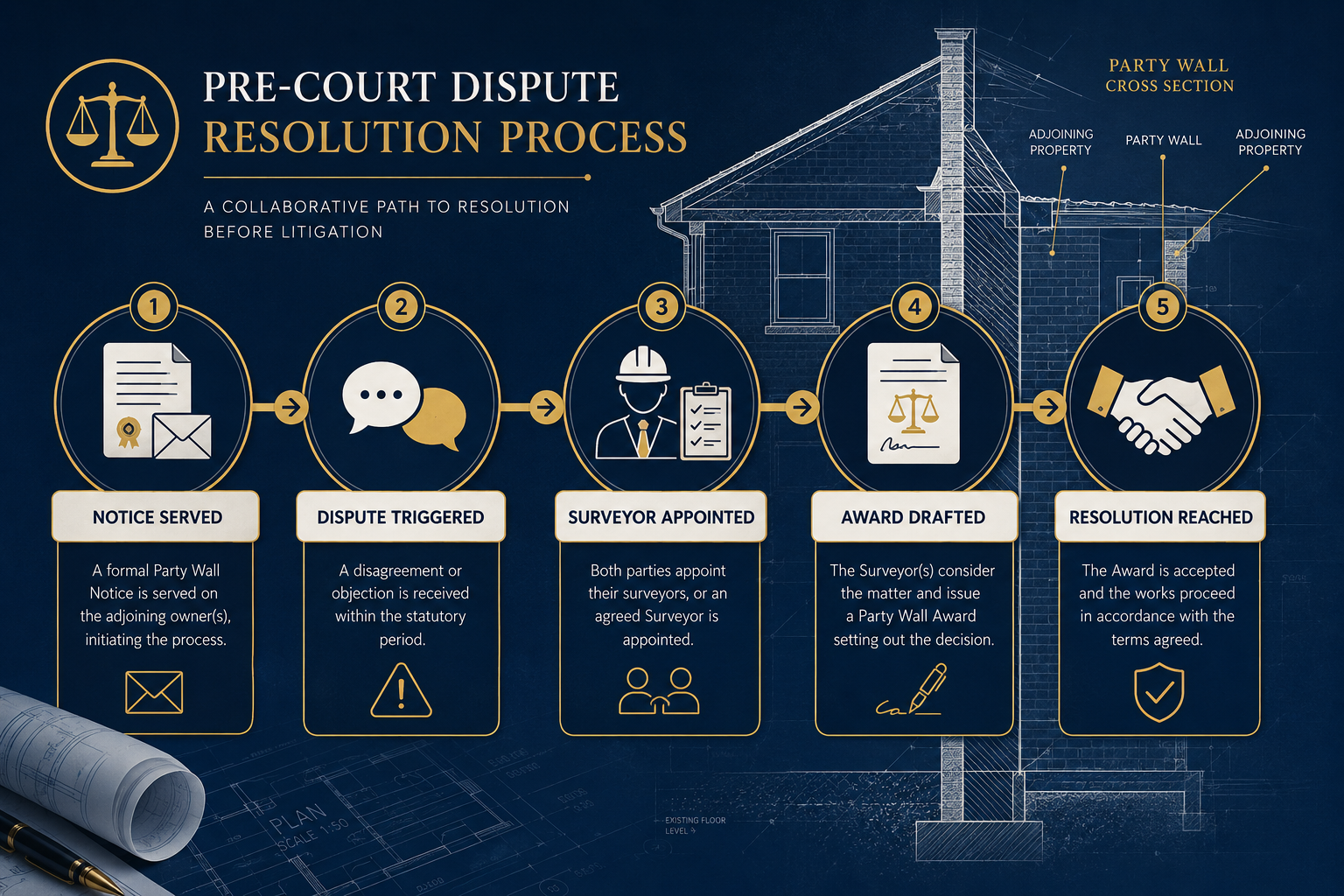
The Party Wall etc. Act 1996 is not merely a set of procedural requirements — it is itself a dispute resolution mechanism. When a building owner serves a party wall notice and the adjoining owner dissents, the Act automatically triggers a surveyor-led process that sidesteps the courts entirely.
How the Statutory Process Works
Under the Act, when a dispute arises, each party may appoint their own surveyor, or both parties may agree to appoint a single party wall agreed surveyor to act impartially. The surveyors then draft a party wall award, a legally binding document that specifies:
- The exact scope of permitted works
- Working hours and noise restrictions
- Protective measures for the adjoining property
- Compensation provisions for any damage caused
This award resolves the dispute without any court involvement [2]. It is enforceable, and either party can appeal it to the County Court within 14 days — but in practice, well-drafted awards are rarely challenged.
"A party wall award drafted by experienced surveyors is one of the most cost-effective dispute resolution instruments available in English property law."
The Agreed Surveyor Advantage
Appointing a single agreed surveyor rather than two separate surveyors reduces costs, speeds up the process, and removes the adversarial dynamic that can arise when each party has their own advocate. For straightforward disputes, this is almost always the preferred route. For more contentious matters involving significant structural works or high-value properties, a three-surveyor panel provides an additional layer of impartiality.
For a detailed breakdown of what these disputes typically involve, the guide to party wall disputes provides a thorough overview of common scenarios and how they are handled.
Core Pre-Court Dispute Settlement Strategies for Party Wall and Valuation Conflicts
1. Early Negotiation and Direct Communication
The most underused strategy is also the simplest: talk to your neighbour before the dispute escalates. A significant proportion of party wall conflicts arise not from genuine legal disagreements but from a lack of communication about the nature and timing of proposed works.
Practical tactics include:
- Sharing draft plans and specifications before formally serving notice
- Scheduling a face-to-face meeting with the adjoining owner to explain the scope of works
- Offering concessions on working hours or protective measures in exchange for consent
- Providing written summaries of conversations to create a paper trail
When direct negotiation fails, the next step is to bring in a professional intermediary rather than immediately escalating to formal proceedings.
2. Surveyor-Led Mediation
Mediation is a voluntary, confidential process in which a neutral third party helps disputing parties reach a mutually acceptable resolution [6]. In the context of party wall and valuation conflicts, a RICS-registered surveyor often serves as the most effective mediator because they bring both technical expertise and procedural authority.
The mediator does not impose a decision. Instead, they facilitate structured dialogue, identify the core issues, and help parties explore creative solutions that a court could not order — such as phased construction schedules, shared monitoring arrangements, or agreed compensation formulas.
Key advantages of surveyor-led mediation:
| Factor | Mediation | Court Litigation |
|---|---|---|
| Average duration | Days to weeks | Months to years |
| Cost range | Moderate | High to very high |
| Confidentiality | Yes | No (public record) |
| Relationship preservation | High | Low |
| Flexibility of outcome | High | Limited to legal remedies |
Property mediation costs can range from $5,000 to $50,000 or more depending on complexity [8], but this remains a fraction of typical litigation costs, which can run to six figures in contested party wall or valuation cases.
3. Early Neutral Evaluation
Early neutral evaluation (ENE) involves appointing an independent expert — typically a senior chartered surveyor or a specialist lawyer — to provide a non-binding assessment of the likely outcome if the dispute proceeded to court. This assessment is shared with both parties and is designed to anchor expectations and encourage settlement.
ENE is particularly effective in valuation disputes, where parties often hold entrenched positions based on their own surveyor's opinion. When a respected independent expert indicates that a particular valuation is unlikely to be upheld, it creates strong commercial pressure to settle [4].
4. Expert Determination
Where both parties agree, an independent expert can be appointed to make a binding decision on a specific technical question — for example, the market value of a property at a particular date, or whether a proposed construction method meets the standard of care required under the Party Wall etc. Act. Unlike mediation, expert determination produces a final answer that both parties are contractually bound to accept.
This approach is especially useful in property valuation disputes where the disagreement is narrow and technical rather than broad and factual. Expert determiners in these cases are typically RICS-registered valuers with specific experience in the relevant property type and location.
5. The Schedule of Condition as a Preventive Tool
One of the most effective pre-court strategies is not a resolution mechanism at all — it is a prevention tool. A schedule of condition is a detailed photographic and written record of an adjoining property's condition before works begin. When damage to property in a party wall context is alleged, the schedule of condition provides objective evidence that either confirms or refutes the claim.
Without this document, disputes about pre-existing versus construction-caused damage are almost impossible to resolve without litigation. With it, most damage claims are settled quickly and fairly.
Valuation Conflicts: Specific Pre-Court Strategies
Valuation disputes require a slightly different toolkit because they are often less about legal rights and more about competing professional opinions on market value, yield, or reinstatement cost.
Understanding Valuation Adjustments in Party Wall Contexts
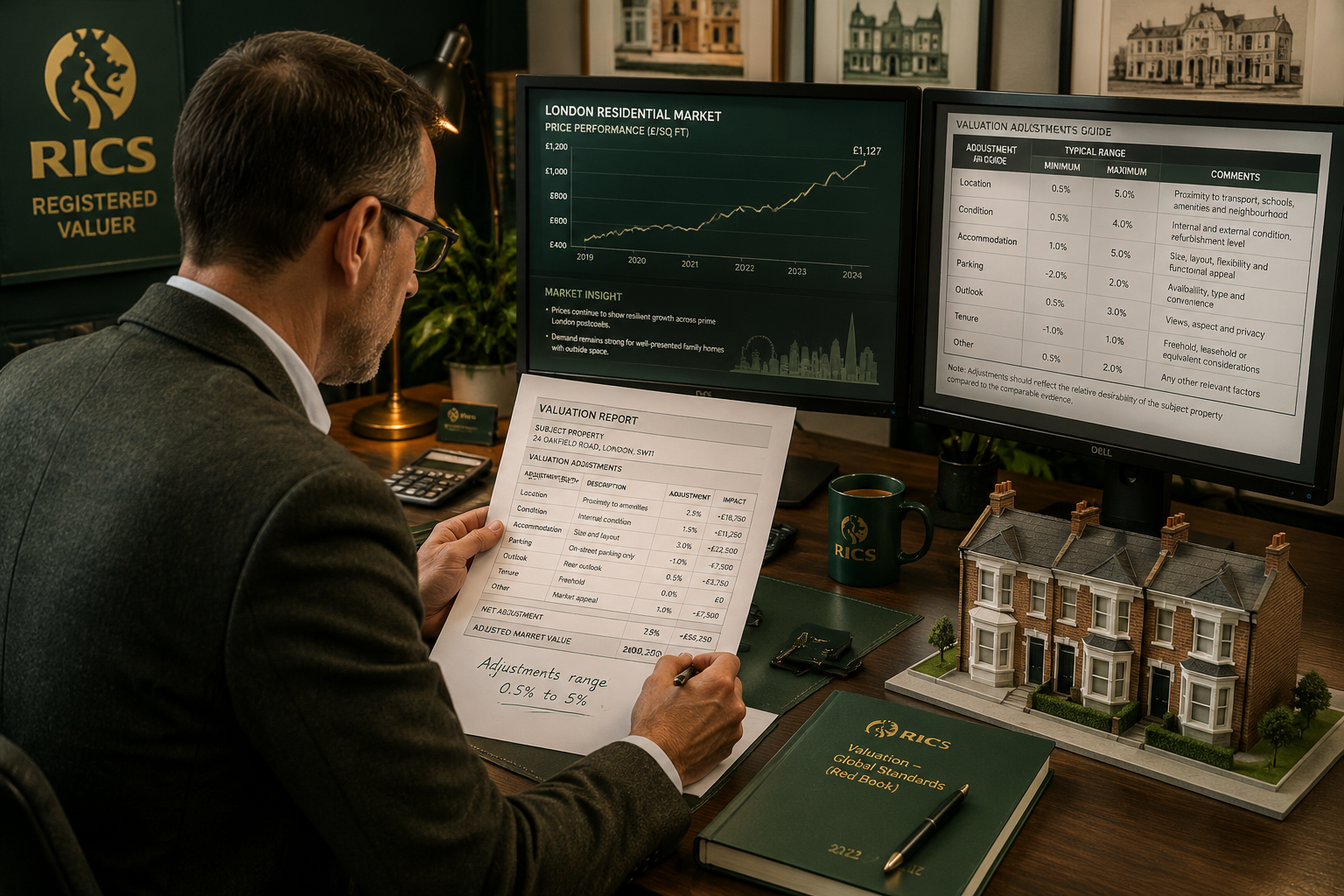
Unresolved party wall matters can negatively affect property values. Valuers regularly apply risk-weighted adjustments, reducing valuations by 0.5% to 5% depending on the severity of the dispute and the potential legal costs involved [5]. This means that a property worth £1 million could be valued at as little as £950,000 if an active party wall dispute is flagged during the valuation process.
For anyone involved in a London property valuation, this is a compelling financial argument for resolving party wall matters before they are captured in a formal valuation report.
Single Joint Expert Appointments
In valuation disputes that are heading toward tribunal or court, both parties can agree to appoint a single joint expert (SJE) whose report is accepted by both sides. This dramatically reduces the cost of expert evidence and often leads to settlement before the hearing date, because both parties receive the same objective assessment simultaneously.
Without Prejudice Negotiations
Any settlement discussions conducted on a "without prejudice" basis cannot be used as evidence in subsequent court proceedings. This protection encourages frank negotiation because neither party risks having their concessions used against them. Property owners and their advisors should use this mechanism actively in valuation disputes, particularly where there is a genuine range of defensible values.
Structured Settlement Meetings
A structured settlement meeting — sometimes called a joint settlement meeting or round-table conference — brings together both parties, their surveyors, and their legal advisors for a focused negotiation session. These meetings are most effective when:
- Both parties have exchanged expert reports in advance
- A mediator or neutral chair is present to manage the process
- A clear agenda identifies the specific issues to be resolved
- Both parties have authority to settle on the day
Practical Negotiation Tactics to Resolve Issues Locally
The most successful pre-court outcomes in party wall and valuation conflicts share a common thread: they are resolved at the local level, between professionals who understand the specific property, the specific works, and the specific neighbourhood.
Document Everything from Day One
From the moment a potential dispute arises, both parties should maintain a contemporaneous record of all communications, site visits, and professional advice received. This documentation serves two purposes: it provides evidence if the dispute escalates, and it often reveals misunderstandings that can be corrected before positions become entrenched.
Engage a Qualified Surveyor Early
The cost of engaging a party wall surveyor at the earliest stage of a dispute is almost always less than the cost of resolving a dispute that has been allowed to fester. Surveyors bring procedural knowledge, professional credibility, and — crucially — the ability to communicate with the other party's surveyor in a shared technical language that removes emotion from the process.
Use the Award Process Constructively
The party wall award is not just a legal formality — it is a negotiating document. Building owners who engage constructively with the award drafting process, rather than treating it as an obstacle, can often secure more favourable terms on working hours, protective measures, and compensation than those who resist the process entirely.
For complex projects involving excavation near neighbouring foundations, understanding the party wall excavation notice requirements from the outset can prevent the most common and costly disputes.
Consider Technology-Assisted Resolution
Emerging technology is beginning to play a role in dispute resolution. AI-assisted systems are being developed to help parties identify the key issues in a dispute, model likely outcomes, and generate draft settlement terms [9]. While these tools are not yet widely deployed in the UK party wall sector, they represent a significant future development for both party wall and valuation conflicts.
When Pre-Court Strategies Reach Their Limits
Pre-court settlement strategies are highly effective, but they are not universally successful. There are circumstances where court intervention becomes unavoidable:
- One party refuses to engage with any form of ADR
- The dispute involves a genuine point of law that requires judicial interpretation
- There are allegations of fraud or professional misconduct
- The financial stakes are so high that neither party is willing to accept a negotiated outcome
In these cases, having pursued pre-court strategies diligently is still valuable — it demonstrates good faith to the court, may reduce the scope of the issues to be decided, and can influence the court's decision on costs.
Conclusion
Pre-court dispute settlement strategies for party wall and valuation conflicts are not a fallback option — they are the primary mechanism through which the vast majority of property disputes are resolved in England and Wales. The statutory framework of the Party Wall etc. Act 1996, combined with professional mediation, early neutral evaluation, expert determination, and structured negotiation, provides a comprehensive toolkit that is faster, cheaper, and more flexible than litigation.
Actionable next steps for property owners and professionals in 2026:
- Serve formal party wall notices at the earliest possible stage to activate the statutory protection framework.
- Appoint a qualified RICS-registered surveyor as soon as a dispute arises — do not wait for positions to harden.
- Commission a schedule of condition before any works begin to prevent damage disputes.
- Use without-prejudice negotiations and structured settlement meetings to explore resolution before instructing solicitors.
- In valuation conflicts, consider a single joint expert appointment to obtain an objective, shared assessment.
- Resolve any outstanding party wall matters before commissioning a formal property valuation to protect the assessed value.
The cost of early professional advice is modest. The cost of unresolved disputes — in legal fees, delayed projects, and reduced property values — is not.
References
[1] Managing Party Wall Disputes Without Court Surveyor Strategies That Keep Projects Moving – partywallsurveyorlondon.uk
[2] Resolving Party Wall Disputes – ansteyhorne.co.uk
[3] How Party Wall Surveyors Resolve Disputes And Save You Thousands In 2026 – partywallsurveyorlondon.uk
[4] Expert Witness Surveyors In Party Wall Disputes Rics Standards For Commercial To Residential Conversions – nottinghillsurveyors.com
[5] Valuation Adjustments For Party Wall Award Costs How To Factor Surveyor Fees And Compensation Into Property Value – canterburysurveyors.com
[6] Real Estate And Construction Mediation How It Works – legalclarity.org
[7] Party Wall Construction Rules Requirements And Costs – legalclarity.org
[8] Property Mediation – bmalaw.com
[9] arxiv – arxiv.org
How Prince Surveyors can help: explore our party wall surveyors or learn about our party wall surveyor costs.