

Last updated: July 24, 2026
Quick Answer: From 1 May 2026, the Renters' Rights Act gives private tenants in England an implied right to request permission to keep a pet, making blanket "no pets" bans unlawful for private landlords. This fundamentally changes how building surveyors, landlords, and property professionals must approach condition reporting, wear and damage assessment, and valuation adjustments for pet-friendly rental properties. Landlords now need robust, evidence-based survey protocols rather than blanket exclusions.
Key Takeaways
- Blanket "no pets" clauses in private assured tenancies in England are no longer lawful from 1 May 2026.
- Landlords must respond to pet requests in writing within 28 days, with any refusal backed by specific, evidenced reasons.
- Standard tenancy deposits remain the primary mechanism for recovering pet-related damage costs; additional pet deposits or fees are not permitted.
- Surveyors should integrate pet-specific condition checks into pre-tenancy and check-out inventories rather than creating a separate survey type.
- Normal wear from a well-managed pet differs legally and practically from damage, and surveyors must document both clearly.
- Valuations for pet-friendly properties may be affected by floor covering condition, odour remediation costs, and market perception.
- Thorough photographic and written evidence at check-in is the single most effective protection for landlords under the new regime.
- Emotional support animals and assistance dogs carry additional legal protections that affect how damage assessments are conducted.

What Does the Renters' Rights Act 2026 Say About Pet-Friendly Rentals?
From 1 May 2026, every private assured tenancy in England includes an implied contractual right for tenants to request permission to keep a pet. Blanket prohibitions on pets are no longer lawful for private landlords, and any refusal must be specific, written, and evidenced.
The Act defines a "pet" broadly: any animal kept mainly for personal interest, companionship, or ornamental purposes. This covers dogs, cats, rabbits, fish, reptiles, and most common companion animals. The definition is deliberately wide, which means building surveyors and landlords must consider a broad range of potential wear patterns, from claw marks on timber floors to tank fixings on walls.
Key points landlords must know:
- A written response to any pet request is required within 28 days.
- Refusal must be justified by the specific property and the particular animal (for example, size, breed, or impact on other residents), not by general apprehension about damage.
- Landlords cannot refuse on grounds of general dislike of animals or prior bad experiences with other tenants' pets.
- If a landlord fails to respond in time or gives an arguably unreasonable refusal, the tenant can challenge the decision in the County Court.
- The Act's pet provisions apply to private assured tenancies; social housing tenancies are expressly excluded from these specific provisions.
Landlords cannot lawfully charge higher rent solely because a tenant has a pet. Penalties of up to £7,000 have been cited in commentary for unlawful rent uplifts linked to pet permissions.
How Do Building Surveys Assess Pet Damage in Rental Properties?
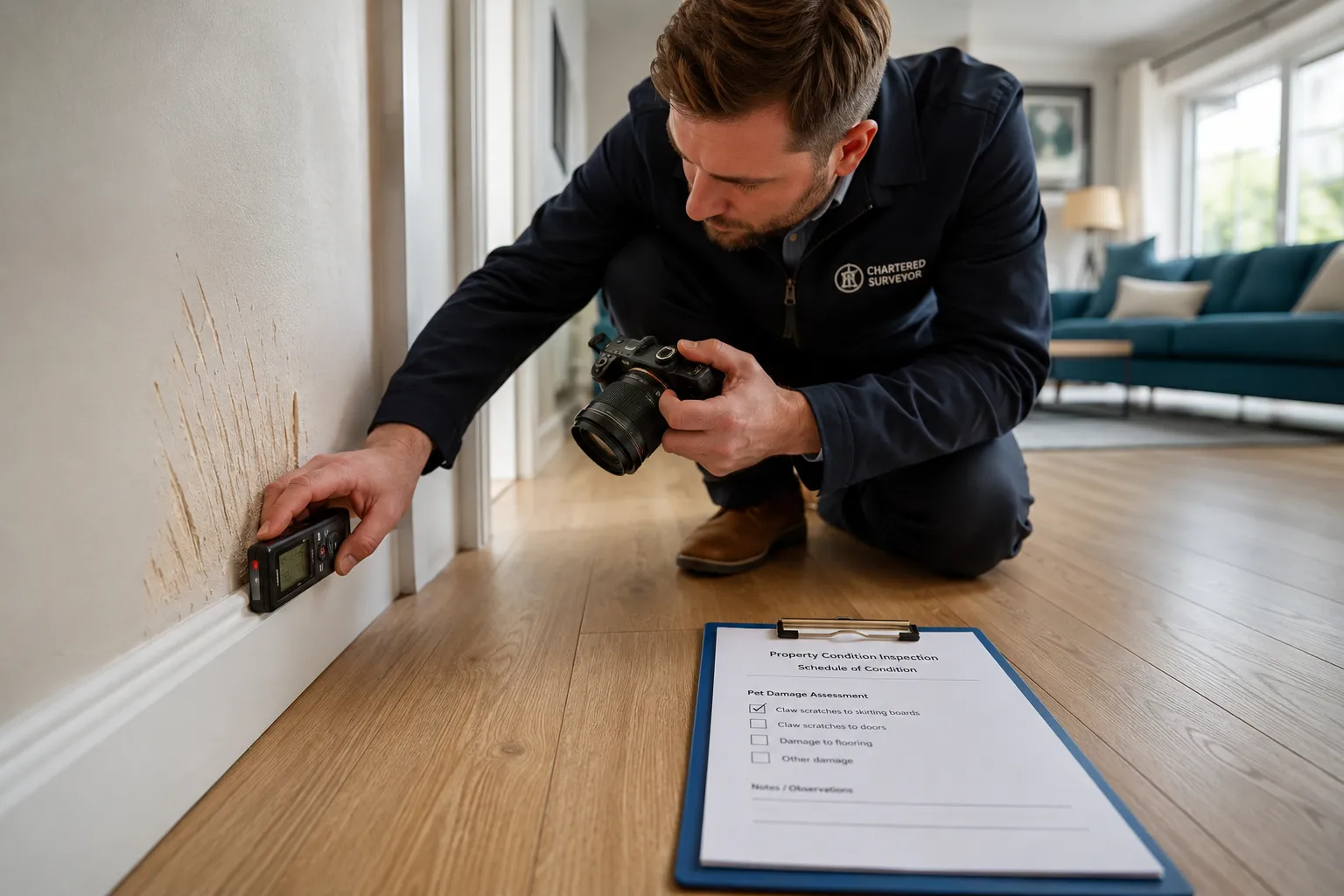
Building surveyors assess pet-related damage by comparing the property's condition at check-out against a detailed pre-tenancy condition report, using photographic evidence, written descriptions, and professional judgement about the cause and extent of deterioration.
No statutory survey template for pet damage has been published as of mid-2026. Current best practice, as recommended by landlord and legal organisations, is to integrate pet considerations into existing check-in and check-out inventories and mid-tenancy inspections, rather than creating a separate "pet survey" protocol.
What a thorough pet-focused condition assessment should cover:
- Floor coverings: scratches, staining, odour penetration, and wear to carpets, hardwood, or laminate
- Walls and skirting boards: claw marks, scuff marks, chewing damage, urine staining
- Doors and frames: scratching, chewing, or impact damage at lower levels
- Garden and outdoor areas: digging, lawn damage, soiling
- Fixtures and fittings: tank or cage fixings, anchor points, or wall fixings left by aquariums or large cages
- Odour: persistent animal odour in carpets, soft furnishings, or subfloor materials
For a comprehensive understanding of what a professional inspection involves, see this overview of Level 3 Full Building Survey services.
"The most effective protection for landlords is not a blanket ban on pets, it is a meticulous pre-tenancy condition report with dated photographs and agreed descriptions of every surface."
What Counts as Normal Wear Versus Damage from Pets Under 2026 Law?
Under the Renters' Rights Act 2026 framework, normal wear and tear from a pet is deterioration that would be expected from responsible ownership of the permitted animal over the tenancy period. Damage goes beyond this: it is deterioration caused by neglect, misuse, or failure to maintain reasonable standards of care.
This distinction matters because landlords can only make deductions from a deposit for damage, not for fair wear and tear.
Practical examples of the distinction:
| Condition | Classification |
|---|---|
| Light scuff marks on skirting boards from a small dog | Normal wear |
| Deep claw gouges through hardwood flooring | Damage |
| Slight fading of carpet in pet sleeping area | Normal wear |
| Urine-soaked carpet requiring full replacement | Damage |
| Minor odour removable by standard cleaning | Normal wear |
| Persistent odour requiring specialist treatment | Damage |
| Small nail holes from a cat scratching post anchor | Borderline (depends on severity) |
The surveyor's role is to assess condition objectively, note the age and original quality of affected items, and apply a reasonable allowance for the tenancy length. A carpet that was already five years old at the start of a two-year tenancy cannot be claimed at full replacement cost even if a pet accelerated its deterioration.
What Are the Survey Protocols for Pet Stains and Odour in Rentals?
Pet stains and odour require specific survey protocols because standard visual inspection can underestimate the extent of contamination, particularly where urine has penetrated subfloor materials or wall cavities.
Recommended survey steps for pet stain and odour assessment:
- Visual inspection of all floor surfaces, walls, and soft furnishings under good lighting.
- UV light testing for urine staining on carpets and hard floors, which reveals contamination invisible to the naked eye.
- Odour assessment at floor level and in enclosed spaces (cupboards, under-stair areas), noting whether odour is superficial or deeply embedded.
- Subfloor inspection where carpet is lifted at edges, checking for staining or odour penetration to the underlay and boards beneath.
- Photographic documentation with timestamps and reference measurements.
- Remediation cost estimation, distinguishing between professional cleaning (minor cases) and full floor covering replacement (severe cases).
For properties with suspected structural or subfloor issues arising from pet damage, a Level 3 Full Building Survey provides the most thorough assessment of building condition and repair costs.

How Much Can Landlords Deduct from Deposits for Pet Damage?
Landlords can deduct from a deposit only the reasonable cost of restoring the property to the condition it was in at the start of the tenancy, adjusted for fair wear and tear. There is no fixed statutory cap on the deduction amount, but it must be proportionate and evidenced.
Standard tenancy deposits remain the primary tool for addressing pet-related damage under the Renters' Rights Act 2026. Additional pet deposits or pet-specific fees are not permitted.
Factors that affect the deduction amount:
- Age and condition of the damaged item at the start of the tenancy (older items attract a betterment reduction)
- Cost of like-for-like repair or replacement, supported by at least two contractor quotes
- Whether professional cleaning or specialist odour treatment is required
- Whether the damage was caused by the permitted pet or was pre-existing
Common mistake: Landlords who fail to document pre-existing condition at check-in will struggle to prove that damage was caused during the tenancy, let alone by the pet specifically. Deposit adjudicators routinely reject claims where the pre-tenancy inventory is absent or vague.
Do Landlords Need Special Insurance for Pet-Friendly Rental Properties?
Standard landlord building and contents insurance policies may not automatically cover pet-related damage, and landlords should review their policy wording carefully now that pet permissions are more common.
Key insurance considerations for pet-friendly rentals:
- Buildings insurance: Check whether gradual damage caused by pets (for example, persistent urine soaking into subfloor timbers) is covered or excluded as a gradual deterioration exclusion.
- Contents insurance: If the landlord provides furnished accommodation, confirm that pet damage to furnishings is covered.
- Specialist landlord policies: Several insurers now offer specific pet-damage endorsements or extensions for landlords who permit pets.
- Reinstatement cost accuracy: Ensure the building is insured for the correct reinstatement value, particularly if pet-related damage has affected structural elements. An insurance reinstatement cost valuation from a chartered surveyor provides an accurate figure.
Landlords should not rely solely on the deposit to cover all eventualities. Where a tenant causes damage that exceeds the deposit, landlords may need to pursue a claim through the courts or their insurer.
How Do Valuations Change for Pet-Friendly Properties?
Pet-friendly rental properties can attract a valuation adjustment in either direction, depending on condition, market demand, and the cost of remediation works required before sale or re-letting.
For property valuations in the context of pet-friendly rentals, surveyors consider:
- Condition-related adjustments: Significant pet damage (deep floor scratching, persistent odour, stained walls) will reduce open market value or require a capital expenditure allowance before sale.
- Market demand: In many urban markets, properties actively marketed as pet-friendly command a rental premium due to the shortage of pet-accepting stock. This can support or improve yield-based valuations.
- Depreciation of floor coverings and fittings: Surveyors will factor in the remaining useful life of carpets, hardwood floors, and garden landscaping when advising on value or sale price.
- Remediation costs: Specialist odour treatment, floor replacement, or redecoration costs are deducted from gross value to arrive at a net realisation figure.
For landlords considering selling a tenanted pet-friendly property, a capital gains tax valuation should account for any condition-related adjustments to the property's market value.
What Documentation Do Landlords Need for Pet Damage Claims?
Landlords need a complete, dated, and photographic pre-tenancy condition report, a signed inventory, mid-tenancy inspection records, and a check-out report to support any pet damage claim. Without this chain of evidence, deposit adjudicators and courts will typically find in the tenant's favour.
Essential documentation checklist:
- Pre-tenancy condition report with photographs of all rooms, surfaces, and fixtures (dated and signed by both parties)
- Written pet consent agreement specifying the permitted animal (species, breed, approximate size)
- Mid-tenancy inspection notes (recommended at least annually for pet-permitted tenancies)
- Check-out report with direct comparison photographs against check-in condition
- Contractor quotes for any remediation work claimed
- Receipts or invoices for completed works
The pet consent agreement should also set out the tenant's maintenance responsibilities: regular flea treatment, keeping pets off specified furniture (if agreed), and prompt reporting of any damage caused.
Can Tenants Dispute Pet Damage Assessments?
Yes. Tenants can challenge pet damage assessments through the deposit protection scheme's dispute resolution service or, if necessary, through the County Court. The burden of proof rests with the landlord to demonstrate that the damage occurred during the tenancy and exceeds fair wear and tear.
Common grounds for tenant disputes include:
- Damage was pre-existing and not documented at check-in
- The claimed cost is disproportionate to the actual damage
- The landlord has applied full replacement cost to an item that was already old or worn
- The damage was not caused by the pet but by another factor (for example, damp or structural movement)
Tenants who believe a refusal of a pet request was unreasonable can also challenge this in the County Court under the Act's enforcement provisions.
What Breeds or Pet Types Are Excluded from Pet-Friendly Rental Protections?
The Renters' Rights Act 2026 does not guarantee approval for any specific pet. Landlords can still refuse on specific, evidenced grounds related to the particular animal and property.
Lawful grounds for refusal include:
- The animal is prohibited by law (for example, certain dog breeds under the Dangerous Dogs Act 1991)
- The property is too small for the animal's welfare needs
- The animal poses a genuine health risk to other residents (for example, severe documented allergies)
- The tenancy is in a building where a superior lease or building rules prohibit animals
Landlords cannot refuse simply because a breed has a general reputation for causing damage, unless there is specific, evidenced risk related to that property and those circumstances.
Are Emotional Support Animals Treated Differently in Damage Assessments?
Emotional support animals and registered assistance animals (such as guide dogs or hearing dogs) carry additional legal protections under the Equality Act 2010, and landlords must treat requests involving these animals with particular care to avoid disability discrimination claims.
For damage assessment purposes, the same evidence-based approach applies: surveyors document condition objectively, and deductions must be proportionate and evidenced. However, a landlord who refuses a reasonable adjustment request for an assistance animal, or who applies disproportionate damage claims, risks both a deposit dispute and an Equality Act complaint.
Practical advice: where a tenant has an assistance animal, document the pre-tenancy condition with extra care and agree in writing on maintenance responsibilities from the outset.
Common Mistakes Landlords Make with Pet Damage Surveys
The most damaging mistakes are procedural, not technical. Landlords who follow the right process rarely lose deposit disputes; those who skip documentation almost always do.
Top mistakes to avoid:
- No pre-tenancy inventory: Without a baseline, no damage claim can be substantiated.
- Vague descriptions: "Good condition throughout" is not a useful baseline. Describe each surface specifically.
- Failing to photograph at floor level: Pet damage is concentrated at skirting board height and below. Standard eye-level photographs miss it.
- Claiming betterment: Replacing a five-year-old carpet at new cost when the pet only accelerated normal end-of-life deterioration.
- Refusing pets without written justification: Under the Act, an undocumented or generic refusal is legally vulnerable.
- Not updating the inventory after mid-tenancy inspections: Changes in condition during the tenancy should be recorded, not just at start and end.
For a broader understanding of what professional building inspections cover and how surveyors document condition, the building inspections and surveys guide for homeowners provides useful context.
How Long Do Landlords Have to Return Deposits After Pet Damage Assessment?
Landlords must return the deposit, or the undisputed portion of it, within 10 days of agreeing the deductions with the tenant. This timeline applies regardless of whether pet damage is involved.
If there is a dispute about deductions, the landlord should raise it with the relevant deposit protection scheme's dispute resolution service before the 10-day window closes. Failure to protect a deposit or return it on time exposes landlords to a penalty of between one and three times the deposit value.
.cg-tool{font-family:Arial,sans-serif;max-width:480px;margin:2em auto;background:#f4f7fb;border:1px solid #d0d9e8;border-radius:8px;padding:1.2em}
.cg-tool h3{margin:0 0 .8em;font-size:1.05em;color:#1a2e4a}
.cg-tool label{display:block;font-size:.88em;color:#333;margin:.6em 0 .2em}
.cg-tool select,.cg-tool input{width:100%;padding:.4em .5em;border:1px solid #b0bcc8;border-radius:4px;font-size:.9em;box-sizing:border-box}
.cg-tool button{margin-top:.9em;width:100%;padding:.55em;background:#1a2e4a;color:#fff;border:none;border-radius:4px;font-size:.95em;cursor:pointer}
.cg-tool button:hover{background:#2a4a6e}
.cg-result{margin-top:.9em;background:#fff;border:1px solid #c5d2e0;border-radius:5px;padding:.8em;font-size:.9em;color:#1a2e4a;display:none}
.cg-result strong{display:block;font-size:1.05em;margin-bottom:.3em}
Pet Damage Deposit Deduction Estimator
function cgCalc(){
var cost=parseFloat(document.getElementById(‘cg-cost’).value)||0;
var age=parseFloat(document.getElementById(‘cg-age’).value)||0;
var life=parseFloat(document.getElementById(‘cg-life’).value)||1;
var rem=Math.max(0,life-age);
var pct=rem/life;
var ded=Math.round(cost*pct);
var r=document.getElementById(‘cg-result’);
r.style.display=’block’;
if(cost<=0){r.innerHTML='Please enter a valid cost.‘;return;}
r.innerHTML=’Estimated fair deduction: £’+ded+’‘
+’Remaining useful life: ‘+rem+’ of ‘+life+’ yrs (‘+Math.round(pct*100)+’%). ‘
+’Betterment reduction applied: £’+Math.round(cost*(1-pct))+’. ‘
+’This is a guide only, a chartered surveyor’s assessment takes precedence.’;
}
Conclusion
The Renters' Rights Act 2026 has fundamentally shifted the starting position for pet-friendly rental properties in England. Landlords can no longer rely on blanket prohibitions; instead, the new framework demands evidence-based decision-making, thorough documentation, and professional survey protocols that distinguish clearly between fair wear and damage.
Actionable next steps for landlords and property professionals:
- Review all existing tenancy agreements and remove blanket "no pets" clauses before they are challenged.
- Invest in a detailed pre-tenancy condition report with floor-level photography before any pet-permitted tenancy begins.
- Create a written pet consent agreement for each permitted animal, specifying maintenance responsibilities.
- Schedule mid-tenancy inspections (at least annually) and document any changes in condition.
- Ensure buildings insurance covers pet-related damage, and obtain an insurance reinstatement cost valuation to confirm accurate cover levels.
- Engage a chartered surveyor for check-out assessments where significant pet damage is suspected, to produce a defensible, professional report.
- Apply betterment reductions to any deposit deduction claims, and support all claims with contractor quotes.
For landlords who want professional guidance on building condition, dilapidations, or property valuations in the context of the new legislation, a Level 3 Full Building Survey or a professional property valuation from a RICS-regulated chartered surveyor provides the most robust foundation for compliance and dispute avoidance.
Frequently Asked Questions
Can a landlord still refuse a pet under the Renters' Rights Act 2026?
Yes, but only with a specific, written, evidenced reason related to the property and the particular animal. General dislike of pets or concern about potential damage is not a lawful ground for refusal.
What is the deadline for a landlord to respond to a pet request?
Landlords must respond in writing within 28 days of receiving a pet request. Failure to respond in time can be treated as an unreasonable refusal and challenged in the County Court.
Can landlords charge a higher rent for pet-friendly tenancies?
No. The Act prohibits rent uplifts linked to pet permissions. Penalties of up to £7,000 have been cited for landlords who attempt to do so.
Does the Act apply to social housing?
No. The pet permission provisions of the Renters' Rights Act 2026 apply to private assured tenancies in England. Social housing tenancies are expressly excluded from these specific provisions.
What is the best way to document pet damage for a deposit claim?
A dated pre-tenancy condition report with photographs at floor level, a signed inventory, mid-tenancy inspection notes, and a check-out report with direct comparison photographs form the minimum evidential standard. Contractor quotes for remediation work should support any deduction claimed.
Are guide dogs and assistance animals treated the same as pets under the Act?
Assistance animals carry additional protections under the Equality Act 2010. Landlords must treat requests involving assistance animals with particular care, and any refusal risks both a deposit dispute and a disability discrimination claim. Damage assessments follow the same evidence-based approach but must be applied proportionately.
How does pet damage affect a property's market valuation?
Significant pet damage, particularly persistent odour or deep floor damage, reduces open market value by the estimated cost of remediation. Conversely, properties in good condition that are actively marketed as pet-friendly can attract a rental premium in markets with limited pet-accepting stock.
What should a pet consent agreement include?
It should specify the permitted animal (species, breed, approximate size), the tenant's maintenance obligations (flea treatment, prompt damage reporting), any agreed restrictions (for example, no pets on specified furniture), and the process for requesting permission to change or add a pet.
Tags: Renters Rights Act 2026, pet-friendly rentals, building survey protocols, pet damage assessment, landlord deposit deductions, rental property valuation, wear and tear, chartered surveyor, tenancy deposit, property inspection, UK rental law, pet consent agreement