

Last updated: July 24, 2026
Quick Answer: PAS 2080:2023 is the British Standards Institution's framework for managing whole-life carbon in buildings and infrastructure. For non-domestic properties in 2026, carbon assessments conducted under this standard are increasingly shaping valuations, lender decisions, and investment appetite. Properties that cannot demonstrate a credible carbon reduction pathway face measurable risks to both market value and insurability.
Key Takeaways
- PAS 2080:2023 sets out a structured process for measuring, managing, and reporting whole-life carbon in buildings, covering both operational and embodied carbon.
- The RICS Whole Life Carbon Assessment (WLCA) Professional Standard, mandatory from 1 July 2024, directly references PAS 2080:2023, making carbon data a formal part of RICS-compliant valuations.
- Non-domestic properties with poor carbon profiles are already seeing valuation discounts, reduced lender appetite, and higher insurance premiums in 2026.
- There is no single statutory "pass or fail" threshold under PAS 2080:2023, but non-compliance with the process itself carries significant commercial consequences.
- Costs for a PAS 2080:2023 carbon assessment on a commercial building vary widely based on size and complexity, typically ranging from a few thousand pounds for smaller assets to significantly more for large or complex portfolios.
- Chartered surveyors and specialist carbon assessors are the primary professionals responsible for conducting and interpreting these assessments.
- Preparing a property early, auditing energy systems, gathering materials data, and commissioning a Level 3 Full Building Survey, reduces both assessment costs and valuation risk.
What Is PAS 2080:2023 and How Does It Work?
PAS 2080:2023 is a publicly available specification published by the British Standards Institution (BSI) that provides a framework for managing carbon in buildings and infrastructure projects throughout their entire lifecycle. It covers both operational carbon (energy used when the building is in use) and embodied carbon (carbon emitted during construction, refurbishment, and demolition).
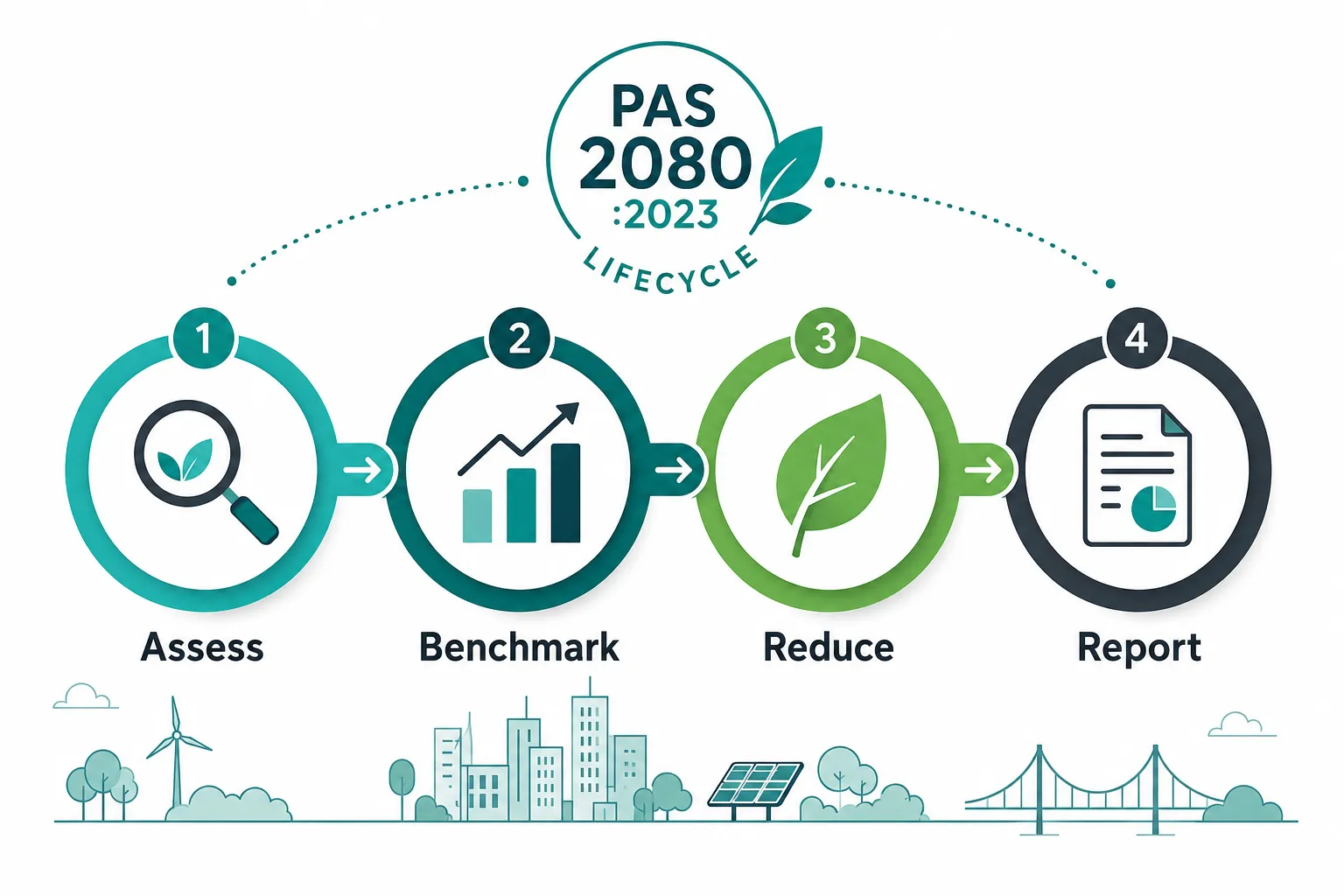
The standard works in four broad stages:
- Assess, Quantify whole-life carbon using recognised calculation methodologies, including energy modelling and lifecycle assessment (LCA) data for materials.
- Benchmark, Compare the building's carbon performance against sector benchmarks to identify where it sits relative to industry norms.
- Reduce, Identify and implement carbon reduction measures, prioritising interventions with the greatest impact at the lowest cost.
- Report, Document findings, decisions, and outcomes in a transparent, auditable format that can be shared with owners, investors, and valuers.
The 2023 revision strengthened requirements around embodied carbon reporting and aligned the standard more closely with the UK's net zero commitments. It also introduced clearer roles and responsibilities for different parties in the supply chain, including building owners, developers, and professional advisers.
For non-domestic properties, this matters because the standard provides the technical backbone for the RICS Whole Life Carbon Assessment Professional Standard, which became mandatory for RICS members from 1 July 2024.
How Do Carbon Assessments Affect Property Valuation in 2026?
Carbon assessments under PAS 2080:2023 now directly influence how chartered surveyors and valuers assess non-domestic properties. Since the RICS WLCA Professional Standard became mandatory, RICS-regulated valuers must consider whole-life carbon data when forming opinions of value for commercial assets.
In practical terms, this means:
- Valuation discounts are being applied to assets with high carbon intensity and no credible reduction plan. The discount reflects both the cost of future retrofitting and the risk of regulatory tightening.
- Green premiums are emerging for well-documented, low-carbon assets, particularly in the office and logistics sectors where occupier demand for sustainable space is strongest.
- Lender requirements are tightening. Several major UK commercial lenders now require carbon assessment data as part of due diligence for loans above certain thresholds.
The relationship is not purely theoretical. Investment funds operating under the EU Taxonomy, UK Sustainability Disclosure Requirements (SDR), and similar frameworks need underlying asset data to meet their own reporting obligations. A commercial property that cannot supply PAS 2080:2023-aligned carbon data is increasingly difficult to include in green-labelled funds, which limits the pool of potential buyers and, by extension, market value.
For landlords and investors reviewing their portfolios, understanding EPC ratings and MEES compliance alongside PAS 2080:2023 carbon data gives the most complete picture of valuation risk.
PAS 2080:2023 vs Other Carbon Assessment Standards
PAS 2080:2023 is not the only carbon assessment framework in use, but it is the most comprehensive and the one most directly embedded in UK professional practice for buildings.
| Standard | Scope | Who Uses It | Mandatory? |
|---|---|---|---|
| PAS 2080:2023 | Whole-life carbon, buildings and infrastructure | Developers, owners, valuers | Via RICS WLCA (from July 2024) |
| CIBSE TM65 | Embodied carbon in building services | M&E engineers | No |
| RIBA 2030 Climate Challenge | Operational and embodied targets | Architects | No (aspirational) |
| ISO 14064 | Organisational carbon accounting | Corporates | No |
| GHG Protocol | Corporate and project emissions | Broad corporate use | No |
The key distinction is that PAS 2080:2023 is specifically designed for the built environment lifecycle, whereas standards like ISO 14064 and the GHG Protocol operate at an organisational level and do not capture the granular, asset-level data that valuers need.
The RICS WLCA Professional Standard sits above PAS 2080:2023 in the professional hierarchy: it mandates that RICS members follow a consistent methodology for whole-life carbon assessments, and PAS 2080:2023 is the technical standard that underpins that methodology. In short, RICS sets the professional obligation; PAS 2080:2023 provides the technical "how."
Which Non-Domestic Properties Need PAS 2080:2023 Carbon Surveys?
PAS 2080:2023 applies most directly to non-domestic properties where RICS-regulated professionals are involved in valuation, development appraisal, or transaction advisory work. In 2026, the practical scope includes:
- New commercial developments above a certain size threshold where planning authorities require whole-life carbon statements.
- Major refurbishments of existing commercial assets, particularly where the project triggers a planning application.
- Investment-grade assets being acquired, refinanced, or included in regulated funds.
- Public sector buildings where government procurement policy requires PAS 2080:2023 alignment.
Smaller commercial properties, a single retail unit or a modest office suite, are less likely to require a full PAS 2080:2023 assessment unless they are part of a larger portfolio transaction or a development scheme. However, even for these assets, the data gathered during a building materials assessment as part of a standard building survey can feed into a future carbon assessment efficiently.
Choose a full PAS 2080:2023 assessment if: the property is being sold, refinanced, or developed; it is over 1,000 sq m GIA; or the owner has sustainability reporting obligations. For smaller assets, a desktop carbon screening may be sufficient as a first step.
How Much Does a PAS 2080:2023 Carbon Assessment Cost?
Costs vary considerably depending on the size, age, and complexity of the building, and whether the assessment is standalone or integrated into a wider building survey. Based on current market rates in 2026:
- Small commercial properties (under 500 sq m): desktop assessments may cost from approximately £2,000 to £5,000.
- Mid-size assets (500-5,000 sq m): a full PAS 2080:2023-aligned assessment typically ranges from £5,000 to £20,000.
- Large or complex assets (above 5,000 sq m, or mixed-use): costs can exceed £30,000, particularly where detailed embodied carbon modelling is required.
These are indicative figures based on surveyor fee schedules and published guidance; actual costs depend on data availability, the level of detail required, and whether specialist sub-consultants (such as structural engineers or M&E specialists) are needed.
Integrating carbon assessment work with a Level 3 Full Building Survey reduces overall cost, because much of the data gathering, construction type, materials, building services condition, overlaps between the two exercises.

What Happens If a Building Fails a PAS 2080:2023 Carbon Assessment?
There is no binary "pass or fail" under PAS 2080:2023. The standard is a management framework, not a compliance threshold. However, a carbon assessment that reveals high whole-life carbon intensity without a credible reduction plan carries serious commercial consequences.
Practical outcomes for a poorly performing asset include:
- Valuation reduction: the surveyor or valuer must reflect the cost of future carbon remediation in the assessed value.
- Reduced lender appetite: some commercial lenders apply higher loan-to-value restrictions or increased margins to assets with poor carbon profiles.
- Occupier resistance: major corporate tenants with their own net zero commitments may decline to lease space that undermines their Scope 3 reporting.
- Insurance implications: insurers are beginning to factor carbon risk into commercial property premiums, particularly for assets with energy-intensive systems.
The most important step after a poor result is to commission a carbon reduction roadmap, a prioritised schedule of interventions that demonstrates a credible pathway to improvement. This document can materially change how lenders and valuers treat the asset. For context on how building defects and environmental issues interact with value, see environmental issues in building surveys.
Common Mistakes in PAS 2080:2023 Building Surveys
Several recurring errors undermine the quality and commercial usefulness of carbon assessments on non-domestic properties.
Incomplete data at the outset. PAS 2080:2023 requires data on both operational energy and embodied carbon. Many assessments stall because owners cannot supply construction records, materials specifications, or energy consumption data. Gathering this information before commissioning the assessment saves time and cost.
Confusing operational EPC ratings with whole-life carbon. An EPC measures operational energy efficiency at a single point in time. PAS 2080:2023 covers the full lifecycle, including embodied carbon in future refurbishment works. A building with a good EPC may still have a high whole-life carbon figure if its construction involved carbon-intensive materials.
Using generic carbon factors instead of project-specific data. Generic factors from published databases are acceptable at early stages, but for investment-grade assessments, project-specific data produces more defensible results.
Failing to appoint a suitably qualified assessor. PAS 2080:2023 assessments require professionals with competence in lifecycle carbon assessment methodology. Not all building surveyors hold this competence, so it is worth confirming qualifications before appointment.
Treating the assessment as a one-off exercise. PAS 2080:2023 is designed as an iterative process. Assessments should be updated when the building undergoes significant change, not filed away after the initial transaction.
Do All Commercial Properties Need PAS 2080:2023 Compliance by 2026?
No statutory deadline currently requires all UK commercial properties to be PAS 2080:2023 compliant by 2026. However, the practical pressure to comply is growing from multiple directions simultaneously.
The RICS WLCA Professional Standard (mandatory from July 2024) means that any RICS-regulated professional involved in valuing or advising on a commercial asset must consider whole-life carbon. This does not automatically require a full PAS 2080:2023 assessment for every transaction, but it does mean carbon data is now a standard part of professional due diligence for significant assets.
Additionally, planning authorities in London and several other major UK cities have adopted policies requiring whole-life carbon assessments for major developments, referencing PAS 2080:2023 as the expected methodology.
For landlords with multiple assets, the practical answer is to prioritise: start with the highest-value assets, those approaching lease events, or those being considered for refinancing. A phased approach to statutory considerations in building surveys alongside carbon compliance work is more manageable than attempting portfolio-wide compliance simultaneously.
How to Prepare a Non-Domestic Property for PAS 2080:2023 Valuation
Preparation reduces cost, speeds up the assessment, and typically produces a better result.
Step 1: Gather existing documentation. Collect as-built drawings, materials specifications, energy consumption records (at least three years of utility data), and any previous EPC or BREEAM certificates.
Step 2: Commission a condition survey. A Level 3 Full Building Survey identifies the current condition of the building fabric and services, which informs the scope of future refurbishment works and therefore the embodied carbon of those works.
Step 3: Identify known deficiencies. Areas of further investigation flagged in a building survey, such as roof coverings, cladding systems, or M&E plant nearing end of life, directly affect the carbon assessment because replacement works carry embodied carbon costs. See areas of further investigation in building surveys for guidance.
Step 4: Appoint a qualified carbon assessor. Look for professionals with RICS membership and demonstrated competence in WLCA methodology, or specialist sustainability consultants with PAS 2080:2023 experience.
Step 5: Review the draft report before finalisation. Carbon assessments contain assumptions that owners can sometimes correct with better data, improving the outcome before the report is used in a transaction.
Who Is Responsible for Conducting PAS 2080:2023 Surveys?
Responsibility is shared across several professional roles, depending on the stage of the building's lifecycle.
- Chartered building surveyors typically lead the physical data-gathering exercise and coordinate with other specialists.
- Sustainability consultants or carbon assessors with lifecycle assessment expertise carry out the quantitative modelling.
- RICS-regulated valuers interpret the carbon data as part of their valuation opinion under the WLCA Professional Standard.
- Building owners and asset managers are responsible for supplying accurate operational data and commissioning assessments at appropriate intervals.
For complex assets, a multidisciplinary team is normal. The building owner or their appointed project manager should clarify roles and responsibilities in writing before the assessment begins to avoid gaps in the data-gathering process.
How Does PAS 2080:2023 Impact Property Insurance and Mortgages?
Carbon performance under PAS 2080:2023 is beginning to affect both insurance and lending decisions for non-domestic properties, though the market is still evolving in 2026.
Insurance: Commercial property insurers are increasingly factoring climate-related risk into underwriting decisions. A building with energy-intensive systems, poor insulation, or a high carbon intensity profile may attract higher premiums or more restrictive cover terms, particularly if it sits in a climate-vulnerable location.
Commercial mortgages and refinancing: Several UK commercial lenders have introduced green lending products that offer preferential rates for assets meeting defined sustainability criteria, including carbon performance benchmarks. Conversely, assets with poor carbon profiles and no improvement plan are facing tighter lending conditions. This mirrors the dynamic already seen in the residential sector, where EPC ratings influence mortgage availability.
For landlords planning to refinance, commissioning a PAS 2080:2023 assessment and carbon reduction roadmap before approaching lenders strengthens the negotiating position and may unlock better loan terms.
Frequently Asked Questions
What is the difference between PAS 2080:2023 and an EPC?
An EPC measures a building's operational energy efficiency at a single point in time using a standardised calculation. PAS 2080:2023 covers the entire building lifecycle, including embodied carbon in materials and construction, making it a far more comprehensive measure of a building's total carbon impact.
Is PAS 2080:2023 a legal requirement for commercial properties in 2026?
It is not a direct statutory requirement for all commercial properties. However, it is embedded in RICS professional standards (mandatory for RICS members from July 2024) and is required by planning policy for major developments in many UK local authorities.
Can a PAS 2080:2023 carbon assessment result be challenged or revised?
Yes. The standard is iterative. If better data becomes available, for example, more accurate materials specifications or measured energy consumption data, the assessment can be updated. There is no formal appeals process, but engaging the assessor with additional evidence before the report is finalised is always advisable.
How long does a PAS 2080:2023 assessment take?
For a straightforward commercial building with good data availability, a desktop assessment may take two to four weeks. A full assessment for a large or complex asset, including site visits and detailed modelling, can take two to four months. See building survey timeframes for related guidance on survey scheduling.
Does PAS 2080:2023 apply to listed buildings or conservation area properties?
Yes, the standard applies to all building types, including listed buildings. However, the carbon reduction options available for listed buildings are constrained by heritage consent requirements, which the assessor must factor into the reduction roadmap. For more on heritage considerations, see listed buildings and conservation areas.
Who owns the PAS 2080:2023 carbon assessment report?
The building owner or the commissioning party typically owns the report. In a transaction context, the scope of reliance, who can rely on the report and for what purpose, should be agreed in writing with the assessor before the work begins.
Conclusion
PAS 2080:2023 carbon assessments have moved from a niche sustainability exercise to a mainstream component of non-domestic property due diligence in 2026. The mandatory RICS WLCA Professional Standard means that carbon data is now formally embedded in how RICS-regulated professionals value and advise on commercial assets. Properties with high carbon intensity and no credible reduction plan face valuation discounts, tighter lending terms, and growing occupier resistance.
Actionable next steps for property owners and professionals:
- Audit your existing data, construction records, energy consumption, and materials specifications, before commissioning an assessment.
- Integrate carbon assessment work with a full building survey to reduce cost and improve data quality.
- Appoint a qualified assessor with demonstrable PAS 2080:2023 competence and RICS-aligned methodology.
- Produce a carbon reduction roadmap alongside the assessment to protect and potentially enhance asset value.
- Review the implications for any upcoming lease events, refinancing, or disposals and factor carbon performance into your timeline.
For professional guidance on building surveys that support PAS 2080:2023 compliance, explore building survey services from a qualified chartered surveyor.
.cg-wrap{font-family:Arial,sans-serif;max-width:560px;margin:2rem auto;background:#f4f8fb;border-radius:10px;padding:1.5rem;box-sizing:border-box}
.cg-wrap h3{margin:0 0 .75rem;font-size:1.1rem;color:#1a2e44}
.cg-q{margin-bottom:.9rem}
.cg-q p{font-size:.9rem;color:#2c3e50;margin:0 0 .4rem;font-weight:600}
.cg-q label{display:block;font-size:.85rem;color:#3a3a3a;cursor:pointer;padding:.2rem 0}
.cg-q input{margin-right:.4rem}
.cg-btn{background:#1a6eb5;color:#fff;border:none;padding:.6rem 1.4rem;border-radius:6px;font-size:.9rem;cursor:pointer;margin-top:.5rem}
.cg-btn:hover{background:#145a94}
.cg-result{margin-top:1rem;padding:.9rem;border-radius:7px;font-size:.88rem;line-height:1.5;display:none}
.cg-high{background:#fff3cd;border-left:4px solid #e6a817;color:#5a3e00}
.cg-med{background:#d4edda;border-left:4px solid #28a745;color:#155724}
.cg-low{background:#cce5ff;border-left:4px solid #1a6eb5;color:#004085}
PAS 2080:2023 Readiness Checker
Answer 4 quick questions to gauge your non-domestic property’s carbon assessment readiness.
1. Do you have 3+ years of energy consumption records?
2. Do you have as-built drawings or materials specifications?
3. Has the property had a Level 3 Building Survey in the last 5 years?
4. Is a sale, refinance, or major refurbishment planned within 12 months?