

Over £850,000 in negotiating damages was awarded to just two residential leaseholders in a single London rights-of-light case — a stark signal that the financial stakes of poorly managed party wall and neighbourly disputes have never been higher. As the UK's "build, build, build" agenda accelerates urban densification in 2026, surveyors are operating in a landscape where procedural precision and interpersonal skill are equally critical. Party Wall Surveys in 2026 Urban Renewal: Managing High-Demand Disputes and Neighbour Relations is no longer a niche specialism — it is a frontline discipline shaping how cities grow. [2]
Key Takeaways 📌
- The UK's urban renewal drive is generating a sharp rise in party wall disputes, rights-of-light claims, and nuisance actions across 2026.
- Statutory notice protocols and award timelines under the Party Wall etc. Act 1996 remain the primary legal framework — and non-compliance carries serious consequences.
- The Cooper v Ludgate House Ltd Supreme Court ruling has reset how damages in rights-of-light cases are calculated, with major implications for surveyors advising on adjoining owner rights.
- Pre-construction investigations are consistently identified as the most effective way to prevent costly redesigns and accidents.
- Conflict resolution skills — not just technical surveying knowledge — are increasingly decisive in high-demand urban environments.
The 2026 Urban Renewal Surge: Why Dispute Volumes Are Rising
The UK government's commitment to building 1.5 million new homes, combined with large-scale commercial regeneration, has transformed the workload profile of party wall surveyors. Cities from Manchester to London are experiencing construction booms that bring adjacent properties into direct conflict with one another on an almost daily basis. [4]
💬 "Rights of light, party wall issues, nuisance claims, and restrictive covenant claims are all expected to come to the fore in 2026 as major sources of neighbourly disputes." — Ashurst Commercial Real Estate Disputes Review [2]
Manchester alone is seeing billions of pounds flow into urban renewal schemes across Northern England, with mixed-use developments stacking residential, commercial, and retail uses on plots that sit cheek-by-jowl with existing occupied properties. [4] This density creates the perfect conditions for party wall friction — shared foundations, excavations near boundary lines, and new structures that alter light, noise, and vibration for neighbours.
Key drivers of increased dispute volumes in 2026:
| Driver | Impact on Party Wall Work |
|---|---|
| Government housing targets | More excavation and extension notices |
| Mixed-use densification | Complex multi-party award scenarios |
| Retrofit and EPC upgrades | Structural alterations triggering Act obligations |
| Rights-of-light litigation | Adjoining owners more aware of compensation rights |
| Building Safety Act cladding remediation | Overlapping statutory regimes on shared structures |
Understanding the consequences of ignoring the Party Wall Act has become essential knowledge not just for building owners but for every surveyor advising on urban development projects.
Notice Protocols: Getting the Procedural Foundation Right
Serving Valid Notices — The Non-Negotiable First Step
The Party Wall etc. Act 1996 creates a clear procedural pathway, but it is only as strong as the notices that initiate it. In high-volume urban renewal contexts, rushed or defective notices are one of the most common causes of disputes escalating unnecessarily.
Three types of notice apply depending on the work:
- Party Structure Notice — for works to an existing party wall or floor (minimum 2 months' notice)
- Line of Junction Notice — for new walls built on or astride the boundary (minimum 1 month's notice)
- Notice of Adjacent Excavation — for excavations within 3 or 6 metres of a neighbouring structure (minimum 1 month's notice)
Each notice must include the building owner's name and address, a description of the proposed works, and the proposed start date. Errors in any of these elements can invalidate the notice and restart the clock — a costly delay in fast-moving urban renewal programmes.
⚠️ Pro tip for surveyors: In 2026's high-demand environment, serve notices earlier than the statutory minimum wherever possible. Adjoining owners are increasingly legally aware and more likely to dissent, triggering the appointment process.
What Happens When Adjoining Owners Dissent?
When an adjoining owner dissents — or fails to respond within 14 days — a dispute is deemed to have arisen. At this point, each party must appoint a surveyor, or agree to appoint a single agreed surveyor. The appointed surveyors then select a third surveyor to act as referee if needed.
In urban renewal contexts with multiple adjoining owners, this can quickly become a multi-party appointment matrix. Surveyors managing party wall awards in these scenarios need strong project management skills alongside their technical expertise.
Research consistently shows that insufficient pre-construction investigations of existing party walls lead to redesigns, structural accidents, and significant programme delays — making thorough early surveying not just good practice but a commercial necessity. [3]
Award Timelines and Conflict Resolution in High-Demand Environments
Managing Award Timelines Under Pressure
The party wall award is the legal document that governs how works are carried out. It records the condition of the adjoining property before works begin (via a Schedule of Condition), sets out the permitted works, and establishes the rights and obligations of both parties.
In 2026's high-demand urban renewal climate, award timelines are under pressure from multiple directions:
- Developers want to start on site as quickly as possible
- Adjoining owners are increasingly seeking detailed technical reviews before agreeing
- Surveyors face heavier caseloads, reducing availability for site inspections
- Courts are seeing more challenges to awards, adding uncertainty
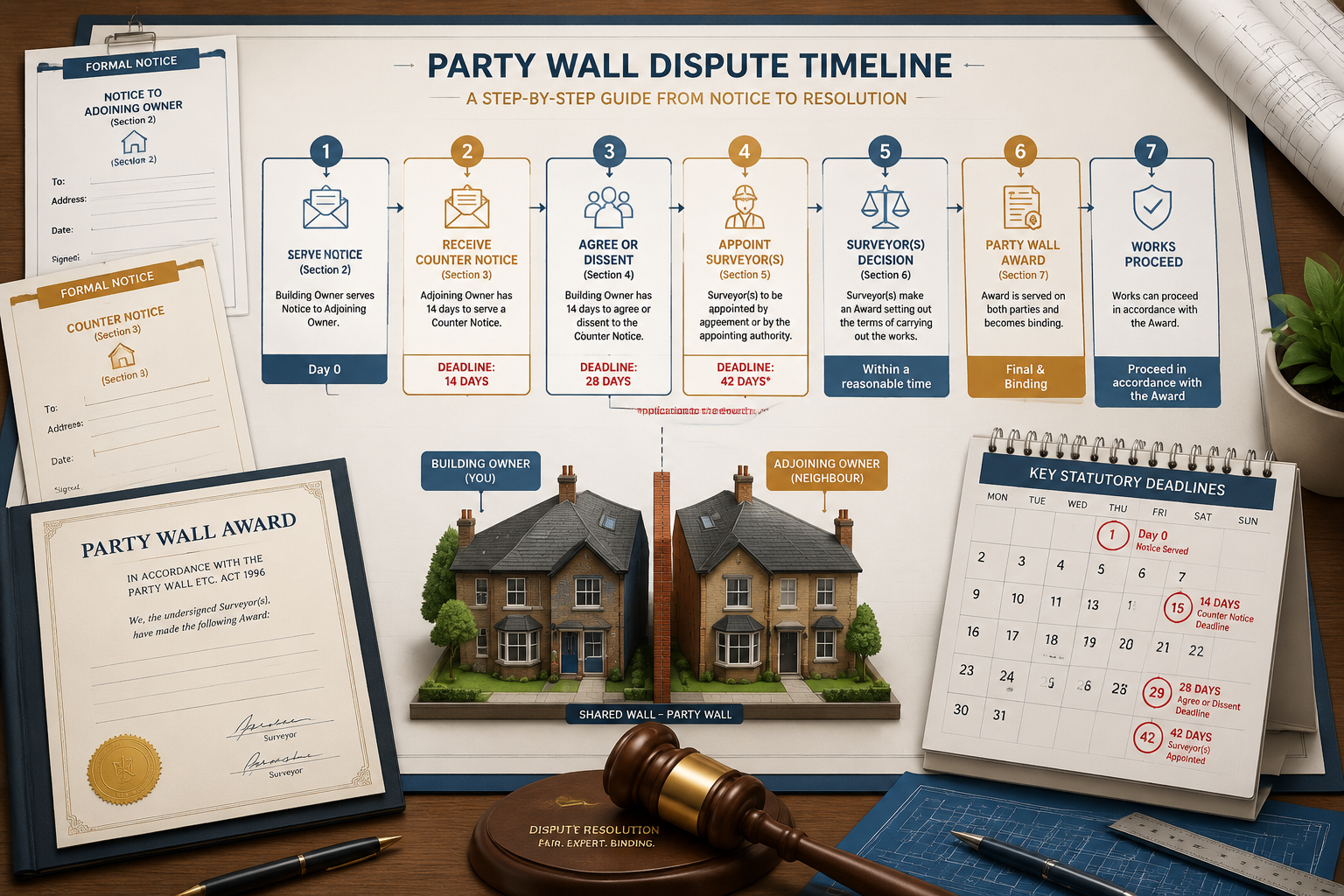
Typical party wall award timeline in an urban renewal context:
Notice served → 14 days for response → Dissent received
→ Surveyors appointed (both parties) → Third surveyor selected
→ Schedule of Condition prepared → Award drafted and agreed
→ Award served on both parties → 14-day appeal window
→ Works commence
This process can take 6–12 weeks in straightforward cases. Complex urban renewal projects involving basement excavations or multi-storey extensions can extend this to 4–6 months. For guidance on the specific requirements of basement projects, the party wall surveyor considerations for basement works provide a detailed breakdown of the additional complexities involved.
Similarly, loft conversions — one of the most common urban renewal works in dense residential areas — carry their own specific obligations. Understanding whether party wall agreements are required for loft conversions is a question surveyors are fielding with increasing frequency in 2026.
Conflict Resolution: The Human Side of Party Wall Work
Technical competence gets a surveyor to the table. Conflict resolution skills determine what happens there.
Common sources of interpersonal conflict in 2026 party wall disputes:
- 🏗️ Noise and disruption anxiety — adjoining occupiers worried about quality of life during long urban renewal programmes
- 💰 Compensation expectations — heightened by high-profile cases like Cooper v Ludgate House Ltd [2]
- 🔍 Distrust of the process — adjoining owners unfamiliar with the Act assuming the surveyor acts only for the developer
- 📋 Scope creep concerns — fears that approved works will expand beyond what was notified
Effective surveyors in 2026 are deploying a range of conflict resolution approaches:
| Approach | When to Use |
|---|---|
| Early informal engagement | Before formal notice, to reduce dissent likelihood |
| Plain-language explanations | When adjoining owners are unfamiliar with the Act |
| Independent third surveyor referral | When appointed surveyors cannot agree on award terms |
| Mediation (non-statutory) | For disputes involving multiple overlapping claims |
| Detailed Schedule of Condition | To pre-empt damage claims after works complete |
The party wall drawings that accompany an award are often a powerful communication tool — clear, annotated drawings help adjoining owners understand exactly what is proposed, reducing anxiety and the likelihood of last-minute objections.
The Legal Landscape Reshaping Party Wall Surveys in 2026 Urban Renewal: Managing High-Demand Disputes and Neighbour Relations
Cooper v Ludgate House Ltd: A Landmark Ruling
The 2025 Supreme Court decision in Cooper v Ludgate House Ltd has sent ripples through every aspect of neighbourly dispute work in 2026. Two residential leaseholders at Bankside Yards in London were awarded £850,000 in negotiating damages after the construction of the Arbor office block caused substantial loss of light to their flats — rather than receiving an injunction to halt the development. [2]
The ruling is significant for party wall surveyors for several reasons:
- The Waldram method was endorsed as the preferred approach for assessing interference with light, superseding newer radiance software methods. [2]
- Damages are now calculated using a hypothetical reasonable release fee model, incorporating a share of development value tempered by property value and development risk. [2]
- Section 203 of the Housing and Planning Act 2016 — which allows local authorities to override certain land rights — was confirmed as a powerful tool for developers working with councils on regeneration schemes. When invoked, the remedy for affected neighbours is limited to statutory compensation based on diminution in value only, with no injunction or negotiating damages available. [2]
💬 "The practical significance of section 203 cannot be overstated for urban renewal developers working alongside local authorities in 2026."
For surveyors advising adjoining owners in regeneration zones, understanding whether a local authority has invoked — or intends to invoke — section 203 is now a critical early step in any rights-of-light or party wall assessment.
Building Safety Act and EPC Changes: Overlapping Regimes
The Almacantar Centre Point case, currently before the Court of Appeal, will determine whether Building Safety Act cladding remediation obligations apply only to specific "relevant defects" or a much wider class of buildings and repair works. [2] The outcome will directly affect how surveyors assess shared structures in mixed-tenure urban renewal schemes.
Meanwhile, changes to EPC metrics expected in the second half of 2026 are likely to trigger a new wave of retrofit works — many of which will involve alterations to party walls and shared structures, generating fresh notice and award obligations. [2]
Surveyors advising on urban renewal projects should also be aware of structural engineering considerations that frequently intersect with party wall work, particularly where foundation reinforcement or underpinning is involved.
Practical Guidance: Managing Party Wall Surveys in 2026 Urban Renewal: Managing High-Demand Disputes and Neighbour Relations
A Step-by-Step Framework for High-Demand Urban Projects
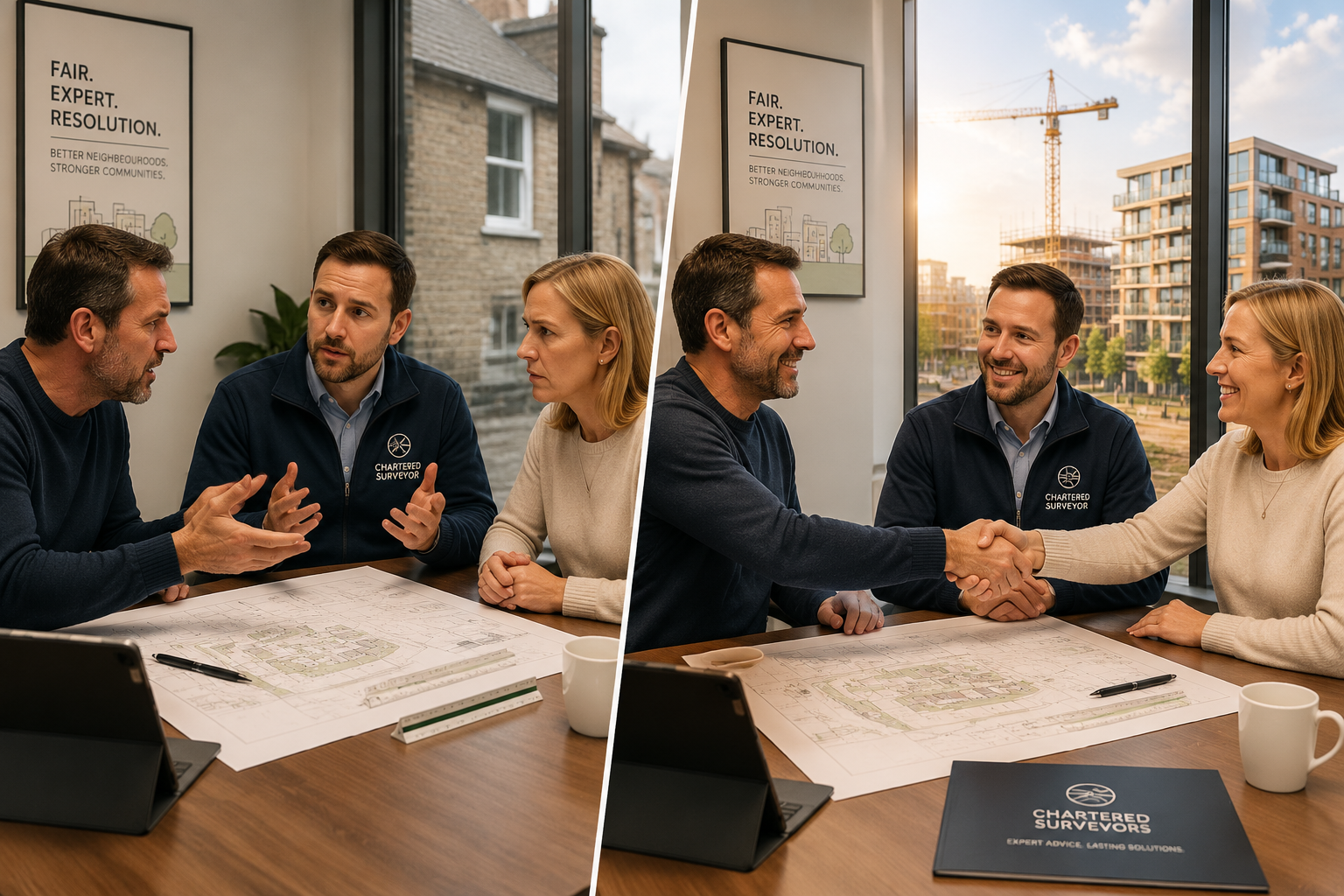
The following framework is designed for surveyors managing party wall work in active urban renewal environments where dispute volumes are elevated and timelines are compressed.
Phase 1: Pre-Notice Investigation 🔍
- Conduct a thorough desk study of existing party wall conditions, previous works, and any existing awards
- Check for section 203 invocations or local authority regeneration designations
- Identify all adjoining owners — including leaseholders and freeholders — who require notice
- Commission structural engineering advice where foundation or excavation works are proposed
Phase 2: Notice Service 📋
- Serve notices well ahead of statutory minimums — aim for 3 months where programme allows
- Use plain English covering letters alongside statutory notices
- Offer an informal briefing to adjoining owners before the formal response period
Phase 3: Appointment and Award ⚖️
- Act impartially at all times — even when appointed by the building owner
- Prepare a detailed Schedule of Condition with photographic evidence
- Set realistic timelines for award completion and communicate these clearly to both parties
Phase 4: During Works 🏗️
- Establish a clear point of contact for adjoining owner concerns
- Conduct regular site inspections to confirm works comply with the award
- Document any variations to the approved works immediately
Phase 5: Post-Completion ✅
- Carry out a post-completion inspection against the Schedule of Condition
- Resolve any damage claims promptly and in accordance with the award
- Retain all documentation for the statutory limitation period
When Disputes Escalate: Using the Third Surveyor
The third surveyor mechanism is one of the Party Wall Act's most effective but underused tools. In 2026's high-dispute environment, surveyors should be more willing to refer unresolved matters to the third surveyor rather than allowing disputes to drift.
Matters suitable for third surveyor referral include:
- Disagreements on the scope of works to be included in the award
- Disputes over the adequacy of the Schedule of Condition
- Conflicting expert opinions on structural risk
- Disagreements on costs and fees
The third surveyor's decision is binding on both appointed surveyors and both parties, subject only to a court appeal within 14 days.
Conclusion: Navigating the Party Wall Landscape in 2026
Party Wall Surveys in 2026 Urban Renewal: Managing High-Demand Disputes and Neighbour Relations demands a dual expertise — rigorous procedural knowledge and genuine interpersonal skill. The legal landscape has shifted significantly, with landmark rulings recalibrating how damages are assessed and how local authority powers interact with private rights. Construction volumes are at levels that will only increase dispute frequency.
Actionable Next Steps for Surveyors 🎯
- Update your rights-of-light knowledge in light of Cooper v Ludgate House Ltd — particularly the Waldram method and hypothetical release fee model.
- Review your notice templates to ensure they are legally robust and written in plain English for adjoining owners.
- Build pre-construction investigation into every urban renewal instruction as a non-negotiable first step — not an optional extra.
- Develop conflict resolution protocols for multi-party urban renewal projects where multiple adjoining owners are involved simultaneously.
- Stay ahead of EPC and Building Safety Act changes expected in the second half of 2026, which will generate new categories of party wall obligation.
- Use the third surveyor mechanism proactively — it exists precisely for high-pressure, high-dispute environments like today's urban renewal landscape.
The surveyors who thrive in 2026's urban renewal environment will be those who combine statutory precision with the communication skills to keep neighbours on side — turning potential disputes into managed, documented, and resolved processes that protect everyone involved.
References
[1] Party Wall Surveys For Mixed Use Developments Tackling Zoning And Neighbour Disputes In 2026 Urban Revivals – nottinghillsurveyors.com
[2] Commercial Real Estate Disputes In 2026 Whats Coming Into View – ashurst.com
[3] (ASCE)LA.1943-4170.0000496 – ascelibrary.org
[4] Party Wall Surveys For Manchester Renewal Projects Managing Agreements In Northern Englands 2026 Growth Surge – nottinghillsurveyors.com