

As Britain's urban landscape transforms to address the housing crisis, office-to-residential conversions under Permitted Development Rights (PDR) have surged dramatically in 2026. These high-volume projects present unique challenges for surveyors navigating party wall obligations in densely built commercial districts. With thousands of office buildings being converted into residential units, understanding Party Wall Surveys for Office-to-Resi PDR Expansions: RICS Protocols for 2026 Permitted Development Conversions has become essential for developers, building owners, and construction professionals alike.
The complexity intensifies when conversion works impact shared walls between properties. Unlike traditional residential extensions, office-to-resi conversions often involve substantial structural alterations, new service installations, and acoustic upgrades—all requiring careful coordination with adjoining owners. RICS protocols provide the framework for managing these relationships professionally while protecting all parties' interests.
Key Takeaways
✅ PDR conversions require full Party Wall Act compliance despite simplified planning—notices must be served for structural alterations, new openings, and works affecting shared walls
✅ RICS protocols mandate comprehensive pre-condition surveys with photographic records and vibration monitoring to protect both converting and adjoining properties
✅ Early engagement prevents costly disputes—serving notices 2+ months before work begins allows time for surveyor appointments and schedule of condition agreements
✅ Acoustic and fire safety upgrades in office-to-resi conversions typically trigger Party Wall Act Section 2 requirements when affecting party walls
✅ Agreed surveyor appointments streamline the process and reduce costs for multi-property PDR conversion projects in commercial districts
Understanding Party Wall Obligations in PDR Office Conversions
What Makes Office-to-Resi Conversions Different?
Office-to-residential conversions under Permitted Development Rights represent a distinct category of building work. While PDR removes certain planning restrictions, it does not waive Party Wall Act 1996 obligations. This critical distinction catches many developers off-guard.
Commercial buildings typically feature different construction methods than residential properties. Party walls in office blocks may support heavier floor loads, contain shared service risers, or have minimal acoustic separation—adequate for offices but insufficient for residential use. When converting these spaces, developers must address:
- Structural modifications to accommodate residential layouts
- New penetrations for plumbing, heating, and ventilation systems
- Acoustic upgrades to meet Building Regulations Part E
- Fire compartmentation improvements for residential safety standards
- Façade alterations including new windows or balconies
Each of these works potentially triggers Party Wall Act requirements, making party wall surveys essential from the project's inception.
The Three Key Party Wall Act Sections for PDR Conversions
Section 1: New Walls on Boundary Lines
Rarely applicable to office conversions unless creating new party walls during subdivision of large floor plates.
Section 2: Works to Existing Party Walls
The most relevant section for PDR conversions. This covers:
- Cutting into party walls for new doorways or service penetrations
- Underpinning shared foundations
- Raising party walls to accommodate new floor levels
- Installing damp-proof courses or insulation within party structures
- Demolishing and rebuilding party walls
Section 6: Excavations Near Adjoining Properties
Applies when basement conversions or foundation work occurs within 3-6 meters of neighboring buildings, depending on depth.
"The expansion of office-to-residential PDR schemes has created unprecedented demand for party wall expertise in commercial districts. Surveyors must adapt traditional residential protocols to the unique challenges of multi-story commercial conversions." — RICS Building Surveying Practice
Common Triggering Works in Office-to-Resi Projects
🔧 Structural alterations: Removing columns, adding steel beams, or modifying floor structures
🔧 Service installations: New soil stacks, heating systems, or electrical risers penetrating party walls
🔧 Acoustic treatments: Installing resilient bars, independent stud walls, or upgraded insulation
🔧 Fire safety upgrades: Creating fire-rated compartments or upgrading party wall fire resistance
🔧 Façade modifications: Installing balconies or bay windows that affect party wall stability
Understanding party wall agreements and what you must know becomes crucial as these projects scale across multiple adjoining properties.
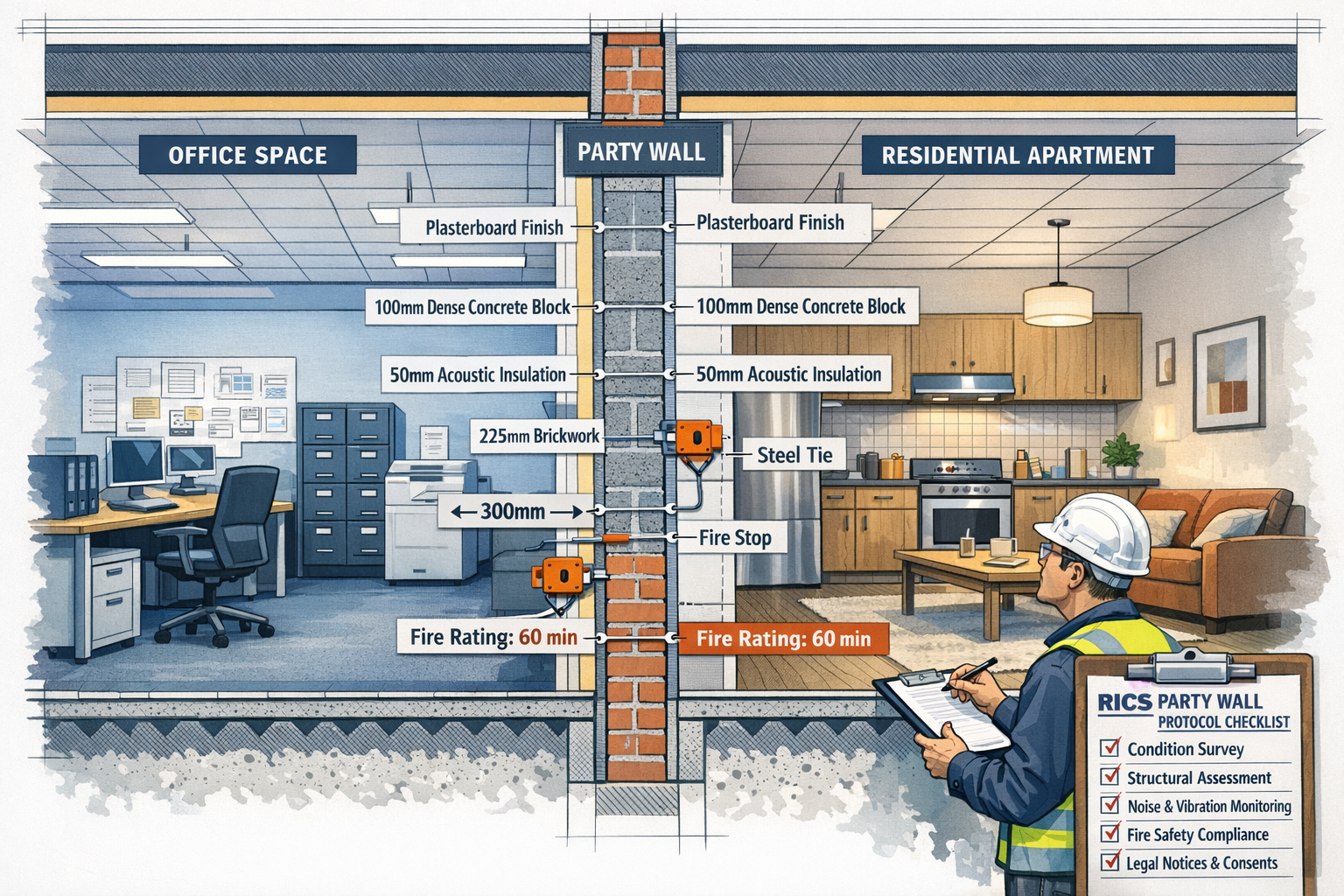
RICS Protocols for Party Wall Surveys in 2026 PDR Projects
Pre-Conversion Assessment Requirements
RICS guidance emphasizes proactive surveying before conversion works commence. This approach aligns with broader industry trends toward quality assurance in building projects [2]. For office-to-resi PDR conversions, pre-conversion assessments should include:
Building Condition Survey
Document existing conditions of the party wall and adjoining properties through:
- Detailed photographic records (internal and external)
- Crack monitoring with dated photographs and measurements
- Structural assessment of party wall integrity
- Identification of existing defects or maintenance issues
- Review of original construction methods and materials
Acoustic Testing Baseline
Establish pre-conversion noise transmission levels to:
- Measure existing sound insulation performance
- Identify areas requiring acoustic upgrades
- Set benchmarks for post-conversion compliance testing
- Document ambient noise levels in adjoining properties
Vibration Monitoring Setup
Install monitoring equipment before works begin:
- Seismograph sensors on party walls and sensitive areas
- Baseline vibration readings during normal conditions
- Alert thresholds based on building age and construction type
- Continuous monitoring protocols during high-impact works
These comprehensive surveys protect all parties and provide objective evidence should disputes arise. The protocols mirror approaches used in [high-rise remediation projects where building safety is paramount][3].
Notice Procedures Specific to PDR Conversions
Serving correct notices under the Party Wall Act is mandatory, not optional. For office-to-resi conversions, the process involves:
Timeline Requirements
- Two months' notice for Section 2 works (works to existing party walls)
- One month's notice for Section 6 works (excavations)
- Additional time for surveyor appointments if disputes arise
Notice Content Must Include
✉️ Clear description of proposed conversion works
✉️ Detailed drawings showing party wall locations and affected areas
✉️ Schedule of works with estimated durations
✉️ Contact information for the building owner and their surveyor
✉️ Explanation of adjoining owners' rights under the Act
Multi-Property Considerations
Office buildings often share party walls with multiple adjoining properties. A single conversion may require serving notices to:
- Businesses in adjacent commercial units
- Residential properties in neighboring buildings
- Owners of properties above or below (in mixed-use developments)
- Freeholders and leaseholders where applicable
Professional surveyors recommend serving notices 3-4 months before planned start dates for complex PDR conversions, allowing adequate time for responses and surveyor appointments.
Surveyor Appointment Strategies
When adjoining owners receive party wall notices, they have three options:
- Consent to the works in writing
- Dissent and appoint their own surveyor
- Take no action (deemed dissent after 14 days)
For large-scale PDR conversion projects, the agreed surveyor approach offers significant advantages:
Benefits of Agreed Surveyor Appointments
💰 Cost efficiency: Single surveyor fee instead of multiple appointments
⏱️ Faster resolution: Streamlined decision-making process
🤝 Reduced conflict: Impartial professional managing all parties' interests
📋 Consistent standards: Uniform approach across multiple adjoining properties
When Separate Surveyors Are Necessary
- Complex structural works with significant risk
- High-value properties where independent representation is preferred
- Existing disputes or contentious relationships
- Works affecting residential properties where homeowners want dedicated representation
The appointed surveyor(s) must produce a Party Wall Award—a legally binding document that:
- Describes the works in detail
- Sets conditions for execution
- Establishes monitoring protocols
- Defines dispute resolution procedures
- Allocates costs between parties
Professional party wall awards should be prepared by RICS-accredited surveyors with specific experience in commercial-to-residential conversions.
Condition Surveys and Documentation Standards
Schedule of Condition Requirements
RICS protocols demand thorough documentation before conversion works begin:
| Documentation Element | Minimum Standard | Best Practice |
|---|---|---|
| Photography | Color photos of all visible defects | 360° coverage with timestamped images |
| Crack Monitoring | Width measurements with tell-tales | Digital monitoring with automated alerts |
| Structural Assessment | Visual inspection by qualified surveyor | Structural engineer review with calculations |
| Services Documentation | Location of visible pipes/cables | Thermal imaging and service tracing |
| External Envelope | Ground-level photography | Drone surveys for upper floors |
Party wall drawings should clearly indicate:
- Exact party wall locations and ownership boundaries
- Proposed penetrations and their dimensions
- Structural support details for new openings
- Fire and acoustic treatment specifications
- Temporary works and access arrangements
Digital Documentation Tools
Modern surveying in 2026 leverages technology for enhanced accuracy:
- 3D laser scanning for precise dimensional records
- Drone surveys for inaccessible façade areas
- Building Information Modeling (BIM) integration
- Cloud-based documentation for real-time sharing
- Digital signature platforms for award execution
These tools align with RICS's emphasis on professional standards and quality assurance in building projects [2].
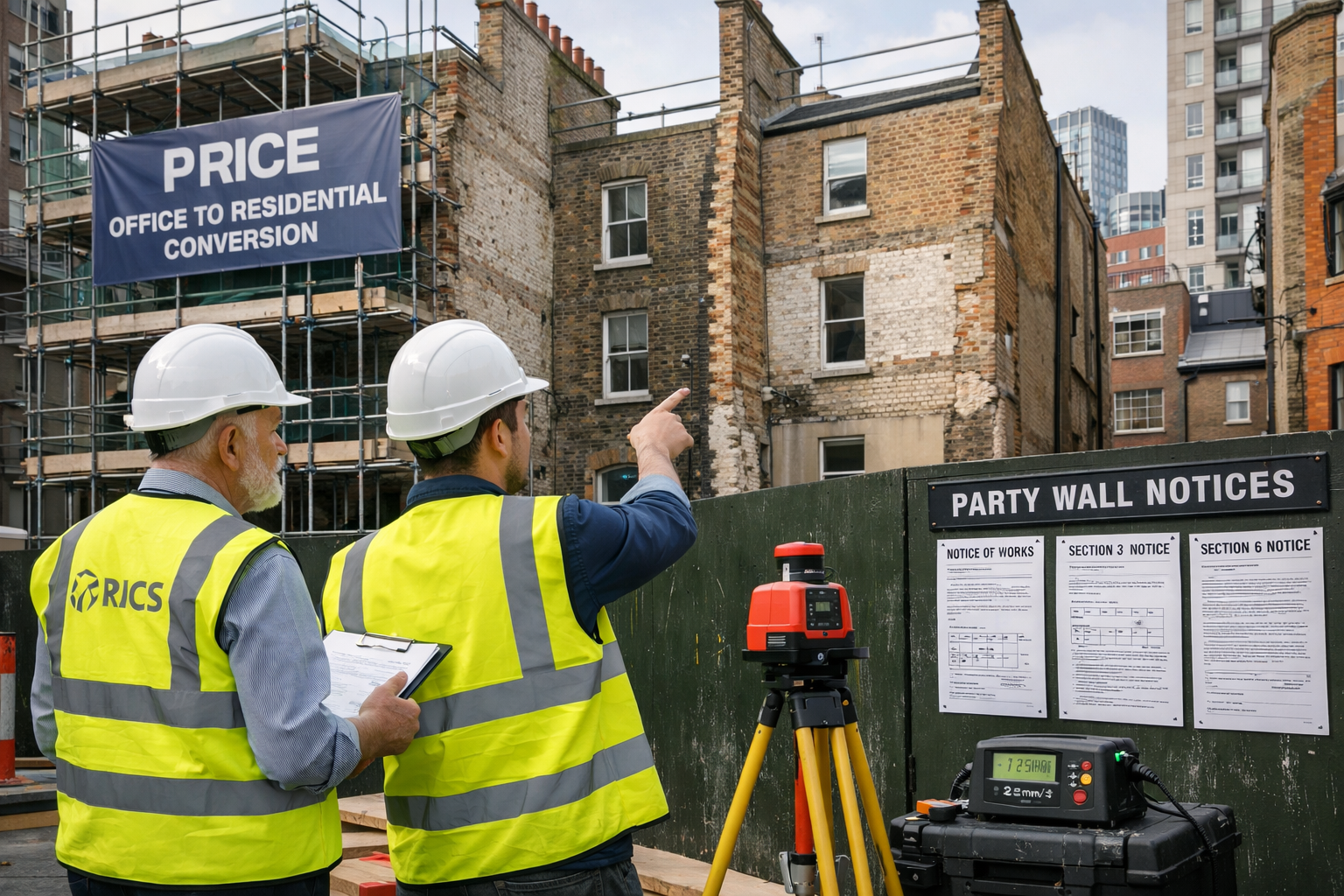
Managing Construction Phase Compliance and Dispute Prevention
Vibration and Structural Monitoring Protocols
Office-to-residential conversions often involve high-impact works that can affect adjoining properties. RICS protocols mandate continuous monitoring during sensitive operations:
Monitoring Equipment Setup
- Seismographs on party walls at multiple levels
- Tilt sensors for monitoring structural movement
- Crack gauges across existing fissures
- Acoustic monitors to track noise transmission
- Dust sensors for environmental protection
Alert Thresholds and Response Procedures
Monitoring systems should trigger alerts when:
- Vibration exceeds 10mm/s peak particle velocity (PPV) for residential structures
- Structural movement exceeds 5mm in any direction
- Existing cracks widen by more than 2mm
- Noise levels exceed 75dB during agreed working hours
When thresholds are breached, protocols require:
- Immediate work cessation in the affected area
- Surveyor notification within 2 hours
- Joint inspection within 24 hours
- Remedial action plan before work resumes
- Enhanced monitoring for remainder of project
Documentation Requirements
Contractors must maintain:
- Daily monitoring reports with timestamped readings
- Photographic evidence of working methods
- Incident logs for any threshold breaches
- Correspondence records with adjoining owners
- Compliance certificates for completed stages
This rigorous approach prevents the escalation of minor issues into costly disputes, protecting both developers and neighboring property owners.
Acoustic Compliance in Mixed-Use Buildings
Converting offices to residential use creates unique acoustic challenges. Commercial buildings rarely meet Building Regulations Part E standards for residential sound insulation. Party Wall Surveys for Office-to-Resi PDR Expansions: RICS Protocols for 2026 Permitted Development Conversions must address:
Airborne Sound Insulation
Party walls must achieve minimum 45dB DnT,w (weighted standardized level difference):
- Independent stud walls with acoustic insulation
- Resilient bars and acoustic plasterboard
- Sealed penetrations around services
- Acoustic sealant at all junctions
Impact Sound Insulation
Floor/ceiling assemblies require 62dB L'nT,w maximum:
- Floating floors with resilient layers
- Acoustic ceiling treatments
- Isolated services to prevent flanking transmission
- Vibration-isolated fixtures and fittings
Testing and Verification
Post-conversion acoustic testing must:
- Be conducted by qualified acoustic consultants
- Follow UKAS-accredited procedures
- Test representative sample units
- Document compliance for Building Control
When acoustic upgrades affect party walls, they trigger Party Wall Act requirements. Surveyors must coordinate with acoustic engineers to ensure treatments don't compromise structural integrity or fire safety.
Dispute Resolution Mechanisms
Despite best efforts, disputes may arise during PDR conversions. RICS protocols provide structured resolution pathways:
Informal Resolution (First Step)
- Direct communication between building owners
- Site meetings with appointed surveyors
- Review of party wall award conditions
- Negotiated adjustments to working methods
Formal Dispute Process
If informal resolution fails:
- Third surveyor appointment: Neutral professional selected by the two appointed surveyors
- Evidence submission: Both parties present documentation and expert opinions
- Site inspection: Third surveyor assesses conditions firsthand
- Determination: Binding decision issued within agreed timeframe
- Award amendment: Updated party wall award incorporating resolution
Common Dispute Triggers in PDR Conversions
⚠️ Excessive vibration or structural movement
⚠️ Works exceeding scope described in original notice
⚠️ Inadequate protection of adjoining property
⚠️ Failure to repair damage caused by conversion works
⚠️ Disputes over cost allocation and fee responsibility
Cost Implications
The Party Wall Act requires building owners (developers) to bear:
- Reasonable costs of adjoining owners' surveyors
- Third surveyor fees if disputes escalate
- Remedial works for damage caused
- Enhanced monitoring if required
Professional surveyors emphasize prevention over resolution—thorough planning, clear communication, and rigorous compliance typically avoid disputes entirely.
Working Hours and Access Arrangements
PDR conversions in commercial districts must balance construction efficiency with adjoining owners' rights:
Standard Working Hours
Most party wall awards specify:
- Weekdays: 8:00 AM to 6:00 PM
- Saturdays: 8:00 AM to 1:00 PM
- Sundays and Bank Holidays: No noisy works
Access Rights Under the Act
Section 8 of the Party Wall Act grants building owners limited access to adjoining properties for:
- Executing works described in the award
- Inspecting party walls during construction
- Making good damage caused by the works
Access must be:
- Reasonable: Minimal disruption to adjoining occupiers
- Pre-arranged: Minimum 14 days' written notice
- Supervised: Accompanied by the adjoining owner or their representative
- Documented: Photographic records of conditions before and after
For occupied commercial premises, access arrangements require careful coordination to avoid business disruption. When determining if you need a party wall surveyor, consider the complexity of access arrangements alongside technical requirements.
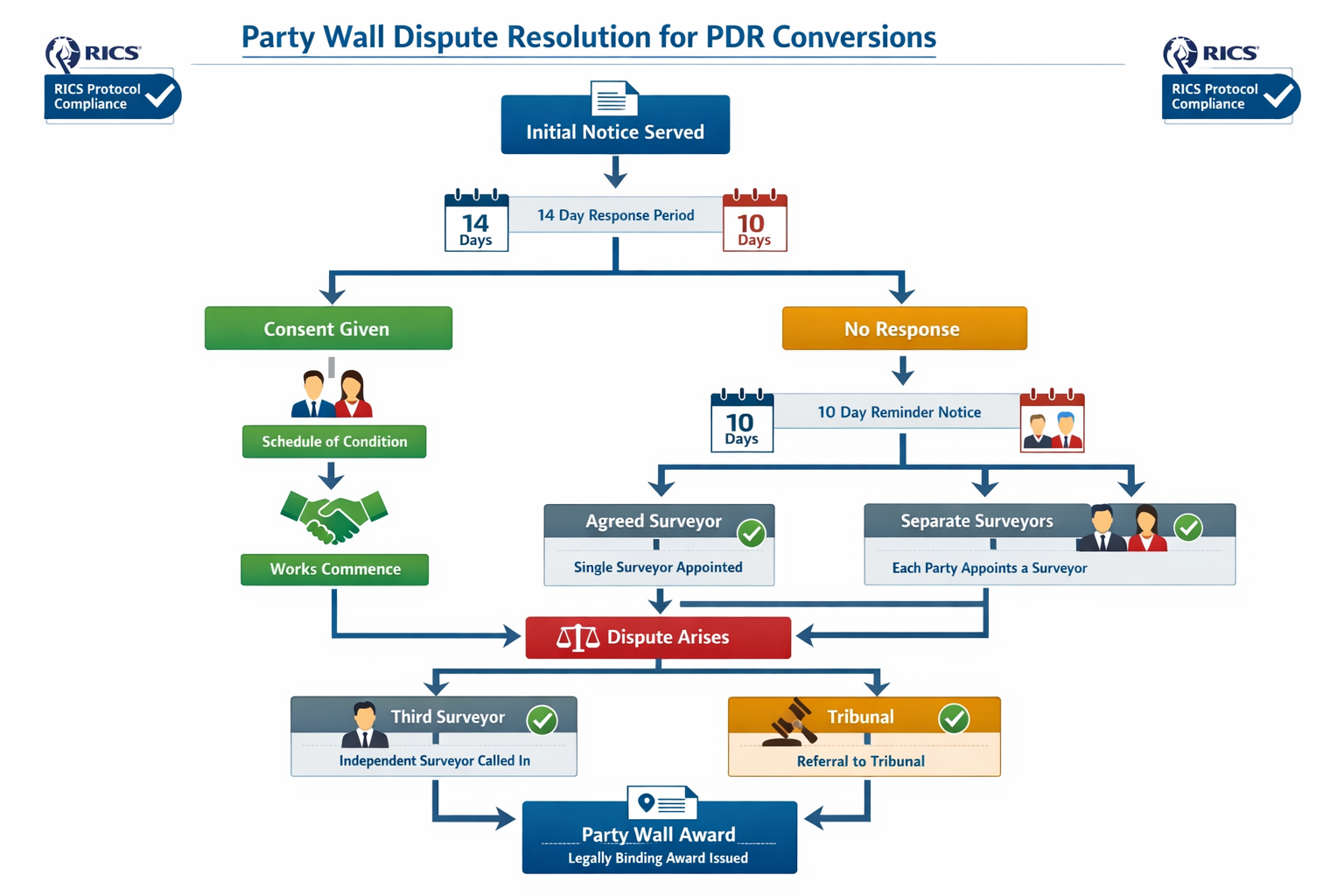
Special Considerations for High-Volume Urban PDR Projects
Multi-Property Coordination Strategies
Urban office-to-residential conversions often affect multiple adjoining properties simultaneously. Efficient coordination requires:
Phased Notice Serving
- Identify all affected properties early in planning
- Serve notices in logical construction sequence
- Stagger surveyor appointments to manage workload
- Coordinate schedules of condition across properties
Centralized Communication Systems
Successful large-scale projects implement:
- Single point of contact for all party wall matters
- Digital portals for document sharing and updates
- Regular stakeholder meetings with all appointed surveyors
- Progress bulletins to keep adjoining owners informed
Bulk Surveyor Appointments
For developments affecting 5+ properties, consider:
- Agreed surveyor serving multiple adjoining owners
- Negotiated fee structures for volume appointments
- Standardized award templates adapted for each property
- Coordinated inspection schedules to minimize disruption
This approach reduces administrative burden while maintaining professional standards across the project.
Fire Safety and Party Wall Upgrades
Converting offices to residential use triggers enhanced fire safety requirements. Party walls play a critical role in fire compartmentation:
Fire Resistance Standards
Residential party walls must achieve:
- 60 minutes fire resistance (REI 60) minimum
- Integrity: Preventing flame penetration
- Insulation: Limiting heat transfer
- Stability: Maintaining structural integrity during fire
Common Upgrade Works
🔥 Installing fire-resistant plasterboard layers
🔥 Sealing service penetrations with intumescent materials
🔥 Upgrading cavity barriers and fire stops
🔥 Removing combustible materials from party wall construction
🔥 Installing fire doors at party wall openings
These works typically require:
- Party wall notices under Section 2
- Building Control approval
- Fire engineer certification
- Post-completion inspection and documentation
The intersection of fire safety regulations and party wall obligations requires careful coordination between multiple professionals—surveyors, fire engineers, and Building Control officers must work collaboratively.
Integration with Building Control and PDR Compliance
While PDR removes planning restrictions, Building Regulations still apply in full. Party wall surveyors must coordinate with:
Building Control Officers
- Structural calculations for party wall alterations
- Fire safety compliance for compartmentation
- Acoustic testing results for sound insulation
- Ventilation and services installations
PDR Compliance Checks
Local authorities can investigate whether conversions meet PDR criteria:
- Prior approval conditions (if applicable)
- Permitted development limitations
- Use class restrictions
- External alteration constraints
Professional Coordination
Effective projects establish clear communication between:
- Party wall surveyors managing Act compliance
- Structural engineers designing alterations
- Acoustic consultants specifying treatments
- Fire safety engineers ensuring compartmentation
- Building Control verifying regulatory compliance
This multi-disciplinary approach prevents conflicts between different regulatory requirements and ensures comprehensive compliance.
Cost Management and Fee Allocation
Understanding cost implications helps developers budget accurately for PDR conversions:
Typical Party Wall Survey Costs (2026)
| Service | Cost Range | Notes |
|---|---|---|
| Building Owner's Surveyor | £1,500-£3,500 | Per property affected |
| Adjoining Owner's Surveyor | £1,200-£2,800 | Paid by building owner |
| Agreed Surveyor | £2,000-£4,500 | Single fee for multiple properties |
| Schedule of Condition | £800-£1,500 | Per property documented |
| Monitoring Equipment | £500-£2,000 | Per monitoring location |
| Third Surveyor | £2,500-£5,000+ | If disputes arise |
Fee Responsibility Under the Act
Building owners (developers) must pay:
- ✅ Their own surveyor's fees
- ✅ Adjoining owners' reasonable surveyor fees
- ✅ Schedule of condition costs
- ✅ Monitoring and inspection expenses
- ✅ Making good any damage caused
Cost Reduction Strategies
💡 Early engagement: Prevents disputes and reduces third surveyor costs
💡 Agreed surveyor appointments: Single fee instead of multiple surveyors
💡 Comprehensive planning: Reduces variation orders and additional surveys
💡 Professional contractors: Minimize damage requiring remediation
💡 Clear documentation: Prevents disputes over pre-existing conditions
Budgeting 2-3% of total conversion costs for party wall compliance provides adequate contingency for most projects.
Conclusion
Party Wall Surveys for Office-to-Resi PDR Expansions: RICS Protocols for 2026 Permitted Development Conversions represent a critical intersection of housing policy, construction law, and professional surveying practice. As Britain continues to address housing shortages through PDR conversions, the volume and complexity of party wall matters will only increase.
Key success factors for developers and surveyors include:
🎯 Early planning: Identify party wall obligations during feasibility stage, not after contracts are signed
🎯 Professional expertise: Engage RICS-accredited surveyors with specific PDR conversion experience
🎯 Comprehensive documentation: Invest in thorough schedules of condition and monitoring systems
🎯 Proactive communication: Maintain transparent relationships with adjoining owners throughout the project
🎯 Regulatory coordination: Integrate party wall compliance with Building Control and fire safety requirements
The expansion of office-to-residential PDR schemes creates both opportunities and obligations. Developers who embrace rigorous party wall protocols protect their investments while maintaining positive community relationships. Adjoining owners benefit from professional protection of their property rights. Surveyors who master these specialized protocols position themselves at the forefront of a growing market sector.
Actionable Next Steps
For developers planning PDR conversions:
- Conduct party wall feasibility assessment during site acquisition
- Appoint experienced surveyors before submitting PDR applications
- Budget adequately for party wall compliance and contingencies
- Serve notices early to allow sufficient time for surveyor appointments
- Implement robust monitoring throughout construction phase
For adjoining property owners receiving notices:
- Seek professional advice from qualified party wall surveyors
- Respond within 14 days to protect your rights
- Request comprehensive schedules of condition before works commence
- Understand your rights regarding access, monitoring, and making good
- Maintain documentation of all correspondence and site conditions
For surveyors expanding into this sector:
- Develop PDR-specific expertise through RICS continuing professional development
- Build relationships with developers, acoustic consultants, and fire engineers
- Invest in technology for efficient documentation and monitoring
- Study case law related to party wall disputes in conversion projects
- Network with specialists in party wall services and commercial surveying
The transformation of Britain's office stock into residential accommodation represents one of the most significant urban regeneration trends of this decade. Professional party wall surveying ensures this transformation proceeds smoothly, protecting property rights while delivering much-needed housing. By following RICS protocols and embracing best practices, all stakeholders can contribute to successful, dispute-free conversions that benefit communities and property owners alike.
References
[1] Uk Influence And Advocacy Update January 2026 – https://www.rics.org/news-insights/uk-influence-and-advocacy-update-january-2026
[2] Adapting Building Surveys For 2026 Retrofit Projects Rics Guidance Post Quality In Retrofit Summit – https://nottinghillsurveyors.com/blog/adapting-building-surveys-for-2026-retrofit-projects-rics-guidance-post-quality-in-retrofit-summit
[3] Party Wall Surveys For High Rise Remediation Works Navigating Building Safety Act Requirements In 2026 – https://nottinghillsurveyors.com/blog/party-wall-surveys-for-high-rise-remediation-works-navigating-building-safety-act-requirements-in-2026