

{"cover":"Professional landscape format (1536×1024) hero image featuring bold text overlay 'Party Wall Surveys for Data Centre Boom in UK: RICS Protocols for High-Value Infrastructure Disputes in 2026' in extra large 72pt white sans-serif font with dark shadow and semi-transparent navy overlay box, positioned in upper third center. Background shows split composition: left side displays modern hyperscale data centre facility with glass facade and cooling systems, right side shows detailed architectural boundary wall cross-section with BIM wireframe overlay. Foreground includes RICS professional surveyor with digital tablet examining shared wall boundary. Color scheme: deep navy blue, electric blue accents, white text, professional grey tones. High contrast, magazine cover quality, editorial infrastructure photography style with technical precision","content":["Detailed landscape format (1536×1024) image showing close-up view of party wall documentation and survey equipment for data centre projects. Scene includes printed RICS protocol checklist on clipboard with highlighted sections, digital laser measurement device displaying precise measurements, architectural plans showing shared boundary lines between data centre and adjacent property, BIM software interface visible on tablet screen showing 3D wall cross-section with measurement annotations. Background shows blurred construction site with steel framework. Color palette: professional blues, whites, technical greys. Clean, organized composition emphasizing precision and professional standards. Include visible RICS logo on documentation for authenticity","Detailed landscape format (1536×1024) image depicting geospatial technology integration in party wall surveys. Scene shows surveyor using advanced total station equipment on tripod, capturing boundary measurements at data centre construction site. Large LED screen in background displays colorful 3D point cloud data and digital twin model of shared wall structure with adjacent properties. Foreground includes laptop showing GIS mapping software with property boundaries overlaid on satellite imagery. Multiple data layers visible including utilities, easements, and party wall locations. Modern data centre building with distinctive cooling towers visible in mid-ground. Color scheme: technology blues, vibrant data visualization colors (green, orange, purple), professional greys. High-tech, precision-focused composition","Detailed landscape format (1536×1024) image illustrating dispute resolution and risk management for high-value data centre party wall projects. Scene shows professional mediation meeting in modern conference room with three RICS surveyors reviewing large-format printed dispute documentation spread across table. Wall-mounted screens display financial impact charts showing potential delay costs (£50,000-£500,000 ranges visible), project timeline Gantt charts with critical path highlighted, and photographic evidence of wall conditions. Table includes gavel symbolizing dispute resolution, signed party wall agreements, and risk assessment matrices. Through conference room windows, data centre construction site visible with cranes and infrastructure. Color palette: authoritative navy and burgundy, gold accents, professional neutrals. Serious, high-stakes business atmosphere with emphasis on documentation and professional resolution"]"}
The UK's data centre landscape is experiencing unprecedented transformation. With global technology companies investing $320 billion in data centre infrastructure in 2026 alone, and the UK government designating these facilities as critical infrastructure, the race to build hyperscale facilities has created a complex web of property boundary challenges. Party wall surveys for data centre boom in UK: RICS protocols for high-value infrastructure disputes in 2026 have become essential tools for preventing costly delays and managing the intricate shared boundaries that characterize these massive developments.
As AI growth zones emerge across Scotland, northeast England, Wales, and Oxfordshire—selected primarily for power access—party wall surveyors face an entirely new category of high-stakes projects. These aren't typical residential extensions or basement conversions. Data centres require substantial excavation, heavy foundation work, and vibration-sensitive cooling systems that can affect neighboring properties in unprecedented ways. The financial implications of getting party wall procedures wrong can reach into the millions, making professional adherence to RICS protocols more critical than ever.

Key Takeaways
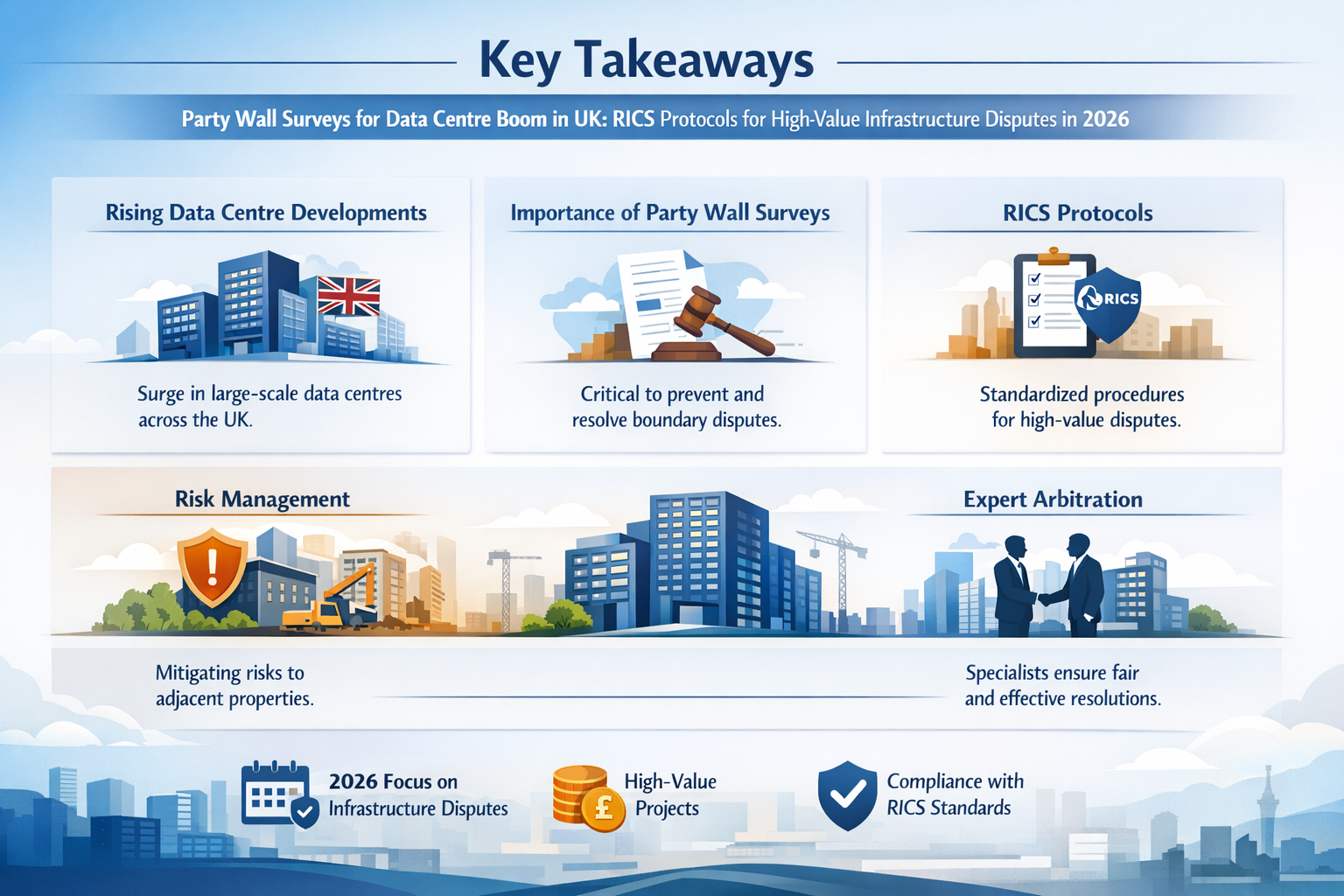
- 🏗️ Data centre construction in the UK requires specialized party wall surveys that integrate BIM and geospatial technology to manage complex shared boundaries
- 📋 RICS protocols updated in 2023 provide the framework for handling high-value infrastructure disputes, though the Party Wall etc. Act 1996 remains unchanged since 2016
- 💰 Financial stakes are enormous: delays in data centre projects can cost £50,000-£500,000 per week, making proper party wall procedures essential
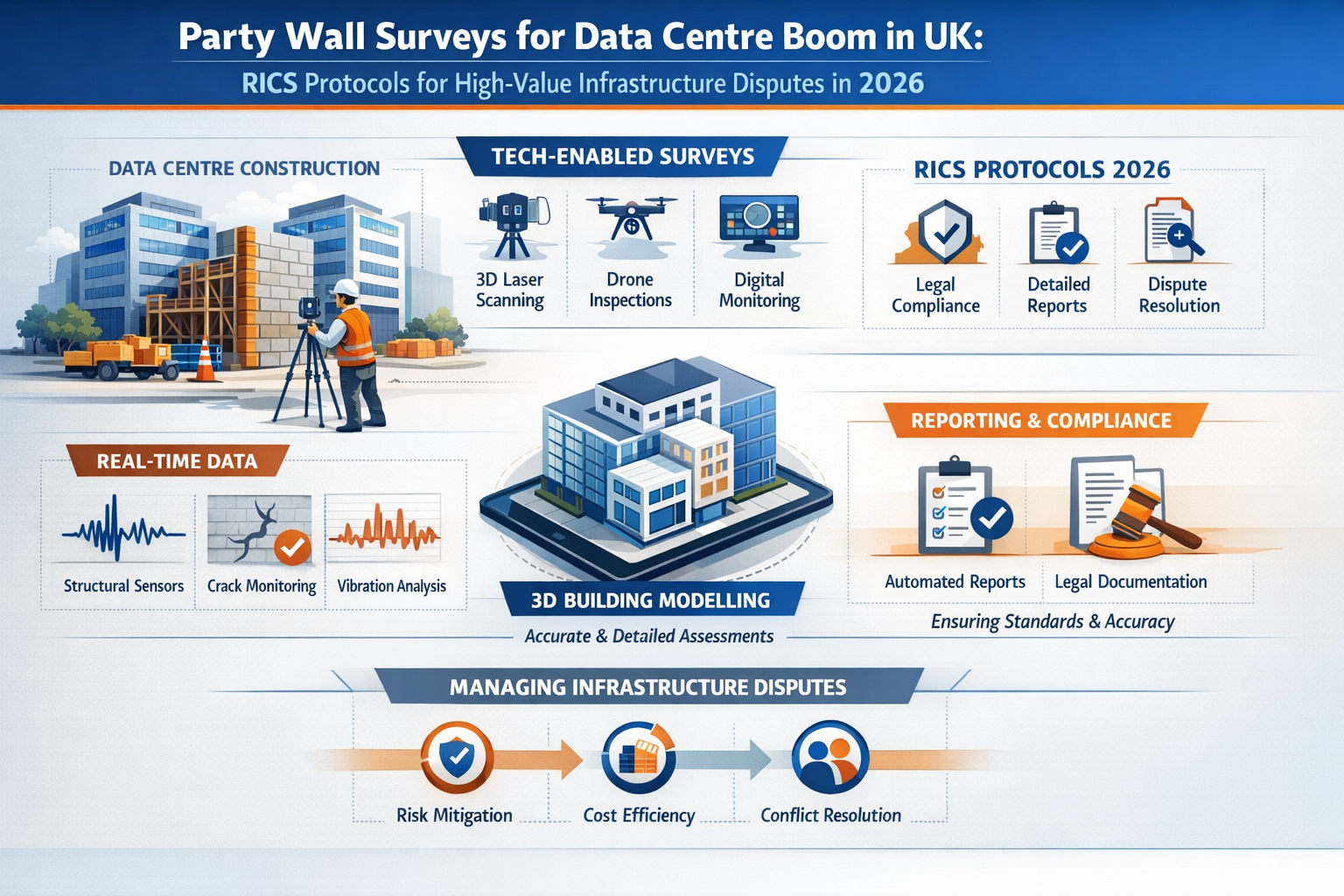
- 🔧 Technology integration including digital twins, 3D laser scanning, and real-time monitoring systems now form the backbone of professional party wall surveys for infrastructure projects
- ⚖️ Dispute prevention checklists and early engagement strategies can reduce conflict probability by up to 70% in high-value developments
Understanding Party Wall Surveys for Data Centre Boom in UK: RICS Protocols for High-Value Infrastructure Disputes in 2026
The intersection of data centre development and party wall legislation creates unique challenges that traditional residential surveying practices weren't designed to address. Understanding how party wall disputes arise in commercial infrastructure contexts requires examining both the legal framework and the technical demands of modern data facilities.
The Legislative Foundation
The Party Wall etc. Act 1996 remains the cornerstone of party wall procedures in England and Wales, despite not being amended since 2016. This legislation governs three main scenarios:
- New walls built on or at the boundary line between properties
- Work to existing party walls including alterations, repairs, or demolition
- Excavation within 3-6 meters of neighboring structures (depending on depth)
For data centre developments, the third category becomes particularly significant. These facilities typically require deep excavations for cooling infrastructure, backup power systems, and cable trenches—often extending well within the zones that trigger party wall obligations.
"The Party Wall Act was written for a different era of construction. When you're dealing with a £200 million data centre that needs to be operational within 18 months, the stakes of getting party wall procedures wrong multiply exponentially." — RICS Party Wall Surveyor
RICS Professional Standards in 2026
RICS re-issued its Professional Standard for Party Wall Legislation and Procedure in May 2023, which is currently being reviewed by a working group to address emerging challenges in infrastructure development. These standards emphasize several key principles for high-value projects:
Competence Requirements:
- Demonstrated experience with commercial and infrastructure projects
- Understanding of structural engineering principles
- Knowledge of modern construction methodologies
- Familiarity with dispute resolution procedures
Documentation Standards:
- Comprehensive photographic and video records
- Detailed condition schedules using standardized templates
- Clear specification of proposed works
- Transparent fee structures and timelines
Ethical Obligations:
- Independence and impartiality when acting as agreed surveyor
- Duty of care to both building and adjoining owners
- Professional indemnity insurance appropriate to project value
- Compliance with RICS Rules of Conduct
Why Data Centres Create Unique Challenges
Data centre construction differs dramatically from conventional building projects in ways that directly impact party wall considerations:
Scale and Speed: Hyperscale facilities can cover 50,000+ square meters and require completion within 12-18 months to meet market demands. This compressed timeline leaves little room for party wall disputes that could delay foundation work.
Vibration Sensitivity: Operating data centres house servers worth millions that are extremely sensitive to vibration. Adjacent construction work must be carefully monitored and controlled—a requirement that extends beyond typical party wall concerns.
Continuous Operations: Unlike residential properties, data centres operate 24/7/365 with service level agreements guaranteeing 99.99%+ uptime. Any disruption to neighboring facilities can trigger substantial financial penalties.
Underground Infrastructure: Data centres require extensive below-ground systems including cooling pipes, electrical conduits, and fiber optic cables. These often extend to or beyond property boundaries, creating complex easement and party wall scenarios.
Technology Integration in Party Wall Surveys for Data Centre Boom in UK: RICS Protocols for High-Value Infrastructure Disputes in 2026
Modern party wall surveys for infrastructure projects have evolved far beyond clipboard inspections and photographic records. The integration of advanced technology has become essential for managing the complexity and risk associated with data centre developments.
Building Information Modeling (BIM) for Party Wall Management
BIM Level 2 has become the standard for major infrastructure projects in the UK, and party wall surveyors must now integrate their work into these digital environments. For data centre projects, this means:
3D Boundary Modeling: Creating precise digital representations of party walls, shared structures, and excavation zones that can be overlaid with construction plans to identify potential conflicts before they occur.
Clash Detection: Using BIM software to automatically identify where proposed data centre foundations, cooling systems, or utilities might impact party walls or adjacent properties. This proactive approach can prevent issues that would otherwise emerge during construction.
Digital Condition Records: Capturing pre-construction conditions in a format that integrates with project management systems, allowing real-time comparison during and after works. This creates an indisputable record that can prevent disputes or resolve them quickly when they arise.
Collaborative Platforms: Sharing party wall information with structural engineers, architects, and contractors through common data environments (CDEs) ensures everyone works from the same information base.
Geospatial Technology and Laser Scanning
3D laser scanning has revolutionized condition surveys for high-value infrastructure projects. For data centre party wall surveys, this technology offers several advantages:
- Millimeter-level accuracy in capturing existing conditions of party walls and adjacent structures
- Point cloud data that can be revisited virtually without additional site visits
- Integration with monitoring systems to detect movement during construction
- Legal-grade evidence that holds up in dispute resolution proceedings
Total station surveys and GPS technology enable precise boundary determination, critical when data centre sites abut multiple properties with complex ownership structures.
Real-Time Monitoring Systems
For high-value data centre projects, static condition surveys are often insufficient. Continuous monitoring provides several benefits:
Vibration Monitoring: Installing triaxial accelerometers on party walls and adjacent structures to measure vibration levels during piling, excavation, and construction activities. This data can demonstrate compliance with agreed limits or provide early warning of potential damage.
Movement Monitoring: Automated crack monitoring systems and tilt sensors detect structural movement in real-time, allowing immediate intervention if settlement or lateral movement exceeds acceptable thresholds.
Environmental Monitoring: Temperature, humidity, and dust sensors protect sensitive equipment in adjacent data centres while providing evidence of construction impact mitigation.
Data Integration: Modern monitoring systems feed directly into project management platforms, creating automatic alerts when parameters exceed agreed limits and generating reports for party wall agreements.
Digital Twin Technology
The most sophisticated data centre projects now employ digital twin technology—virtual replicas of physical assets that update in real-time based on sensor data. For party wall management, digital twins enable:
- Predictive analysis of how construction activities will affect adjacent structures
- Scenario modeling to test different construction sequences and their boundary impacts
- Post-construction verification that works were completed as agreed
- Ongoing asset management for the operational phase of the data centre
Preventing High-Value Infrastructure Disputes: Checklists and Best Practices
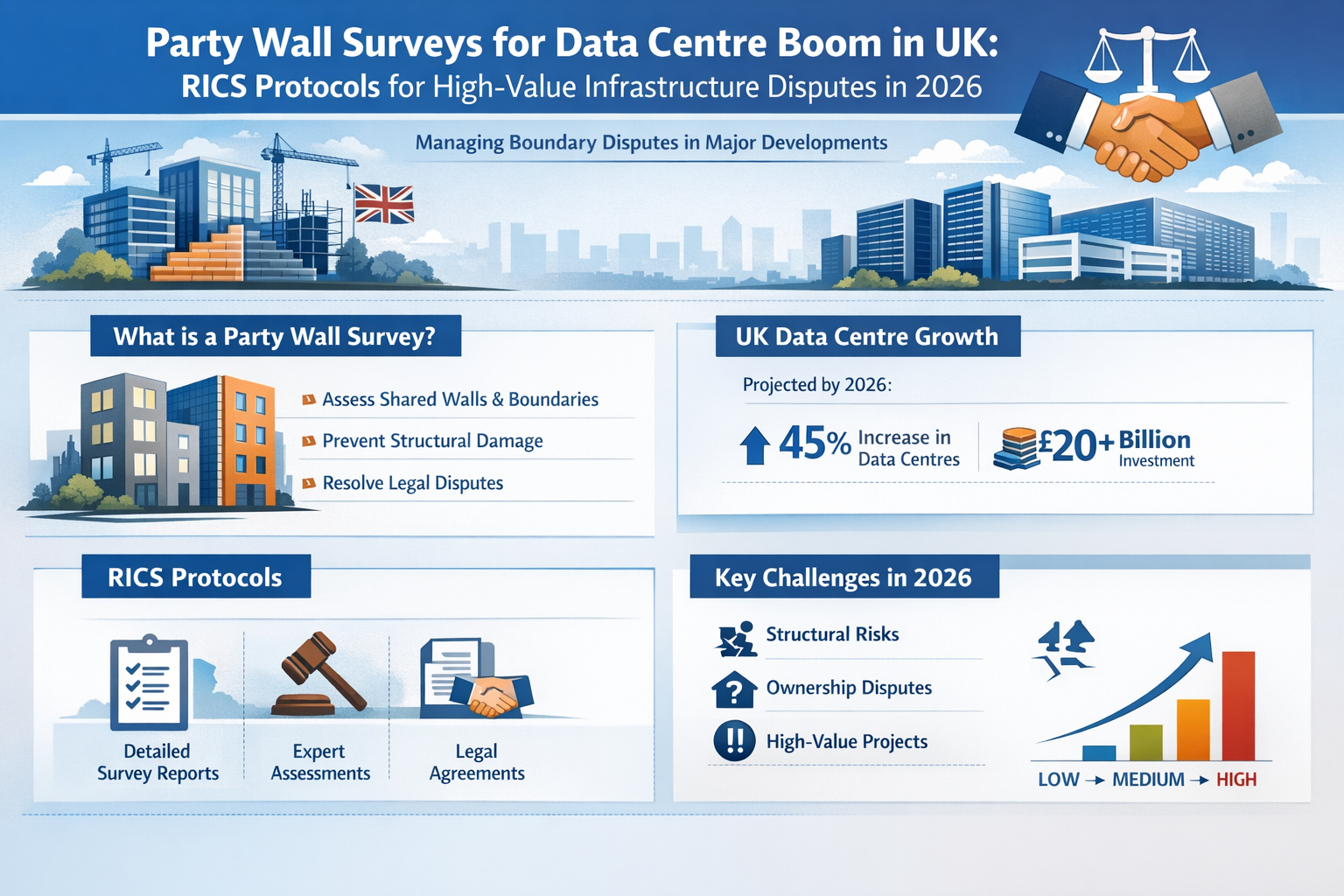
With project delays potentially costing £50,000-£500,000 per week in data centre construction, prevention of party wall disputes becomes a critical risk management function. Party wall surveys for data centre boom in UK: RICS protocols for high-value infrastructure disputes in 2026 emphasize proactive strategies that reduce conflict probability.
Pre-Construction Phase Checklist
Property Investigation (Weeks 1-2):
- ✅ Conduct title searches for all adjacent properties within 6 meters of excavation zones
- ✅ Identify all party walls, party structures, and boundary features
- ✅ Map underground easements, utilities, and rights of way
- ✅ Research previous planning applications and building control records for adjacent properties
- ✅ Identify all relevant owners and occupiers requiring notification
Stakeholder Engagement (Weeks 2-4):
- ✅ Initiate early dialogue with adjacent property owners before formal notices
- ✅ Present project overview with clear explanation of party wall procedures
- ✅ Provide preliminary timeline and contact information
- ✅ Address concerns and questions in accessible language
- ✅ Document all communications for future reference
Understanding what are my party wall rights helps both building and adjoining owners approach negotiations from an informed position.
Technical Assessment (Weeks 3-6):
- ✅ Commission comprehensive condition surveys using 3D laser scanning
- ✅ Conduct structural assessment of party walls and adjacent structures
- ✅ Identify any pre-existing defects or weaknesses
- ✅ Establish baseline monitoring for vibration and movement
- ✅ Prepare detailed photographic and video records
Notice Procedures (Weeks 6-8):
- ✅ Serve Party Structure Notices or Adjacent Excavation Notices as appropriate
- ✅ Include detailed drawings and specifications of proposed works
- ✅ Provide clear explanation of adjoining owner's options
- ✅ Allow full 14-day response period (or 1 month for Line of Junction Notices)
- ✅ Follow up with adjoining owners approaching deadline
For those unfamiliar with the process, understanding when you need a party wall surveyor becomes critical at this stage.
Award Preparation and Agreement
Surveyor Appointment:
When an adjoining owner dissents or fails to respond, the dispute resolution mechanism activates. For high-value infrastructure projects, consider:
- Agreed Surveyor Approach: Single surveyor appointed by both parties (faster, more cost-effective for straightforward cases)
- Two Surveyors Approach: Each party appoints their own surveyor who then work together (appropriate for complex data centre projects with significant risk)
- Third Surveyor Selection: Agreed upon in advance to resolve any deadlocks between appointed surveyors
Award Content for Infrastructure Projects:
A comprehensive Party Wall Award for data centre construction should include:
- Detailed Scope of Works: Precise description of excavation depths, foundation types, temporary works, and construction methodology
- Access Arrangements: Specific provisions for surveyor inspections, monitoring equipment installation, and emergency access
- Working Hours: Restrictions appropriate to adjacent property use (particularly important if neighboring data centres operate continuously)
- Vibration Limits: Specific thresholds based on equipment sensitivity and structural capacity
- Monitoring Protocols: Frequency of inspections, reporting requirements, and action triggers
- Insurance Requirements: Appropriate professional indemnity and contractor's all-risk coverage
- Dispute Resolution: Clear procedures for addressing issues during construction
- Security for Expenses: Financial guarantees appropriate to project scale
Construction Phase Management
Ongoing Compliance:
- 📊 Conduct inspections at agreed intervals (typically weekly for major excavation)
- 📊 Maintain real-time monitoring systems with automatic alerts
- 📊 Provide regular reports to all parties
- 📊 Document any variations from agreed works immediately
- 📊 Address concerns promptly before they escalate
Communication Protocols:
Establish clear communication channels:
- Primary contact: Project manager available during working hours
- Emergency contact: 24/7 availability for critical issues
- Regular updates: Weekly progress reports to adjoining owners
- Inspection coordination: Minimum 48-hour notice for surveyor access
Understanding what happens if a neighbour refuses party wall works helps prepare contingency plans for difficult situations.
Dispute Resolution Strategies
When disputes arise despite preventive measures, swift resolution becomes essential:
Early Intervention Techniques:
- Immediate site meeting involving all surveyors and key stakeholders
- Independent expert opinion on technical matters in dispute
- Mediation services before formal legal proceedings
- Temporary works modifications to address specific concerns
- Enhanced monitoring to provide objective evidence
Third Surveyor Referral:
When appointed surveyors cannot agree, the Third Surveyor makes binding determinations. For infrastructure projects:
- Select Third Surveyors with relevant infrastructure experience
- Provide comprehensive technical documentation
- Present clear, evidence-based arguments
- Accept that decisions are final and binding
Cost Management:
High-value projects require careful financial management:
- Establish realistic budgets for party wall procedures (typically 0.5-1% of construction value for complex projects)
- Include contingency for potential disputes (additional 0.25-0.5%)
- Track costs against budget throughout process
- Document all expenses for potential recovery
Post-Completion Procedures
Final Inspections:
- ✅ Conduct comprehensive post-construction condition survey
- ✅ Compare against baseline records to identify any damage
- ✅ Document completion of all agreed works
- ✅ Verify removal of temporary works and monitoring equipment
- ✅ Prepare final report for all parties
Damage Resolution:
If damage occurred despite precautions:
- Obtain quotes from qualified contractors for remedial works
- Agree scope and timing of repairs with affected owners
- Complete repairs to standard that restores pre-existing condition
- Provide warranties for completed remedial works
Record Retention:
Maintain comprehensive records for minimum 6 years (12 years for sealed awards):
- All notices, consents, and awards
- Condition survey reports and monitoring data
- Correspondence and meeting minutes
- Photographic and video evidence
- Financial records and invoices
Financial Implications and Risk Management
The financial stakes in data centre party wall disputes dwarf typical residential cases. Understanding these implications helps justify appropriate investment in professional party wall procedures.
Cost of Delays
Data centre construction operates on aggressive timelines driven by market demand. Every week of delay carries substantial costs:
| Delay Factor | Weekly Cost Impact |
|---|---|
| Direct Construction Costs | £50,000-£150,000 |
| Extended Preliminaries | £25,000-£75,000 |
| Lost Revenue | £100,000-£250,000 |
| Contractual Penalties | £50,000-£200,000 |
| Financing Costs | £15,000-£50,000 |
| Total Potential Weekly Impact | £240,000-£725,000 |
These figures explain why data centre developers increasingly view professional party wall management as essential risk mitigation rather than optional compliance.
Insurance Considerations
Professional Indemnity Insurance for party wall surveyors must reflect project values. For data centre work:
- Minimum £5 million coverage for projects under £50 million
- £10 million+ coverage for major hyperscale facilities
- Run-off coverage for minimum 6 years post-completion
- Specific endorsements for infrastructure work
Project Insurance should include:
- Contractor's All Risk (CAR) policies covering party wall damage
- Third-party liability for adjacent property damage
- Professional indemnity for design team members
- Delay in Start-Up (DSU) coverage for revenue loss
Value of Prevention
Investing in comprehensive party wall procedures delivers measurable returns:
Prevention Investment:
- Comprehensive condition surveys: £15,000-£40,000
- Monitoring systems: £25,000-£75,000
- Professional surveyor fees: £50,000-£150,000
- Total Prevention Investment: £90,000-£265,000
Potential Dispute Costs:
- Legal proceedings: £100,000-£500,000
- Project delays: £240,000-£725,000 per week
- Remedial works: £50,000-£500,000
- Reputational damage: Unquantifiable
- Total Potential Dispute Costs: £390,000-£1,725,000+
The risk-reward calculation clearly favors comprehensive prevention strategies.
Community Engagement and Sustainability Concerns
The rapid expansion of data centres has generated community concerns that extend beyond traditional party wall considerations. In 2026, protests against hyperscale data centre projects have emerged across the UK, reflecting broader anxieties about environmental impact, energy consumption, and community consultation.
Addressing Community Concerns
Transparency in Party Wall Procedures:
While party wall matters are primarily bilateral between building and adjoining owners, data centre developers increasingly recognize the value of broader community engagement:
- Public information sessions explaining construction methodology and party wall protections
- Community liaison officers providing accessible contact points for concerns
- Regular updates on construction progress and any party wall issues
- Independent monitoring with results made publicly available
Environmental Considerations:
Data centres' substantial energy and water consumption intersect with party wall considerations when:
- Cooling systems create noise or vibration affecting adjacent properties
- Water extraction affects ground conditions and settlement risk
- Power infrastructure requires easements across neighboring land
- Emergency generators create air quality concerns
Sustainability Integration:
Modern RICS protocols increasingly recognize sustainability factors:
- Minimizing construction waste from party wall works
- Using sustainable materials for repairs and making good
- Considering embodied carbon in remedial specifications
- Protecting ecological features on boundary areas
Regulatory Evolution
While the Party Wall etc. Act 1996 remains unchanged, related regulations continue to evolve:
Building Safety Act 2022: Introduces higher-risk building regime with enhanced competency requirements that may influence party wall surveyor qualifications for major projects.
Planning System Changes: Streamlined approvals for data centres as critical infrastructure may affect timing of party wall procedures relative to planning consent.
Critical National Infrastructure Designation: Data centres' new status may influence dispute resolution approaches and timeframes for essential facilities.
Looking Forward: The Future of Party Wall Surveys in Infrastructure Development
As the UK's data centre boom continues through 2026 and beyond, party wall surveying practice must continue evolving to meet the challenges of critical infrastructure development.
Emerging Trends
Artificial Intelligence in Surveys:
AI-powered analysis of condition survey data can:
- Automatically identify defects and changes between inspections
- Predict settlement patterns based on soil conditions and construction methodology
- Optimize monitoring sensor placement for maximum coverage
- Generate risk assessments for different construction scenarios
Blockchain for Record-Keeping:
Distributed ledger technology offers potential for:
- Immutable records of conditions, notices, and awards
- Automated smart contracts triggering inspections or payments
- Transparent audit trails for all parties
- Reduced disputes over documentation authenticity
Standardized Digital Protocols:
Industry-wide adoption of common data standards will enable:
- Seamless integration between different software platforms
- Automated compliance checking against RICS standards
- Benchmarking of party wall performance across projects
- Improved knowledge sharing and best practice dissemination
Professional Development
The complexity of infrastructure party wall work demands enhanced competency:
Specialized Training: RICS and other professional bodies are developing infrastructure-specific party wall qualifications covering:
- Advanced structural engineering principles
- Geotechnical considerations for deep excavations
- Technology integration and digital surveying
- High-value dispute resolution techniques
Continuing Professional Development: Party wall surveyors working on data centres must maintain current knowledge of:
- Evolving construction methodologies
- New monitoring technologies
- Case law developments
- Sustainability requirements
For those considering entry to this specialized field, exploring early careers programs provides pathways into professional surveying practice.
Conclusion
Party wall surveys for data centre boom in UK: RICS protocols for high-value infrastructure disputes in 2026 represent a critical evolution in professional surveying practice. The unprecedented scale and speed of data centre development, combined with the financial stakes involved, have transformed party wall work from routine compliance into strategic risk management.
Key success factors for managing party wall procedures in data centre projects include:
- Early engagement with all stakeholders before formal notice procedures begin
- Technology integration using BIM, laser scanning, and real-time monitoring to provide objective evidence and prevent disputes
- Comprehensive documentation that withstands scrutiny in high-value dispute resolution
- Professional competence with specific experience in infrastructure and commercial projects
- Proactive communication maintaining transparency with all parties throughout construction
- Appropriate resources allocated to party wall procedures reflecting project value and complexity
The investment in professional party wall management delivers substantial returns through dispute prevention, delay avoidance, and risk mitigation. With weekly delay costs potentially exceeding £500,000 in major data centre projects, the £90,000-£265,000 typically invested in comprehensive party wall procedures represents exceptional value.
Actionable Next Steps
For Data Centre Developers:
- ✅ Engage RICS-qualified party wall surveyors with infrastructure experience during project feasibility stage
- ✅ Budget appropriately for party wall procedures (0.75-1.5% of construction value)
- ✅ Initiate early dialogue with adjacent owners before formal notices
- ✅ Invest in comprehensive monitoring systems appropriate to project risk
- ✅ Maintain transparent communication throughout construction
For Adjoining Owners:
- ✅ Understand your party wall rights when receiving notices
- ✅ Appoint your own surveyor for complex infrastructure projects
- ✅ Ensure comprehensive baseline condition surveys are completed
- ✅ Maintain regular communication with appointed surveyors
- ✅ Document any concerns immediately rather than waiting
For Party Wall Surveyors:
- ✅ Develop specialized competence in infrastructure projects through training and experience
- ✅ Invest in technology platforms that support complex project management
- ✅ Maintain appropriate professional indemnity insurance for high-value work
- ✅ Stay current with RICS protocol updates and emerging case law
- ✅ Build networks with specialists in structural engineering, geotechnics, and dispute resolution
The UK's data centre boom presents both challenges and opportunities for the party wall surveying profession. By embracing technology, maintaining rigorous professional standards, and focusing on dispute prevention, surveyors can ensure these critical infrastructure projects proceed smoothly while protecting the rights of all affected parties.
For those facing party wall issues related to data centre or other construction projects, seeking professional advice early prevents costly complications. Understanding the consequences of ignoring the Party Wall Act emphasizes why proper procedures matter, regardless of project scale.
As 2026 progresses and the AI-driven data centre expansion continues, the integration of advanced surveying technology with time-tested RICS protocols will define success in managing these high-stakes boundary relationships. The future of party wall surveying lies in combining professional judgment with digital precision—ensuring that critical infrastructure development proceeds while protecting property rights and preventing disputes.
References
[2] Uk Party Walls Webinar – https://www.rics.org/training-events/online-training/scheduled/uk-party-walls-webinar
[4] Watch – https://www.youtube.com/watch?v=oORz6MsyGE8
[7] Hyperscale Data Centre Protests – https://theecologist.org/2026/feb/27/hyperscale-data-centre-protests