

Over 61,700 build-to-rent units were under active construction across major markets as of Q1 2026, with institutional capital continuing to pour into the sector at a pace not seen since the post-pandemic housing surge [3]. Yet behind every BTR site boundary lies a legal obligation that many developers still underestimate: the Party Wall etc. Act 1996. For multi-unit schemes where shared walls, excavations, and foundations are the norm rather than the exception, party wall compliance is not a procedural footnote — it is a project-critical discipline.
This article examines Party Wall Surveys for Build-to-Rent Schemes: RICS Guidance Amid Institutional Expansion in 2026, covering notice drafting, award protocols, schedule of condition requirements, and the implications of RICS's forthcoming 8th edition guidance for surveyors and developers managing high-yield northern investment portfolios.
Key Takeaways
- RICS launched a consultation in April 2026 on the draft 8th edition of "Party Wall Legislation and Procedure," representing the most significant overhaul of party wall standards in over a decade [1].
- The 8th edition reinforces that a party wall surveyor's appointment is statutory and personal, independent of client instruction — a critical point for BTR developers appointing surveyors across large multi-unit schemes [1].
- Build-to-rent institutional investment is accelerating, with major players such as Blackstone and NHK Capital Partners opening new communities in 2026 [5][8].
- Proper notice drafting and award protocols for BTR schemes require careful attention to shared boundaries, excavation notices, and schedule of condition reports to protect developer liability.
- Northern UK BTR markets present specific party wall challenges due to dense terraced housing stock and complex shared boundary arrangements.
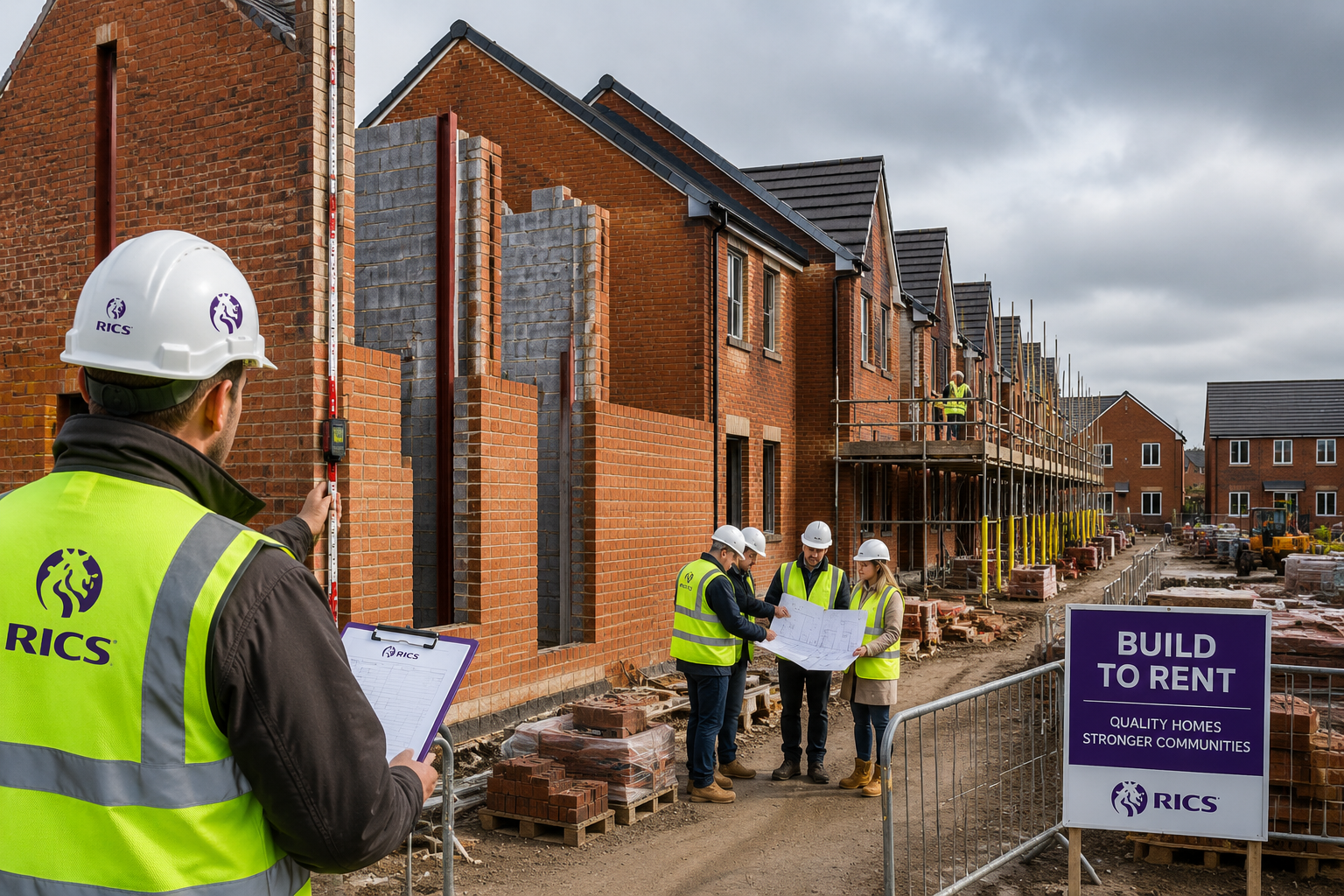
The Build-to-Rent Boom and Its Party Wall Implications
The BTR sector has demonstrated remarkable resilience. National data shows that average rents climbed from $2,121 in early 2023 to a peak of $2,227 in mid-2025, settling at $2,207 in Q1 2026 — evidence of stable, sustained demand despite affordability pressures [6]. Institutional confidence has followed. In March 2026, Red Cedar Construction Services secured a $75 million investment to scale national BTR and multifamily operations toward a target of 4,000 homes annually by 2028 [4]. Blackstone, through Tricon Residential, opened a 493-home BTR community in Southern California's Inland Empire in the same month [5].
In the UK, the institutional expansion of BTR is equally pronounced, particularly across northern cities such as Manchester, Leeds, Sheffield, and Liverpool, where land values support higher yields. These markets are characterised by dense residential fabric — terraced streets, back-to-back housing, and tightly packed urban plots — all of which create complex shared boundary arrangements that trigger obligations under the Party Wall etc. Act 1996.
Why BTR schemes face heightened party wall exposure:
- Large footprints mean multiple adjoining owners, each requiring individual notice
- Deep foundation designs and basement-level parking trigger the Act's excavation provisions
- Phased construction on multi-block schemes creates rolling notice obligations
- Institutional investors demand clean legal records, making retroactive party wall compliance costly
For developers and their legal teams, understanding party wall matters from the outset of a BTR project is not optional — it is fundamental to programme delivery.
RICS 8th Edition Guidance: What Changes for BTR Surveyors in 2026
In April 2026, RICS launched a formal consultation on the draft 8th edition of its professional guidance note, "Party Wall Legislation and Procedure." The consultation closed on 5 June 2026 and sought feedback from surveyors, developers, and legal practitioners across England and Wales [1]. The resulting guidance is expected to be implemented immediately upon publication, making it essential reading for all professionals involved in BTR delivery.
Core Changes in the Draft 8th Edition
The proposed revisions introduce several substantive changes that directly affect how party wall surveys are conducted on large-scale BTR projects [1][2]:
| Area of Change | Previous Position | 8th Edition Direction |
|---|---|---|
| Letters of appointment | Varied formats in common use | Revised, standardised templates |
| Draft awards | Inconsistent drafting practices | Updated model award documents |
| Surveyor independence | Implied through professional conduct | Explicitly reinforced as statutory and personal |
| Regulatory conduct | General RICS ethics framework | Strengthened specific guidance |
| Procedural errors | Limited formal guidance | Clearer protocols to reduce liability |
Key principle from the 8th edition: A party wall surveyor's appointment is personal and statutory. It operates independently of client instruction. This means a BTR developer cannot direct a jointly appointed surveyor to expedite or modify an award in ways that favour the building owner.
This reinforcement of surveyor independence is particularly significant for BTR schemes. When a developer appoints a single "agreed surveyor" across dozens of adjoining properties — a common cost-saving approach on large sites — the surveyor must remain impartial throughout. Understanding the role of an agreed surveyor is essential for BTR project managers who may otherwise assume that a single appointment equates to a single point of control.
The 8th edition also addresses procedural errors that have historically generated disputes and professional liability claims. For BTR developers managing tight construction programmes, procedural errors — such as serving defective notices or failing to obtain a valid award before commencing notifiable works — can result in injunctions that halt entire phases of development [2].
Notice Drafting and Award Protocols for Multi-Unit BTR Projects
Party Wall Surveys for Build-to-Rent Schemes: RICS Guidance Amid Institutional Expansion in 2026 places particular emphasis on getting the notice stage right. For a BTR scheme with, say, 150 units across a brownfield site in Leeds or Manchester, the notice obligations can be substantial.
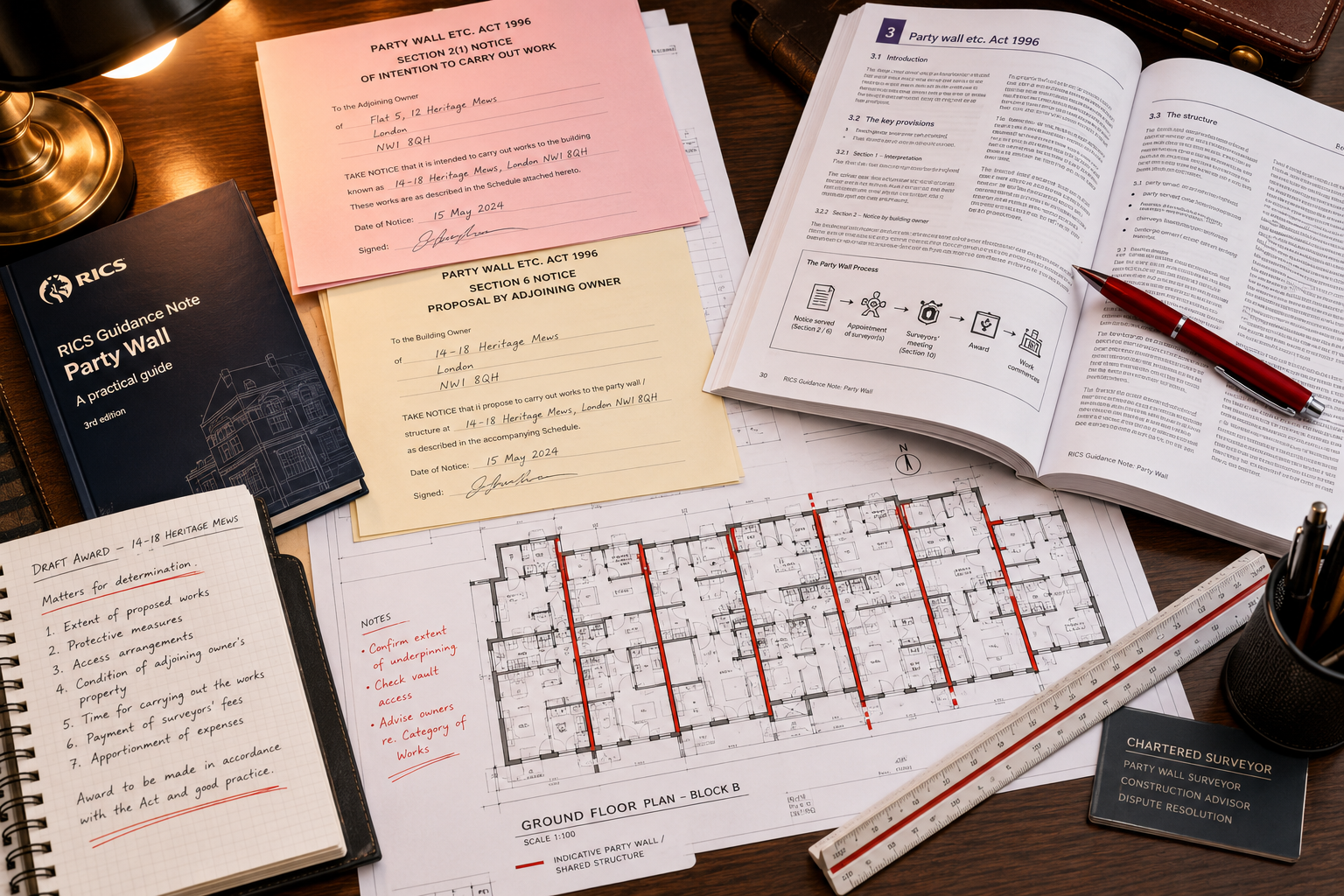
Identifying Notifiable Works on BTR Sites
The Party Wall etc. Act 1996 triggers notice obligations across three main categories of work:
- Line of junction works — building a new wall at or astride the boundary
- Party structure works — cutting into, underpinning, or raising an existing party wall
- Excavation works — digging within 3 metres of an adjoining structure to a depth below its foundations, or within 6 metres under certain conditions
On BTR sites, all three categories frequently apply simultaneously. A developer constructing a new residential block adjacent to an existing terrace may need to serve party wall notices under Sections 1, 2, and 6 of the Act at the same time. The 3-metre rule for excavations is particularly relevant where BTR schemes incorporate underground car parks or deep pile foundations.
Drafting Notices for Multiple Adjoining Owners
One of the most operationally demanding aspects of BTR party wall compliance is serving notices on multiple adjoining owners — which, in a dense urban setting, could mean 20 to 50 separate parties. Best practice for notice drafting on BTR schemes includes:
- Identify all adjoining owners early — commission a boundary survey before RIBA Stage 3 to avoid late discoveries
- Serve notices simultaneously where possible — staggered service can create programme conflicts when consent periods expire at different times
- Use clear, accurate descriptions of proposed works — vague descriptions are a leading cause of disputed notices
- Allow adequate notice periods — one month for Section 1 notices, two months for Sections 2 and 6
- Record service methods — recorded delivery or personal service with a signed receipt
For BTR developers with institutional backers, the documentation trail is as important as the legal compliance itself. Investors conducting due diligence will scrutinise party wall records as part of their legal review.
Award Protocols on Large BTR Schemes
Where an adjoining owner dissents — or fails to respond within the statutory period — the matter proceeds to a party wall award. On a BTR scheme with multiple adjoining owners, this can mean managing several concurrent award processes simultaneously.
A party wall award is a legally binding document that sets out the rights and obligations of both parties. For BTR schemes, awards should address:
- The specific works permitted and their sequence
- Working hours and noise restrictions
- Access arrangements for surveyors and contractors
- Security and protection measures for adjoining structures
- Dispute resolution mechanisms
The award process must be completed before notifiable works begin. On phased BTR schemes, this means rolling award programmes aligned with each construction phase — a logistical challenge that requires dedicated party wall management from the earliest stages of project planning.
Schedule of Condition: Protecting BTR Developers and Adjoining Owners
A party wall schedule of condition is one of the most valuable tools available to BTR developers. It creates a contemporaneous photographic and written record of the condition of adjoining properties before works commence. In the event of a damage claim, the schedule provides the evidential baseline against which any alleged deterioration is assessed.
For BTR schemes in northern cities where adjoining properties are often older terraced houses with pre-existing defects — settlement cracking, damp, aging mortar — a thorough schedule of condition protects the developer from inflated or spurious claims.
A comprehensive schedule of condition for a BTR scheme should include:
- External elevations of all adjoining properties within the zone of influence
- Internal rooms adjacent to the shared boundary or excavation zone
- Existing cracks, with crack gauges installed where appropriate
- Drainage inspection records where relevant
- Photographic evidence with timestamps and geolocation data
Surveyors operating under the forthcoming 8th edition guidance will be expected to produce schedules that meet higher standards of consistency and completeness [2]. BTR developers should factor this into their surveyor appointment briefs and programme allowances.
Party Wall Surveys for Build-to-Rent Schemes: Managing Shared Boundaries in Northern Markets
The northern BTR investment thesis is compelling: higher gross yields, lower land acquisition costs, and strong rental demand from young professionals in cities undergoing significant regeneration. However, the built environment in these markets creates specific party wall challenges that differ materially from those encountered on greenfield suburban BTR sites.
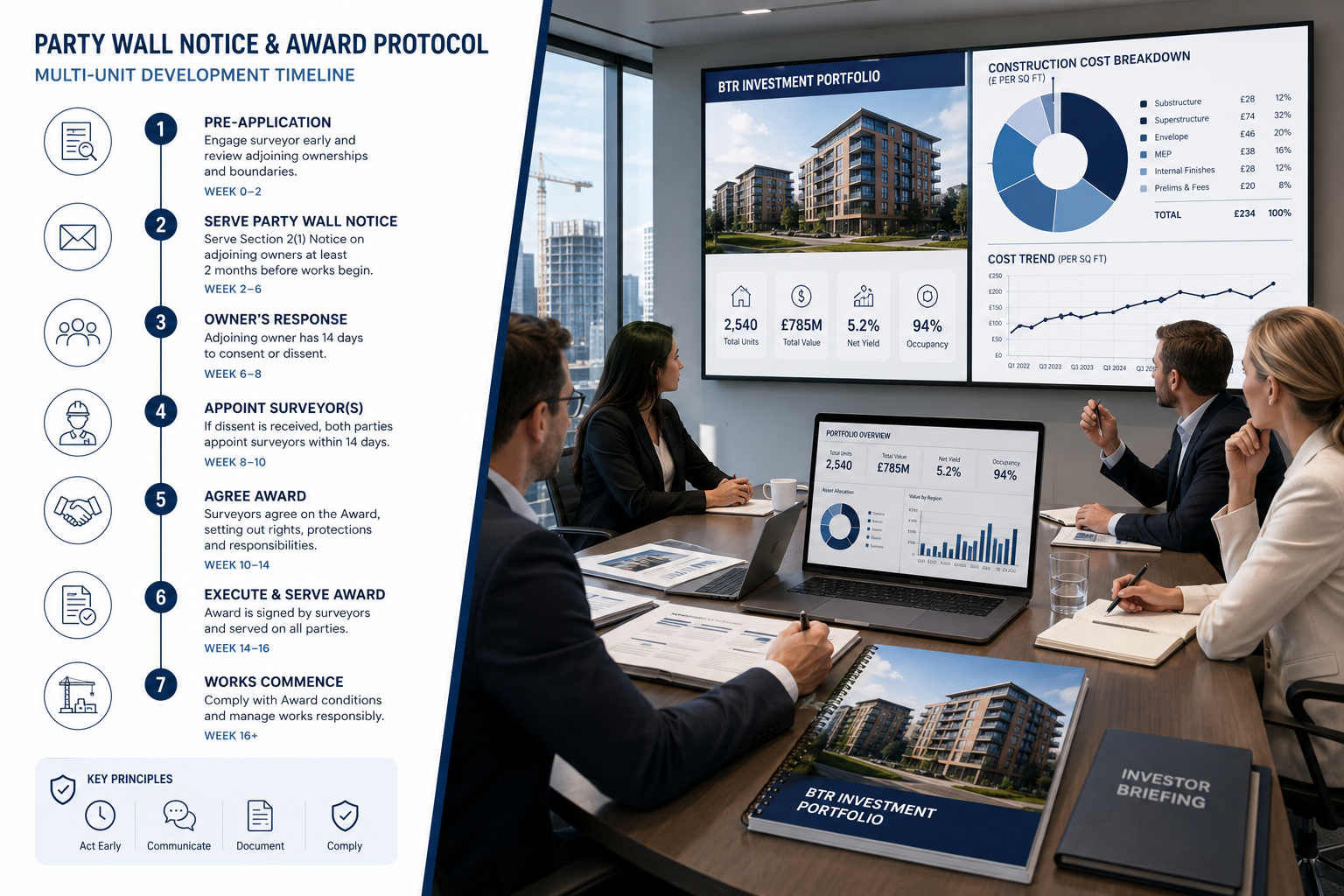
Characteristics of Northern Urban BTR Sites
- Victorian and Edwardian terraced housing stock with shallow foundations that are sensitive to nearby excavation
- Back-to-back and courtyard arrangements where multiple shared walls exist on a single plot
- Irregular plot boundaries that complicate line-of-junction determinations
- Mixed tenure — freehold, leasehold, and shared ownership — affecting who qualifies as an "adjoining owner" under the Act
The party wall excavation notice process is particularly critical in these settings. Deep pile foundations, which are common in BTR schemes to achieve the structural loads required for multi-storey residential blocks, frequently fall within the 3-metre and 6-metre excavation zones of neighbouring Victorian properties.
Institutional Investors and Party Wall Due Diligence
Institutional investors — pension funds, REITs, and private equity vehicles — are increasingly sophisticated in their due diligence requirements. A BTR scheme that proceeds without proper party wall compliance exposes the developer to:
- Injunctions that halt construction and trigger programme overruns
- Damage claims from adjoining owners without a schedule of condition baseline
- Defective award challenges that invalidate the legal basis for completed works
- Reputational risk with institutional partners who require clean title on acquisition
For developers seeking to attract and retain institutional capital in the 2026 BTR market, party wall compliance is a value-protection measure as much as a legal obligation. Engaging chartered surveyors in London and across northern markets with specific BTR party wall experience is a practical step toward managing this risk.
Cost Considerations for BTR Party Wall Compliance
Party wall surveyor costs on BTR schemes are proportional to the complexity of the works and the number of adjoining owners involved. Understanding party wall surveyor costs at the outset allows developers to budget accurately and avoid the false economy of under-resourcing the party wall process.
On a typical BTR scheme with 10 to 20 adjoining owners, party wall costs — including notices, schedules of condition, and awards — can range from tens of thousands to over £100,000 depending on complexity. This is a modest sum relative to the cost of a single injunction-related programme delay.
Conclusion: Actionable Steps for BTR Developers and Surveyors in 2026
Party Wall Surveys for Build-to-Rent Schemes: RICS Guidance Amid Institutional Expansion in 2026 represents a convergence of two powerful forces: the accelerating institutional appetite for BTR assets and the most significant reform of party wall professional standards in over a decade. Developers, surveyors, and investors who understand this convergence will be better positioned to deliver compliant, programme-efficient BTR schemes.
Actionable next steps for BTR developers:
- Commission a boundary survey and adjoining owner identification exercise at RIBA Stage 2 — before design decisions lock in foundation and excavation strategies.
- Appoint an experienced party wall surveyor with specific BTR and multi-unit scheme experience at the earliest opportunity.
- Build notice periods and award programmes into the master construction programme, treating them as critical path items.
- Require comprehensive schedules of condition for all adjoining properties within the zone of influence before any notifiable works begin.
- Monitor the publication of the RICS 8th edition guidance and ensure appointed surveyors are operating in accordance with its updated standards [1][2].
- Brief institutional investors and their legal advisers on party wall compliance records as part of the standard due diligence package.
For surveyors, the 8th edition consultation signals a higher bar for competence, consistency, and independence. Staying current with RICS guidance is not merely a professional obligation — on BTR schemes where the stakes are measured in millions, it is a commercial imperative.
The BTR sector's expansion shows no sign of slowing. The legal frameworks governing shared boundaries have not changed, but the standards by which surveyors must navigate them are being raised. Those who prepare now will be the professionals and developers that institutional capital trusts most.
References
[1] RICS Launches Consultation on Updated Party Wall Practice Guidance – rics.org
[2] RICS 8th Edition Party Wall Guidance Post Consultation Changes and Immediate 2026 Implementation for Surveyors – canterburysurveyors.com
[3] BTR Under Construction 1Q 2026 – realpage.com
[4] Red Cedar Construction 75M Investment Build Rent – mecktimes.com
[5] Blackstone Adds More Build-to-Rent Housing in California's Inland Empire – homes.com
[6] Build Rent Through Q1 2026 Three Years Data Reveal Stable Demand Shifting Supply and Capital – naahq.org
[7] Home Survey Standards – rics.org
[8] NHK Capital Partners Celebrates Grand Opening of Soltera Rolling Pines – globenewswire.com
[9] RICS Consumer Guide Party Walls – ricsfirms.com
How Prince Surveyors can help: explore our party wall surveyors or learn about our party wall surveyor costs.