

Fewer than one in three building owners who trigger the Party Wall etc. Act 1996 process know they have the legal right to challenge an adjoining owner's surveyor fees before those fees are formally awarded — a gap in knowledge that costs thousands of pounds every year. Understanding the full Party Wall Surveyor Fees Breakdown 2026: Negotiation Tactics and Recovery from Adjoining Owners is not just useful background reading; it is a practical financial safeguard for anyone undertaking works that affect a shared boundary.
This guide cuts through the complexity of notices, awards, and inspections to show exactly where costs arise, who is legally responsible for paying them, and how building owners can push back against excessive charges under current regulations.
Key Takeaways
- The building owner who initiates notifiable works is generally liable for all reasonable surveyor fees, including those of the adjoining owner's appointed surveyor.
- Appointing a single agreed surveyor can reduce total costs by 30–50% compared to each party appointing their own surveyor.
- London-based party wall surveyors charge significantly more than regional counterparts, with hourly rates ranging from £200 to £400 in the capital versus £80 to £200 elsewhere.
- Building owners can legally challenge fees they consider disproportionate, particularly where an adjoining owner's surveyor has appointed unnecessary consultants or billed excessive hours.
- Early neighbour communication, correct notice service, and fixed-fee agreements are the three most effective tools for controlling costs before they escalate.
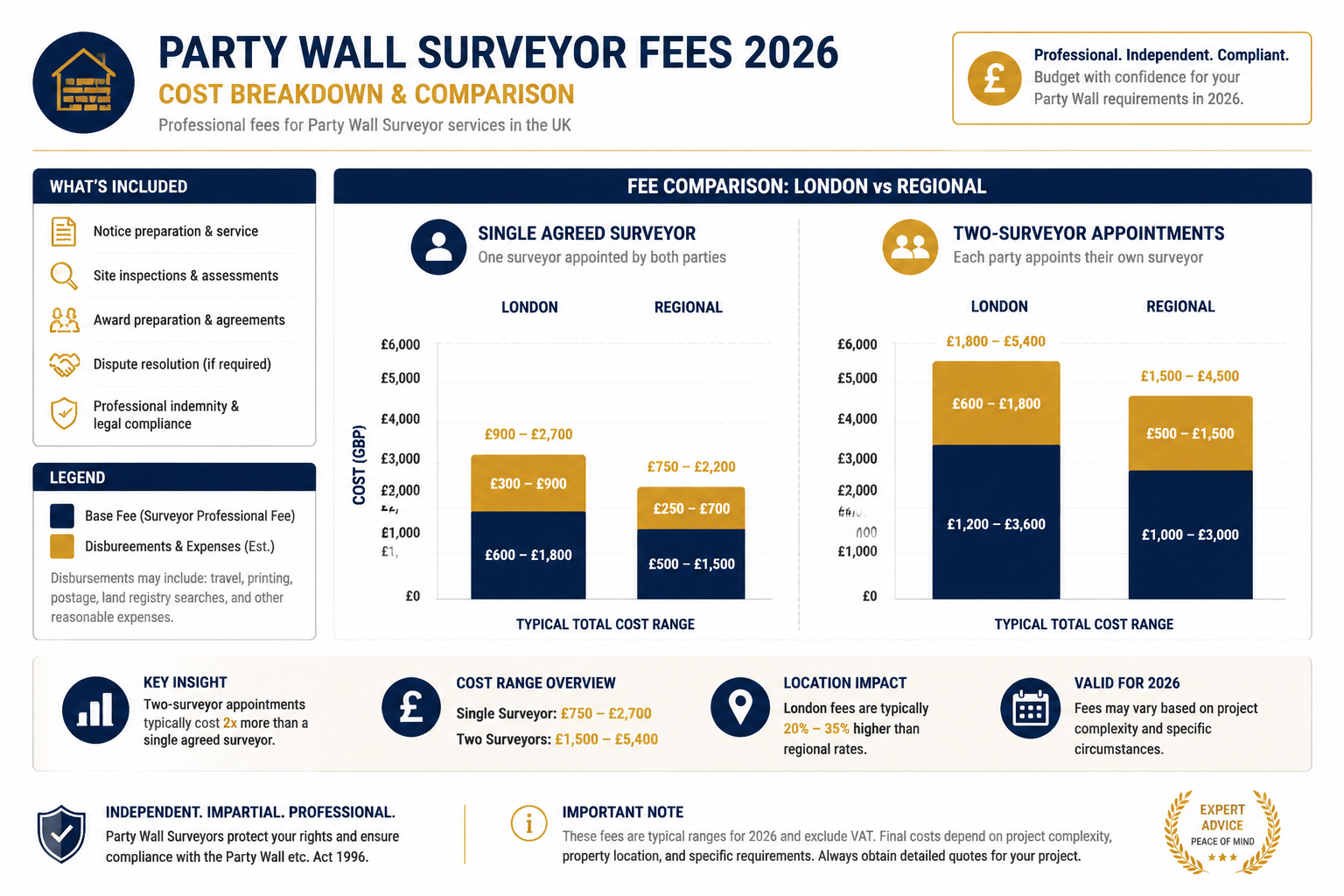
Understanding the Full Cost Structure of Party Wall Surveyor Fees in 2026
Before negotiating or challenging any charge, it helps to understand exactly what drives fees at each stage of the party wall process.
Stage-by-Stage Fee Drivers
Party wall surveyor costs do not arrive as a single invoice. They accumulate across several distinct stages:
1. Notice preparation and service
Serving a valid party wall notice is the starting point. Some surveyors include notice preparation within a fixed-fee package; others bill it as a separate line item. Expect to pay £150–£350 for this stage alone if billed hourly.
2. Schedule of condition
A pre-works photographic and written record of the adjoining owner's property protects both parties if damage claims arise later. This typically costs £150–£300 and is strongly recommended for any project involving excavation or structural alteration. For more on damage claims, see the guidance on damage to property in party wall matters.
3. Drafting and agreeing the party wall award
This is the most time-intensive stage. The award sets out the rights and obligations of both parties, the method of working, and the hours during which work may proceed. For a straightforward domestic project with a single adjoining owner, total fees typically range from £700 to £1,500. [1]
4. Site inspections during works
Inspections during construction are billed either as a fixed visit fee or against an hourly rate. Complex projects, such as basement excavations, can require multiple visits and push total costs well above £10,000, with some cases reaching £15,000. [2]
5. Post-works inspection
A final visit confirms the condition of the adjoining property matches the pre-works schedule of condition, closing out the surveyor's involvement.
Fee Ranges at a Glance
| Scenario | Typical Total Fee Range |
|---|---|
| Single agreed surveyor, simple project | £900 – £2,700 |
| Two separate surveyors, simple project | £1,800 – £5,400 |
| Complex project (e.g., basement, multiple adjoining owners) | £5,000 – £15,000+ |
| Third surveyor referral | Additional £500 – £1,500 |
Sources: [3] [5]
Geographic Variation
Location is one of the biggest cost variables. In London, hourly rates range from £200 to £400, while regional surveyors typically charge £80 to £200 per hour. [2] This disparity reflects both the higher cost of living in the capital and the concentration of complex, high-value projects. Homeowners in areas such as South West London or North London should factor in these premium rates when budgeting.
Fixed Fees vs. Hourly Billing
Fixed-fee arrangements have become more widely available in 2026 and offer genuine cost certainty for straightforward projects. Hourly billing remains standard for complex, multi-party projects where the scope of work is difficult to predict at the outset. [3]
Key point: Always request a written fee estimate before appointing any surveyor, and clarify whether the quote covers the entire process or only specific stages.
Who Pays Party Wall Surveyor Fees: Legal Responsibilities Explained
The default rule under the Party Wall etc. Act 1996 is clear: the building owner who initiates the notifiable works pays all reasonable surveyor fees, including those of the adjoining owner's surveyor. [4] This is one of the most misunderstood aspects of the entire process and a frequent source of disputes.
When the Building Owner Pays
In the vast majority of residential projects — rear extensions, loft conversions, basement works — the building owner bears the full cost. This includes:
- Their own surveyor's fees
- The adjoining owner's surveyor's fees (if the adjoining owner appoints one)
- Any third surveyor fees if a referral becomes necessary
For a detailed look at how this applies to specific project types, the party wall matters overview provides useful context.
Exceptions to the Default Rule
There are limited circumstances where the adjoining owner may share or bear costs:
- Shared benefit works: Where both owners benefit from the work — for example, repairing a defective shared wall — costs may be apportioned proportionally.
- Unnecessary obstruction: If an adjoining owner unreasonably refuses consent or appoints a surveyor who prolongs proceedings without justification, a surveyor or third surveyor may apportion some costs to the adjoining owner.
- Adjoining owner-initiated inspections: If the adjoining owner requests additional inspections beyond what the project reasonably requires, those additional costs may be recoverable from them.
The Agreed Surveyor Option
Appointing a single party wall agreed surveyor — one professional who acts impartially for both parties — is the most cost-effective route. It can cut total costs by 30–50% compared to each party appointing their own surveyor. [5] The agreed surveyor approach works best when the relationship between neighbours is cooperative and the project is relatively straightforward.
Additional Costs to Budget For
Beyond core surveyor fees, building owners should plan for: [6]
- Schedule of condition photography: £150–£300
- Structural engineer consultations: £300–£800
- Legal advice (if disputes escalate): £200–£500 per hour
For loft conversion projects specifically, the party wall considerations for loft conversions page outlines additional cost factors worth reviewing.

Party Wall Surveyor Fees Breakdown 2026: Negotiation Tactics and Recovery from Adjoining Owners
Knowing the fee structure is one thing. Knowing how to challenge and recover costs is another. The Party Wall Surveyor Fees Breakdown 2026: Negotiation Tactics and Recovery from Adjoining Owners framework rests on three pillars: pre-appointment negotiation, in-process challenge, and post-award recovery.
Pre-Appointment Negotiation Tactics
The most powerful cost control happens before any surveyor is formally appointed.
Communicate early with neighbours. Serving notice at the right time — typically two months before structural works and one month before excavation works — and having an informal conversation with neighbours beforehand dramatically reduces the likelihood of dissent. When neighbours feel informed rather than ambushed, they are far less likely to appoint their own surveyor. [5]
Propose the agreed surveyor route in writing. When serving notice, include a written suggestion that both parties use a single agreed surveyor. Name a specific RICS-regulated professional and provide their fee schedule. This creates a documented record that the building owner acted reasonably and in good faith.
Request fixed-fee quotes from multiple surveyors. In 2026, fixed-fee arrangements are increasingly available. Obtaining two or three written quotes gives a clear market benchmark and strengthens any later challenge to an adjoining owner's surveyor's fees. [3]
Challenging Excessive Adjoining Owner Surveyor Fees
Under the Act, the building owner is only obligated to pay reasonable fees. This is a critical qualifier. Grounds for challenging an adjoining owner's surveyor's fees include:
- Unjustified hourly rates: If the adjoining owner's surveyor charges £350 per hour for a simple terraced house extension, that rate can be challenged as disproportionate to the complexity of the work.
- Unnecessary consultant appointments: Surveyors who appoint structural engineers, legal advisers, or other consultants without clear justification inflate the total bill. These costs are challengeable. [3]
- Excessive time claims: Detailed time-recording should be requested. If a surveyor claims 12 hours to draft a standard award for a simple project, that claim is open to scrutiny.
- Duplication of effort: Where an agreed surveyor could have handled the matter, the additional cost of a second surveyor appointment may be argued as unnecessary.
How to formally challenge fees:
- Write to the adjoining owner's surveyor requesting a full itemised fee breakdown.
- Compare the claimed fees against published RICS guidance and market rates.
- If agreement cannot be reached, refer the fee dispute to the third surveyor under Section 10 of the Act.
- As a last resort, the County Court has jurisdiction to review party wall award fees.
Recovery Strategies After the Award
Once a party wall award has been made, recovery options narrow but do not disappear.
Third surveyor referral. Either surveyor can refer a fee dispute to the third surveyor, whose determination is binding. This adds £500–£1,500 to total costs but can recover significantly more if the original fees were inflated. [5]
Award amendment. If new evidence of excessive billing emerges after the award is made, an application can be made to amend the award under Section 10(12) of the Act.
Damage claims and cost offsetting. If the adjoining owner later makes a damage claim that is found to be exaggerated or unfounded, the costs of defending that claim — including surveyor time — may be recoverable. See the guidance on damage to property in party wall matters for more detail.
Dispute Escalation: The Third Surveyor
When the two appointed surveyors cannot agree on fees or any other matter, a third surveyor — selected at the time of appointment — is called in. Their decision is final and binding on both parties. [5] The third surveyor process is not an appeal mechanism; it is a dispute resolution tool. Using it strategically, rather than reactively, is key to cost management.

Practical Steps to Minimise Party Wall Surveyor Costs in 2026
A structured approach before, during, and after works significantly reduces the risk of fee disputes escalating.
Before Serving Notice
- Review whether the proposed works actually trigger the Act. Not all works near a boundary require a party wall notice. The Party Wall Act 3-metre rule is a common source of confusion and unnecessary notice service.
- Instruct a surveyor who offers a transparent, itemised fee structure from the outset.
- Have an informal conversation with neighbours before formal notice is served.
During the Award Process
- Keep communication with the adjoining owner's surveyor professional and documented.
- Request regular fee updates rather than waiting for a final invoice.
- Query any consultant appointments promptly — delays in raising objections can weaken a later challenge.
After Works Complete
- Ensure the post-works inspection is carried out promptly to close out the surveyor's involvement and stop the clock on hourly billing.
- Retain all correspondence, fee schedules, and time records for at least six years.
- If a damage claim arises, instruct a surveyor immediately to document the condition and prevent costs from escalating unchecked.
Common Mistakes That Inflate Costs
| Mistake | Likely Cost Impact |
|---|---|
| Serving notice too late | Delays, additional surveyor time |
| Failing to propose agreed surveyor | Doubles total surveyor fees |
| Not requesting fixed-fee quotes | Exposure to open-ended hourly billing |
| Ignoring early fee escalation signals | Larger final invoice, harder to challenge |
| Allowing damage claims to go unmanaged | Additional surveyor and legal costs |
Conclusion
The Party Wall Surveyor Fees Breakdown 2026: Negotiation Tactics and Recovery from Adjoining Owners is not a passive exercise in cost acceptance. Building owners have real, legally grounded tools to control, challenge, and recover surveyor costs — provided they act early and with a clear understanding of how fees accumulate.
The most effective strategy combines early neighbour communication, a written proposal for an agreed surveyor, fixed-fee quotes from multiple professionals, and a willingness to formally challenge any fees that cannot be justified against market rates or RICS guidance.
Actionable next steps:
- Before serving any notice, check whether the works genuinely trigger the Act and review the party wall matters guidance for clarity.
- Serve the correct notice at the correct time using a qualified surveyor familiar with current regulations.
- Propose the agreed surveyor route in writing to the adjoining owner as part of the notice process.
- Request itemised, fixed-fee quotes from at least two RICS-regulated surveyors before appointing anyone.
- If fees from an adjoining owner's surveyor appear excessive, request a full time-record breakdown immediately and compare against published benchmarks.
- If agreement cannot be reached, do not hesitate to invoke the third surveyor mechanism — it exists precisely for this purpose.
Taking these steps in 2026 can mean the difference between a smoothly managed, cost-controlled process and a fee dispute that outlasts the building works themselves.
References
[1] Party Wall Surveyor Cost – aylingassociates.com
[2] The Reality Of Party Wall Surveying In 2026 Fees Disputes And Daily Challenges From Industry Pros – canterburysurveyors.com
[3] Party Wall Surveyor Fee Disputes 2026 Negotiation Tactics And Rics Fee Scales – partywallsurveyorlondon.uk
[4] Who Pays For A Party Wall Surveyor – legalclarity.org
[5] Cost Breakdown Of Party Wall Agreements In 2026 Surveyor Fees Who Pays What And Budgeting For Disputes – manchestersurveyors.com
[6] Who Pays Party Wall Surveyor Fees Cost Breakdown And Recovery Strategies Under The 2026 Act – partywallsurveyorlondon.uk
How Prince Surveyors can help: explore our party wall surveyors or learn about our party wall surveyor costs.