

Last updated: July 24, 2026
Quick Answer: Under the Party Wall etc. Act 1996, UK homeowners must serve written party wall notices on adjoining owners before carrying out any work that affects a shared wall, boundary, or nearby foundations, and this applies directly to many solar panel and EV charger installations in 2026. The notice period is at least two months for works directly on a party wall, and at least one month for line-of-junction works. A boundary survey is a separate but often complementary step that confirms exactly where your land ends and your neighbour's begins before any installation proceeds.
Key Takeaways
- The Party Wall etc. Act 1996 applies to renewable energy projects where work affects a shared wall, boundary structure, or involves excavation near a neighbour's foundations.
- Written party wall notices must be served at least two months before party wall works and at least one month before line-of-junction works.
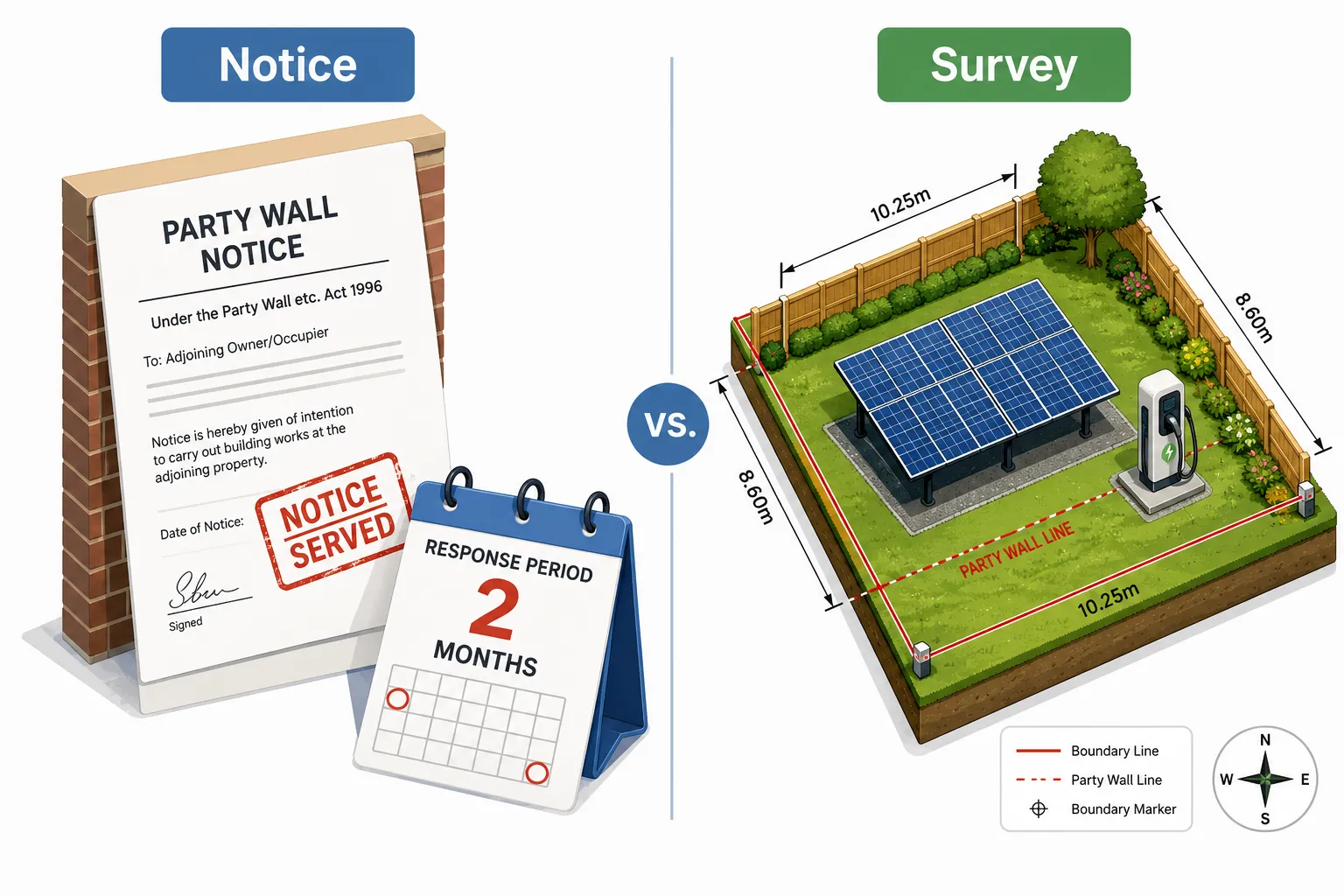
- A boundary survey is not the same as a party wall notice, one confirms land ownership limits, the other is a statutory legal requirement.
- EV charger installations near or on a party fence wall, and ground-mounted solar arrays with concrete footings, are the most common triggers for party wall obligations in 2026.
- Flat roof solar installations on terraced or semi-detached properties frequently require party wall notices because the roof structure is often shared.
- Ignoring the Act can result in injunctions, forced removal of equipment, and neighbour disputes that delay or derail your project.
- Costs for a party wall surveyor typically range from £700 to £2,000 per adjoining owner, depending on complexity.
- You can appoint an agreed surveyor jointly with your neighbour to reduce costs and speed up the process.

What Is a Party Wall Notice and Why Do You Need One for Solar Panels
A party wall notice is a formal written document served on an adjoining owner to inform them of proposed building works that fall under the Party Wall etc. Act 1996. For solar panel installations, a notice is required whenever the work involves cutting into, loading on, or otherwise physically affecting a party wall or party fence wall, or when foundations for a ground-mounted system are close enough to a neighbour's structure to trigger the Act's excavation provisions.
Many homeowners assume solar panels are a simple permitted development matter that only involves their own roof. That assumption is often wrong. On a terraced or semi-detached property, the roof structure, party wall, and even the eaves may be shared or structurally connected to the adjoining property. Drilling through a chimney breast that forms part of a party wall, attaching brackets to a shared gable, or running cable through a party wall all require prior notice.
When a party wall notice is required for solar installations:
- Fixing mounting brackets directly into a party wall or shared gable end
- Running conduit or cabling through a party wall
- Installing a flat roof solar array on a roof that is structurally shared with a neighbour
- Excavating for ground-mounted solar panel footings within three metres of a neighbour's building (or six metres if the excavation depth exceeds the neighbour's foundations)
For a broader overview of when the Act applies and how the process works, the top questions about party wall surveys guide covers the fundamentals in plain language.
Do You Need a Boundary Survey Before Installing Solar Panels
A boundary survey is strongly recommended before any solar or EV charger installation that involves ground-level work near a property boundary. A boundary survey establishes the precise legal limits of your land, which determines whether proposed footings, cable trenches, or mounting structures fall within your ownership or encroach onto a neighbour's land.
Without a boundary survey, homeowners risk installing equipment on land they do not legally own, an error that can be expensive and legally complex to resolve. The average cost of a boundary dispute makes clear that prevention is far cheaper than resolution after the fact.
You should commission a boundary survey before installation if:
- You are installing a ground-mounted solar array in a garden or field
- You plan to run underground cable trenches near a fence or wall
- Your title deeds or Land Registry plan show an unclear or disputed boundary
- A neighbour has previously raised concerns about the boundary position
- The property has been subdivided, extended, or had outbuildings added in recent decades
A boundary survey produces a measured plan that can be used alongside party wall drawings to give all parties, and any appointed surveyor, a clear picture of the works.
What Is the Difference Between a Party Wall Notice and a Boundary Survey
These are two distinct legal and professional processes that often need to work together on renewable energy projects.
| Aspect | Party Wall Notice | Boundary Survey |
|---|---|---|
| Legal basis | Party Wall etc. Act 1996 | Land law / title deeds |
| Purpose | Notify neighbour of works affecting shared structures | Establish precise land ownership limits |
| Who prepares it | Building owner (or their surveyor) | Chartered surveyor (RICS-qualified) |
| Trigger | Works on/near party wall or within excavation zones | Unclear or disputed boundary; ground-level works |
| Output | Formal notice document; potentially a Party Wall Award | Measured boundary plan / report |
A party wall notice does not confirm where your boundary is, it simply notifies your neighbour of works that may affect shared structures. A boundary survey does not authorise you to carry out those works. Both may be needed on the same project.
Party Wall Act Requirements for EV Charger Installation Near a Property Line
For most domestic EV charger installations, a wall-mounted unit on an external house wall, the Party Wall etc. Act is unlikely to apply unless the charger is being fixed to a party wall or the cable route requires cutting through one. However, ground-mounted EV charger posts with concrete foundations near a boundary are a different matter.
If a ground-mounted EV charger post requires a concrete footing and that footing is within three metres of a neighbour's building, the excavation provisions of the Act are triggered. A one-month notice must be served on the adjoining owner before work begins.
Common EV charger scenarios and their party wall implications:
- Wall-mounted charger on your own external wall: no notice required in most cases
- Wall-mounted charger drilled into a party wall: notice required
- Ground-mounted post with concrete footing within 3m of neighbour's structure: notice required
- Cable trench running parallel to and near a party fence wall: assess depth and proximity; seek professional advice
If you are unsure whether your planned EV charger installation triggers the Act, consulting a party wall surveyor before starting is the safest course.
Can You Install Solar Panels Without Notifying Your Neighbour
No, if the installation work falls within the scope of the Party Wall etc. Act 1996, you cannot lawfully start without first serving the correct notice. Proceeding without notice does not make the work illegal in a criminal sense, but it removes your legal protections and exposes you to injunctions and claims for damages.
A common misconception is that permitted development rights for solar panels remove the need for party wall compliance. They do not. Permitted development covers planning permission only. The Party Wall etc. Act is entirely separate legislation. You can have full permitted development rights and still be obliged to serve a party wall notice.
For more on this point, the article on common misconceptions about party wall agreements addresses exactly this confusion. The consequences of ignoring the Party Wall Act are also worth reviewing before proceeding without advice.
Party Wall Notice Timeline: How Long Before You Can Start a Solar Installation
The notice period depends on the type of work involved. For works directly on a party wall, for example, fixing solar mounting brackets into a shared gable or cutting through a party wall to run cabling, the notice must be served at least two months before work begins. For line-of-junction works (building on or near the boundary line), the minimum notice period is one month.
Party wall notice timeline for a typical solar installation:
- Confirm whether the Act applies (consult a surveyor if unsure)
- Serve written notice on each adjoining owner
- Wait for consent or dissent (neighbours have 14 days to respond)
- If the neighbour consents in writing, work can proceed after the notice period
- If the neighbour dissents or does not respond, a surveyor must be appointed and a Party Wall Award issued before work starts
- Once the Award is in place, work can begin
The full process from notice to Award can take six to ten weeks if a neighbour dissents, so build this into your project timeline. Rushing this stage is one of the most common mistakes on renewable energy projects.
Who Qualifies as an Adjoining Owner for Party Wall Purposes
An adjoining owner is any person who owns or occupies property that shares a party wall, party fence wall, or boundary with the building owner carrying out the works. This includes freeholders, leaseholders with a lease of more than one year, and mortgagees in possession.
For a terraced house, this typically means the owners on either side. For a semi-detached property, it means the one attached neighbour. For a detached property, adjoining owners are those whose land is close enough to be affected by excavation works under the Act.
Key points on adjoining owner status:
- Tenants with leases of one year or less are not adjoining owners under the Act
- If a property is jointly owned, all owners must be served
- If the adjoining property is rented, both the landlord (freeholder) and the long leaseholder (if any) may need to be served
- Local authorities and housing associations count as adjoining owners if they own the neighbouring property
Do Flat Roof Solar Installations Require Party Wall Notices
Yes, in many cases they do. Flat roof solar installations on terraced or semi-detached properties are one of the most frequently overlooked triggers for party wall obligations in 2026. The flat roof of a terraced property is often a party structure, meaning it is shared between two or more properties, or it sits directly on walls that are party walls.
Fixing ballasted solar frames or penetrating the roof membrane to install mounting anchors on a flat roof that forms part of a party structure requires a party wall notice. Even ballasted (non-penetrating) systems add load to the structure, which can be relevant where the roof is shared.
Before commissioning a flat roof solar installation, a party wall schedule of condition is advisable. This documents the existing condition of the shared structure before work begins, protecting both the building owner and the adjoining owner if any damage is later alleged.
Common Mistakes People Make With Party Wall Notices on Solar Projects
The most frequent errors are serving notice too late, serving it on the wrong person, or assuming the Act does not apply because the work seems minor.
Mistakes to avoid:
- Serving notice after signing a contract with an installer: Installers often want to start quickly. Serve notice before you commit to a start date.
- Assuming roof-only work is always exempt: Flat roofs and shared gable walls are common exceptions.
- Not checking all adjoining owners: Corner properties may have multiple neighbours to notify.
- Using an informal letter instead of a valid statutory notice: The notice must meet specific requirements under the Act.
- Failing to record the condition of adjoining property before works: Without a schedule of condition, any pre-existing damage could be attributed to your project.
- Ignoring the Act because the neighbour seems agreeable: Verbal consent has no legal standing under the Act.
How Much Does a Party Wall Survey Cost for Renewable Energy Projects
Party wall surveyor fees for renewable energy projects typically range from £700 to £2,000 per adjoining owner, though straightforward cases can be lower and complex disputes can cost more. The building owner generally pays the surveyor's fees, including those of the adjoining owner's surveyor if the neighbour appoints one separately.
Appointing an agreed surveyor, one surveyor acting for both parties, is the most cost-effective route where the neighbour is willing. This can reduce total fees significantly compared to each party appointing their own surveyor.
For a detailed breakdown of what drives costs, the cost of a party wall agreement guide provides practical figures and explains what is included. The cost of a party wall surveyor article covers hourly rates and fixed-fee options.
Factors that affect cost:
- Number of adjoining owners
- Whether neighbours consent or dissent
- Complexity of the works (flat roof vs. simple wall fixing)
- Whether a schedule of condition is required
- Whether a formal Party Wall Award is needed
What to Do If a Neighbour Disputes Your Solar Panel Installation
If a neighbour dissents to your party wall notice or raises a dispute about your solar installation, the statutory process under the Act provides a clear resolution path. A surveyor (or two surveyors, one per party) will be appointed to assess the works and issue a Party Wall Award. This Award sets out the conditions under which work may proceed and is legally binding on both parties.
Do not attempt to proceed with works while a dispute is unresolved. Doing so can result in an injunction stopping the works entirely. The party wall disputes process is designed to be neutral, the surveyors act as quasi-arbitrators, not advocates for either side.
If a neighbour refuses to engage at all or will not appoint a surveyor, the Act provides for the building owner's surveyor to appoint a surveyor on the neighbour's behalf after a set period. For guidance on this scenario, see the article on what happens when a neighbour refuses party wall works.
Is a Party Wall Notice Required for Ground-Mounted EV Chargers
A party wall notice is required for a ground-mounted EV charger if its concrete footing involves excavation within three metres of a neighbour's building or structure, or within six metres if the excavation is deeper than the neighbour's foundations. This falls under Section 6 of the Party Wall etc. Act 1996 (the excavation provisions).
A simple surface-mounted post with a shallow ground anchor in the middle of a large garden is unlikely to trigger the Act. But a post with a substantial concrete footing near a boundary wall, garage, or outbuilding almost certainly will.
Decision rule: If the footing depth plus proximity to a neighbour's structure raises any doubt, commission a brief professional assessment before breaking ground. The cost of that advice is negligible compared to the cost of a dispute.
Party Wall Notice Requirements in England and Wales for 2026 Installations
The Party Wall etc. Act 1996 applies in England and Wales only. Scotland and Northern Ireland have different legal frameworks for boundary and neighbour disputes, and neither has a direct equivalent of the Party Wall Act.
In England and Wales, as of 2026, the Act remains unchanged in its core requirements. Recent local authority guidance (including updates issued in mid-2026) reiterates that written notices must be served within the statutory timeframes and that verbal or informal agreements do not satisfy the Act's requirements.
Key jurisdictional points for 2026:
- England and Wales: Party Wall etc. Act 1996 applies; written notices mandatory
- Scotland: No equivalent Act; boundary matters handled under Scots property law and the common law of nuisance
- Northern Ireland: No equivalent Act; seek local legal advice
- Republic of Ireland: Separate jurisdiction; different planning and neighbour law applies
For properties in England and Wales, the Act's requirements are non-negotiable regardless of the scale of the renewable energy project.
FAQ
Does permitted development for solar panels remove the need for a party wall notice?
No. Permitted development rights cover planning permission only. The Party Wall etc. Act 1996 is separate legislation and applies independently of planning status. You can have full permitted development rights and still be legally required to serve a party wall notice.
How long does the party wall process take for a solar installation?
If a neighbour consents in writing within 14 days of receiving the notice, work can begin after the notice period (one or two months depending on the work type). If a neighbour dissents or does not respond, the full process including surveyor appointment and Award can take six to ten weeks from the date of notice.
Can I use the same surveyor as my neighbour?
Yes. An agreed surveyor acts for both parties and is often the most cost-effective option. Both parties must consent to the appointment. The agreed surveyor must act impartially.
What happens if I start solar installation work without serving a party wall notice?
Your neighbour can apply to court for an injunction to stop the works. You also lose the legal protections the Act provides, including the right to a formal Award that sets out agreed working conditions. Retrospective consent is possible but is not guaranteed and can be costly.
Does a boundary survey need to be done by a chartered surveyor?
For a boundary survey to carry legal weight, for example, in a dispute or as evidence in a party wall process, it should be carried out by a chartered surveyor (RICS-qualified). A general builder or installer cannot produce a legally reliable boundary determination.
Are leaseholders required to serve party wall notices?
Yes. Leaseholders who wish to carry out works covered by the Act must serve notices in the same way as freeholders. They may also need consent from their freeholder under the terms of their lease, in addition to complying with the Act.
Conclusion
Party wall notices for renewable energy projects are not a bureaucratic afterthought, they are a legal requirement that protects both the building owner and the adjoining owner when solar panels or EV chargers are installed near shared structures or boundaries. In 2026, with solar and EV charger uptake accelerating across the UK, the risk of disputes and injunctions caused by skipped or incorrectly served notices is higher than ever.
Actionable next steps:
- Before signing any installation contract, establish whether your proposed works affect a party wall, party fence wall, or involve excavation near a neighbour's structure.
- Commission a boundary survey if any ground-level works are planned near a property boundary.
- Serve the correct statutory notice on all adjoining owners within the required timeframes, two months for party wall works, one month for line-of-junction works.
- If a neighbour dissents or you anticipate a dispute, appoint a qualified party wall surveyor promptly to avoid delays.
- Arrange a schedule of condition before works begin to protect all parties.
A chartered surveyor experienced in both party wall matters and renewable energy installations can handle the notice, survey, and Award process efficiently. Starting that conversation early, before your installer books a date, is the single most effective way to keep your 2026 solar or EV charger project on track.
.pw-checker{font-family:Arial,sans-serif;max-width:540px;margin:2rem auto;background:#f8f9fa;border:1px solid #dde2e8;border-radius:8px;padding:1.5rem}
.pw-checker h3{margin:0 0 1rem;font-size:1.1rem;color:#1a2e44}
.pw-checker label{display:block;margin:.6rem 0 .2rem;font-size:.9rem;color:#333;font-weight:600}
.pw-checker select{width:100%;padding:.45rem;border:1px solid #ccc;border-radius:4px;font-size:.9rem;background:#fff}
.pw-btn{margin-top:1rem;padding:.55rem 1.2rem;background:#1a6b3c;color:#fff;border:none;border-radius:4px;font-size:.95rem;cursor:pointer;width:100%}
.pw-btn:hover{background:#145530}
.pw-result{margin-top:1rem;padding:.85rem 1rem;border-radius:6px;font-size:.9rem;line-height:1.5;display:none}
.pw-result.notice{background:#fff3cd;border-left:4px solid #e6a817;color:#5a3e00}
.pw-result.clear{background:#d4edda;border-left:4px solid #28a745;color:#155724}
.pw-result.check{background:#cce5ff;border-left:4px solid #0066cc;color:#003366}
Party Wall Notice Checker, Solar & EV Charger
function pwCheck(){
var w=document.getElementById(‘pw-work’).value;
var b=document.getElementById(‘pw-boundary’).value;
var r=document.getElementById(‘pw-result’);
r.className=’pw-result’;r.style.display=’none’;
if(!w||!b){r.className=’pw-result check’;r.style.display=’block’;r.innerHTML=’Please select both options to get a result.’;return;}
var msg=”,cls=”;
if(w===’roof’&&b===’attached’){cls=’notice’;msg=’Notice likely required. Fixing into a shared gable or party wall triggers the Act. Serve notice at least 2 months before work starts.’;}
else if(w===’flat’){cls=’notice’;msg=’Notice likely required. Flat roofs on terraced/semi-detached properties are often party structures. A schedule of condition is also advisable.’;}
else if(w===’ground’&&b===’within3′){cls=’notice’;msg=’Notice required. Excavation within 3m of a neighbour’s structure triggers Section 6 of the Act. Serve at least 1 month’s notice.’;}
else if(w===’ev-post’&&b===’within3′){cls=’notice’;msg=’Notice likely required. Concrete footings within 3m of a neighbour’s building trigger the excavation provisions. Seek surveyor advice.’;}
else if(w===’ev-wall’&&b===’attached’){cls=’notice’;msg=’Check carefully. If the charger is fixed into a party wall or cable passes through it, a notice is required.’;}
else if(b===’over3’&&(w===’ground’||w===’ev-post’)){cls=’clear’;msg=’Notice unlikely required for excavation purposes. Confirm no other party wall elements are affected before proceeding.’;}
else if(w===’roof-det’){cls=’clear’;msg=’Notice unlikely required for a detached house roof installation, provided no shared walls or boundary structures are affected.’;}
else{cls=’check’;msg=’Professional assessment recommended. Your combination of work type and proximity may or may not trigger the Act. Consult a chartered surveyor before starting.’;}
r.className=’pw-result ‘+cls;r.style.display=’block’;r.innerHTML=msg;
}