

Rental voids in England fell to a record low of just 12 days on average in early 2025, according to data from Rightmove — and demand for Houses in Multiple Occupation (HMOs) has never been more intense. Landlords and developers are converting single-family properties at pace to meet that demand, yet many are walking straight into costly legal disputes because they have overlooked one critical framework: the Party Wall etc. Act 1996. Understanding the full scope of Party Wall Implications for HMO Conversions in Tight Rental Markets: 2026 Surveyor Compliance Checklist requirements is no longer optional — it is the difference between a profitable conversion and a project frozen by injunction.
Key Takeaways
- HMO conversions frequently trigger Party Wall Act obligations because structural works commonly affect shared walls, floors, and foundations.
- Serving the correct party wall notices before work begins is a legal requirement, not a courtesy — failure can expose landlords to injunctions and compensation claims.
- In tight rental markets, project delays caused by party wall disputes are especially costly, making early surveyor engagement essential.
- A formal party wall award protects both the building owner and the adjoining owner and sets legally binding conditions for how work must proceed.
- The 2026 compliance checklist for HMO surveyors covers notice timelines, schedule of condition surveys, sound insulation obligations, and dispute resolution pathways.
Why HMO Conversions Create Heightened Party Wall Risk
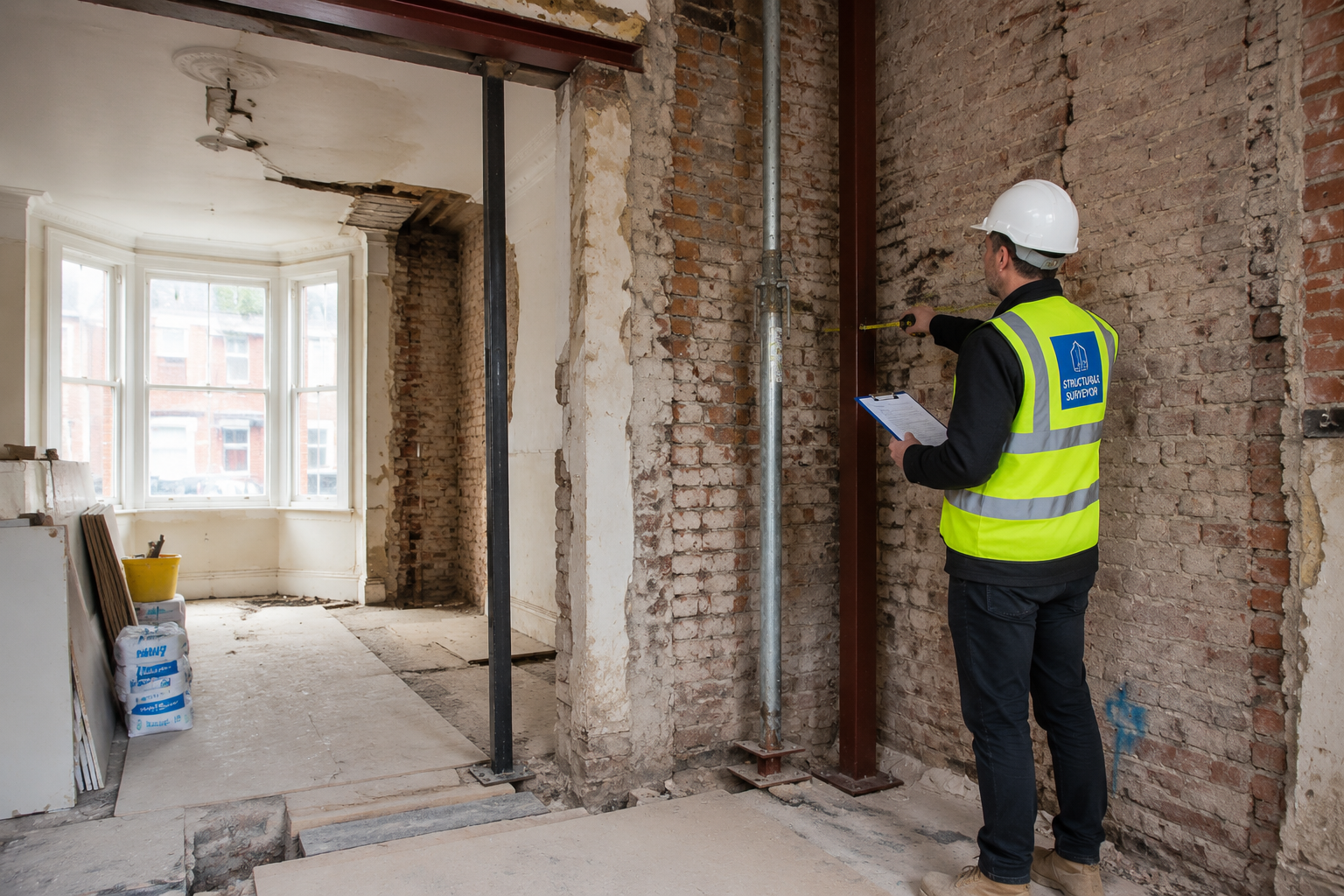
An HMO conversion is rarely a simple cosmetic refurbishment. To accommodate multiple tenants, developers typically undertake structural alterations: removing load-bearing walls, inserting new floor joists, installing en-suite bathrooms, upgrading fire compartmentation, and sometimes underpinning foundations to extend downward. Each of these activities can directly affect a party wall — the shared wall or structure that sits on the boundary between two properties.
Under the Party Wall etc. Act 1996, a "party wall" encompasses:
- Party walls proper: walls that stand astride the boundary and are shared by two owners.
- Party fence walls: walls that stand on the boundary but are not part of a building.
- Floors and ceilings: in converted flats or maisonettes, these also count as party structures.
For HMO conversions in terraced or semi-detached Victorian and Edwardian stock — the most common conversion targets in high-demand urban areas — almost every significant structural intervention will engage the Act. The risk is compounded because adjoining neighbours in dense urban streets are often owner-occupiers or private landlords who are acutely aware of their rights and quick to seek legal redress.
The Specific Works That Trigger Obligations
The Act identifies three categories of notifiable work:
| Section | Work Type | Typical HMO Trigger |
|---|---|---|
| Section 1 | New wall on or near boundary | Side extensions, outrigger additions |
| Section 2 | Works to existing party wall | Cutting in for beams, raising the wall, underpinning |
| Section 6 | Excavation near adjoining foundations | Basement conversions, new drainage runs |
A developer converting a mid-terrace into a six-bedroom HMO will almost certainly trigger Section 2 works when installing steel beams to open up ground-floor layouts, and may trigger Section 6 if drainage or underpinning is involved. Ignoring these obligations is not a grey area — it is a legal breach.
The 2026 Surveyor Compliance Checklist for HMO Party Wall Work
The Party Wall Implications for HMO Conversions in Tight Rental Markets: 2026 Surveyor Compliance Checklist below reflects current best practice as of 2026, incorporating updated RICS guidance and lessons learned from a rising volume of HMO-related party wall disputes in urban markets.
Step 1: Pre-Application Structural Assessment
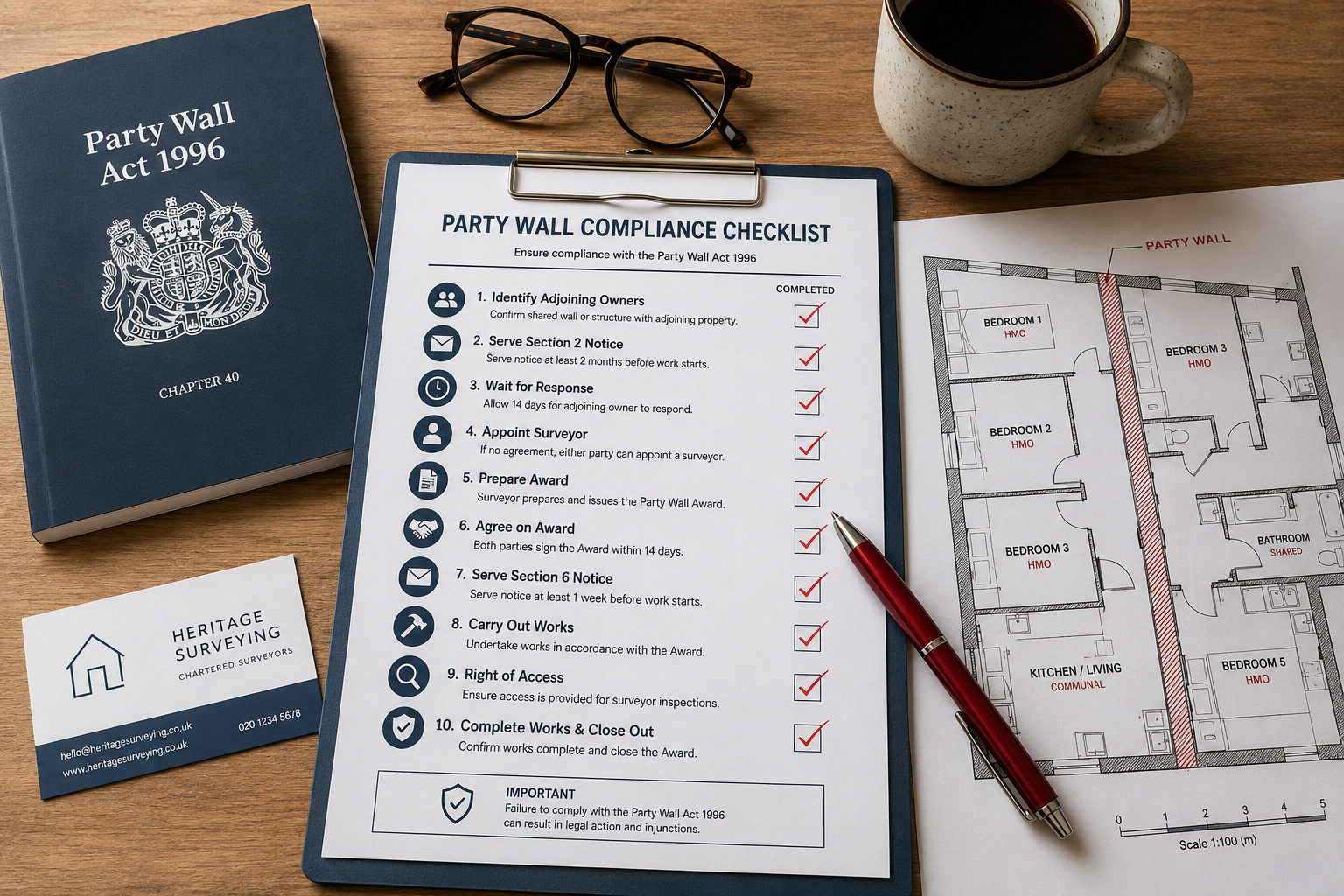
Before any planning or building regulations application is submitted, commission a structural engineer's assessment to identify every element of the proposed HMO conversion that will affect a party structure. This assessment should:
- Map all party walls, party floors, and party ceilings on a scaled drawing.
- Identify proposed beam positions, stud wall removals, and any excavation depths.
- Flag potential Section 1, 2, and 6 obligations.
This step prevents the common mistake of serving notices only for the most obvious works while overlooking secondary interventions — such as a new bathroom drainage run that passes within three metres of an adjoining foundation.
For a thorough pre-purchase or pre-conversion assessment, a Level 3 building survey is strongly advisable, as it will identify existing defects in the party wall that must be recorded before works begin.
Step 2: Serve Correct and Timely Party Wall Notices
The Act prescribes specific notice periods that cannot be shortened without the written consent of the adjoining owner:
- Section 1 notice: At least one month before work begins.
- Section 2 notice: At least two months before work begins.
- Section 6 notice: At least one month before work begins.
For HMO conversions in tight rental markets, two months is a significant delay if not planned for. Developers who start the clock early — ideally at the point of purchase — avoid the scenario where a fully funded, consented project sits idle waiting for a notice period to expire.
Notice content must include:
- The building owner's name and address.
- A description of the proposed works with drawings where relevant.
- The proposed start date.
- A statement that the Act applies.
Guidance on party wall act notices and how to respond is essential reading for any landlord managing this process without a solicitor.
Step 3: Manage Adjoining Owner Responses
Once a notice is served, the adjoining owner has 14 days to respond. Three outcomes are possible:
- Consent in writing: Work can proceed without a formal award, though a schedule of condition is still strongly recommended.
- Dissent and agreement on a single agreed surveyor: One surveyor acts for both parties — the most cost-efficient route.
- Dissent and appointment of separate surveyors: Each party appoints their own surveyor; the two then appoint a third surveyor in case of deadlock.
"In dense urban rental markets, adjoining owners are increasingly sophisticated. Many now instruct solicitors at the notice stage, making professional surveyor engagement from the outset a practical necessity rather than a luxury."
Understanding whether a neighbour can legally refuse a party wall agreement is a question developers frequently ask. The answer is nuanced: an adjoining owner cannot block notifiable works indefinitely, but they can trigger the formal award process, which takes time and costs money.
Step 4: Commission a Schedule of Condition
A schedule of condition is a detailed photographic and written record of the adjoining property's state before works begin. For HMO conversions, this document is critical because:
- It establishes a baseline against which any damage claims are assessed.
- It protects the building owner from inflated or fraudulent damage claims.
- It protects the adjoining owner by ensuring genuine damage is documented and remedied.
The schedule should cover all rooms adjacent to or above/below the party structure, including cellars, loft spaces, and external elevations. In properties with existing damp, cracking, or settlement — common in Victorian terraces — a thorough schedule of condition is the single most important document in any subsequent dispute.
Step 5: Obtain a Formal Party Wall Award
Where consent is not given, a party wall award is the legally binding document that governs how works proceed. For HMO conversions, the award typically specifies:
- Permitted working hours (critical for minimising impact on existing tenants in adjacent properties).
- Methods of work, particularly for cutting into or supporting the party wall.
- Dust, noise, and vibration controls.
- Insurance requirements.
- The right of the adjoining owner's surveyor to inspect works.
- Remediation obligations if damage occurs.
The award is enforceable in the County Court. Proceeding without one — where one is required — exposes the building owner to an injunction that can halt the entire project.
Step 6: HMO-Specific Sound Insulation Obligations
HMO conversions carry an additional compliance layer that interacts directly with party wall work: Approved Document E of the Building Regulations requires that walls and floors between dwellings meet specific sound insulation standards. When a party wall is opened up to insert beams or services, the opportunity — and obligation — to upgrade acoustic performance arises.
Surveyors preparing party wall awards for HMO conversions in 2026 should ensure the award references the building owner's obligation to restore or improve sound insulation to the required standard after any works to the party structure. Failure to address this in the award creates a gap that can lead to post-completion disputes and enforcement action from the local authority.
Step 7: Post-Works Inspection and Sign-Off
Once notifiable works are complete, the appointed surveyor(s) should conduct a post-works inspection comparing the current condition of the adjoining property against the schedule of condition. Any damage attributable to the works must be made good by the building owner at their own cost.
For HMO developers working at pace in competitive rental markets, this final step is often rushed or skipped. That is a mistake. An undocumented post-works inspection leaves the building owner exposed to claims months or even years after the conversion is complete.
Common Compliance Failures in HMO Conversions
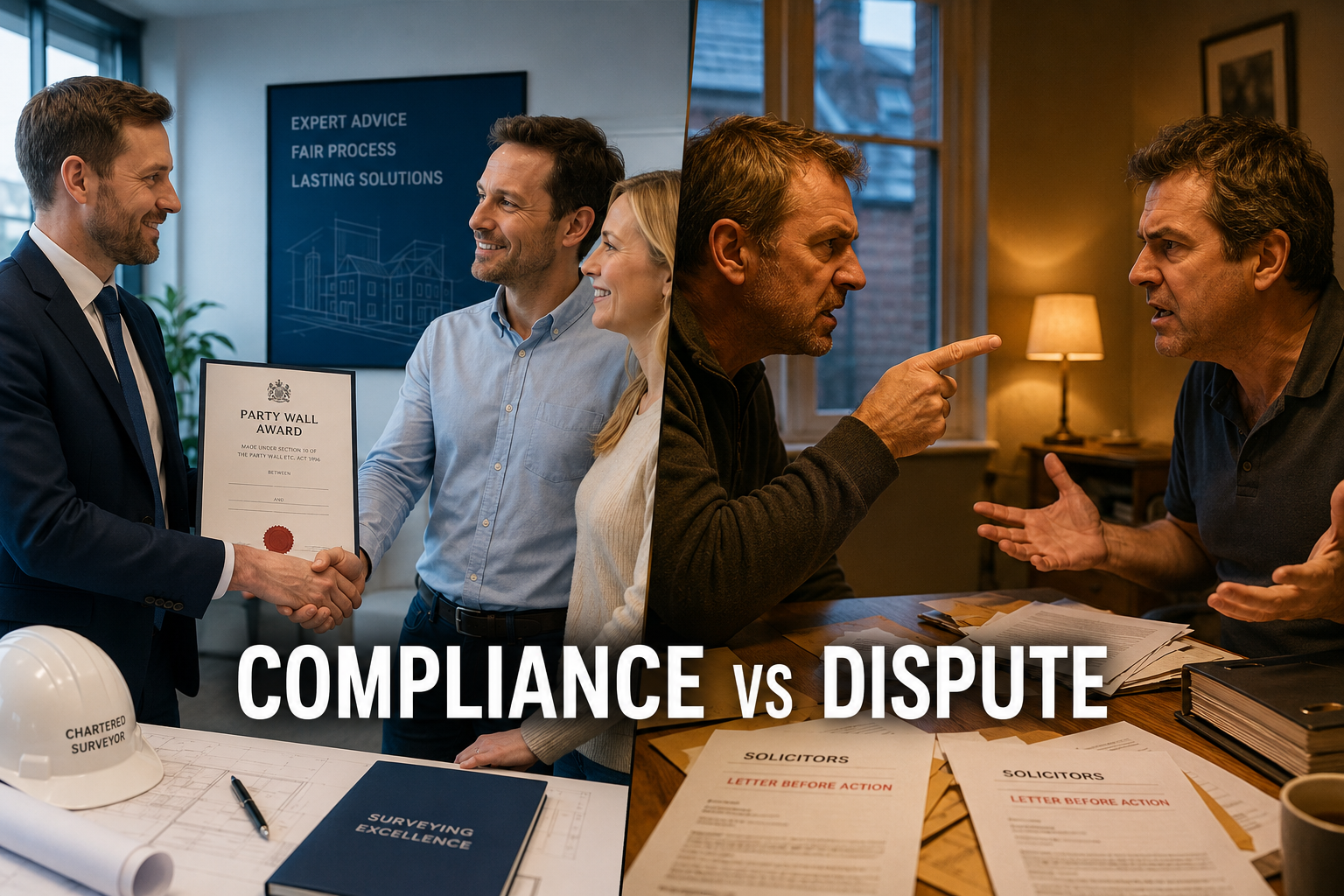
The following failures account for the majority of party wall disputes arising from HMO conversions, based on patterns observed across urban rental markets in 2026:
1. Late or missing notices
Developers begin structural works before notices are served, or serve notices for only some of the notifiable works. Both scenarios expose the building owner to injunctions.
2. Inadequate drawings
Notices served without detailed drawings of the proposed works give the adjoining owner insufficient information to assess the impact. This routinely leads to dissent and delay.
3. No schedule of condition
Without a pre-works record, any crack or defect discovered by the adjoining owner after the conversion is attributed to the HMO works — whether or not it was caused by them.
4. Ignoring Section 6 obligations
Drainage upgrades required for multiple bathrooms in an HMO frequently involve excavation within three or six metres of an adjoining foundation. Many developers fail to recognise this as a notifiable excavation.
5. Proceeding after dissent without an award
Once an adjoining owner dissents, work cannot lawfully proceed until an award is in place. Proceeding anyway is one of the most serious breaches of the Act.
Understanding what a party wall surveyor does — including their role in preventing these failures — is essential for any developer planning an HMO conversion.
Cost Implications for HMO Developers in 2026
Party wall compliance has a direct cost, but non-compliance costs far more. The key cost elements are:
| Item | Typical Cost Range (2026) |
|---|---|
| Party wall surveyor fee (agreed surveyor) | £700 – £1,500 per award |
| Party wall surveyor fee (separate surveyors) | £1,200 – £3,000+ per award |
| Schedule of condition | £300 – £800 |
| Third surveyor determination | £1,500 – £5,000+ |
| Injunction costs (if non-compliant) | £5,000 – £25,000+ |
For context, a six-bedroom HMO in a tight rental market can generate £3,000 to £5,000 per month in rental income once let. A two-month project delay caused by an injunction costs the equivalent of the entire party wall compliance budget many times over.
For detailed current pricing, the party wall surveyor cost guide provides a comprehensive breakdown of fee structures and what drives costs up or down.
Developers should also factor in the cost of finding qualified party wall surveyors with specific experience in HMO and multi-occupancy conversions — not all party wall surveyors are equally familiar with the additional complexity these projects introduce.
Dispute Avoidance: Practical Strategies for HMO Landlords
The best party wall dispute is the one that never happens. For HMO developers operating in high-demand urban markets, the following strategies significantly reduce the risk of conflict:
- Engage neighbours early: Before serving formal notices, have an informal conversation explaining the project scope and timeline. Neighbours who feel informed are less likely to dissent reflexively.
- Use an agreed surveyor where possible: A single surveyor acting for both parties is faster, cheaper, and less adversarial than the two-surveyor route.
- Provide detailed drawings with every notice: More information upfront reduces uncertainty and the likelihood of dissent.
- Build notice periods into the project programme from day one: Treat the two-month Section 2 notice period as a fixed constraint, not an afterthought.
- Address sound insulation proactively: Propose enhanced acoustic measures in the award to demonstrate good faith and reduce the risk of post-completion complaints.
The step-by-step party wall process guide is a valuable reference for landlords managing this process for the first time.
Conclusion
The Party Wall Implications for HMO Conversions in Tight Rental Markets: 2026 Surveyor Compliance Checklist outlined above is not a bureaucratic formality — it is a practical risk management framework for one of the most commercially sensitive property development activities in the current market. With rental demand at record levels and conversion activity accelerating, the volume of party wall disputes arising from HMO projects is rising in parallel.
Actionable next steps for HMO developers and landlords in 2026:
- Commission a structural assessment before purchase or planning application to identify all notifiable works.
- Serve party wall notices at the earliest possible stage — ideally on exchange of contracts.
- Appoint a qualified party wall surveyor with HMO conversion experience before any works begin.
- Ensure a schedule of condition is completed for all adjoining properties before the first structural intervention.
- Build compliance timelines into the project programme and budget for surveyor fees from the outset.
- Obtain a formal party wall award wherever consent is not given in writing.
- Complete a post-works inspection and address any damage before the project is signed off.
Compliance is not the obstacle to a successful HMO conversion — it is the foundation on which a profitable, dispute-free project is built.
References
- UK Government. (1996). Party Wall etc. Act 1996. HMSO.
- Royal Institution of Chartered Surveyors. (2020). Party Wall Legislation and Procedure: Guidance Note. RICS.
- Ministry of Housing, Communities and Local Government. (2016). Approved Document E: Resistance to the Passage of Sound. HMSO.
- Rightmove. (2025). Rental Market Report Q1 2025. Rightmove PLC.
- Department for Levelling Up, Housing and Communities. (2023). Houses in Multiple Occupation: Licensing Guidance. HMSO.
How Prince Surveyors can help: explore our party wall surveyors or learn about our party wall surveyor costs.