

Over 30% of subsidence claims in London involve tree root activity near foundations — yet the party wall process remains the most underused tool for protecting those same trees during construction works. When a building owner excavates close to a boundary, the risks run in both directions: roots can destabilise new foundations, and excavation can fatally damage the root systems of mature, protected trees. Party Wall Awards for Tree Root Protection in Foundation Works: RICS Vibration Monitoring Protocols sit at the intersection of these competing risks, providing a legal and technical framework that protects both property and landscape.
In 2026, with suburban garden developments and basement extensions at record levels across London and the South East, understanding how to serve the right notices, draft specialist clauses, and deploy calibrated monitoring technology has never been more important for building owners, adjoining owners, and their surveyors alike.
Key Takeaways
- The Party Wall etc. Act 1996 triggers notice obligations whenever excavation occurs within 3 or 6 metres of an adjoining owner's structure, including foundations near protected trees.
- A well-drafted Party Wall Award should include specialist tree root protection clauses, root protection area (RPA) restrictions, and defined vibration thresholds.
- RICS vibration monitoring protocols set peak particle velocity (PPV) limits that must be specified within the award before works begin.
- A pre-works schedule of condition is essential to establish a baseline for any post-works damage claims involving root disturbance or structural movement.
- Surveyors acting under the Act have authority to require real-time monitoring data, restrict working hours, and mandate root barrier installations as award conditions.
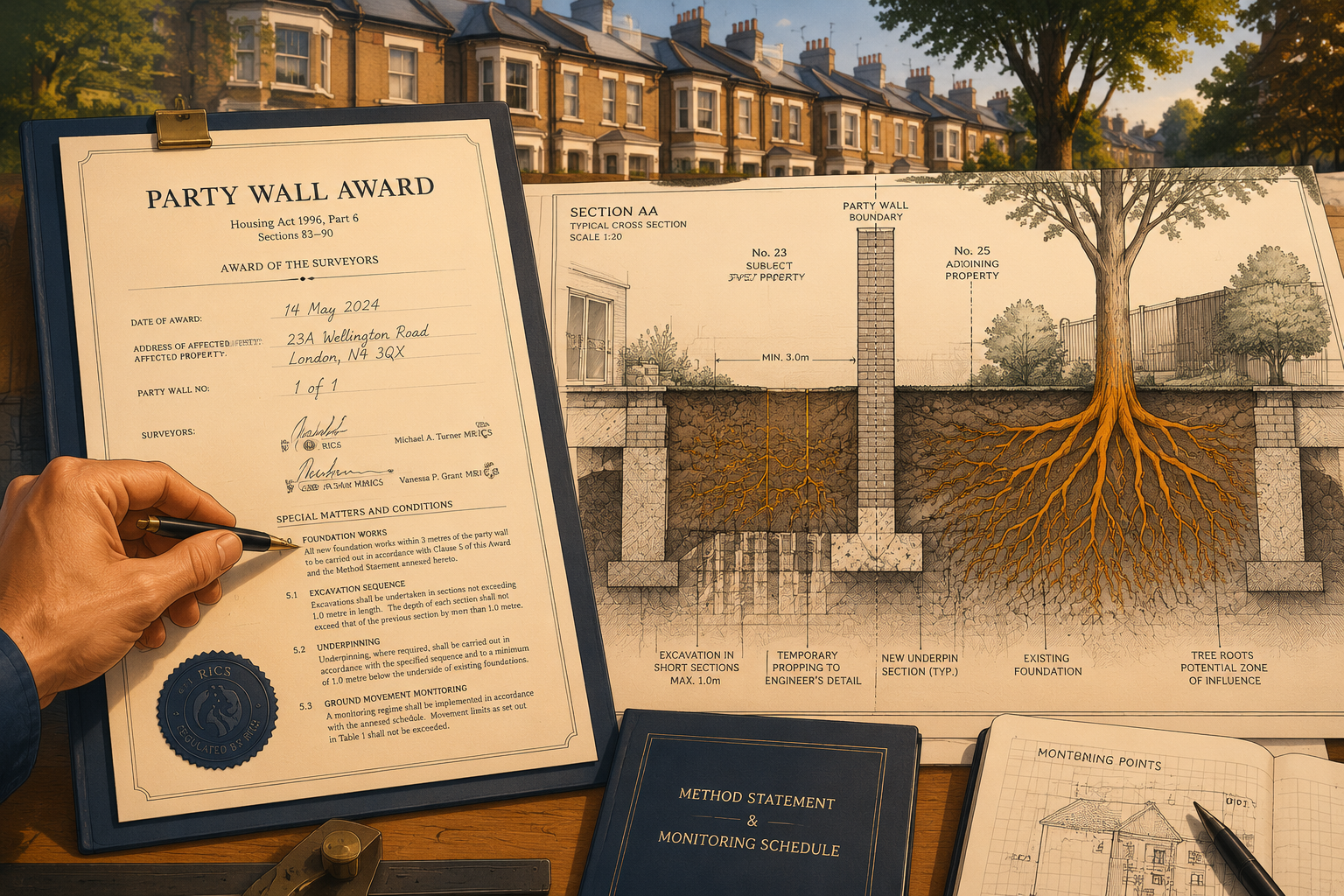
Why Tree Root Protection Belongs Inside the Party Wall Award
The relationship between tree roots and foundation works is rarely straightforward. Mature trees — particularly oak, poplar, willow, and lime — can extend their root systems to a distance equal to or greater than their crown spread. In clay-heavy soils common across much of London and the Home Counties, these roots actively manage soil moisture, meaning excavation can trigger both direct root severance and secondary soil shrinkage.
The Party Wall etc. Act 1996 creates a statutory framework that governs works to party walls, party structures, and excavations near neighbouring buildings. Critically, Section 6 of the Act applies to excavations within 3 metres of an adjoining owner's building where the new foundations will go deeper than the neighbour's existing foundations, and within 6 metres where a 45-degree line drawn from the bottom of the new excavation intersects the neighbour's foundations. For more detail on how these distances are calculated, the Party Wall Act 3 metre rule explained is a useful reference.
What the Act does not explicitly address is the protection of trees themselves. This is where the award drafting process becomes critical. Surveyors have broad discretion under Section 10 of the Act to include conditions that protect the adjoining owner's property — and courts have consistently interpreted "property" to include garden features, boundary trees, and landscape elements that contribute to the value and enjoyment of the adjoining land.
A robust Party Wall Award for foundation works near trees should include:
- Identification of all trees within the root protection area (RPA) of the excavation zone
- Reference to any Tree Preservation Orders (TPOs) or conservation area designations
- Specification of the RPA boundary in accordance with BS 5837:2012
- Prohibition on mechanical excavation within defined distances from the trunk
- Requirements for hand-digging or air-spade techniques within the RPA
- Root barrier membrane specifications where roots must be managed
- Vibration threshold limits for all mechanical plant operating near the RPA
The Party Wall Agreement process provides the legal vehicle for all of these conditions. Without a properly served notice and a subsequent award, none of these protections are enforceable under the Act.
Serving Notice: Triggers, Timelines, and Specialist Requirements
The notice-serving stage is where tree root protection begins. A building owner planning excavation works near a boundary must serve a Section 6 notice on every adjoining owner at least one month before works commence. The notice must describe the proposed works, the depth of excavation, and the method of construction.
Where trees are present near the excavation zone, surveyors advising building owners should recommend that the notice pack includes:
- An arboricultural impact assessment (AIA) prepared by a qualified arboriculturalist
- A site plan showing the RPA of all relevant trees overlaid on the proposed excavation footprint
- Proposed root protection measures, including any deviation from standard mechanical excavation
- Proposed vibration monitoring methodology
If the adjoining owner dissents or fails to respond within 14 days, a dispute is deemed to have arisen and the surveyor appointment process under Section 10 begins. This leads to the preparation of a Party Wall Award — the legally binding document that governs how the works proceed [1].
The RICS 8th edition consultation guidance emphasises that surveyors should visit both properties before making an award, in order to understand the construction, fabric, and condition of the adjacent owner's property and the consequences of the awarded works [1]. In the context of tree root protection, this means physically inspecting the garden, identifying visible surface roots, assessing soil type, and reviewing any existing arboricultural reports.
"Surveyors should understand the construction, fabric, and condition of the adjacent owner's property before making an award." — RICS Party Wall Legislation & Procedure, 8th Edition Consultation Draft [1]
For party wall disputes that arise specifically because of tree concerns, the surveyor appointment process may benefit from the involvement of an agreed surveyor — a single professional acting for both parties — which can reduce costs and speed up the award process. The agreed surveyor approach is particularly effective where both parties share a common interest in protecting a boundary tree.
Party Wall Awards for Tree Root Protection in Foundation Works: RICS Vibration Monitoring Protocols in Practice
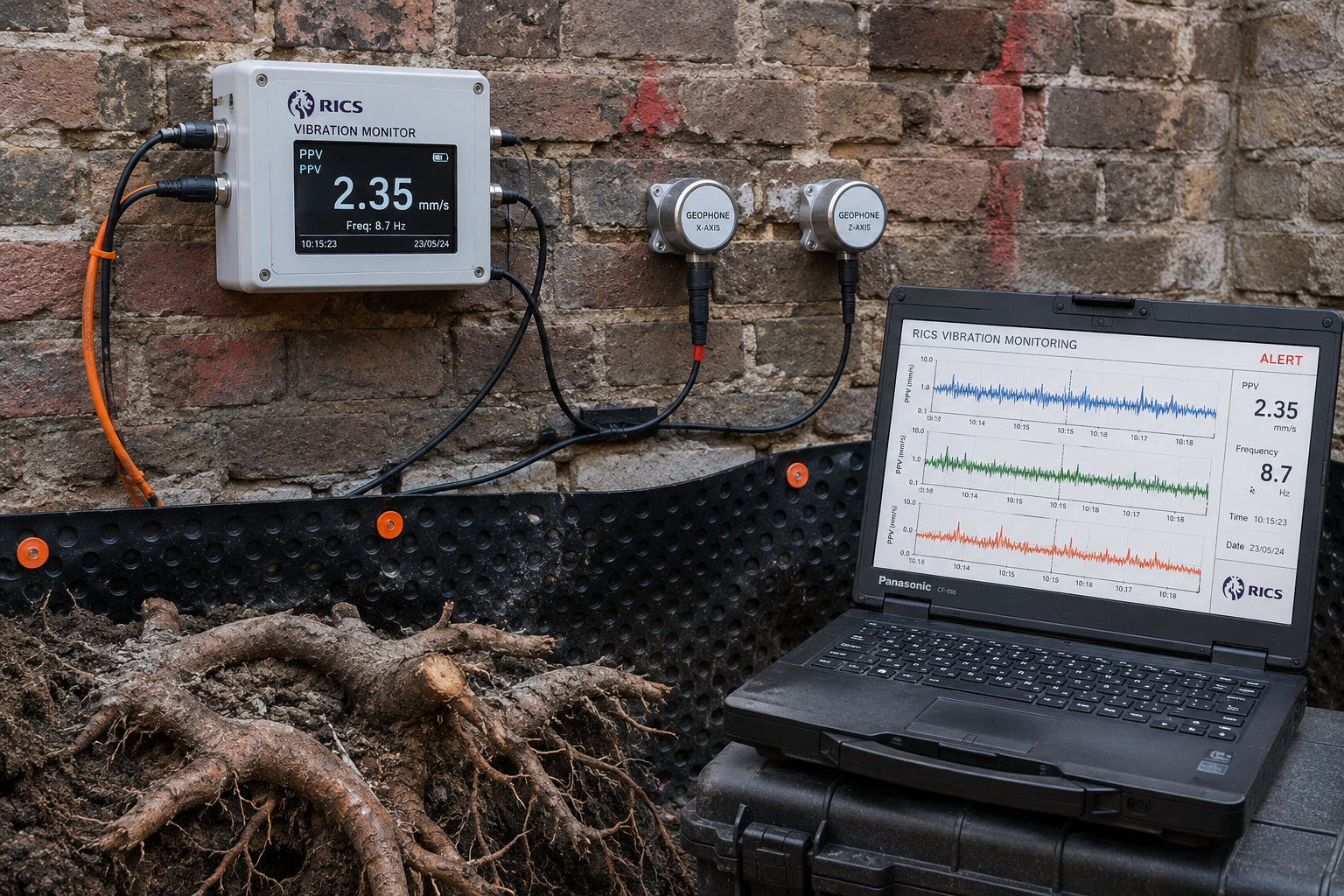
Vibration monitoring is the technical backbone of any award dealing with mechanical excavation near tree root zones. Ground-borne vibration from piling, breaking out concrete, or operating tracked excavators can cause soil compaction, root shear, and structural micro-cracking in adjacent buildings — all within the same event. RICS vibration monitoring protocols, drawn from British Standard BS 7385 and the Construction Industry Research and Information Association (CIRIA) guidance, establish the thresholds that awards must reference.
Understanding Peak Particle Velocity Thresholds
The key measurement is peak particle velocity (PPV), expressed in millimetres per second (mm/s). PPV measures the speed at which soil particles move in response to vibration, and it is the most reliable predictor of both structural damage and root zone disturbance.
| Vibration Source | Typical PPV Range (mm/s) | Relevant Threshold for Sensitive Structures |
|---|---|---|
| Tracked excavator (general) | 0.5 – 5.0 | 5.0 mm/s (residential) |
| Hydraulic breaker | 5.0 – 50.0 | 10.0 mm/s (alert level) |
| Vibratory compactor | 2.0 – 20.0 | 5.0 mm/s (near trees/roots) |
| Piling (percussive) | 10.0 – 100.0 | Requires pre-agreed limits in award |
For works near protected trees, many surveyors now apply a more precautionary PPV limit of 3.0 mm/s within the root protection area, reflecting the sensitivity of fine root structures to repeated vibration cycles. This threshold should be explicitly stated in the award, along with the consequences of exceedance — typically a mandatory work stoppage and notification to both surveyors.
Party Wall Awards for Tree Root Protection in Foundation Works: RICS Vibration Monitoring Protocols require that monitoring equipment be installed before works begin. Geophones — small sensors that measure ground movement — are typically fixed to the party wall structure at multiple heights and to ground anchors within the garden. Data is logged continuously and, in many modern setups, transmitted in real time to a cloud-based platform accessible to both surveyors [4].
What the Award Must Specify
A well-drafted award dealing with vibration monitoring near tree root zones should include the following clauses:
- Equipment specification: Type, calibration standard, and placement of geophones
- Monitoring frequency: Continuous during mechanical works, with daily summary reports
- Alert and action levels: Defined PPV thresholds triggering warnings and work stoppages
- Reporting obligations: Who receives data, how quickly, and in what format
- Exceedance procedure: Mandatory notification, works suspension, and remediation steps
- Data retention: Minimum period for storing monitoring records post-completion
The RICS guidance also notes that any changes to the awarded design must be agreed in writing by the parties, or in case of disagreement, referred to the surveyors for determination by a further award [2]. This is particularly relevant where ground conditions during excavation reveal unexpected root density or soil instability, requiring a change in excavation method.
For single-storey extensions and bungalow developments where mechanical excavation is used close to the boundary, vibration monitoring provisions are now considered standard practice by leading surveyors [6]. The same principle applies to any foundation works — including underpinning, new build footings, and basement construction — where tree root zones are within the influence zone of the works.
The Schedule of Condition: Baseline Protection for Trees and Structures
Before any works begin, the award should require a comprehensive schedule of condition covering both the adjoining owner's building and, where relevant, the trees and garden features within the root protection area.
The RICS 8th edition consultation draft specifically recommends pre-works inspections to record the condition of the adjoining owner's building before any building works commence [1]. For tree root protection purposes, this baseline documentation should extend to:
- Photographic record of visible surface roots, soil condition, and any existing root damage
- Written description of tree health, crown condition, and trunk diameter at breast height
- Record of any existing cracks, settlement, or movement in structures near the tree
- Soil type assessment, particularly relevant in shrinkable clay areas
This baseline is the foundation of any post-works damage claim. Without it, attributing root damage or structural movement to the construction works — rather than pre-existing conditions — becomes legally and technically difficult.
The schedule of condition also informs the vibration monitoring thresholds. A building or tree that is already showing signs of stress warrants lower alert levels and more frequent inspections. Surveyors acting under the Act have the authority to require interim inspections during works to verify compliance with award conditions [2].
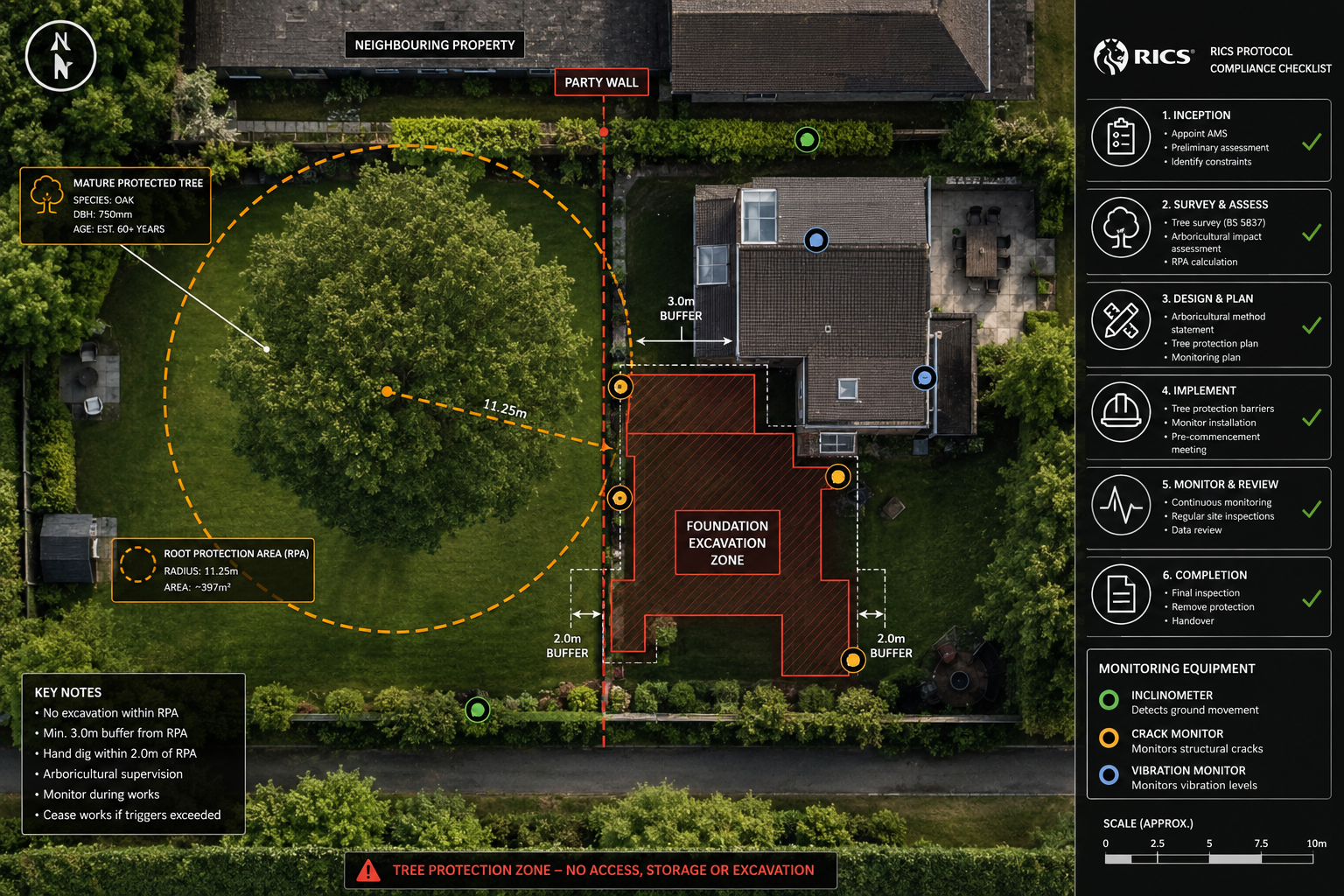
Specialist Award Clauses: Root Barriers, Working Methods, and Post-Works Verification
Beyond vibration monitoring, Party Wall Awards for Tree Root Protection in Foundation Works: RICS Vibration Monitoring Protocols increasingly incorporate a suite of specialist clauses that address the full lifecycle of risk.
Root Barrier Specifications
Where excavation must occur within or near the RPA, the award should specify the installation of a physical root barrier — typically a high-density polyethylene (HDPE) membrane installed vertically in a trench — to prevent future root encroachment into the new foundation zone. The award should state:
- Depth and continuity of the barrier
- Material specification and minimum thickness
- Inspection requirements before backfilling
- Responsibility for maintenance
Restricted Working Methods
The award can prohibit specific plant or techniques within defined zones. Common restrictions include:
- No percussive piling within X metres of tree trunk
- Hand-digging only within the inner RPA (typically 1 x stem diameter from trunk)
- Air-spade or hydro-excavation required for root exposure
- No storage of materials, spoil, or plant on the root protection area
Post-Works Tree Health Assessment
A final inspection clause requiring a post-works arboricultural assessment is increasingly included in awards where protected trees are involved. This provides an objective record of any change in tree health attributable to the works, and supports any subsequent claim under the Act or in tort.
For building owners and their surveyors working across London and the South East, chartered surveyors in South West London and chartered surveyors in North London with experience in arboricultural party wall matters are well placed to advise on these specialist clauses.
Common Pitfalls and How to Avoid Them
Even experienced surveyors encounter difficulties when tree root protection intersects with party wall procedure. The most common issues in 2026 include:
Failure to identify all relevant trees at the notice stage. A notice that does not reference nearby trees gives the adjoining owner limited grounds to insist on protective conditions. Building owners should instruct an arboricultural survey before serving notice.
Generic vibration limits that do not reflect site conditions. Copying standard PPV thresholds without reference to soil type, tree species, or existing structural condition creates awards that are either unworkable or insufficiently protective.
No provision for design changes. Where ground conditions require a change in foundation type or excavation method, an award without a design change clause can leave both parties without a clear procedure. Section 7(5) of the Act requires any such changes to be agreed in writing or determined by a further award [2].
Inadequate monitoring equipment placement. Geophones placed only on the party wall structure will not capture vibration levels within the root zone. Awards should specify ground-level monitoring points within the garden as well as wall-mounted sensors [4].
No post-works verification. An award that ends at practical completion without requiring a post-works tree health assessment or structural inspection leaves the adjoining owner without a clear route to redress if damage emerges later.
Conclusion
Party Wall Awards for Tree Root Protection in Foundation Works: RICS Vibration Monitoring Protocols represent one of the most technically demanding areas of party wall practice in 2026. The intersection of statutory law, arboricultural science, and precision monitoring technology demands a level of specialist knowledge that goes well beyond standard award drafting.
Actionable next steps for building owners and their advisers:
- Commission an arboricultural impact assessment before serving any Section 6 notice where trees are present within or near the excavation zone.
- Ensure the Party Wall Award explicitly references BS 5837:2012 root protection area calculations and BS 7385 vibration thresholds.
- Specify real-time vibration monitoring with defined PPV alert and action levels, and name the responsible party for data reporting.
- Include a pre-works schedule of condition covering both the adjoining structure and visible tree root systems.
- Build in a post-works arboricultural assessment clause to provide a clear baseline for any post-completion claims.
- Engage a surveyor with demonstrable experience in both party wall procedure and arboricultural risk — the two disciplines must work in tandem for the award to be effective.
For adjoining owners concerned about the impact of neighbouring foundation works on protected trees, the party wall matters guidance provides a clear starting point for understanding rights and options under the Act.
References
[1] Viewcompounddoc – consultations.rics.org
[2] Viewcompounddoc – consultations.rics.org
[3] Party Wall Awards For Net Zero Retrofits Surveyor Checklists Post Rics Sustainability Report 2025 – wimbledonsurveyors.com
[4] Party Wall Notices For Steel Beam Installations Structural Protocols And Award Essentials Under The 2026 Act – partywallsurveyorlondon.uk
[5] Party Wall Surveys For 5g Mast Installations Rics Protocols Amid 2026 Telecom Infrastructure Expansion – nottinghillsurveyors.com
[6] Party Wall Challenges In Bungalow Extensions Rics Survey Protocols For Single Storey Boundary Works In 2026 – wimbledonsurveyors.com
[7] Party Wall Legislation And Procedure – rics.org
[8] Party Wall Survey Guide – strutsurveyors.com
How Prince Surveyors can help: explore our party wall surveyors or learn about our party wall surveyor costs.