

{"cover":"Professional landscape format (1536×1024) hero image with bold text overlay: 'Party Wall Awards for Net Zero Retrofits: Integrating PAS 2080 Carbon Metrics into 2026 Boundary Works', extra large 72pt white bold sans-serif font with dark semi-transparent background bar for contrast, centered upper third placement. Background shows a split-scene of a Victorian terraced house undergoing sustainable retrofit with external wall insulation being installed at a shared boundary wall, green carbon metric graphs overlaid on architectural drawings, warm amber and deep green color palette with white accents, editorial magazine quality, high contrast professional composition","content":["Detailed landscape format (1536×1024) showing a chartered surveyor in hard hat and high-vis vest reviewing a Party Wall Award document on a clipboard at a shared boundary wall construction site, with thermal imaging camera equipment visible nearby, architectural drawings spread on a portable table showing boundary lines and insulation layers, PAS 2080 carbon baseline data charts visible on a tablet screen, natural daylight, professional documentary photography style, muted grey and green tones, depth of field focus on documents","Landscape format (1536×1024) close-up overhead aerial view of a drafting table with a Party Wall Award document open showing sustainability clauses and carbon reduction statement sections, surrounded by PAS 2080 guidance booklets, RICS sustainability report pages, a carbon calculator on a laptop screen showing whole-life carbon figures in kgCO2e, a ruler and red pen marking key clauses, warm desk lamp lighting, professional editorial flat-lay composition, navy blue and cream color scheme","Landscape format (1536×1024) showing two surveyors in a modern office meeting room reviewing a large wall-mounted diagram of a terraced house cross-section with arrows indicating heat loss points, embodied carbon data tables, retrofit material specifications including mineral wool insulation and triple-glazed windows, a third surveyor role flowchart on a whiteboard, digital tablet showing carbon verification checklist, professional corporate photography style, clean white and forest green color palette, sharp focus on the technical diagram"]
The UK's 29 million existing homes account for roughly 20% of the nation's total carbon emissions — and the vast majority of them share a wall, fence, or boundary with a neighbour. That single fact makes the intersection of Party Wall Awards for Net Zero Retrofits: Integrating PAS 2080 Carbon Metrics into 2026 Boundary Works one of the most consequential — and least discussed — areas in sustainable construction law today.
As retrofit programmes accelerate in 2026, surveyors face a new challenge: embedding whole-life carbon assessments directly into legally binding Party Wall Awards, without creating procedural delays that stall green projects. The 2023 revision of PAS 2080 broadened its scope to cover the entire built environment, including residential buildings, and the RICS Sustainability Report published in 2025 reinforced the need for consistent carbon measurement across all construction activity [1][2]. The result is a rapidly evolving practice where boundary works documentation must now speak two languages simultaneously — property law and carbon science.
Key Takeaways
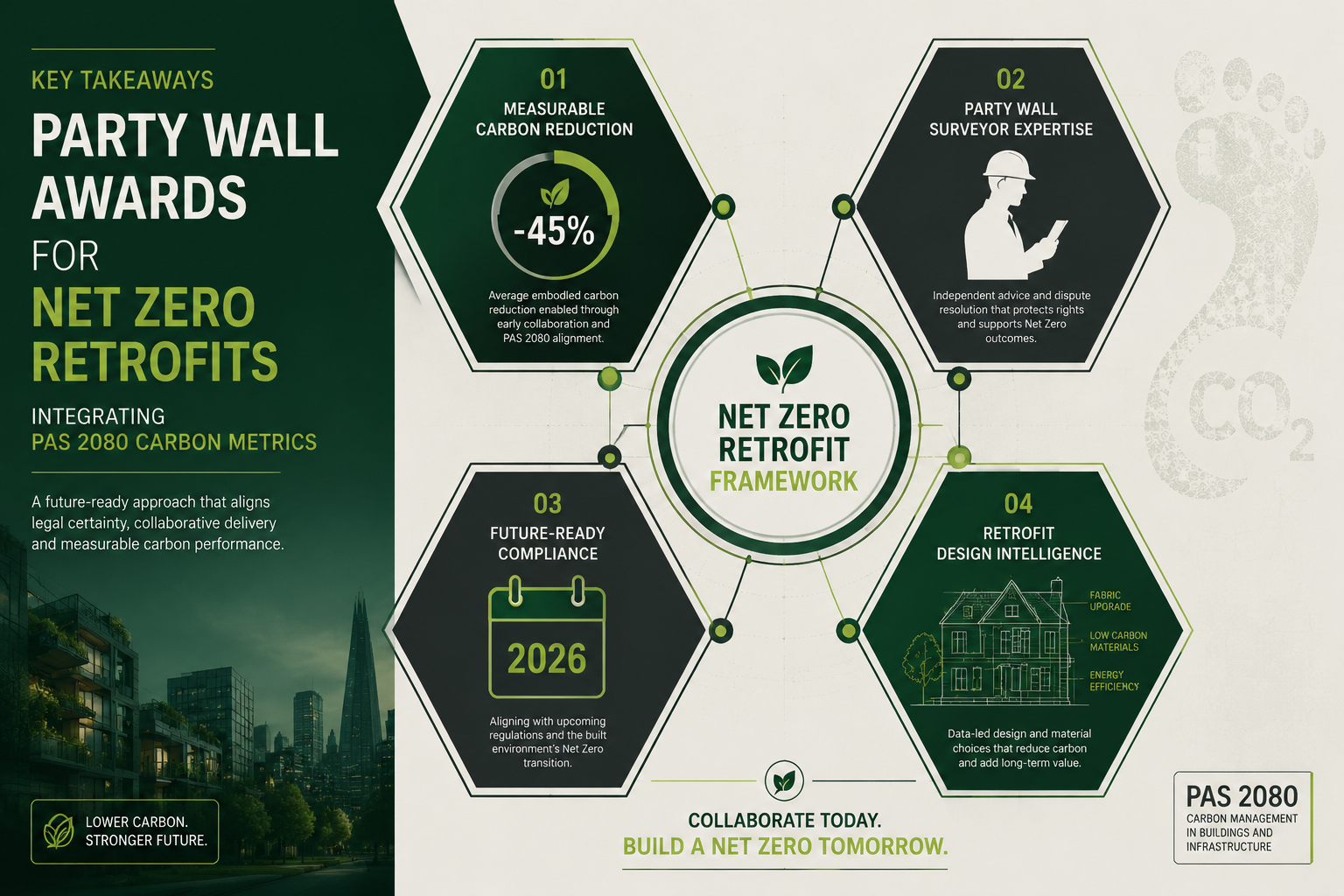
- PAS 2080:2023 now applies to residential buildings, making whole-life carbon management directly relevant to Party Wall Award drafting for retrofit projects.
- Party Wall Awards in 2026 increasingly include carbon reduction statements, sustainability clauses, and post-works carbon verification requirements.
- Surveyors must establish a pre-works carbon baseline using thermal imaging and embodied carbon data before retrofit boundary works begin.
- The Third Surveyor's role is expanding to include technical assessment of thermal performance evidence in disputed retrofit cases.
- Integrating PAS 2080 metrics into awards protects adjoining owners, supports net-zero compliance, and reduces the risk of costly post-completion disputes.
What PAS 2080 Means for Boundary Works in 2026
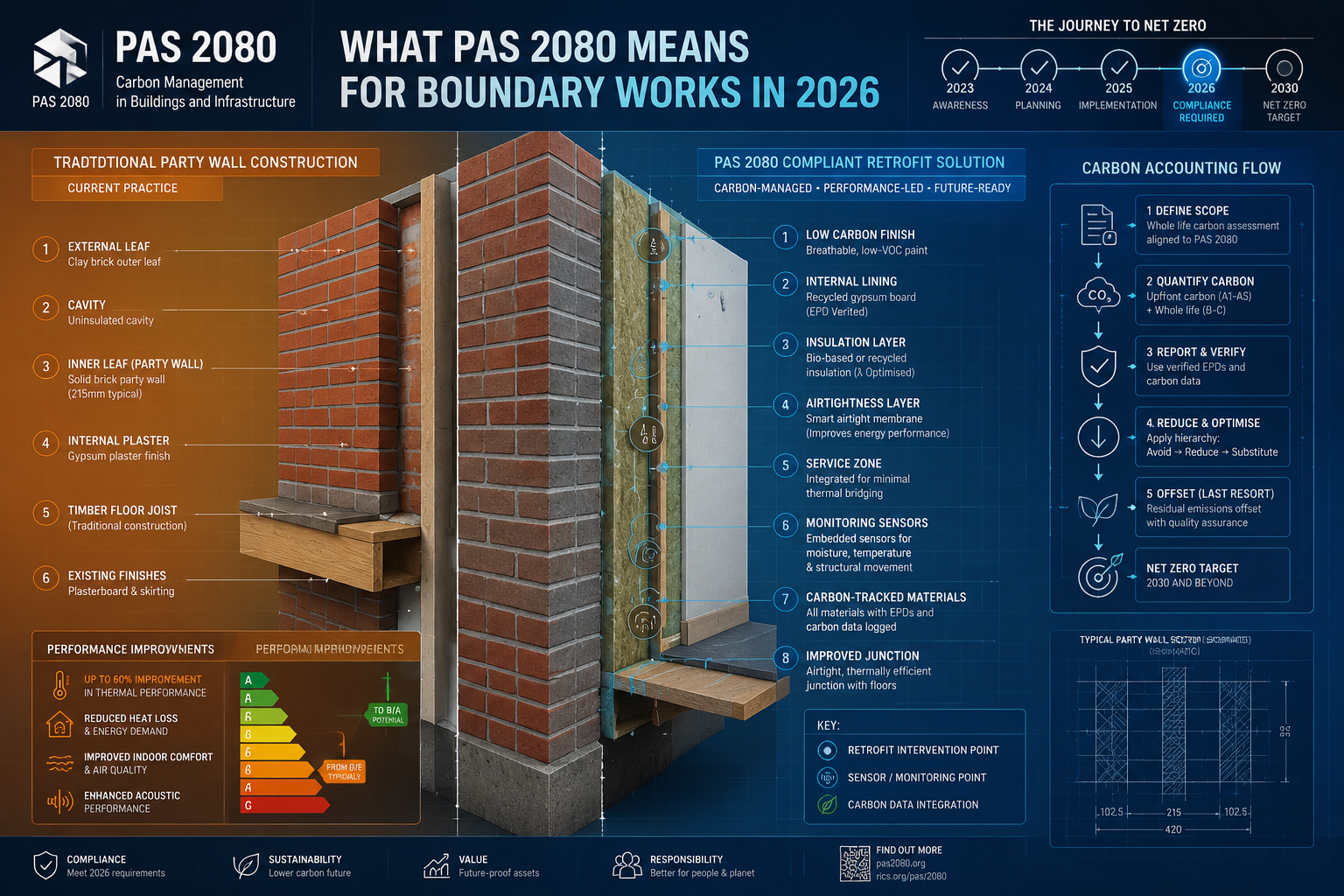
PAS 2080 is the British Standards Institution's publicly available specification for managing whole-life carbon in buildings and infrastructure [4]. Originally focused on large infrastructure projects, the 2023 revision was a watershed moment. It extended the standard's reach to encompass all built environment assets, including domestic properties, and placed emphasis on collaboration across the entire value chain — from designers and contractors to building owners and their neighbours [1].
For Party Wall purposes, this matters enormously. When a building owner undertakes a net-zero retrofit that touches a shared wall — installing external wall insulation (EWI), upgrading party wall junctions, or improving airtightness at the boundary — the works fall squarely within the scope of both the Party Wall etc. Act 1996 and PAS 2080's whole-life carbon framework.
The Core PAS 2080 Principles Relevant to Retrofit Awards
PAS 2080 asks practitioners to think about carbon in three distinct phases:
| Carbon Phase | Definition | Retrofit Relevance |
|---|---|---|
| Embodied Carbon | Carbon in materials and construction processes | Insulation, fixings, mortar at the party wall |
| Operational Carbon | Carbon from energy use once complete | Reduced heating demand after EWI installation |
| Whole-Life Carbon | Total carbon across the asset's full lifespan | The metric that Party Wall Awards now reference |
The Institution of Civil Engineers (ICE) has published guidance documents to help practitioners apply PAS 2080 in practice, stressing that systems thinking — not siloed project-by-project analysis — is essential for achieving net-zero goals [5]. For surveyors drafting awards, this translates into a requirement to look beyond the immediate construction phase and consider the long-term carbon implications of every material specified at the boundary.
Key point: A Party Wall Award that specifies low-carbon mortar for repointing a shared chimney stack is no longer unusual. In 2026, it is becoming standard practice.
How Surveyors Embed Carbon Metrics into Party Wall Awards for Net Zero Retrofits: Integrating PAS 2080 Carbon Metrics into 2026 Boundary Works
The practical challenge for any surveyor is translating an abstract carbon standard into the specific, enforceable language of a Party Wall Award. The RICS Sustainability Report 2025 identified the absence of consistent carbon measurement as a critical gap, and post-report, surveyor checklists have been updated to incorporate sustainability clauses and carbon measurement requirements as standard [2].
Understanding the full scope of party wall matters is the starting point. From there, the integration of PAS 2080 metrics follows a structured sequence.
Step 1: Pre-Works Carbon Baseline Documentation
Before any retrofit boundary work begins, surveyors must now establish a comprehensive carbon baseline. Enhanced protocols include:
- Thermal imaging surveys to record existing heat loss patterns at the party wall junction
- Embodied carbon inventory of existing materials, noting what will be demolished or retained
- Operational carbon benchmarking using current energy performance data for both the building owner's and adjoining owner's properties
This pre-works baseline serves a dual purpose. It provides the reference point against which post-completion carbon savings are measured, and it creates a defensible record should any dispute arise about the retrofit's impact on the adjoining property [3].
For surveyors preparing a party wall schedule of condition, the carbon baseline documentation should now sit alongside the traditional photographic record of existing defects. Both protect the adjoining owner; one from physical damage, the other from unverified carbon claims.
Step 2: The Carbon Reduction Statement
Party Wall Awards for net-zero retrofit projects now mandate a carbon reduction statement as a core document [2]. This statement must:
- Be prepared in accordance with the RICS Whole Life Carbon Assessment standard
- Quantify the estimated annual reduction in operational carbon emissions attributable to the works
- Express savings in kgCO2e per year, referenced against the pre-works baseline
- Identify the methodology used and the assessor's qualifications
"A carbon reduction statement is not a marketing document — it is a technical instrument that forms part of the legal award and can be relied upon by both parties in any subsequent dispute."
This shift means that building owners commissioning retrofit works must engage a qualified retrofit assessor early in the process, not as an afterthought. The statement must be provided to adjoining owners within 28 days of completion [2].
Step 3: The Model Sustainability Clause
A standardised sustainability clause is now being incorporated into Party Wall Awards where retrofit works are involved [2]. The clause typically requires the building owner to ensure that:
- Works meet specified energy performance standards, verified by a qualified retrofit assessor
- Low-carbon materials are used where technically feasible, with substitutions documented
- Post-works thermal imaging is conducted to verify junction performance at the party wall
- Carbon verification reports are provided to the adjoining owner within the agreed timeframe
For loft conversions that involve party wall works — a common retrofit scenario — the party wall for loft conversions process now routinely incorporates these sustainability clauses where insulation upgrades are planned at the shared roof structure.
Protecting Adjoining Owners: Retrofit Risks and the Updated Award Framework
Net-zero retrofits introduce structural and environmental risks that traditional Party Wall Awards were not designed to address. Surveyors are now responsible for assessing these risks and including protective conditions within the award itself [3].
Structural Loading Changes
Adding external wall insulation to a party wall changes the load distribution on the shared structure. A thick EWI system can add significant weight per square metre. Awards must now specify:
- Maximum additional load per square metre at the party wall
- Structural engineer sign-off requirements before works commence
- Monitoring protocols during installation
For properties where party wall excavation is also involved — for instance, when installing ground-source heat pump infrastructure near the boundary — the interaction between excavation depth, changed loading, and existing foundations must be addressed explicitly in the award.
Damp Transfer and Interstitial Condensation
One of the most significant risks in retrofit boundary works is the unintended transfer of moisture. Poorly specified insulation at a party wall junction can drive condensation into the adjoining property's wall, causing damp damage that may not manifest for months or years.
The updated award framework addresses this by requiring:
- Hygrothermal analysis of the proposed insulation specification at the party wall junction
- Damp monitoring clauses that require the building owner to commission post-works moisture readings at agreed intervals
- Remediation obligations if damp transfer is identified within a defined period after completion
If damage to property in party wall works does occur as a result of retrofit-related damp transfer, the pre-works carbon baseline documentation and the award's protective clauses provide the evidentiary foundation for any claim.
Airtightness and Ventilation
Improving airtightness at the boundary can inadvertently affect ventilation in the adjoining property, particularly in older terraced houses where air movement through the party wall has historically compensated for inadequate mechanical ventilation. Awards in 2026 increasingly include conditions requiring the building owner to demonstrate that airtightness improvements will not adversely affect the adjoining property's indoor air quality.
The Third Surveyor's Expanding Role in Net Zero Retrofit Disputes
When building owners and adjoining owners cannot agree on the terms of a party wall agreement for a retrofit project, the matter may be referred to a Third Surveyor. Traditionally, the Third Surveyor's role was confined to resolving disputes about physical works and their impact on the adjoining structure.
In the context of Party Wall Awards for Net Zero Retrofits: Integrating PAS 2080 Carbon Metrics into 2026 Boundary Works, that role has expanded considerably [2].
What Third Surveyors Must Now Assess
Third Surveyors in retrofit disputes may be required to evaluate:
- Technical evidence on thermal performance, including competing thermal bridging calculations at the party wall junction
- Carbon measurement methodology disputes, where the building owner's assessor and the adjoining owner's assessor have produced materially different carbon reduction figures
- Material substitution disagreements, where the adjoining owner objects to a specified low-carbon material on grounds of aesthetics, durability, or impact on their property
This requires Third Surveyors to develop familiarity with the RICS Residential Retrofit Standard and the Whole Life Carbon Assessment methodology — skills that go well beyond traditional party wall practice [2].
Practical implication: Surveyors acting as Third Surveyors on retrofit cases should consider formal CPD in PAS 2080 application and whole-life carbon assessment before accepting appointments in this area. NQA and similar bodies offer certification pathways for organisations seeking to demonstrate competence in PAS 2080 compliance [6].
Drafting Party Wall Awards for Net Zero Retrofits: Integrating PAS 2080 Carbon Metrics into 2026 Boundary Works — A Practical Checklist
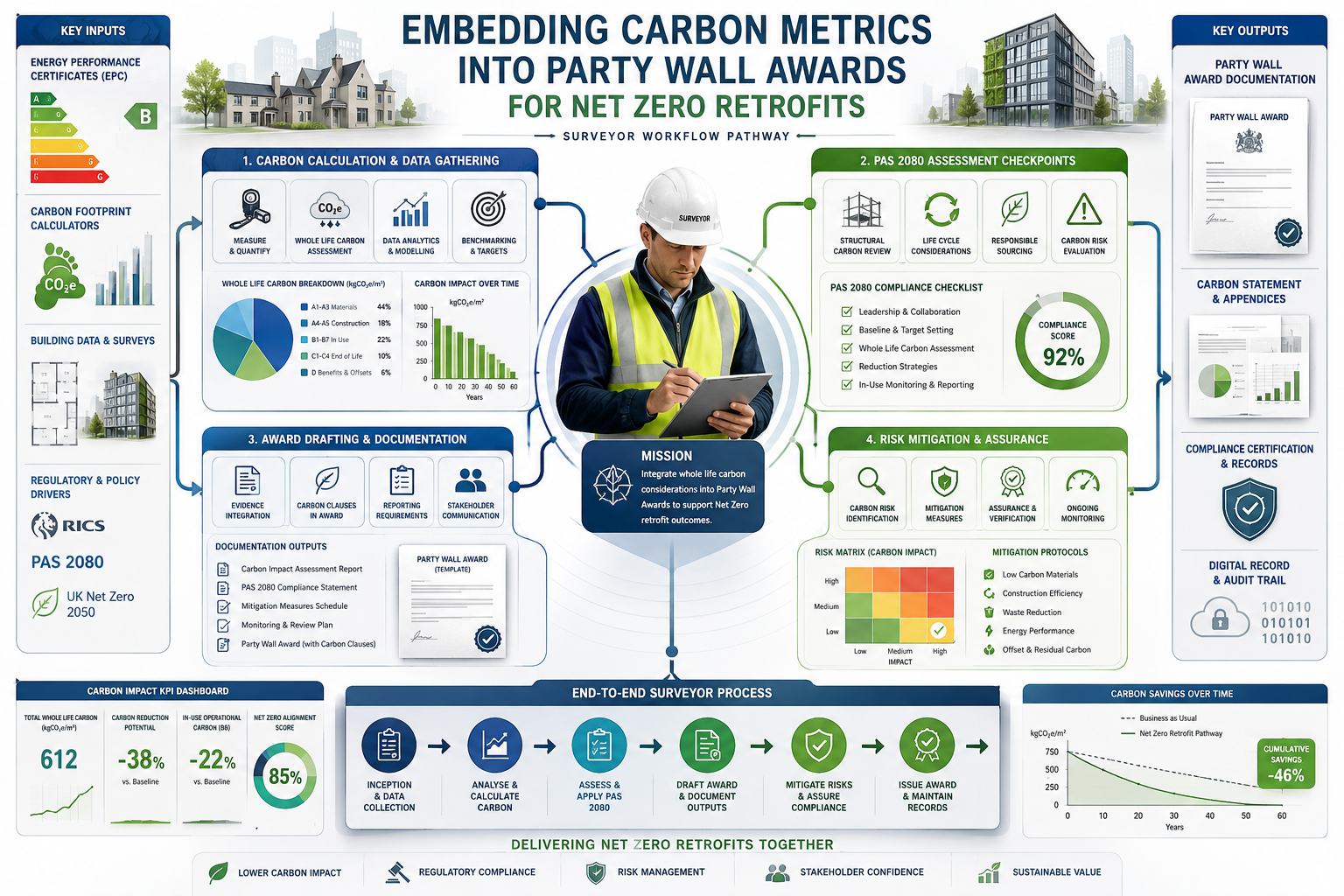
The following checklist consolidates current best practice for surveyors drafting awards for retrofit boundary works in 2026 [2][3]:
Pre-Award Stage
- Confirm the works trigger the Party Wall etc. Act 1996 (shared wall, boundary, or within 3 metres/6 metres of foundations — see the party wall act 3 metre rule)
- Commission thermal imaging baseline survey of the party wall
- Obtain embodied carbon inventory of existing materials to be disturbed
- Confirm the building owner has engaged a qualified retrofit assessor
Award Drafting Stage
- Include the model sustainability clause referencing energy performance standards
- Attach the pre-works carbon baseline as a schedule to the award
- Specify low-carbon material requirements and acceptable substitution process
- Include hygrothermal analysis requirements for insulation at the party wall junction
- Set out post-works monitoring obligations (damp, thermal, structural)
- Define the 28-day deadline for carbon reduction statement delivery to the adjoining owner
Post-Works Stage
- Require post-completion thermal imaging to verify junction performance
- Confirm carbon reduction statement has been prepared to RICS Whole Life Carbon Assessment standard
- Document any material substitutions made during construction
- Retain all carbon documentation as part of the award file
For building owners and adjoining owners who have questions about how this process applies to their specific situation, the party wall act questions resource provides a useful starting point before engaging a surveyor.
Conclusion
The integration of PAS 2080 carbon metrics into Party Wall Awards represents a fundamental shift in how boundary works are documented, negotiated, and enforced. For surveyors, it is no longer sufficient to record existing defects and specify working methods. In 2026, a well-drafted award for a net-zero retrofit must also establish a carbon baseline, mandate a carbon reduction statement, include protective conditions against retrofit-specific risks, and set out clear post-works verification obligations.
The good news is that this added complexity does not have to delay green projects. When surveyors engage early, when building owners commission retrofit assessors at the design stage, and when awards are drafted with the full PAS 2080 framework in mind, the process can run concurrently with design development rather than after it.
Actionable next steps for building owners planning retrofit boundary works:
- Appoint a party wall surveyor with demonstrable experience in net-zero retrofit projects before serving notice.
- Engage a qualified retrofit assessor at the design stage, not after the Party Wall Award is issued.
- Commission a pre-works thermal imaging survey of the party wall to establish the carbon baseline.
- Review the draft award carefully for sustainability clauses, carbon reduction statement requirements, and post-works monitoring obligations.
- Retain all carbon documentation — it forms part of the legal record and supports any future dispute resolution.
The built environment's path to net zero runs directly through the party wall. Getting the award right is not a bureaucratic exercise — it is a material contribution to the UK's climate commitments, one shared boundary at a time.
References
[1] What Is Pas 2080 2023 Version – ice.org.uk
[2] Party Wall Awards For Net Zero Retrofits Surveyor Checklists Post Rics Sustainability Report 2025 – wimbledonsurveyors.com
[3] Party Wall Implications Of Rics Sustainability Report 2025 Survey Protocols For Net Zero Boundary Works In 2026 – nottinghillsurveyors.com
[4] Pas 2080 Carbon Management In Infrastructure And Built Environment – bsigroup.com
[5] Guidance Document Pas2080 – ice.org.uk
[6] Pas 2080 – nqa.com
How Prince Surveyors can help: explore our party wall surveyors or learn about our party wall surveyor costs.