

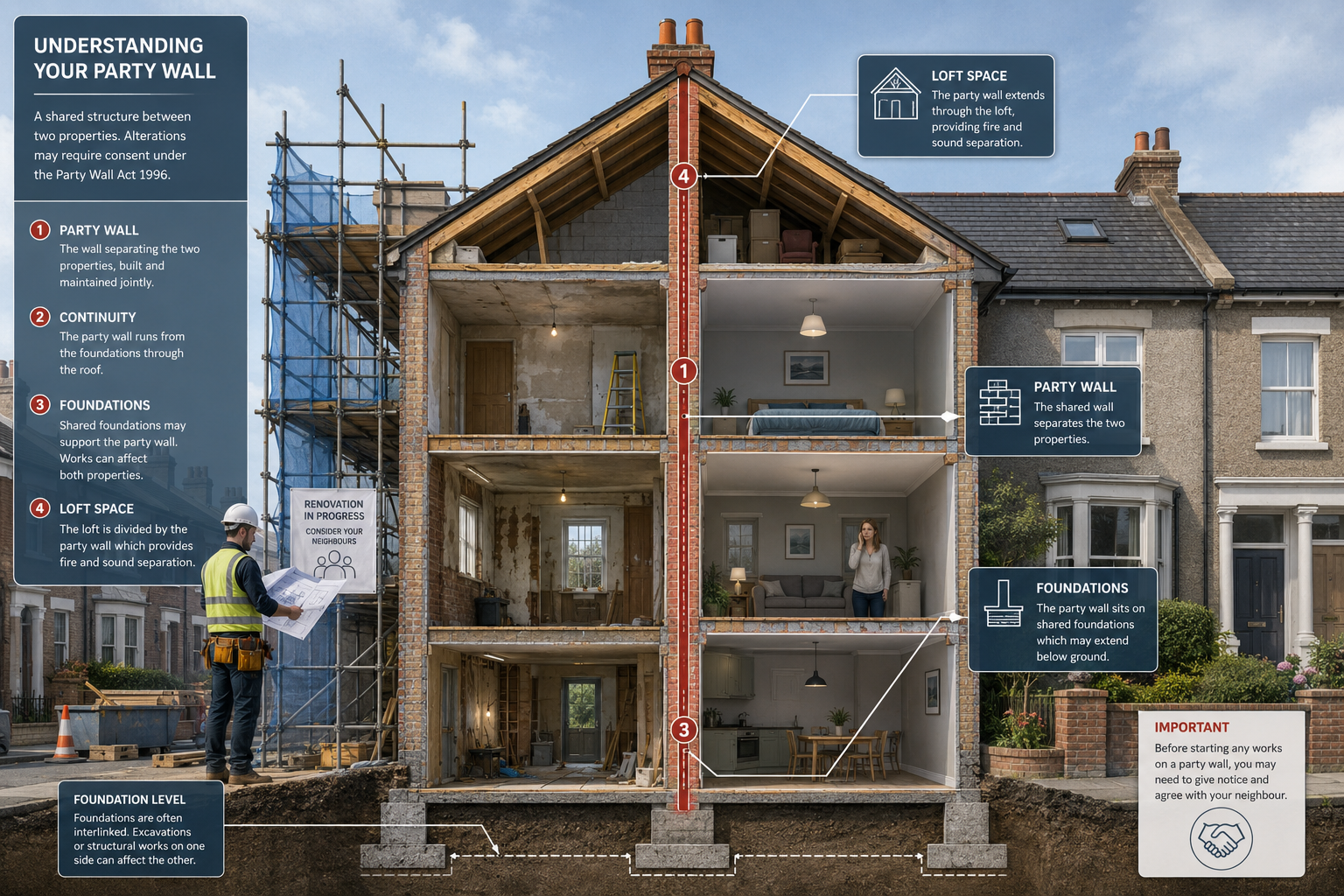
Terraced houses account for roughly 25% of all residential dwellings in England and Wales — and nearly every renovation project in these properties touches a shared wall. That shared wall is precisely where disputes begin. Understanding Party Wall Agreements in Terraced Homes: Negotiation Tactics and Legal Essentials Under the 1996 Act is not optional for homeowners planning loft conversions, rear extensions, or basement excavations. It is a legal requirement that, when ignored, can result in injunctions, costly delays, and permanently damaged neighbourly relations [5].
Key Takeaways
- The Party Wall etc. Act 1996 is the governing legislation for all notifiable works on shared walls in England and Wales.
- Building owners must serve formal written notice on adjoining owners before starting relevant works — failure to do so carries serious legal consequences.
- Neighbours can consent in writing, dissent and appoint surveyors, or do nothing (which triggers a deemed dissent after 14 days).
- A consensual agreement is faster and cheaper than a formal party wall award, but both are legally binding.
- In 2026, RICS is consulting on an updated 8th edition guidance note that will raise professional standards for surveyors working under the Act.
What the Party Wall etc. Act 1996 Actually Covers
The Party Wall etc. Act 1996 creates a statutory framework for resolving disputes about shared structures before they become legal battles. It applies to three broad categories of work:
- Works to an existing party wall or party structure — cutting into, raising, underpinning, or demolishing a shared wall.
- New building at or near the boundary — constructing a new wall along or astride the boundary line.
- Excavation near neighbouring buildings — digging foundations within 3 metres of an adjoining structure (or 6 metres for deeper excavations).
For terraced homeowners, the most common triggers are loft conversions involving steel beam insertion, single-storey rear extensions, and basement conversions requiring underpinning [4].
What Counts as a Party Wall?
A party wall is not simply any wall that sits next to a neighbour. The Act distinguishes between several types of shared structures. A party wall stands astride the boundary and is shared by two owners. A party fence wall is a garden or boundary wall that is not part of a building. Understanding this distinction matters because the notice requirements and rights differ between them. For a detailed breakdown, see this guide on what is a party fence wall under the Party Wall Act definition.
In a standard mid-terrace property, the walls separating each house are almost always party walls in the truest sense — shared ownership, shared responsibility, and shared legal obligations.
Serving Notice: The First Legal Essential
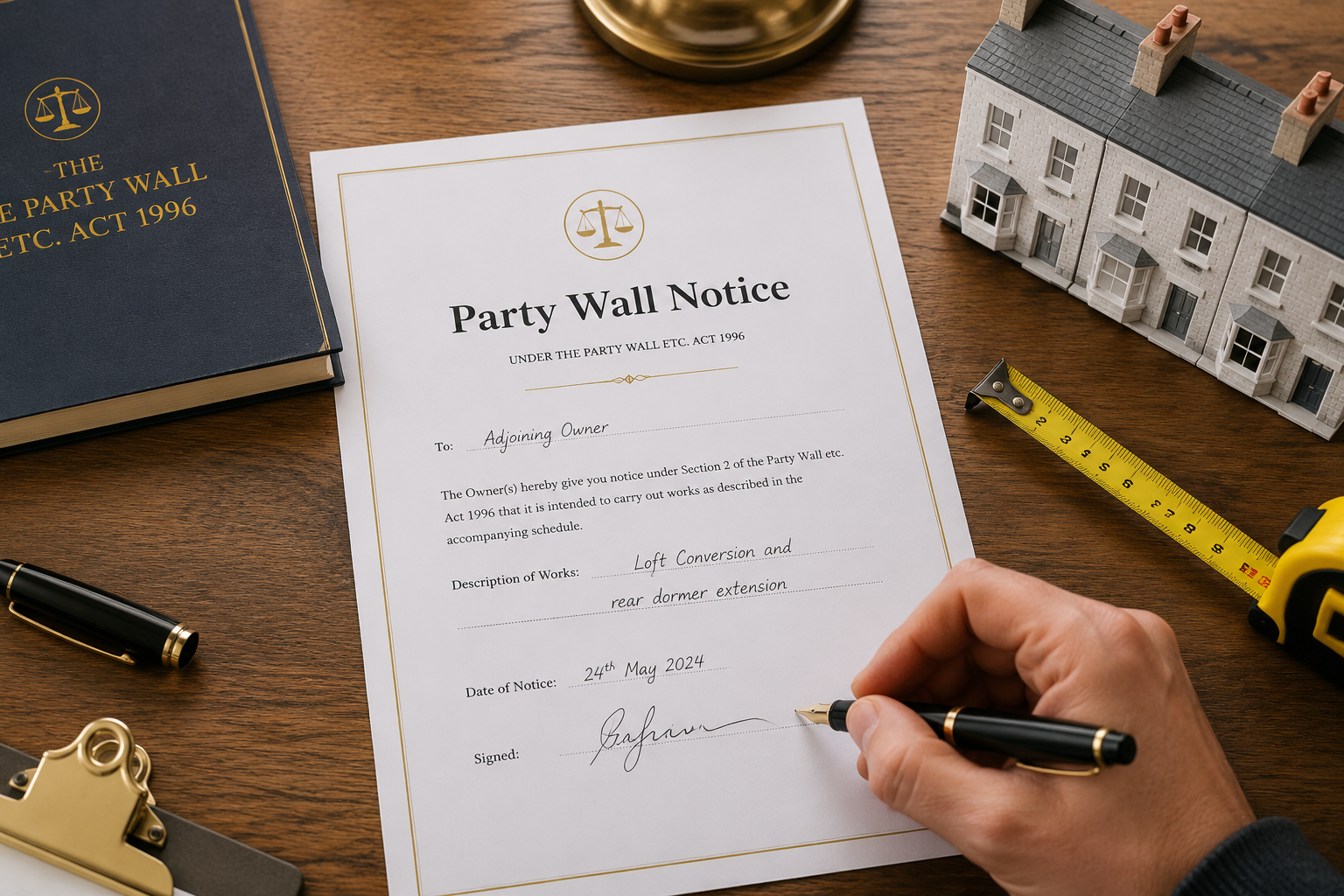
Before any notifiable work begins, the building owner must serve a formal written notice on every adjoining owner. This is not a courtesy — it is a statutory obligation. The type of notice depends on the type of work:
| Work Type | Notice Required | Minimum Notice Period |
|---|---|---|
| Works to existing party wall | Party Structure Notice | 2 months |
| New wall on or at boundary | Line of Junction Notice | 1 month |
| Excavation near foundations | Three Metre/Six Metre Notice | 1 month |
The notice must include the building owner's name and address, a description of the proposed works, and the planned start date. Errors in notice service — wrong addresses, missing details, or serving too late — are among the most common procedural failures that lead to legal challenges [2].
For practical guidance on how to serve a Party Structure Notice correctly, including the information that must be included, see this resource on what is a Party Structure Notice and how to serve it.
Acceptable Methods of Service
The Act permits notices to be delivered by hand, sent by post to the last known address, or in some cases served on a solicitor acting for the adjoining owner. The draft RICS 8th edition guidance, currently under consultation in 2026, provides updated and more detailed instructions on acceptable delivery methods and the timelines for responses — a direct response to disputes that arose from procedural ambiguity [1].
The Three Responses: Consent, Dissent, or Silence
Once a notice is served, the adjoining owner has 14 days to respond. There are three possible outcomes:
1. Written Consent
The adjoining owner agrees to the works in writing. This is the fastest and most cost-effective outcome. It creates a consensual agreement that is legally binding, and no surveyor appointment is required — though both parties should still document the agreed conditions carefully [6].
2. Dissent
The adjoining owner disagrees or wishes to impose conditions. Both parties must then appoint surveyors. They can agree on a single Agreed Surveyor, or each party appoints their own. The two appointed surveyors then select a Third Surveyor in case of deadlock. The surveyors produce a Party Wall Award — a formal document that sets out the rights and obligations of both parties.
3. No Response (Deemed Dissent)
If the adjoining owner does not respond within 14 days, the Act treats this as a dissent. The surveyor appointment process is triggered automatically. Building owners should never assume silence means approval.
For a full explanation of how to respond to a party wall notice — and what the different responses mean in practice — see this article on Party Wall Act notices: what they are and how to respond.
Negotiation Tactics for Terraced Homeowners
Effective negotiation under the Act is about reducing friction before it escalates. The following tactics consistently produce better outcomes for both building owners and adjoining owners.
Start the Conversation Early
The legal minimum notice period is one or two months, but experienced practitioners recommend approaching neighbours three to six months before the planned start date. Early, informal conversations allow concerns to be raised and addressed before positions become entrenched. When neighbours feel consulted rather than notified, consent is far more likely.
Use a Schedule of Condition
A schedule of condition is a photographic and written record of the adjoining property's existing state before works begin. It protects both parties. For the building owner, it provides evidence that pre-existing cracks or damage were not caused by their works. For the adjoining owner, it creates a baseline for any future damage claims. Requesting a schedule of condition voluntarily — before it is demanded — signals good faith and often accelerates consent.
Offer to Pay Reasonable Costs
Under the Act, the building owner is generally responsible for the reasonable costs of the adjoining owner's surveyor when dissent is triggered. Offering to cover these costs upfront, rather than waiting for them to be disputed, removes a common source of anxiety for neighbours who worry about unexpected legal fees.
"The most effective negotiation tactic under the Party Wall Act is not legal leverage — it is transparency. Neighbours who understand what is happening, why it is happening, and how their property will be protected almost always reach agreement faster."
Avoid Appointing Surveyors Unnecessarily
A consensual agreement — where the adjoining owner signs a written consent to the works — avoids the need for formal surveyor appointments entirely. This saves both time and money. For straightforward projects where the works are limited and the neighbour is cooperative, a well-drafted consent letter is sufficient. Guidance on having a party wall agreement without a surveyor outlines when this approach is appropriate and what it must include.
The Party Wall Award: What It Is and Why It Matters
When dissent is triggered and surveyors are appointed, the outcome is a Party Wall Award (also called a party wall agreement in common usage, though technically distinct). This is a legally binding document that sets out:
- The exact works permitted
- The method and sequence of construction
- Hours during which works may take place
- Security for expenses (if applicable)
- Rights of access for the building owner
- Compensation provisions for damage
The award is enforceable in the county court. Either party can appeal an award within 14 days of service, but courts rarely overturn awards made by properly appointed surveyors following correct procedure [8].
For a detailed explanation of what a party wall award contains and how it is structured, see this guide on party wall contract templates and party wall awards.
The Role of the Third Surveyor
When two appointed surveyors cannot agree, either party can refer the matter to the Third Surveyor — selected at the outset by the two appointed surveyors. The Third Surveyor's decision is binding. The RICS draft 8th edition guidance, published for consultation in April 2026, provides significantly clearer instructions on appointing and engaging the Third Surveyor, addressing a gap that had previously led to procedural disputes [2].
Legal Consequences of Non-Compliance
Ignoring the Party Wall etc. Act 1996 is not a minor administrative oversight. The legal consequences are serious and well-documented [5]:
- Injunctions: Courts can order works to stop immediately until the Act's procedures are followed.
- Damages: Building owners can be held liable for damage caused to adjoining properties, with no schedule of condition to limit claims.
- Retrospective awards: Surveyors can still be appointed after works begin, but the building owner loses the procedural protections the Act provides.
- Increased costs: Disputes that arise from non-compliance are almost always more expensive to resolve than following the process correctly from the start.
Recent reports in 2026 also highlight a shortage of qualified party wall surveyors, creating delays in the appointment process. Building owners are strongly advised to engage surveyors early in the planning stage to avoid project hold-ups caused by limited surveyor availability [3].
2026 Updates: RICS Consultation and What It Means for Terraced Homeowners
In April 2026, RICS opened an eight-week consultation on the draft 8th edition of its Party Wall Legislation and Procedure guidance note. This is the most significant update to professional standards in this area for several years [1].
Key changes in the draft include:
- Revised appendices and updated letters of appointment to reduce ambiguity in surveyor engagements.
- A new draft award template designed to improve consistency across the profession.
- Strengthened guidance on fee practices, responding to cases where surveyor fees were contested and led to satellite disputes [2].
- Clarified notice service procedures, specifying acceptable delivery methods and response timelines more precisely.
- Greater emphasis on public engagement, encouraging surveyors to communicate clearly with all parties rather than operating solely between professionals.
One of the most important clarifications in the draft is the confirmation that a surveyor's appointment under the Act is personal and statutory — independent of what the client wants. This means a building owner cannot instruct their appointed surveyor to act in a way that ignores the adjoining owner's legitimate interests. This clarification is designed to prevent the procedural errors that have led to legal challenges in recent years [2].
For terraced homeowners, these changes mean that the professional standards governing the surveyors they appoint are being raised. Choosing a surveyor who is up to date with the 2026 guidance will matter.

Costs: What to Expect and How to Manage Them
Party wall costs vary considerably depending on the complexity of the works, the number of adjoining owners, and whether the matter proceeds by consent or formal award. As a general guide:
- Consensual agreement (no surveyor): Minimal cost — primarily the time to draft and serve the notice correctly.
- Agreed Surveyor appointment: Typically £700 to £1,500 for straightforward works.
- Two-surveyor appointment: £1,200 to £2,500+ per side, depending on complexity.
- Third Surveyor referral: Adds further costs, which the losing party may be required to bear.
The building owner typically pays the adjoining owner's reasonable surveyor fees when dissent is triggered. Keeping costs down starts with serving a clear, correct notice and attempting to reach consent before the formal process begins. For practical strategies, see this guide on how to keep party wall costs down.
Conclusion: Practical Next Steps for Terraced Homeowners in 2026
Party Wall Agreements in Terraced Homes: Negotiation Tactics and Legal Essentials Under the 1996 Act demand attention at the earliest stage of any renovation project — not as an afterthought once planning permission is secured. The Act exists to protect both building owners and their neighbours, and its procedures, when followed correctly, make construction projects run more smoothly for everyone involved.
Actionable next steps:
- Identify whether your planned works trigger the Act by reviewing the three categories of notifiable work. If in doubt, consult a qualified party wall surveyor before proceeding.
- Approach your neighbours early — ideally three to six months before the planned start date — and explain the works in plain terms.
- Serve the correct notice in the correct format, with sufficient notice period. Use a free sample party wall agreement template as a starting point.
- Commission a schedule of condition before works begin, regardless of whether consent or dissent is given.
- Appoint a surveyor who is familiar with the 2026 RICS guidance to ensure the process is handled to the current professional standard.
- Do not start works without the required notice period expiring — even if the neighbour has verbally agreed.
The difference between a smooth renovation and a costly legal dispute often comes down to whether the Party Wall etc. Act 1996 was followed from the start. In terraced housing, where every wall has a neighbour on the other side, that process is not a formality — it is the foundation of a successful project.
References
[1] Rics Opens Consultation On Party Wall Guidance Update – propertywire.com
[2] Rics 8th Edition Party Wall Guidance 2026 Implementation Challenges And Surveyor Compliance Strategies – wimbledonsurveyors.com
[3] Party Wall Act Compliance For 2026 Lettings Landlord Instructions Surveys Amid Rics Reported Supply Constraints – canterburysurveyors.com
[4] Party Wall Agreements What You Need To Know – fmb.org.uk
[5] Commercial Property And The Party Wall Etc Act 1996 – bradley-mason.com
[6] Party Wall Agreement – aylingassociates.com
[8] Quick Guide To Party Walls – lexisnexis.com
How Prince Surveyors can help: explore our party wall surveyors or learn about our party wall surveyor costs.