

Manufacturing output in the UK has seen a modest but meaningful uptick heading into 2026, and with that growth comes a surge in factory extensions, new production bays, and warehouse additions — many of which sit directly against shared boundary walls. For every building owner pushing out a new production floor, there is an adjoining owner whose rights, property, and structural safety are directly at stake. This guide on Party Wall Agreements in Manufacturing Expansions: 2026 Guide for Adjoining Owner Rights covers everything surveyors, factory operators, and neighbouring landowners need to know about navigating the Party Wall etc. Act 1996 in an industrial context.

Key Takeaways
- Manufacturing expansions that affect a shared or boundary wall trigger formal obligations under the Party Wall etc. Act 1996, regardless of the scale of the works.
- Adjoining owners have enforceable rights to receive notice, appoint a surveyor, and obtain a binding Party Wall Award before works begin.
- The building owner typically bears surveyor costs, but cost-sharing arrangements are possible where both parties benefit.
- Failing to serve proper notice can result in injunctions, project delays, and significant legal costs.
- A Schedule of Condition report is a critical protective tool for adjoining owners in industrial settings where vibration and heavy machinery are involved.
What the Party Wall etc. Act 1996 Means for Industrial Properties
The Party Wall etc. Act 1996 is the primary legislation governing works to shared walls and boundary structures in England and Wales. It applies equally to residential and commercial or industrial properties. A party wall is any wall that stands on the boundary line between two separately owned properties, or any wall that forms part of one building but is used by an adjoining owner for support or enclosure [1].
In a manufacturing context, this includes:
- Shared structural walls between two factory units on an industrial estate
- Walls forming the boundary between a manufacturing site and a neighbouring warehouse
- Foundations that extend beneath or near a neighbouring property's ground
- Floors and ceilings in multi-storey industrial buildings that separate separately owned units [7]
The Act sets out three main types of notifiable works:
| Type of Work | Relevant Section | Notice Period |
|---|---|---|
| Works to an existing party wall or structure | Section 2 | 2 months |
| New building at or astride the boundary line | Section 1 | 1 month |
| Excavation near a neighbouring building | Section 6 | 1 month |
For a detailed breakdown of how each section operates in practice, the Party Wall etc. Act 1996 overview provides a clear reference point.
Why Manufacturing Expansions Trigger the Act More Often Than Expected
Factory extensions frequently involve all three categories above simultaneously. A business adding a new production bay might excavate new foundations within 3 metres of a neighbouring structure, build a new wall along the boundary line, and cut into an existing shared wall to create an opening for machinery access. Each of these actions independently triggers a separate notice obligation under the Act [4].
Many manufacturers underestimate this. The assumption that commercial-to-commercial works are somehow exempt is incorrect. The Act makes no distinction based on the use of the property.
Adjoining Owner Rights: A Practical Breakdown for 2026
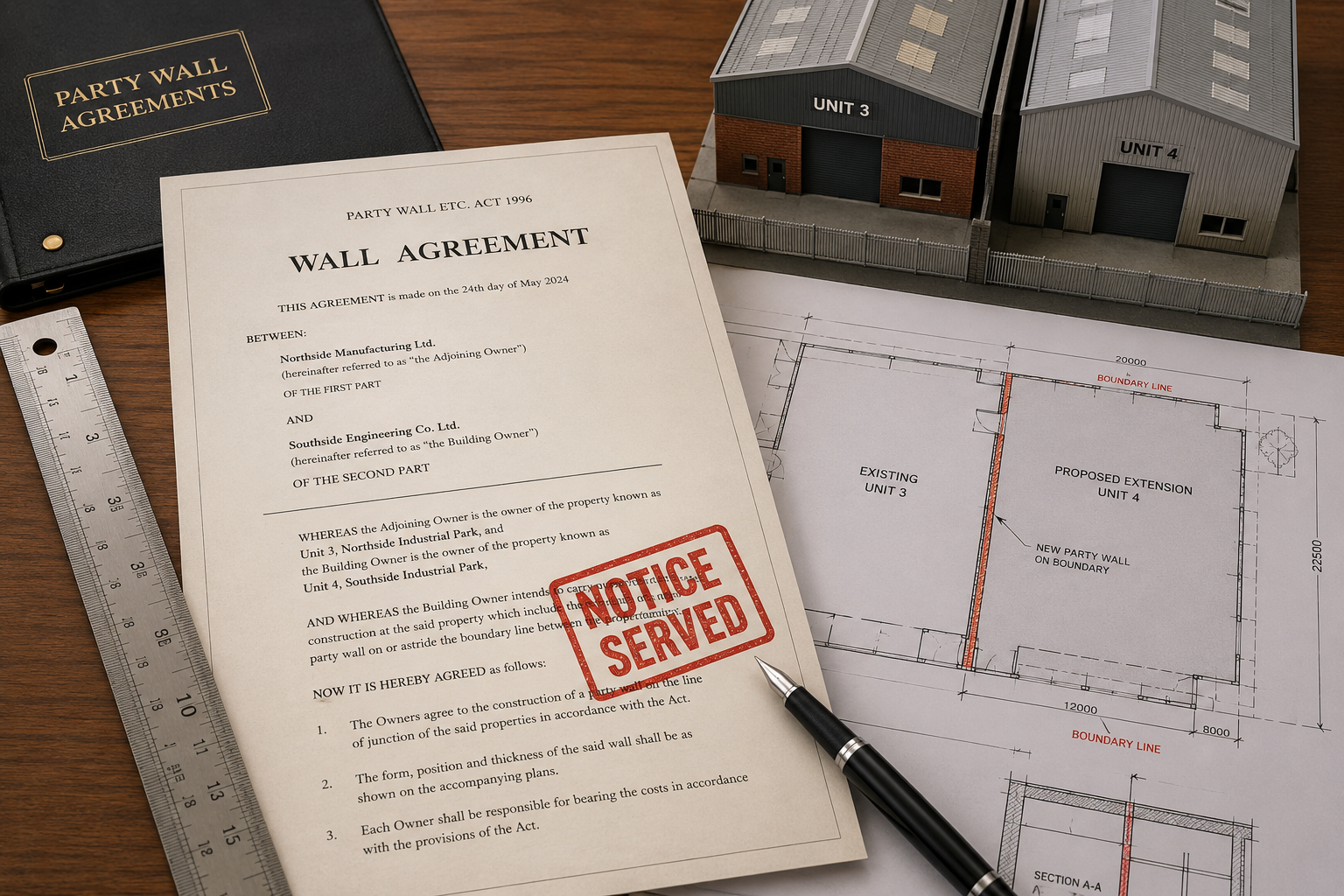
Understanding the rights available to an adjoining owner is central to this guide on Party Wall Agreements in Manufacturing Expansions: 2026 Guide for Adjoining Owner Rights. These rights are not merely procedural — they are substantive protections with real enforcement teeth [3].
The Right to Receive Formal Notice
Before any notifiable work begins, the building owner must serve a written notice on every affected adjoining owner. In an industrial estate setting, this can mean serving multiple parties — the freeholder, any leaseholders with more than one year remaining on their lease, and any mortgagees with an interest in the property [9].
The notice must:
- Clearly describe the proposed works
- State the date on which works are intended to start
- Be served within the correct timeframe (one or two months depending on the work type)
- Be addressed to the correct legal owner, not just the occupier
For guidance on how notices are structured and what they must contain, see this resource on Party Wall Act notices and how to respond.
The Right to Consent or Dissent
Once a notice is received, the adjoining owner has 14 days to respond. There are three options:
- Consent in writing — works can proceed under agreed conditions
- Dissent and appoint a surveyor — a dispute is formally triggered
- Do nothing — after 14 days, a dispute is deemed to have arisen automatically [4]
In manufacturing contexts, adjoining owners are strongly advised not to simply consent without conditions. Industrial works often involve heavy vibration, deep excavation, and structural alterations that can cause significant damage. Dissenting and appointing a surveyor ensures that a formal Party Wall Award is produced, which is a legally binding document setting out exactly how works must be carried out [3].
The Right to a Schedule of Condition
Before works begin, the adjoining owner is entitled to have a Schedule of Condition prepared. This is a detailed photographic and written record of the existing state of the adjoining property. In manufacturing settings, this is particularly valuable because:
- Heavy machinery and vibration from construction can cause cracking in floors and walls
- Industrial properties often have complex services and drainage that can be disrupted
- Proving pre-existing versus new damage is far easier with a documented baseline
Without a Schedule of Condition, establishing liability for damage becomes a contested and costly process.
The Right to Appoint a Surveyor
If the adjoining owner dissents, they have the right to appoint their own surveyor. The building owner pays for this surveyor's reasonable fees in most cases [5]. This is a significant protection — it means the adjoining owner can obtain professional representation at no direct cost to themselves.
Alternatively, both parties can agree to appoint a single "Agreed Surveyor" who acts impartially for both sides. This can reduce costs and speed up the process, though it is generally more appropriate for straightforward works.
For adjoining owners seeking dedicated representation, an adjoining owner's surveyor provides independent advocacy throughout the process.
Negotiating Party Wall Awards in Manufacturing Expansions: 2026 Guide for Adjoining Owner Rights
The Party Wall Award (also called a Party Wall Agreement in common usage) is the formal document that resolves the dispute and sets the framework for how works proceed. It is produced by the appointed surveyor or surveyors and is legally binding on both parties [2].

What a Party Wall Award Should Cover in an Industrial Context
A well-drafted Award for a manufacturing expansion should address:
- Scope of works: Precise description of what is and is not permitted
- Working hours: Restrictions on noisy or vibration-heavy operations, particularly relevant if the adjoining property is also in active production
- Access rights: When and how the building owner's contractors may access the adjoining property
- Protection measures: Specific requirements for temporary propping, dust suppression, or vibration monitoring
- Damage provisions: The process for reporting and compensating any damage caused
- Completion obligations: Requirements to make good any damage before the Award is considered discharged
For a clearer picture of what these documents look like in practice, reviewing a party wall contract template and award guide is a useful starting point.
Cost-Sharing Arrangements
The default position under the Act is that the building owner pays all costs associated with the party wall process, including the adjoining owner's surveyor fees [5]. However, there are circumstances in manufacturing expansions where costs can be shared:
- If the works also benefit the adjoining owner (for example, underpinning that strengthens a shared wall both parties rely on)
- If the adjoining owner requests additional works beyond what the building owner proposed
- If the adjoining owner's surveyor raises unreasonable objections that unnecessarily prolong the process
"The building owner is generally responsible for surveyor costs, but where both parties benefit from the works, a proportionate cost-sharing arrangement can be negotiated within the Award."
Keeping costs proportionate is important. For practical strategies on managing the financial side of the process, this guide on how to keep party wall costs down offers actionable advice.
Common Mistakes in Manufacturing Party Wall Cases
Several errors repeatedly arise in industrial party wall disputes [9]:
- Leaving notice too late: Many manufacturing projects are on tight timelines. A two-month notice period can derail a project if not built into the programme from the outset.
- Incorrect identification of adjoining owners: On industrial estates, ownership structures can be complex. Failing to serve notice on a leaseholder with more than one year remaining is a procedural failure.
- Using non-compliant notice formats: Notices must meet the Act's requirements. Informal letters or emails do not suffice.
- Assuming consent means no Award is needed: Even where an adjoining owner consents, a written record of agreed conditions is strongly recommended for manufacturing works given the potential for damage.
Consequences of Non-Compliance
Ignoring the Act's requirements is a serious risk in any expansion project. Courts have shown willingness to grant injunctions halting construction where proper procedures have not been followed [6]. For a manufacturing business, a court-ordered stop on a factory extension can mean:
- Lost production capacity
- Contractor standing-time costs
- Legal fees that dwarf the cost of compliance
- Reputational damage with neighbouring businesses
The Act also does not provide a limitation period for bringing a claim based on damage caused by non-compliant works. An adjoining owner can pursue a claim in tort even if the Act's procedures were not followed.
Practical Steps for Adjoining Owners in 2026
When a manufacturing neighbour serves notice of an intended expansion, the adjoining owner should act promptly and methodically.
Step 1 — Verify the notice is valid: Check that it names the correct parties, describes the works clearly, and gives the required notice period.
Step 2 — Seek professional advice: Contact a qualified party wall surveyor before the 14-day response window closes. For those in the capital, specialist services are available across South London, North London, and other areas.
Step 3 — Dissent formally: Unless the works are genuinely minor and the relationship with the building owner is well-established, dissenting and triggering the surveyor appointment process is the safest course.
Step 4 — Commission a Schedule of Condition: Ensure this is completed before any works commence.
Step 5 — Review the draft Award carefully: The Award is a binding legal document. Every condition matters. Surveyors acting for adjoining owners should scrutinise working hours, access provisions, and damage remediation clauses with particular care in industrial settings.
Step 6 — Monitor works during construction: The Award gives the adjoining owner's surveyor ongoing authority to inspect works and enforce compliance.
Conclusion
Manufacturing growth in 2026 is creating real pressure on industrial boundaries across England and Wales. For every factory adding capacity, there is a neighbouring business whose structural safety and operational continuity depends on the proper application of the Party Wall etc. Act 1996.
Adjoining owners should not treat a party wall notice as a formality. The rights available under the Act — to receive notice, appoint a surveyor, obtain a binding Award, and protect property through a Schedule of Condition — are substantive and enforceable. Exercising them properly is the most effective way to ensure that a neighbour's expansion does not become a costly problem.
Building owners planning manufacturing expansions should build notice periods into project programmes from day one, identify all affected adjoining owners carefully, and engage a qualified surveyor early to avoid the injunctions and delays that non-compliance can trigger.
Actionable next steps:
- If a notice has been received, contact a qualified party wall surveyor immediately and do not let the 14-day window pass without a formal response.
- If planning a manufacturing expansion, map all adjoining owners before finalising the project programme and serve notices at the earliest opportunity.
- Ensure a Schedule of Condition is commissioned before any works begin, regardless of which side of the wall you are on.
- Review the Party Wall Awards process to understand what protections a formal Award provides before agreeing to any informal arrangement.
References
[1] Your Party Wall Rights And Responsibilities – legalclarity.org
[2] Party Wall Construction Rules Requirements And Costs – legalclarity.org
[3] Rights Of An Adjoining Owner Uk – partywallresolution.com
[4] Party Wall Act Sections Explained – surveyofpartywall.co.uk
[5] Who Pays For A Party Wall Surveyor – legalclarity.org
[6] Commercial Property And The Party Wall Etc Act 1996 – bradley-mason.com
[7] Party Wall Leasehold Flats London – surveyofpartywall.co.uk
[8] Party Wall Agreement Selling – getpine.co.uk
[9] Party Wall Agreement – aylingassociates.com
How Prince Surveyors can help: explore our party wall surveyors or learn about our party wall surveyor costs.